JA & NRAN Film Screening
Recently, JA and the No REDD in Africa Network (NRAN) held an event on REDD. The event was to commemorate the Week of Action Against False Solutions which was within the Reclaim Power: Global Month of Action on Energy. The Month of Action ended on Monday, with the opening day of COP19 in Warsaw, Poland, where once again world leaders will get together to postpone urgent action on climate and ignore the fact that we’re hurtling towards climate disaster.
For our REDD event, we gathered together in the Museum of Natural History in Maputo with a small but spirited group. Samuel Mondlane moderated the meeting. JA’s Director, Anabela Lemos introduced the debate around REDD (Reducing Emissions from Deforestation and forest Degradation), calling it a false solution for the climate crisis.
We showed a few films criticising carbon trading, offsetting and REDD, calling them dangerous distractions that were avoiding the real solutions from being applied to stop catastrophic climate change, such as reducing fossil fuel use.
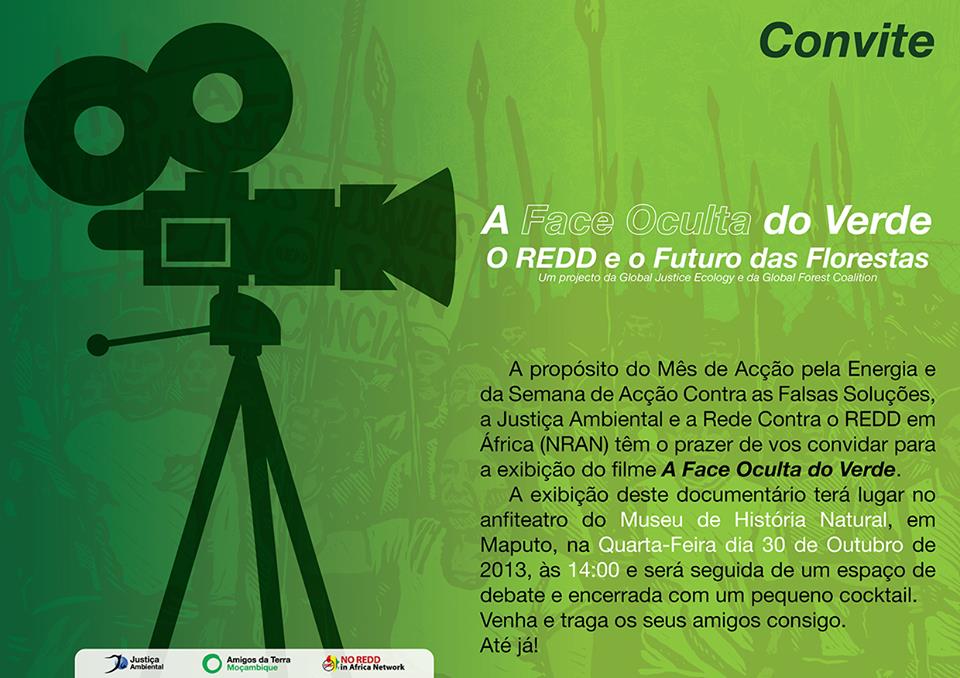
After the films, we opened up for a discussion on what people had seen in the films. This discussion is very important, because, in Mozambique, the debate of whether or not REDD is good for the country, had not taken place. It was only assumed that since money was coming in, Mozambique should take it, without any discussion of the dangers and perverse incentives behind it. See below our flyer for the event.

JA had sparked these discussions a few months ago, with the REDD workshop that we held in Maputo in August 2013. We were able to bring some key international people to Maputo, and facilitate their connections and information-sharing with Mozambican community people and NGOs.
The international key people that came together for the meeting were:
- Tom Goldtooth, Indigenous Environmental Network
- Nnimmo Bassey, Environmental Rights Action & Health of Mother Earth Foundation, Nigeria
- Isaac Rojas, Coordinator, Forests & Biodiversity program, Friends of the Earth International
- Winnie Overbeek, World Rainforest Movement
- Cassandra Smithies, fierce anti-REDDs activist from the US
- Blessing Karumbidza, Timberwatch, South Africa
- Odey Oyama, Rainforest Resource and Development Centre, Cross River state, Nigeria
- Jonas Aparecido, Landless Peoples’ Movement and community person, Brazil
- Augusto Juncal, Landless Peoples’ Movement & Via Campesina Brazil
- Diwirgui Anastacio Martinez Jimenez, community person from Kuna tribe, Panama
- Makoma Lekalakala, earthlife Africa Johannesburg
- Blessol Wambui, The Rules, Nairobi
- Khadija Sharife, Center for Civil Society, South Africa
- Abdullah Vawda, Forum of African Investigative Reporters, South Africa
It was also very important for JA to invite community people and farmers. We managed to bring farmers from 8 out of 10 provinces of Mozambique, including Niassa, Cabo Delgado, Nampula, Zambezia, Tete, Sofala, Gaza, and Maputo. There were multiple community people from some of these provinces. JA’s close partner, União Nacional de Camponeses (UNAC, National Farmers Union) allied with this process and sent many of their community members.
This was important because we felt it was crucial to open up a dialogue not just with people in Maputo, but people in the provinces who will be directly confronted and affected by REDD or REDD-type projects. The involvement of community people in decision-making is crucial to good governance structures and justice. We also invited NGOs and government people from Maputo, so that there could be a good, healthy discussion, which had not happened before.
The 1st day of the workshop – lots of information sharing and debate
The first day of the workshop provided a lot of information on REDD. Isaac and Winnie introduced REDD. Tom gave an emotive presentation about REDD in North America. Cassandra spoke about the opposition to REDD in many parts of Latin America, and explained the connections between the California Climate Change Bill trying to offset emissions by pushing REDD in Chiapas, Mexico and Acre, Brazil. Diwirgui and Jonas talked about the REDD opposition in their communities.
After this global perspective, we then starting talking about REDD in Africa. Odey of Nigeria and Blessing of South Africa provided perspectives of fierce REDD opposition in their contexts. The final case was presented by Boaventura of Via Campesina Mozambique, talking about a problematic REDD project right here in the country.
Main themes from the 1st day
The first day’s presentations and discussions were incredibly rich and detailed. We heard about climate change and what it means for our people. It increases droughts and floods; it increases temperatures especially here in Africa. It affects our lands, water and, more importantly, the farmers. Climate change impacts rivers and rain and weather patterns, that’s how it affects farmers. The crops start to fail, the land starts to get drier and more barren.
We heard from Tom about the links between dirty energy burning in the northern countries and these REDD projects in the south. We heard that those who created the climate problem to begin with, are continuing to make it worse. They are continuing to burn dirtier forms of coal, oil and gas, such as the tar sands.
Then they come to the southern countries, trying to ‘offset’ their emissions from burning the dirty energy. As JA Director Anabela Lemos explained, the carbon credits come from the Kyoto Protocol, it is abstract, and it doesn’t exist. So they come to the southern countries to ‘offset’ their emissions. In Africa, Asia, Latin America, where we still have forests left, they engage in large land grabs under the excuse that they will save the forests. We heard from Blessing regarding REDD in Tanzania. We heard from Odey regarding REDD in Nigeria and from Diwirgui about the struggle of the Kuna people against REDD in Panama. The story is the same everywhere in the world.
We heard some strong phrases about REDD and land grab and what it’s doing to this continent of Africa. We heard the phrase ‘green-grabbing’. We also heard the phrase ‘second colonialism’. Many countries in the south went through colonialism. They want the land, the resources under our land, and this is why people are calling it a ‘second colonialism’. Will we fight it again or not? We also heard the phrase ‘green masks’ that the big international conservation organisations are wearing and pretending as if REDD can save the forests. In reality, REDD is about buying the forests, cutting them down and turning them into plantations which are just green deserts.
The 2nd day of the workshop
For the 2nd day, we heard from Jonas and from Manito Lopes, a community member from Zambezia province, Mozambique, about community forest management providing much better options than REDD to safeguard forests.
The REDD workshop was a huge success. We had great participation from international, Mozambican community members as well as Maputo-based NGOs. We raised awareness about the very real dangers of REDD. We together released a Maputo Declaration on REDD, available here.
The 3rd day’s meeting was a closed NRAN strategy meeting. JA is committed to continuing the No REDD struggles in Mozambique, Africa and beyond.

 JA4change