"Only after the last tree has been cut down, Only after the last river has been poisoned, Only after the last fish has been caught, Only then will you find that money cannot be eaten." Cree Indian Prophecy
After more than a year without full compliance with thecourt ruling, Justiça Ambiental JA! filed a criminal complaint alleging the offence of aggravated disobedience against the Director of the GMNK and the Minister for Mineral Resources and Energy.
When a court orders a public body to disclose information and that order is ignored, this is not merely a conflict between a civil society organisation and the State. A much deeper issue is at stake: whether, in Mozambique, court decisions are meant to be obeyed, or only obeyed when it suits.
It was precisely this that led Justiça Ambiental (JA!) to file, in early July, a criminal complaint with the Maputo City Public Prosecutor’s Office against the Director of the Mphanda Nkuwa Hydroelectric Project Implementation Office (GMNK) and the Minister of Mineral Resources and Energy.
The proceedings stem from a failure to comply with a ruling handed down by the Maputo City Administrative Court, which ordered the disclosure of public information relating to the Mphanda Nkuwa hydroelectric project.
A battle that has been going on for several years
Since 2019, Justiça Ambiental has been requesting key documentation relating to the Mphanda Nkuwa project. Among other things, it has asked for access to technical studies, terms of reference, information on the anticipated social and environmental impacts, and documentation regarding measures designed to protect the rights of potentially affected communities.
This information is essential to enable local communities to understand the project, participate in decisions that affect them and demand that their rights be respected.
However, for several years, the responses were inadequate or simply non-existent. Whilst the GMNK provided only partial and evasive information, the Ministry of Mineral Resources and Energy repeatedly refused to respond to the organisation’s requests.
In light of this situation, Justiça Ambiental brought the case before the Maputo City Administrative Court.
In February 2025, the Court ruled in favour of the organisation and ordered the public bodies to provide the requested information within ten days – a significant victory for the right to information in the country. In its ruling, the Court was clear: the State cannot refuse access to public information on grounds not provided for by law, nor can it withhold documents that are essential to ensuring the informed participation of communities.
A court ruling is not optional
Despite the court ruling, the court’s order has still not been fully complied with.
In view of this failure to comply, and after exhausting all available avenues to secure voluntary compliance with the judgement, Justiça Ambiental lodged a criminal complaint.
It did not do so because it regards criminal proceedings as an end in themselves. It did so because, in a state governed by the rule of law, a court ruling ceases to serve any purpose if public authorities can simply ignore it without consequence.
The law specifically provides for this possibility, classifying the refusal by public authorities to comply with certain judicial decisions as a criminal offence (Article 110(2) of Law No. 7/2014 of 28 February – Law on Contentious Administrative Proceedings). The complaint lodged therefore aims to enable the Public Prosecutor’s Office to investigate whether the events that took place constitute this offence.
Much more than just a process
This case goes far beyond the issue of access to a few documents.
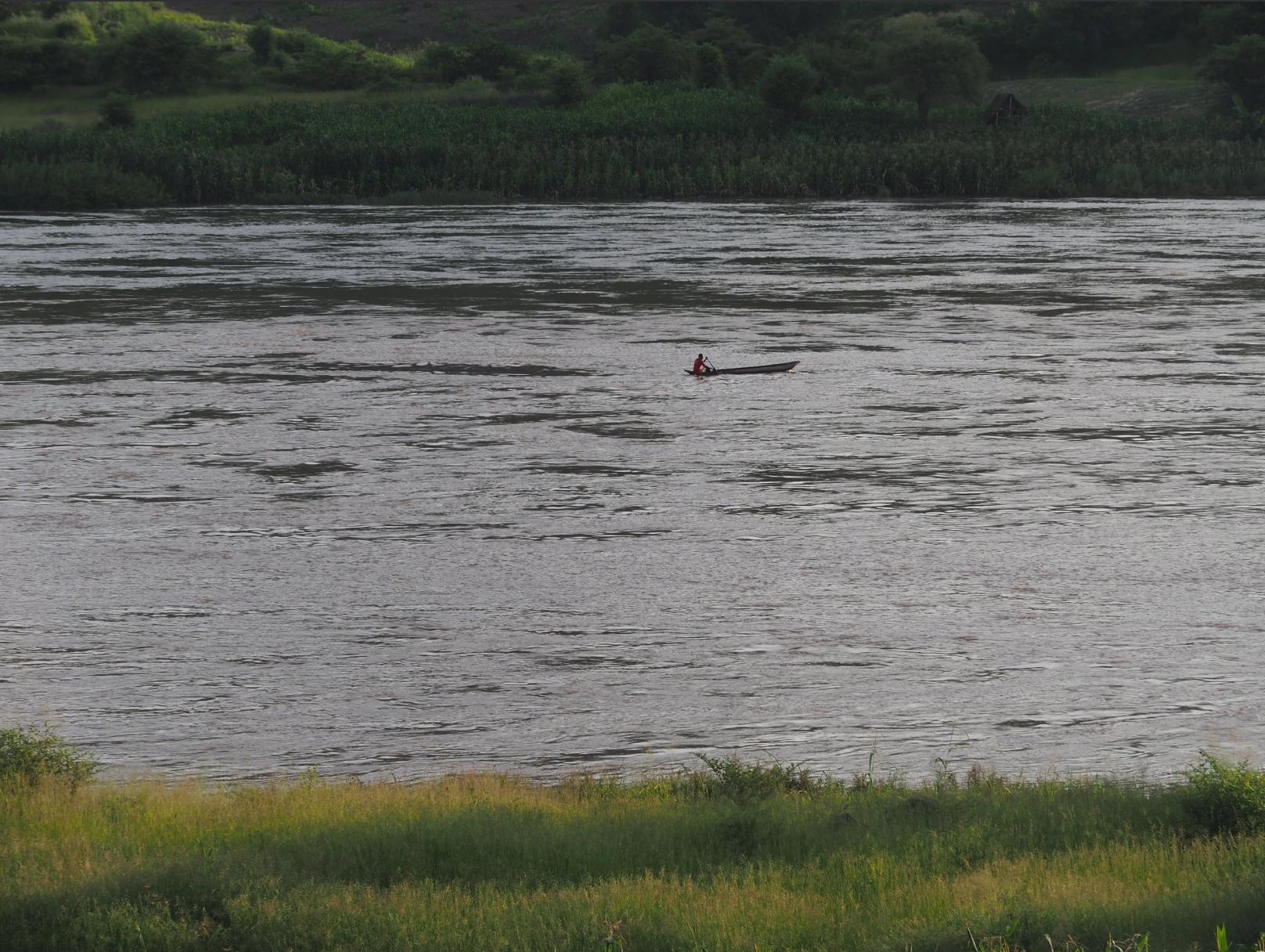
Mphanda Nkuwa is one of the largest infrastructure projects planned for Mozambique. If this mega-dam is built, its impacts could affect thousands of people, profoundly alter the lives of communities living along the Zambezi River, and have environmental, economic and social consequences that will last for generations.
The greater the impact of a project, the greater the transparency required in its planning.
Without public information, there can be no effective participation. Without participation, communities are unable to defend their rights or influence decisions that will affect their land, their livelihoods and their future.
This is precisely why the Administrative Court ruled that the information requested should be disclosed.
What is really at stake
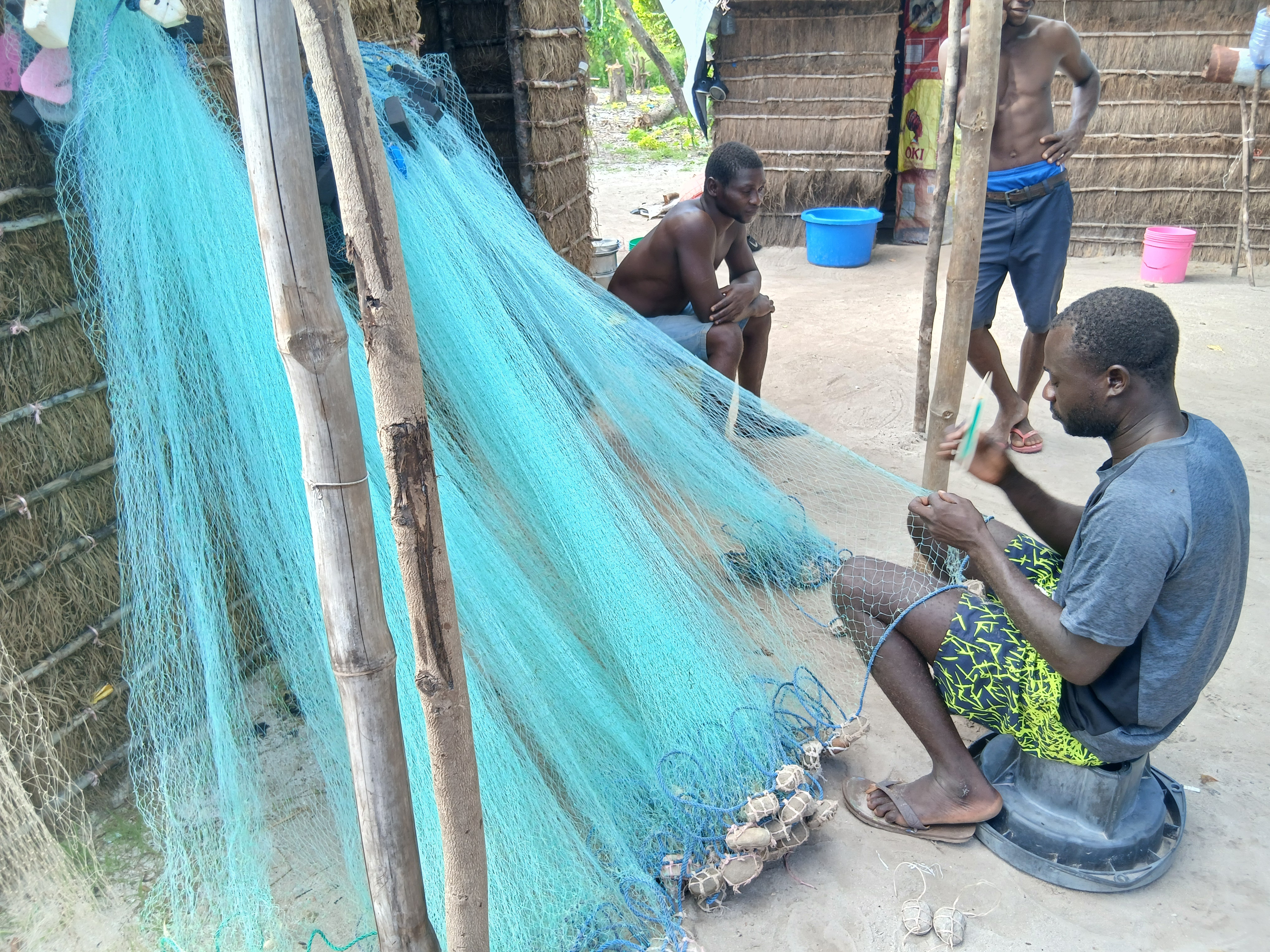
For several years, Justiça Ambiental has been denouncing the lack of transparency that has characterised the development of the Mphanda Nkuwa project. At the same time, various communities have reported restrictions on the exercise of fundamental rights, intimidation directed at those who express concerns about the project, and negative impacts on activities such as agriculture and fishing.
The criminal complaint now filed aims to reaffirm a simple yet essential principle: no public authority may choose which judicial decisions it wishes to comply with.
In a state governed by the rule of law, court decisions are binding on everyone, including state bodies.
When this ceases to be the case, it is not merely a judgement that remains unfulfilled. It is the very trust that citizens place in the justice system that is undermined.
That is why transparency, access to information and respect for judicial decisions are not mere legal formalities. They are indispensable conditions for protecting the rights of communities, ensuring effective public participation and guaranteeing that major decisions on the country’s future are taken openly, responsibly and subject to public scrutiny.
Without this scrutiny, and without respecting the law and the rights of the affected communities, the proposed Mphanda Nkuwa mega-dam – and any other so-called development project – will continue to be illegitimate and a source of social instability.
Local peoples experience wave after wave of direct harm from the gas projects in the Rovuma Basin of Cabo Delgado, while gas companies, financial institutions and decision makers continue to justify their involvement. The destruction of sensitive marine ecology and the projects’ high contribution to climate change must be considered when assessing the impacts on communities. The combination of resettlement violations, lost food fields, exclusion from fishing areas, and physical and chemical pollution from dredging activities, is already directly ruining the ability of hundreds of families to continue their livelihoods and survival activities.
Warnings about the environmental and social impacts of Cabo Delgado gas exploitation have been issued by activists and academics since exploration activities began in 2006 [1]. Regardless, projects are creeping on – even in the midst of violent conflict and criminal proceedings for alleged human rights violations [2]. While the Mozambique State hangs on to the promise of meagre – and reducing – revenues sometime in the future, local peoples have already lost and are continuing to lose their means of survival [3]. The harm to nature is worse than anticipated, and the harms to communities are becoming irreparable.
Independent researcher Chris Engelbrecht warns in his 2025 assessment of the environmental risks of the gas projects that the region is highly vulnerable to the combined impacts of climate change and alien invasive species, and would be significantly harmed by chemical, acoustic, and physical pollution resulting from gas activities [4]. The local communities, whose livelihoods are based on natural resources, remain most vulnerable to these combined impacts.
The marine area is home to iconic species such as humpback whales and loggerhead turtles, the steep marine shelf is potentially a critical habitat, and species new to science have been identified around potential well sites in deep waters. However, Engelbrecht stresses that a thorough biodiversity study of the marine area affected is lacking, and without one, there is no way to know what species and habitats would be lost as a result of gas activities. Critically, there is also no adequate assessment of the resultant impact on local economies and nutrition.
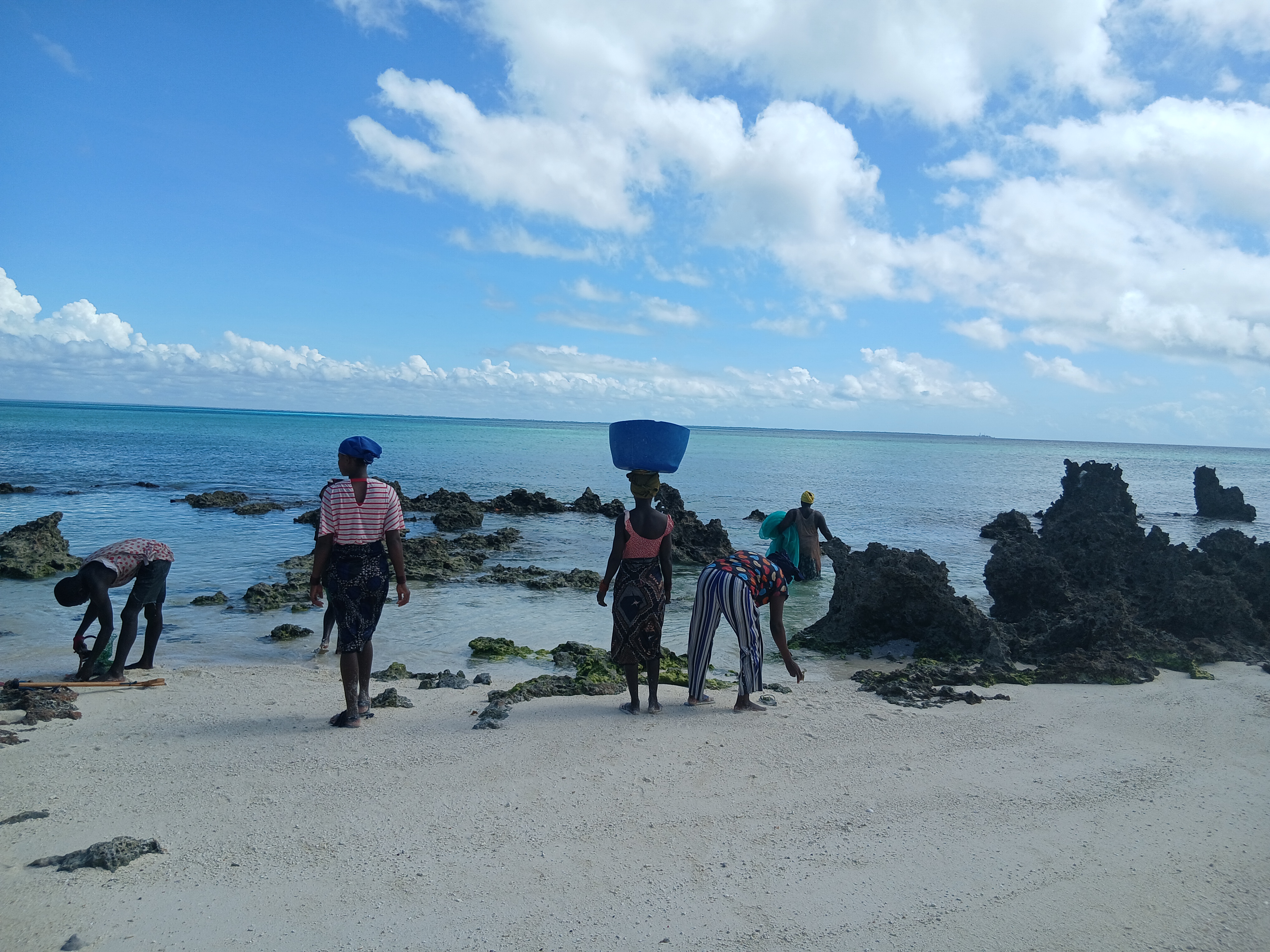
In 2025, communities reported severe harm to near-shore habitats from dredging in Palma Bay and around Tecomaji Island for marine infrastructure and shipping [5]. Many of the families living on the island now had previously lived in villages on the Afungi Peninsula, and had been required to relocate for the gas projects. Shellfish and shallow-water fish are very important for local nutrition, and are mainly collected by women and children for both food and sale. Coral reefs and seagrass beds are key habitats for these species. Data Desk exposed that dredging since around October 2024 has cut through coral reefs on the northern end of Palma Bay [6]. It is expected that dredging in the Bay would produce at least 12 million cubic metres of waste – which is toxic and smothers corals and seagrass.
Overall, gas exploitation presents the risk of a number of significant impacts on ecosystems:
Chemical pollution from gas and condensate leaks, spills from operations and marine traffic, and air pollution from the processing plants.
Toxic gas and gas condensate leaks from wells and pipelines. Condensate lingers for long periods below the surface and is more toxic than crude oil.
Alien invasive species which are introduced by ships severely impacts local ecology.
Ongoing noise pollution from drilling for the gas wells, operations of the floating plants, and the gas related marine traffic – including massive LNG carriers.
Physical damage to coral reefs, seagrass beds, and other habitats in the deep-sea and near-shore areas, from drilling for gas wells, and dredging for pipelines and marine infrastructure.
The waste from drilling and dredging is toxic, reduces water quality, and can smother seafloor creatures and habitats.
Significant contribution to climate change of at least 4,5 gigatonnes of carbon dioxide equivalent.
Engelbrecht urgently recommends for more data to enable broader and more reliable quantification of the combined impacts of the gas extraction, existing impacts, and emerging stresses resulting from locked-in climate change impacts. He urges application of the Precautionary Principle – which is absent in the gas project environmental impact assessments – and a moratorium on the projects until it can be proven that they can cause no irreversible harm.
Similar warnings and recommendations made well over a decade ago were ignored by decision makers, the gas companies, and financial institutions. Already in 2009, communities had reported ecological disturbance, species loss, and reduced fishing catches following seismic exploration, according to interviews conducted by Joshua Dimon and Daniel Ribeiro two months after the seismic surveys [7]. They reported fish and shellfish deaths, the deaths of six turtles, and red tides with related health impacts. The Maganja community reported a mass die-off of bottom-dwelling fish – with carcasses covering several kilometres of beach – as well as the disappearance of shellfish. A detailed study was not conducted (or is not available in public), although the company reported “no social impacts… no complaints”.
In addition, Dimon and Ribeiro report inadequate communication with communities at the time, resulting in hearing injuries among fishermen, and extended periods of not fishing with resultant losses to diet and income. They also report discrepancies in compensation for affected fishing communities compared to tourism operators, and no compensation at all for the shallow-water seismic programme during which fishermen did not fish.
This pattern of inadequate consultation, communication, and monitoring continues in the gas project relationships with local peoples [8].
Since the start of the project members of the Maganja community have been affected by land grabs and remain with many significant grievances. Following unsuccessful negotiations with the gas company, ten community members faced intimidation in January 2025, an illustration of the darker dynamics around free prior and informed consent in relation to the projects [9]. Overall, thousands of people in many communities have been affected by resettlement and loss of their food fields, and thousands more have been affected by restricted access to the sea and coast, and attempts to secure more land – including for roads [10]. There are now new reports of communities being asked to leave their homes on Tecomaji Island.
While the gas projects make up stories of progress and wealth for Mozambique, the harm to nature combined with the loss of homes, lands and access to natural resources, has directly reduced living conditions for thousands of people, and transferred an immeasurable cost to local communities. It in any case remains to be seen what revenues will eventually reach Mozambique, considering the mounting costs demanded from the State [11], and whether these revenues will be used for local welfare.
Il y a des espaces qui sont des événements. Et il y a des espaces qui, avec le temps, se transforment en processus politiques. L’atelier de Maputo sur l’impunité des entreprises et les droits de l’homme, organisé par Justiça Ambiental JA!, appartient à cette deuxième catégorie.
Alors qu’il en est à sa 10e édition, cet atelier ne se contente pas de célébrer une date. Il célèbre une décennie de résistance, de construction collective, de production de connaissances et de renforcement d’un mouvement qui s’est efforcé de s’opposer à l’une des structures les plus puissantes de notre époque : le pouvoir des entreprises et l’impunité qui le caractérise.
Depuis dix ans, cet espace rassemble des communautés touchées, des mouvements sociaux, des organisations de la société civile, des universitaires, des avocats, des journalistes, des artistes et des militants venus de différentes régions d’Afrique et du monde entier. Ce qui nous unit, ce n’est pas seulement notre préoccupation face à des cas concrets de violations des droits de l’homme. C’est la prise de conscience que, derrière chaque cas, se cachent des structures économiques, politiques et juridiques qui permettent à l’exploitation de perdurer.
Comme l’a déclaré Anabela Lemos, directrice de Justiça Ambiental JA!:
“Cette année, c’est avec une grande fierté que nous célébrons les 10 ans de l’atelier sur l’impunité des entreprises et les droits de l’homme. Ce sont 10 ans de résistance, consacrés à renforcer notre mouvement, afin que nous puissions tous jouir des mêmes droits : le droit à un environnement sain, le droit à l’éducation, à la santé, à une vie digne, à nos territoires et à nos cultures, ainsi qu’à nos biens communs.
Aujourd’hui, nous luttons contre l’usurpation de nos territoires, contre les graves violations des droits de l’homme commises par les entreprises qui exploitent nos ressources, telles que ENI, Total, EDF, Portucel et Jindal, pour n’en citer que quelques-unes, mais aussi par l’État, qui a le devoir et l’obligation de protéger et de défendre le peuple mozambicain.
Nous luttons pour changer ce modèle dit de « développement », qui a déjà clairement démontré qu’il ne fait qu’aggraver la pauvreté, les inégalités et les violations des droits, la violence, la militarisation et la destruction de l’environnement dans notre pays.
Nous nous battons pour que tous les Mozambicains et toutes les Mozambicaines connaissent leurs droits et s’organisent de plus en plus pour exiger un pays qui appartienne à tous et soit au service de tous, où la vie vaut plus que le profit. Un pays en paix, à l’abri des guerres, des assassinats et des insurrections.”
Cette déclaration résume le parcours et la raison d’être de l’atelier de Maputo.
Dix ans plus tard, qu’est-ce qui a changé?
La première réponse serait dérangeante : bon nombre des structures contre lesquelles nous luttons sont toujours présentes. Les communautés continuent d’être déplacées de force au nom de projets de “développement”. Les ressources naturelles continuent d’être accaparées par les grandes entreprises. L’État continue, dans de nombreux cas, de présenter l’investissement étranger comme une solution miracle à des problèmes qui sont, dans une large mesure, engendrés par le modèle économique lui-même. Notre système judiciaire continue de s’incliner devant le grand capital – et de refuser de demander des comptes aux élites politiques qui le soutiennent. L’exploitation du gaz, du charbon, des minerais, des forêts et des terres s’accompagne toujours de conflits, de réinstallations, de la perte des moyens de subsistance, de la destruction de l’environnement et de la militarisation.
Dans de nombreux cas, le développement est souvent évalué par le volume des investissements, de la croissance économique ou des entrées de devises, tandis que les conditions de vie concrètes des communautés restent inchangées – voire s’aggravent.
Mais quelque chose a changé. Ce qui a changé, c’est la capacité à nommer les problèmes, à relier entre elles différentes luttes. Ce qui a changé, c’est la prise de conscience que ce qui se passe dans une communauté touchée par une mine, un barrage ou un projet gazier n’est pas un accident isolé, mais s’inscrit dans un système conçu à cet effet. Et ce qui a surtout changé, c’est la capacité à construire la solidarité et à exiger des changements systémiques.
C’est dans cet espace qu’une communauté du Mozambique peut dialoguer avec une communauté du Kenya, d’Eswatini, d’Afrique du Sud, du Mali ou du Brésil. C’est dans cet espace qu’un combat local peut être compris comme s’inscrivant dans un conflit mondial autour de la terre, des ressources naturelles, de l’énergie, du climat et du pouvoir.
Du signalement des cas à la compréhension du système
L’une des principales contributions de l’atelier de Maputo a précisément été celle-ci : faire passer le débat de la dénonciation isolée à l’analyse des structures.
La première journée de la 10e édition a cherché à comprendre le système qui engendre l’impunité. Le capitalisme, le racisme, le patriarcat, la xénophobie et l’afrophobie ont été analysés non pas comme des phénomènes distincts, mais comme des systèmes d’oppression qui se renforcent mutuellement.
La question n’est plus seulement : qui a violé ce droit ?
Elle est désormais aussi : quel système permet à cette violation de se produire, de se répéter et de rester impunie ?
Ce changement est fondamental. Car il est urgent et nécessaire de tenir une entreprise transnationale pour responsable d’une violation concrète. Mais cela ne suffit pas si le système continue à produire de nouvelles entreprises, de nouveaux projets et de nouvelles violations.
Le “développement” qui engendre la dépendance
Le deuxième jour, le débat s’est concentré sur l’économie politique de la dépendance.
Dix ans d’ateliers ont démontré qu’il n’est pas possible d’aborder la question du pouvoir des grandes entreprises sans évoquer la dette, le colonialisme, les investissements étrangers, les traités internationaux et les chaînes de production mondiales.
L’Afrique continue d’être intégrée dans l’économie mondiale principalement en tant que fournisseur de matières premières, d’énergie et de main-d’œuvre bon marché. Dans le même temps, elle reste dépendante des importations de technologies, de produits finis et de financements. Ce modèle est présenté comme du développement.
Mais un modèle qui laisse les pays endettés, dépendants et vulnérables, tandis que les ressources génèrent des profits à l’étranger et de la pauvreté et de la violence chez nous, doit être remis en question. L’atelier a été un espace permettant précisément de poser cette question: le développement pour qui?
L’État entre obligation et captation
Un autre axe fondamental de l’atelier a été la relation entre l’État et les entreprises.
L’État a l’obligation de protéger les droits de l’homme et l’environnement. Cependant, dans de nombreux contextes, les institutions publiques finissent par protéger les investissements plutôt que les personnes. C’est dans ce contexte que se manifeste la « captation par les entreprises ».
Lorsque les entreprises influencent les politiques publiques, les lois et les décisions institutionnelles ; lorsque les traités d’investissement limitent la capacité législative des États ; lorsque les communautés ne sont consultées qu’une fois les décisions prises ; lorsque les militants et les journalistes sont persécutés pour avoir dénoncé des violations, il devient nécessaire de se demander si l’État continue d’agir en tant que garant de l’intérêt public.
La phrase prononcée lors de la quatrième table ronde résume bien cette réalité:
“La population n’a pas besoin d’être au courant du projet une fois que le tracteur est déjà sur place.”
Il ne s’agit pas seulement d’une question de procédure. Il s’agit de pouvoir et d’autodétermination.
Qui décide de l’utilisation des terres ? Qui décide de l’utilisation des ressources ? Qui définit ce qu’est le développement ? Qui prend en charge les coûts lorsque les projets échouent ?
Ce sont là des questions centrales pour tout débat sérieux sur la souveraineté.
La crise climatique et la nécessité d’une transition juste
La crise climatique a rendu encore plus urgente la nécessité de remettre en question le modèle économique dominant. Le système climatique mondial présente un dysfonctionnement: l’excès de gaz à effet de serre dans l’atmosphère, provoqué principalement par la combustion de combustibles fossiles. Les communautés côtières et rurales sont déjà confrontées à des inondations, des sécheresses, des cyclones, des pertes de récoltes et à la destruction de leurs moyens de subsistance. Or, ce sont souvent les populations qui ont le moins contribué à la crise climatique qui subissent ses conséquences les plus graves.
Dans le même temps, la soi-disant transition énergétique risque de reproduire les mêmes schémas d’exploitation.
Si la transition vers les énergies renouvelables passe par une nouvelle ruée vers les minerais, par l’accaparement des terres et par le déplacement des communautés, nous ne ferons que remplacer un modèle extractiviste par un autre.
Une transition juste ne peut se limiter à remplacer les combustibles fossiles par de nouvelles sources d’énergie. Elle doit passer par la démocratisation de l’énergie, la protection des communautés, le respect des droits humains et la garantie pour les générations futures d’une planète habitable.
Un espace qui favorise également le mouvement
L’impact de l’atelier ne peut se mesurer uniquement au nombre de tables rondes organisées ou de participants présents. Son véritable impact réside dans les relations qu’il tisse. Il réside dans la communauté qui y trouve le soutien nécessaire pour poursuivre son combat, dans le militant qui se rend compte que son combat n’est pas isolé, dans le journaliste qui y trouve la solidarité dont il a besoin pour continuer à enquêter, dans l’avocat qui transforme une plainte en stratégie juridique, dans le chercheur qui met ses connaissances au service des communautés, dans l’organisation qui y trouve des partenaires pour mener une campagne.
C’est ce réseau qui fait de l’atelier bien plus qu’un simple événement.
Comme cela a été souligné lors de la séance de clôture, au cours des dix dernières années — et en s’appuyant sur de nombreuses autres années d’engagement en faveur de la justice environnementale —, les communautés touchées, les mouvements sociaux, les organisations de la société civile, les universitaires, les experts, les avocats et les artistes ont travaillé ensemble pour renforcer le mouvement contre le pouvoir et l’impunité des entreprises sur le continent.
L’atelier de Maputo a permis d’approfondir une analyse systémique des multiples crises que traverse l’Afrique et d’en comprendre également leur dimension mondiale. La réponse ne peut donc pas être uniquement nationale; il est nécessaire de construire une solidarité régionale, continentale et internationale.
Une solidarité panafricaine, capable de reconnaître que la lutte d’une communauté contre un barrage, une mine ou un projet gazier est liée aux luttes d’autres peuples contre ce même système d’exploitation.
Dix ans plus tard, “a luta continua”
Le 10e atelier ne s’est pas limité à de simples paroles, il s’est conclu par des engagements.
Les participants ont réaffirmé leur responsabilité de relayer ces discussions au sein de leurs communautés, organisations et mouvements. Ils ont réaffirmé l’importance de continuer à dénoncer les injustices et les crimes commis par les entreprises. Ils ont réaffirmé l’urgence d’un traité contraignant des Nations unies visant à réglementer les entreprises transnationales, qui soit solide et efficace. Ils ont réaffirmé le caractère central de la lutte pour l’autodétermination des peuples sahraoui et palestinien. Ils ont réaffirmé leur engagement envers la Déclaration de Maputo contre l’impunité des entreprises et pour les droits de l’homme et la justice climatique, adoptée en août 2024.
Et ils ont réaffirmé quelque chose d’encore plus fondamental : la solidarité active et radicale avec tous ceux qui sont intimidés, soumis à des pressions, emprisonnés ou assassinés pour avoir résisté au pouvoir des grandes entreprises transnationales et du système capitaliste mondial.
Dix ans plus tard, l’importance de cet espace réside précisément dans sa capacité à résister à la fragmentation.
Car, malgré de nombreuses années de résistance, les structures contre lesquelles nous luttons restent solides. Les entreprises restent puissantes, les États restent vulnérables à la captation, les communautés restent menacées, les défenseurs des droits continuent d’être persécutés et le modèle économique continue de faire passer le profit avant la vie.
Mais il y a aussi plusieurs choses qui continuent de se développer : la capacité des peuples et des communautés touchés à s’organiser et à se mobiliser pour un système plus juste. La prise de conscience que la terre et la dignité n’ont pas de prix. La certitude qu’aucun projet de développement ne peut être considéré comme légitime lorsqu’il implique la création de zones de sacrifice. Et la conscience que, tout comme d’autres systèmes d’oppression ont déjà été démantelés par le passé grâce à la mobilisation et aux revendications populaires, ceux qui nous oppriment aujourd’hui le seront également.
L’atelier de Maputo continuera à s’affirmer comme un espace construit collectivement par les mouvements sociaux, les organisations et les individus engagés du continent africain, en vue d’atteindre ces objectifs. La lutte continue, pour la justice, les droits et la souveraineté, jusqu’à ce que nous soyons tous et toutes libres!
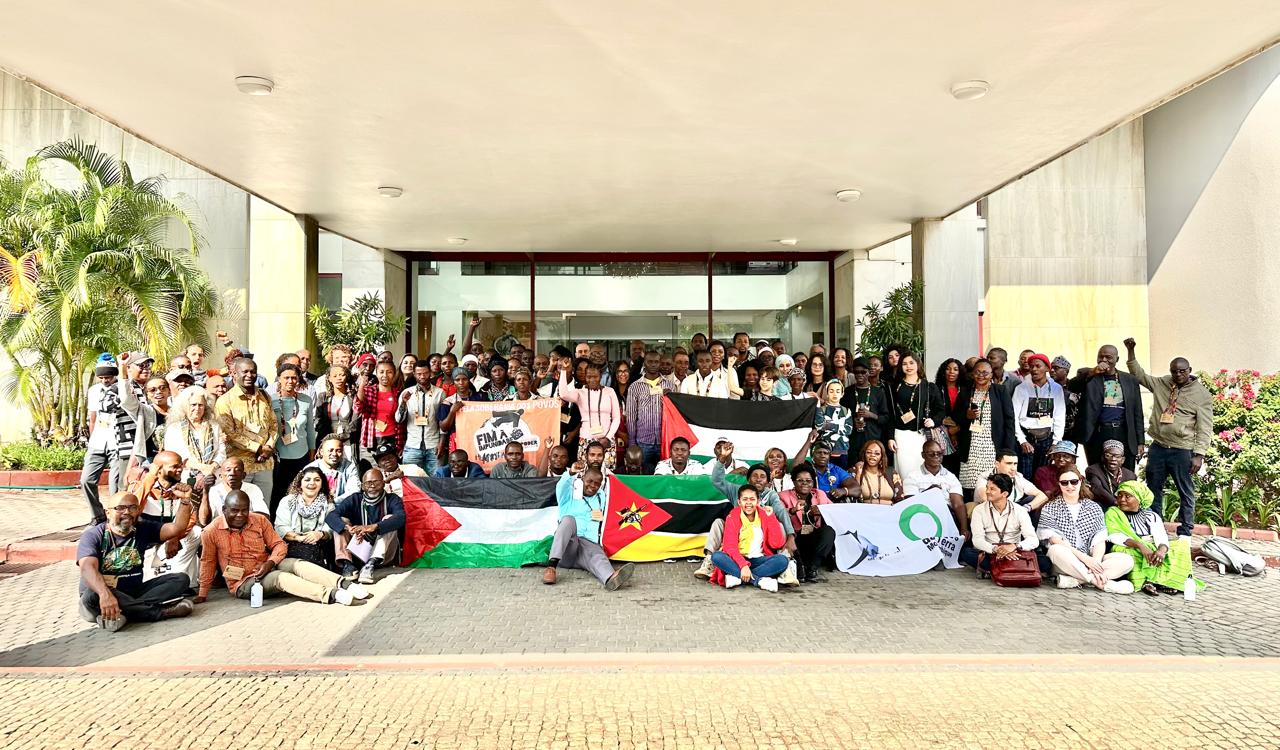
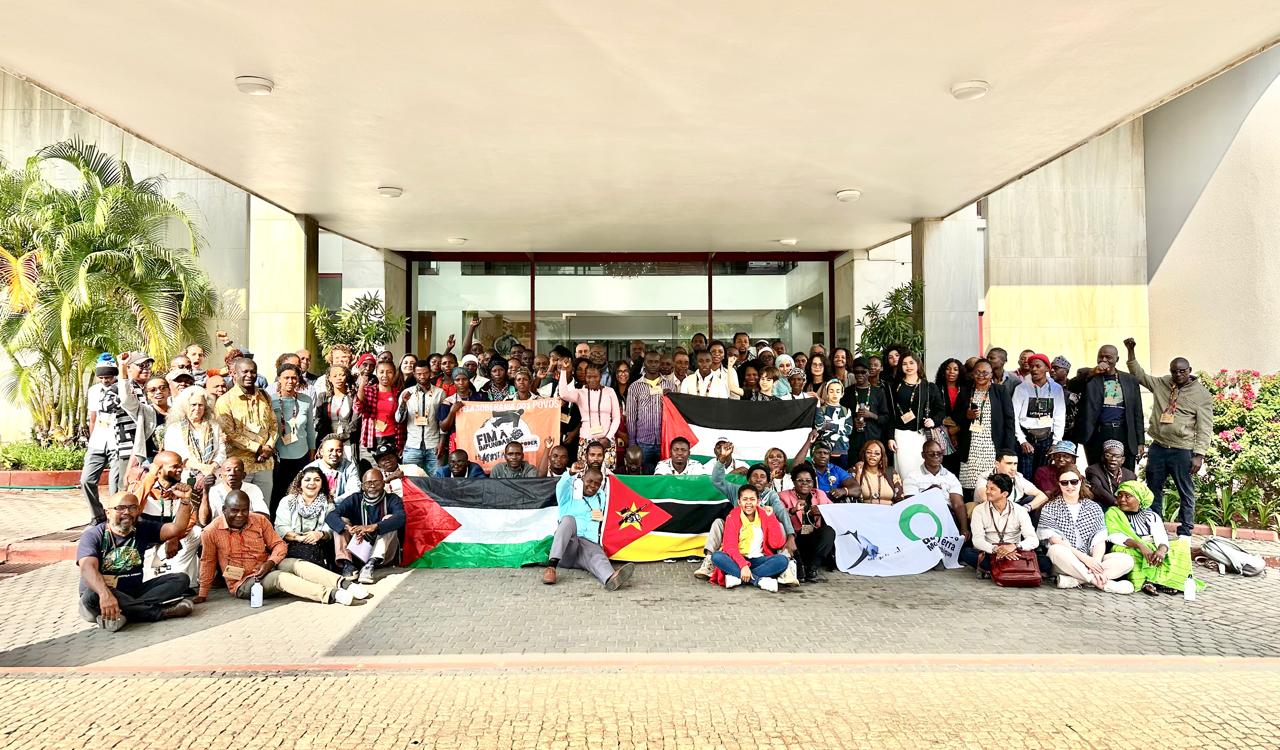
There are spaces that are events. And there are spaces that, over time, become political processes. The Maputo Workshop on Corporate Impunity and Human Rights, organised by Justiça Ambiental JA!, falls into the second category.
Now in its 10th edition, the Workshop is not merely marking an anniversary. It is celebrating a decade of resistance, collective endeavour, knowledge-building, and the strengthening of a movement that has sought to challenge one of the most powerful structures of our time: corporate power and the impunity that characterises it.
The forum has brought together affected communities, social movements, civil society organisations, academics, lawyers, journalists, artists and activists from different parts of Africa and the world. What unites us is both concern for specific cases of human rights violations, and understanding that, behind every case, there are economic, political and legal structures that enable exploitation.
As Anabela Lemos, Director of Justiça Ambiental JA!, stated:
“This year we are celebrating, with great pride, the 10th anniversary of the Workshop on Corporate Impunity and Human Rights. These have been 10 years of resistance, strengthening our movement so that we may all enjoy the same rights: the right to a healthy environment, the right to education, to healthcare, to a life of dignity, to our territories and cultures, and to our common goods.
Today we are fighting against the usurpation of our territories and against serious human rights violations committed by companies that are exploiting our resources – such as ENI, Total, EDF, Portucel and Jindal, to name a few – as well as by the State, which has a duty and an obligation to protect and defend the Mozambican people.
We are fighting to change this so-called ‘development’ model, that has already clearly shown that it is only exacerbating poverty, inequality, rights violations, violence, militarisation and environmental destruction in our country.
We are fighting to ensure that all Mozambicans – men and women alike – know their rights and organise themselves more and more to demand a country that belongs to everyone and is for everyone, where life is worth more than profit. A country at peace, free from war, murder and insurgency.”
This statement summarises the history and purpose of the Maputo Workshop.
Ten years on, what has changed?
The first answer would be an uncomfortable one: many of the structures we are fighting against remain in place. Communities are still forcibly displaced in the name of ‘development’ projects. Natural resources are still appropriated by large corporations. The state continues, in many cases, to present foreign investment as a magic solution to problems that are, to a large extent, created by the economic model itself. Our judicial system continues to bow to big business – and to refuse to hold the political elites who back it to account. The exploitation of gas, coal, minerals, forests and land is still accompanied by conflict, resettlement, loss of livelihoods, environmental destruction and militarisation.
In many cases, development is still measured by the volume of investment, economic growth or foreign exchange inflows, whilst the actual living conditions of communities remains the same or have worsened.
Yet something significant has changed. The ability to identify the problems and link different struggles has strengthened. There is now clear recognition that what happens in a community affected by a mine, a dam or a gas project is not an isolated incident, but the result of a system designed to bring about such outcomes. Above all, what has changed is the motivation to build solidarity and demand systemic change.
It is in this space that a community in Mozambique can engage in dialogue with a community in Kenya, Eswatini, South Africa, Mali or Brazil. It is in this space that a local struggle can be understood as part of a global struggle over land, natural resources, energy, climate and power.
From reporting cases to understanding the system
The Maputo Workshop has moved the discussion beyond isolated complaints to an analysis of the underlying structures.
This year, the workshop began with strengthening understanding of the system that produces impunity. Capitalism, racism, patriarchy, xenophobia and Afrophobia were analysed, not as separate phenomena, but as mutually reinforcing systems of oppression.
The question is no longer simply: who violated this right?
The question has also become: what system enables this violation to take place, to be repeated and to go unpunished?
This shift is fundamental. It is necessary and urgent to hold transnational corporations accountable for specific violations. But it is not enough if the system continues to produce new companies, new projects and new violations.
‘Development’ that produces dependency
On the second day, the discussion focused on the political economy of dependency. The Workshop has been a space for debating precisely the question: development for whom?
Africa continues to be integrated into the global economy primarily as a supplier of raw materials, energy and cheap labour. At the same time, it remains dependent on imports of technology, finished goods and finance. This model is presented as development.
Yet this model must be questioned. It is a model that leaves countries indebted, dependent and vulnerable, whilst resources generate profits abroad and poverty and violence at home.
The long experience of the Workshop shows that it is not possible to discuss the power of large corporations without addressing debt, colonialism, foreign investment, international treaties and global production chains.
The State: between obligation and capture
The relationship between the state and the companies is a key theme of the Workshop.
The State has a duty to protect human rights and the environment. However, in many contexts, public institutions prioritise the protection of investments over the protection of people. It is in this context that corporate capture arises.
When companies influence public policy, laws and institutional decisions; when investment treaties limit states’ legislative capacity; when communities are consulted only after decisions have already been taken; and when activists and journalists are persecuted for exposing violations, it becomes necessary to ask whether the state continues to act as the guardian of the public interest.
The statement made during the fourth panel sums up this reality:
“The people don’t need to know about the project once the tractor is already there.”
This is about power and self-determination, not merely a matter of procedure.
Who decides on land use? Who decides on resources? Who defines what development is? Who bears the costs when projects fail?
These are central issues in any serious debate on sovereignty.
The climate crisis and the need for a just transition
The climate crisis makes it even more urgent to challenge the dominant economic model. There is a dysfunction in the global climate system – an excess of greenhouse gases in the atmosphere, caused mainly by the burning of fossil fuels. Coastal and rural communities are already facing floods, droughts, cyclones, crop failures and the destruction of their livelihoods. Yet it is often the people who have contributed least to the climate crisis who bear its most severe impacts.
At the same time, the so-called energy transition risks reproducing the same patterns of exploitation.
If the transition to renewable energy depends on new mineral rushes, land grabs and the displacement of communities, we will simply be replacing one extractivist model with another.
A just transition cannot simply mean swapping fossil fuels for new centralised and privately owned energy sources. It must mean democratising energy, protecting communities, respecting human rights and ensuring that future generations have a habitable planet.
A space that fosters movements
The impact of the workshop cannot be measured solely by the number of panel discussions held or the number of participants in attendance. Its true impact lies in the relationships that are built. It lies in the community that finds support to continue its struggle, in the activist who realises that their struggle is not in isolation, in the journalist who finds solidarity to continue investigating, in the lawyer who turns a complaint into a legal strategy, in the academic who puts their knowledge at the service of communities, and in the organisation that finds partners for a campaign.
It is this network that makes the Workshop more than just an event.
Over the last ten years — and building on many more years of commitment to environmental justice — affected communities, social movements, civil society organisations, academics, experts, lawyers and artists have been working together to strengthen the movement against corporate power and impunity on the continent.
The Maputo Workshop has enabled us to conduct in-depth systemic analysis of the multiple crises affecting Africa, and to understand their global dimension. The response, therefore, cannot be merely national; we must build regional, continental and international solidarity.
A pan-Africanist solidarity, capable of recognising that one community’s local struggle against a dam, a mine or a gas project is linked to the local struggles of other peoples against the same system of exploitation.
Ten years on, “a luta continua”
This year, the 10th Workshop ended with strong commitments.
Participants reaffirmed:
their responsibility to take the discussions back to their communities, organisations and movements;
the importance of continuing to denounce injustices and corporate crimes;
the urgency of a strong and effective, legally binding United Nations treaty to regulate transnational corporations;
the centrality of the struggle for self-determination of the Sahrawi and Palestinian peoples;
their commitment to the Maputo Declaration against Corporate Impunity and for Human Rights and Climate Justice, adopted in August 2024.
Participants also reaffirmed something even more fundamental: active and radical solidarity with all those who are intimidated, pressured, imprisoned or murdered for resisting the power of large transnational corporations and the global capitalist system.
Ten years on, the importance of this forum lies precisely in its ability to resist fragmentation.
Despite decades of resistance, the structures we are fighting against remain standing: corporations remain powerful, states remain vulnerable to capture; communities remain under threat; rights defenders continue to be persecuted; and the economic model continues to prioritise profit over life.
There is also strong growth, including: the capacity of affected peoples and communities to organise and mobilise for a fairer system; the realisation that land and dignity are priceless; the certainty that no development project can be considered legitimate when it involves the creation of ‘sacrifice zones’; and the awareness that, just as other systems of oppression have been dismantled in the past through popular mobilisation and protest, so too will those that oppress us today.
The Maputo Workshop will continue to consolidate itself as a space built collectively by social movements, organisations and committed individuals from the African continent, working towards these objectives. The struggle continues – for justice, rights and sovereignty – until we are all free!
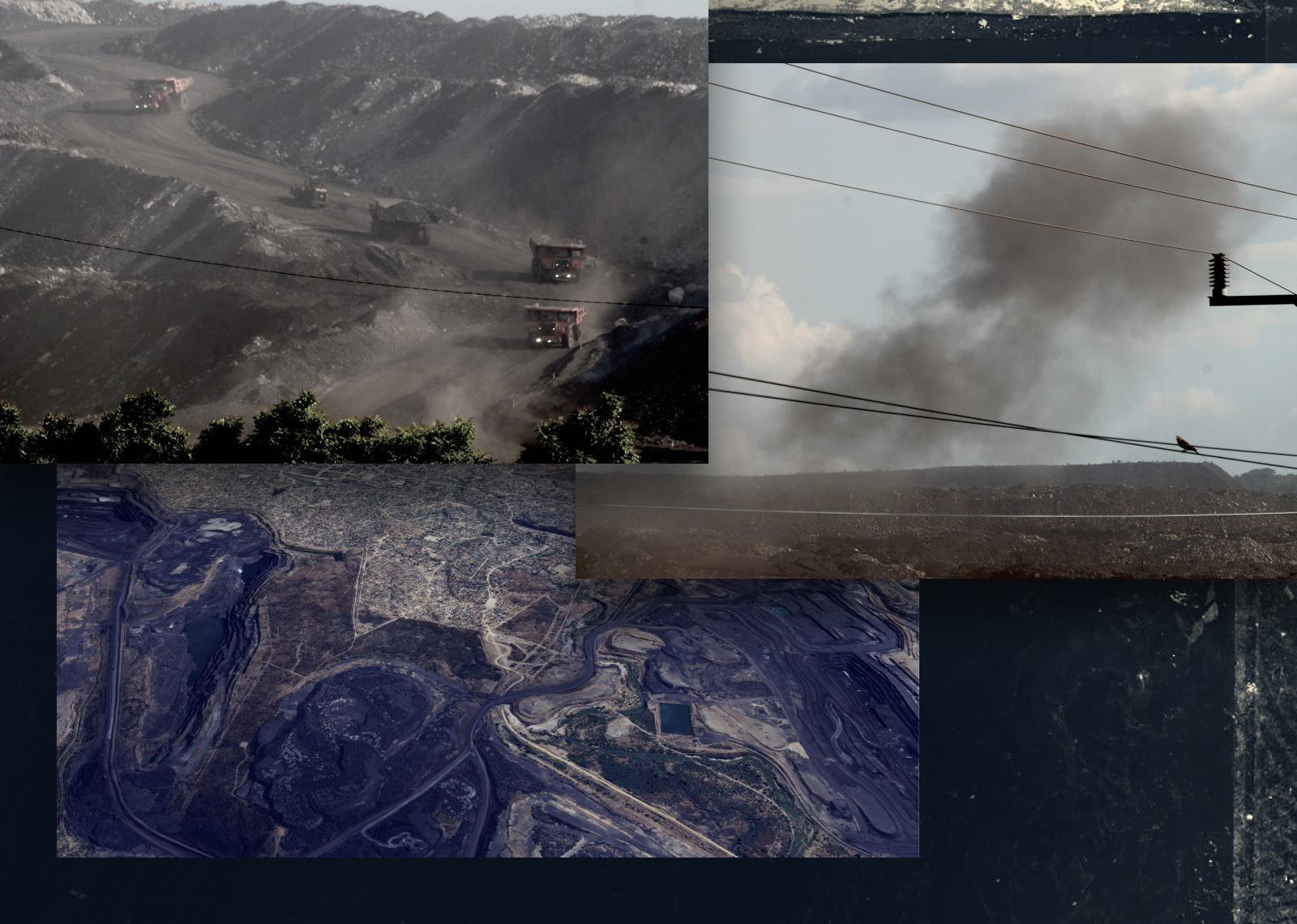
This documentary represents the most comprehensive investigative audiovisual work to date, featuring exclusive footage, on the human and environmental destruction caused by open-cast coal mining in Moatize and Marara, in Tete province Mozambique, both owned by Jindal Steel and Power Limited (JSPL). Justiça Ambiental JA! invites everyone concerned about environmental and social justice to watch and share this documentary. The struggle of the communities affected by these mega-projects is a struggle for the right to say NO to extractivism that destroys lives, ecosystems and the climate to fuel the profits of large transnational corporations.
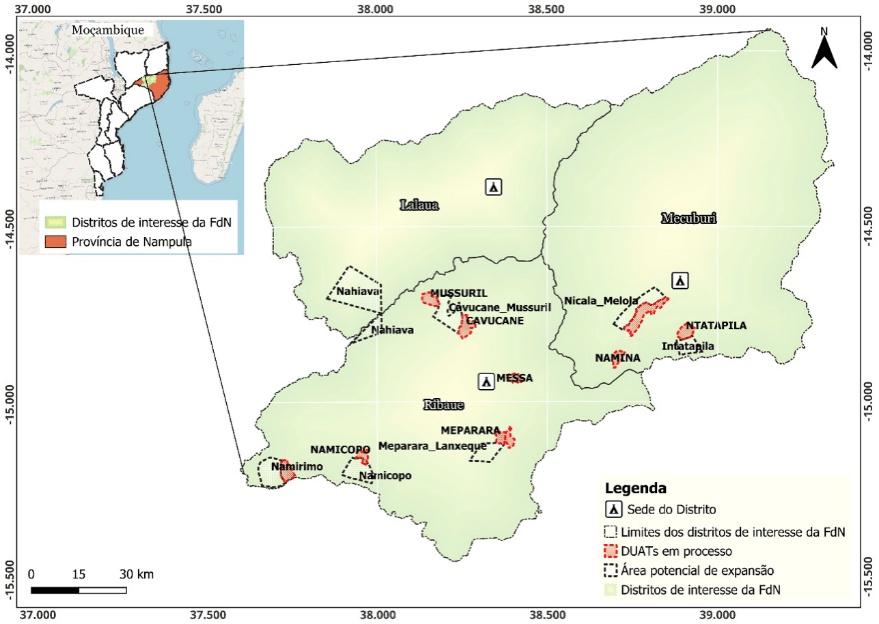
In the districts of Ribaué and Mecuburi, in Nampula Province, worrying signs are emerging of the continuation of practices that, in the recent past, gave rise to deep conflicts between local communities and the company Green Resources. Today, under a new name, Florestal do Norte SA, the same monoculture plantation model appears to be returning, shrouded in contradictions, lack of transparency, and serious doubts regarding the legality of the land access process.
In 2021, through document reference N/Ref. No 29/LGR-AA/2021, Green Resources announced the relinquishment of its Land Use and Benefit Rights (DUATs), in a process presented as a positive example of returning land to the Mozambican state. However, only a few years later, the same areas are once again the object of interest, now by Florestal do Norte SA.1
According to official information on its website, the new company, through the Nampula Reforestation Project, aims in the long term to restore, on a large scale, around 17,200 hectares of degraded land, using a combination of native and non-native tree planting, assisted natural regeneration, and agroforestry systems2—precisely in the areas previously occupied by Green Resources. According to representatives of the Provincial Environmental Services (SPA) in Nampula, it has already obtained provisional DUATs for some plots in 2024. This fact alone raises questions about the timing and unusual flexibility within Mozambique’s land administration system, whereby land recently returned to the state is reassigned to another entity. Once again, the law is being bypassed: according to provincial and district government authorities, Florestal do Norte SA already holds provisional DUATs, yet there is still no Environmental Impact Assessment process, which by law must precede the granting of DUATs, even on a provisional basis.
On the ground, the reality experienced by communities reinforces these concerns. In several localities, such as Messa and Cavucane, community members state that they did not participate in formal community consultations regarding the entry of the new company. Many confuse occasional meetings—often related to the land return process—with consultations for the installation of Florestal do Norte. In other cases, there were no consultations at all. This situation calls into question compliance with the principle of free, prior and informed consent, a fundamental right of indigenous peoples and local communities recognized internationally, which guarantees their ability to approve or reject projects, policies or activities affecting their lands, resources or way of life, free from coercion.3
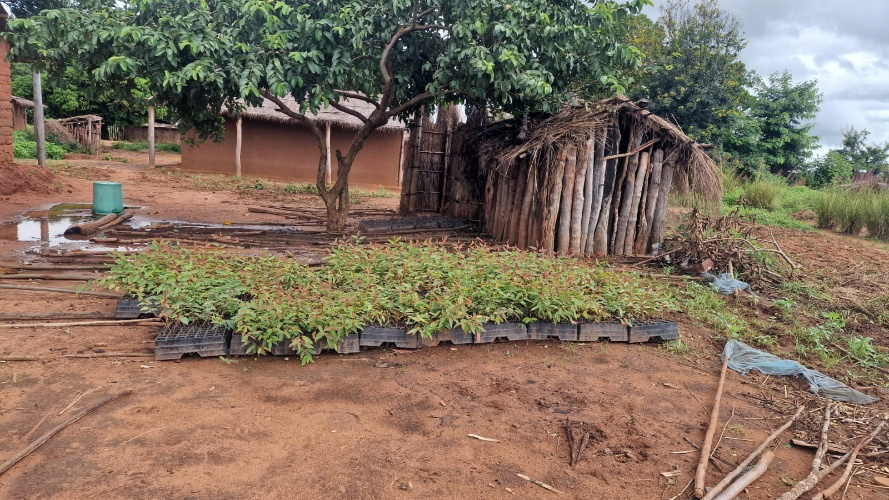
foto: Mudas de Eucalipto em Messa
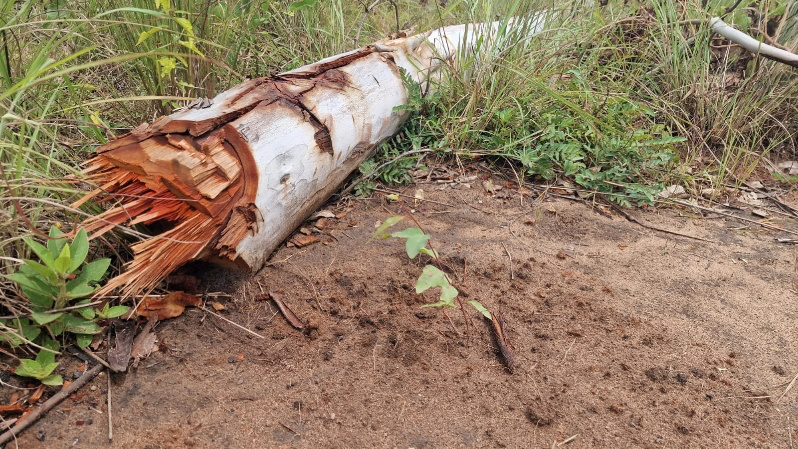
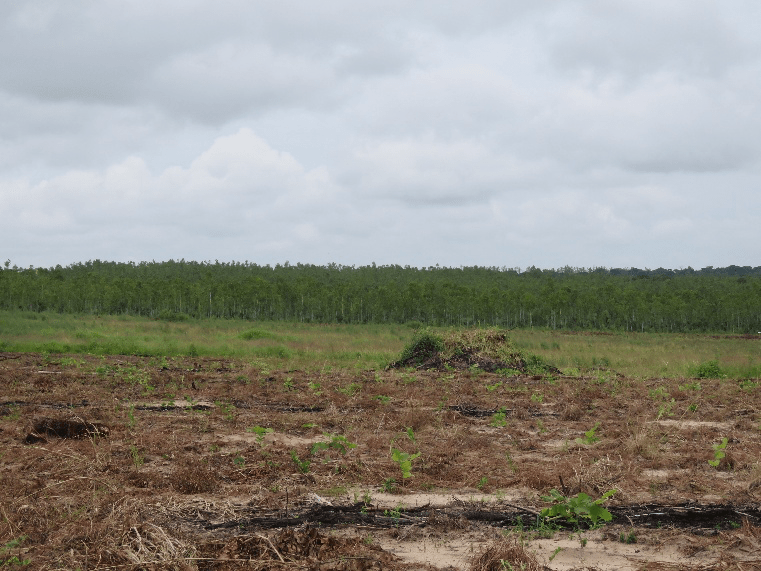
The contradictions are not limited to the consultation process. While government representatives claim that the company has not yet begun activities on the ground, allegedly due to lack of funding, evidence on the ground suggests otherwise. In the communities of Messa and Intatapila, ongoing activities have been observed, including tree felling, land preparation, and the planting of eucalyptus and some native species. According to community members, these activities began as early as December 2025, information confirmed on the ground by Justiça Ambiental. Therefore, Florestal do Norte has been operating since December 2025 without an Environmental License, has now emerged as Director of Florestal do Norte SA—the company seeking to exploit the same areas and develop the same type of activity using the same strategies in clear violation of the law.
An additional factor reinforcing concern is the continuity of actors involved in this process. The former Director of Green Resources in Mozambique4 has now emerged as Director of Florestal do Norte SA—the company seeking to exploit the same areas and develop the same type of activity using the same strategies.5 It is important to note that, before serving as Director of Green Resources, he held several highly relevant positions within the state for many years, including as National Director of Land and Forests (DNTF) in the Ministry of Agriculture. As such, he had privileged access to land-related information, possessed deep knowledge of administrative processes, and maintains a well-established network of influence within the Ministry of Land and Environment. He likely knows exactly how to “accelerate” DUAT processes and how to navigate legal loopholes in community consultations. This overlap raises an unavoidable question: are we witnessing genuine change, or merely a reconfiguration of the same project under a different identity? Is this a classic example of how revolving doors between the state and the private sector facilitate the expansion of agribusiness and monocultures in Mozambique.
foto: Plantio de Eucalipto em Messa
It is important to emphasize that conflicts between communities and Green Resources remain unresolved. Many communities are still awaiting compensation, clarification, and justice6. Nevertheless, the Mozambican state, through its institutions, is moving forward with allocating these same lands to a new entity, without ensuring that inherited problems have been properly addressed.
It is worth recalling that Green Resources AS (GRAS), in partnership with USAID and the ILRG program, produced a report presenting a notable and innovative effort in the Mozambican context, implementing a divestment model aimed at repairing communities affected by land occupation for forest monocultures7. What initially appeared to be a positive example of land restitution to the state is now revealing more complex and troubling dimensions. The sequence of events—relinquishment, unresolved conflicts, rapid reassignment of the same areas, and continuity of actors—raises legitimate doubts about the transparency and integrity of the entire process.
Foto: Plantio de Jambir em Intatapila
In this context, critical questions must be asked: who benefits from this reconfiguration? Who gains from the rapid reoccupation of the land? And what is the true role of public institutions in validating these processes? These questions become even more relevant at a time when Mozambique is undergoing a revision of its Land Legislation8. There is a risk that certain actors are seeking to secure control over large tracts of land before the approval of potentially more restrictive rules, in a kind of pre-emptive race to secure advantageous positions.
The facts observed in Nampula, together with the limited public information about the land return process, point to a troubling pattern: lack of transparency, limited community participation, and possible irregularities in land allocation processes. In this scenario, it becomes urgent to strengthen public scrutiny, ensure respect for community rights, and demand greater accountability from all stakeholders. Without this, the risk is clear: repeating the mistakes of the past—this time under new names, but with the same negative impacts on communities and the environment.
Image: Éric Delfosse with Emidio Josine / Disclose
Maputo / Paris, 15th April 2026 — An investigation published today by Disclose and Socialter lays bare the human and environmental costs of ArcelorMittal’s dependence on coal extracted in Moatize, in Tete province, central Mozambique. This coal is then shipped to ArcellorMittal’s Dunkirk plant, the single most polluting factory in France, although it received millions of euros of public funds, especially targeted to produce “green steel”.
Air saturated with toxic particles, cracked homes, poisoned farmland, contaminated water, and destroyed livelihoods: the residents of Moatize are paying with their health and their futures for steel produced thousands of kilometres away — while the transnational corporation makes billions in profits.
Air monitoring conducted by Justiça Ambiental JA! between September and October 2024 recorded fine particle concentrations of up to 340 μg/m³ in Moatize, which is seven times the WHO recommended threshold. Zinc levels were nearly 20 times higher than safety limits in neighbouring South Africa. Vanadium and manganese, both known carcinogens, exceeded safe thresholds by 12 and 7 times respectively. As local residents, affected communities and civil society organisations like JA! have repeatedly denounced, the families of Moatize are suffocating under coal dust.
The contamination reaches far beyond the air. Scientists have found dangerous concentrations of metals including copper and selenium in water sources around Moatize. Farmland is coated in coal dust. Explosions from the mine crack the walls of nearby homes. In January 2026, a red-hot rock projectile tore through a family’s house while a mother and daughter were inside.
Women and children, as always, pay the highest price. Isabel Graça Correia, 43, is one of many who has been suffering with tuberculosis — a disease strongly linked to coal dust exposure. She was forced to terminate a pregnancy and has been unable to conceive since.
ArcelorMittal: profits, public money, and an architecture of corporate impunity
The coal extracted by Vulcan Minerals, a subsidiary of Indian conglomerate Jindal Steel and ArcelorMittal’s direct supplier, is shipped from Mozambique’s port of Nacala to ArcelorMittal’s Dunkirk plant in France. ArcelorMittal is the world’s second largest steel producer, headquartered in Luxembourg and controlled by the billionaire Mittal family, with operations in over 60 countries — and its Dunkirk plant is the single most polluting factory in France, producing 12 million tonnes of CO₂ per year.
According to Disclose’s investigation, this same corporation has received at least €244 million in French public funds since 2021, pledged to reduce its environmental footprint through the production of “green steel”, then scaled back its green transition plans. The two electric ovens promised by 2027 became one, now delayed to 2029.
When confronted with the findings of this investigation, ArcelorMittal claimed that “no material risk, no warning signal and no unfavourable observation” had been identified in its supply chain assessment. This is an insult to every person living in Moatize.
Under the French law on the duty of vigilance, ArcelorMittal is legally required to prevent serious harm to human health and the environment throughout its own activities and those of the entities in its supply chain. The evidence of pollution in both Moatize and Dunkirk points out to failure to comply with those legal obligations, while the company is making huge financial profits. Last year’s profits amounted to 3.15bn USD.
“This investigation confirms what communities in Moatize have been shouting for years. ArcelorMittal’s coal supply chain is a textbook case of colonial extractivism: a marginalized community in one of the world’s poorest countries bears the toxic burden of production, while a transnational company headquartered in Europe collects the profits — backed by hundreds of millions in European public subsidies. It is not an accident, it is an architecture, and the corporation responsible calls it ‘no risk’. JA! Stands with these communities and will continue supporting their struggle until there is justice.” – Erika Mendes, Justiça Ambiental JA!
“This toxic coal supply chain, from Moatize in Mozambique to Dunkirk in France, is not an isolated failure. It is the designed outcome of a global economic model that extracts wealth from communities in the Global South to fuel industrial production in the Global North, shielded by legal loopholes, weak enforcement of existing laws, and the active support of governments and financial institutions. It is unacceptable to see the same patterns repeating over decades, with communities paying the price while transnational corporations make profits and even benefit from public money that would be urgently needed for a true and just energy transition.”– Juliette Renaud, Friends of the Earth France.
Our demands
Justiça Ambiental and Friends of the Earth France call on:
the French government to condition all public subsidies on verifiable respect of human rights and the environment in all the supply chain;
the Mozambican government to immediately halt coal extraction operations in Moatize until an independent, community-informed assessment of the full human, environmental and health costs has been conducted and made public; to implement urgent measures to monitor, control and reduce pollution levels; to provide immediate public health responses to affected communities and ensure that they have access to justice, remedy and reparations;
all governments, to actively support and engage on the ongoing negotiations for a strong and effective UN Binding Treaty on transnational corporations and human rights, which must establish enforceable obligations and effective access to justice and remedies for affected communities like those in Moatize.
Families from the communities of Milamba 1 and 2, affected by the liquefied natural gas projects of TotalEnergies, Eni and ExxonMobil, were the first to be resettled in the town of Quitunda in 2019. At the time, this was a strategic decision, driven by the prior displacement of these families, who were fleeing the threat of attacks by insurgents. Thus, although they represented a relatively small number of affected families, they were prioritised in the resettlement process.
Between July and August 2019, the 109 families from Milamba 1 and 2 received their homes. Initially, the zone chief and other influential figures mobilised local residents not to accept the houses until replacement land for their food fields (machambas) had been allocated. However, under pressure from the company responsible for the project and the local government, the families eventually agreed to accept the houses, despite the uncertainty regarding when they would receive the land for agricultural production.
Between 2020 and 2022, families from these resettled areas were allocated land in the community of Senga, where the so-called Phase Zero of the resettlement programme was officially launched. However, this phase was never formally concluded, and to this day, there are still records of complaints regarding the non-payment of compensation for the permanent loss of land, and in most cases, the complaints lodged have not been resolved. The fact is that there is now talk of a resettlement process having been completed, without, however, the promises made to the various affected communities in the different phases set out in the Palma resettlement plan having been fulfilled. This is an extremely protracted and complex resettlement process due to the high number of people and families affected, delays in the payment of compensation and the apparent lack of coordination among the various project teams 1 . The complexity and scope of the resettlement process itself are increasing the number of people affected by the ongoing search for new areas to allocate as compensation land, affecting new communities and families every day.
Most of the resettled families who received replacement land in the community of Senga are currently facing disputes with the respective landowners of those areas. This situation arises because TotalEnergies has not yet compensated some of the local families for the permanent loss of their land. In many cases, the company claims that the land was idle; however, the communities affected by the project dispute this classification, stating that the areas were being left fallow — a common and recommended agricultural practice in both traditional and conventional farming, as it contributes to soil fertilisation. Furthermore, several plots were clearly demarcated.
As a result, shortly after the land was allocated, the families resettled in Quitunda began to receive threats, being warned that they should not farm on these plots until the rightful owners had received the compensation provided for in the agreements reached between the company and the community during the Phase Zero negotiations of the resettlement.
At one point, the situation appeared to be relatively under control, particularly in cases where some families reached informal agreements for the shared use of the land. However, in most situations, what is observed is the abandonment of the plots by the resettled families, who are frequently prevented from using them by the respective landowners. In some cases, this prohibition occurs even after the families have already sown their crops.
This is the case of the three elderly women who, after being allocated replacement land in Senga, were subsequently evicted by the former owner of the land that had been assigned to them. They no longer have the strength to argue or fight for land that was never truly theirs. The lands they knew as their own were those where they were born and raised, lands that were taken over by the project in Milamba, their community to which they can no longer return.
Today, they find themselves reduced to the insignificance imposed upon them by that very project. They remain at home, lamenting their futures.
With no land to grow the food that sustains them, all that remains is to wait for the day when old age can no longer bear the weight of their lamentations or the regret of not having resisted a little longer. Today, they lament having lost the land they always knew as their own in exchange for a promise that was never kept — a land from which they were driven out, without even having had the chance to protest or demand justice.
1 In Quitunda, some resettled families received coconut seedlings in 2024, although they are still waiting for the allocation of their respective compensation land. In practice, the seedlings were distributed without the families having land where they can plant them.
Press release by Justiça Ambiental, ReCommon, Friends of the Earth France, BankTrack, urgewal
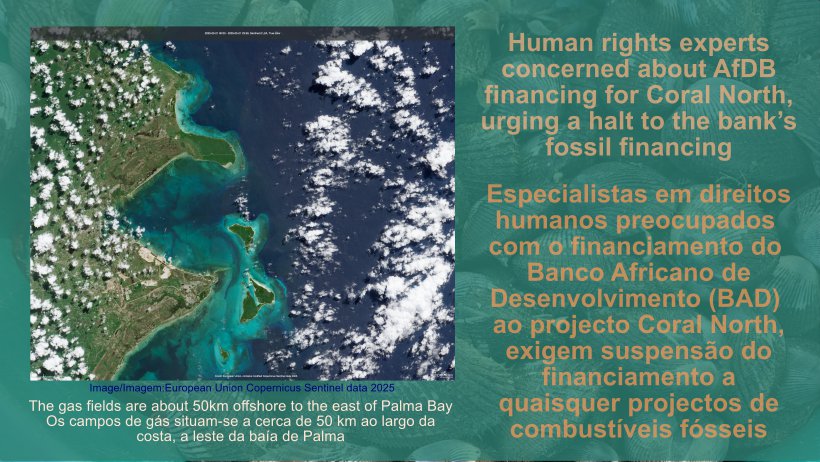
01 April 2026 – Campaign members of the “Say No to Gas! In Mozambique” coalition share the serious concerns expressed by UN-appointed human rights experts regarding the African Development Bank’s (AfDB) $150 million loan to support the Coral North Floating Liquefied Natural Gas (FLNG) project [1]. They demand that all financial institutions respond to the call of these experts, by committing to not support the gas expansion in northern Mozambique and suspend financing for new fossil fuel projects.
The project, led by Italian company Eni, consists of a floating platform designed for gas extraction and liquefaction off the coast of Cabo Delgado, Mozambique’s northernmost province. It is effectively a replica of Eni’s Coral South FLNG, which has been operational and exporting liquefied gas since November 2022. For the past eight years, the region has been the scene of violent conflict between the Mozambican army and insurgent groups.
In the UN statement, the human rights experts state that the Coral North project “risks exacerbating human rights violations, contributing to climate change and diverting already scarce public funds away from urgent investments in renewable energy”. They also warned that it could compound existing tensions and human rights challenges caused by the gas sector in Cabo Delgado province.
Three other gas extraction and processing projects in northern Mozambique are on the radar – TotalEnergies’ Mozambique LNG, Rovuma LNG led by ExxonMobil and Eni, and Coral South FLNG led by Eni. According to the human rights experts: “Previous LNG projects in Cabo Delgado have suffered from inadequate consultation, which has undermined local participation in key project decisions and resulted in loss of livelihoods and long-term socioeconomic disruption for communities who depend heavily on fishing, agriculture and natural resources. Despite promises of employment creation, high illiteracy rates and limited access to education mean that local communities have reportedly benefited little from job opportunities generated to date”. They highlight that this has occurred in a region where armed conflict and climate change have already caused large-scale displacement.
Previously, experts have warned that the Coral North FLNG project could have a significant climate impact, with excessive greenhouse gas emissions, an issue that was highlighted as early as March 2025. ReCommon’s investigation ‘Hidden Flames’, examined the climate impacts of the Coral South FLNG plant, with a particular focus on gas flaringand associated emissions – both of which were underestimated by Eni [3].
In correspondence with the AfDB, members of the StopMozGas coalition were assured that the Coral North FLNG project has “integrated strong environmental and climate measures, including flaring minimisation and emissions management, positioning Coral North among the cleaner LNG projects.” However, flaring is not an uncommon concern at LNG plants, with a recent investigation by Data Desk showing that LNG terminals tend to flare for significantly longer than the industry claims once they start producing, and that flaring remains persistent for decades at many facilities [4].
The UN human rights experts state: “We are deeply concerned that a leading multilateral development bank would finance a project of this nature at a time when the harmful environmental and climate consequences of fossil fuel expansion are well understood…. Financial institutions and businesses have a responsibility, under the UN Guiding Principles on Business and Human Rights, to identify, prevent, mitigate, and remedy human rights impacts linked to their activities and business relationships.”
Their warning explicitly refers to Coral North FLNG and is addressed to the AfDB, but the audience it addresses between the lines is much broader. TotalEnergies is involved in two criminal proceedings in France: the first for involuntary manslaughter and failure to assist persons in danger [5], the second for complicity in war crimes, torture and enforced disappearance [6]. The site on which the French multinational’s Mozambique LNG project is due to be built is shared with ExxonMobil and Eni’s Rovuma LNG. These factors – relating to Coral North FLNG and other fossil fuel projects in the area – must not be overlooked by the international financial backers of the infrastructure, both confirmed and potential.
According to the UN statement, the African Development Bank’s decision appears to be at odds with its 2021–2030 Strategy on Climate Change and Green Growth, with the advisory opinion of the International Court of Justice on climate change, and with the imperative, enshrined in international human rights law, to decarbonise economies over the course of this decade. The experts are urging the bank to suspend all financing for fossil fuel projects.
“The costs of the gas to Mozambique are mounting, the promised revenues are sinking further, and local people and businesses are cut off from opportunities, in the process of exploiting fossil reserves that will contribute little to Mozambique’s energy security. The African Development Bank – along with all financial institutions that remain involved – must reconsider its involvement in both Coral North FLNG and Mozambique LNG,” says Anabela Lemos, Director at Justiça Ambiental, Maputo.
“The statement from UN human rights experts is crystal clear: it acknowledges that the majors that have taken control over Mozambique’s gas reserves are responsible for a disastrous track record of human rights violations. This reality is starkly documented with regard to Total’s activities in Cabo Delgado and its Mozambique LNG project. Once these facts are established, the course of action is equally clear to these experts: financial institutions are subject to obligations, and must refuse to support fossil fuel projects in Mozambique and around the world. This obviously applies to the French banks Crédit Agricole and Société Générale, which stubbornly continue to finance Total in a gas project that has already claimed far too many victims,” says Lorette Philippot, Private Finance Campaigner at Friends of the Earth France.
“Even UN human rights experts have come out against new gas projects in Mozambique, citing a long list of human rights issues. TotalEnergies’ Mozambique LNG project is a prime example of the challenges such endeavors face. Siemens Energy should heed the UN experts’ advice and call off its plans to supply gas turbines for this disastrous project,” says Sonja Meister, Energy Campaigner at Urgewald.
“Gas expansion in Mozambique is violating human rights, destroying pristine nature and contributing to climate chaos in one of the countries most vulnerable to climate catastrophes, as the recent and still ongoing massive floods show – with hundreds of thousands of affected individuals and widespread displacements. Commercial banks, like Standard Chartered, Rand Merchant Bank, Nedbank and Absa Banks, have a duty to stop finance to all of Mozambique’s gas expansion, or face the increased risks of committing finance to ever more well-documented harmful business practices,” says Diogo Silva, Banks and Climate campaign lead at BankTrack.
“SACE and Cassa Depositi Prestiti have decided to confirm their financial support for Mozambique LNG despite the serious human rights violations associated with the project. UBI Banca, now controlled by Intesa Sanpaolo, financed Coral South FLNG. All these financial institutions are vying to support both Coral North FLNG and Rovuma LNG with public and private capital. We call on them to heed the warning from UN experts and not to provide financial support for these projects. Projects which, in the domestic context, would exacerbate Italy’s dependence on fossil fuels – a short-sighted choice given the energy and economic repercussions resulting from the recent closure of the Strait of Hormuz,” says Simone Ogno, campaigner at ReCommon.
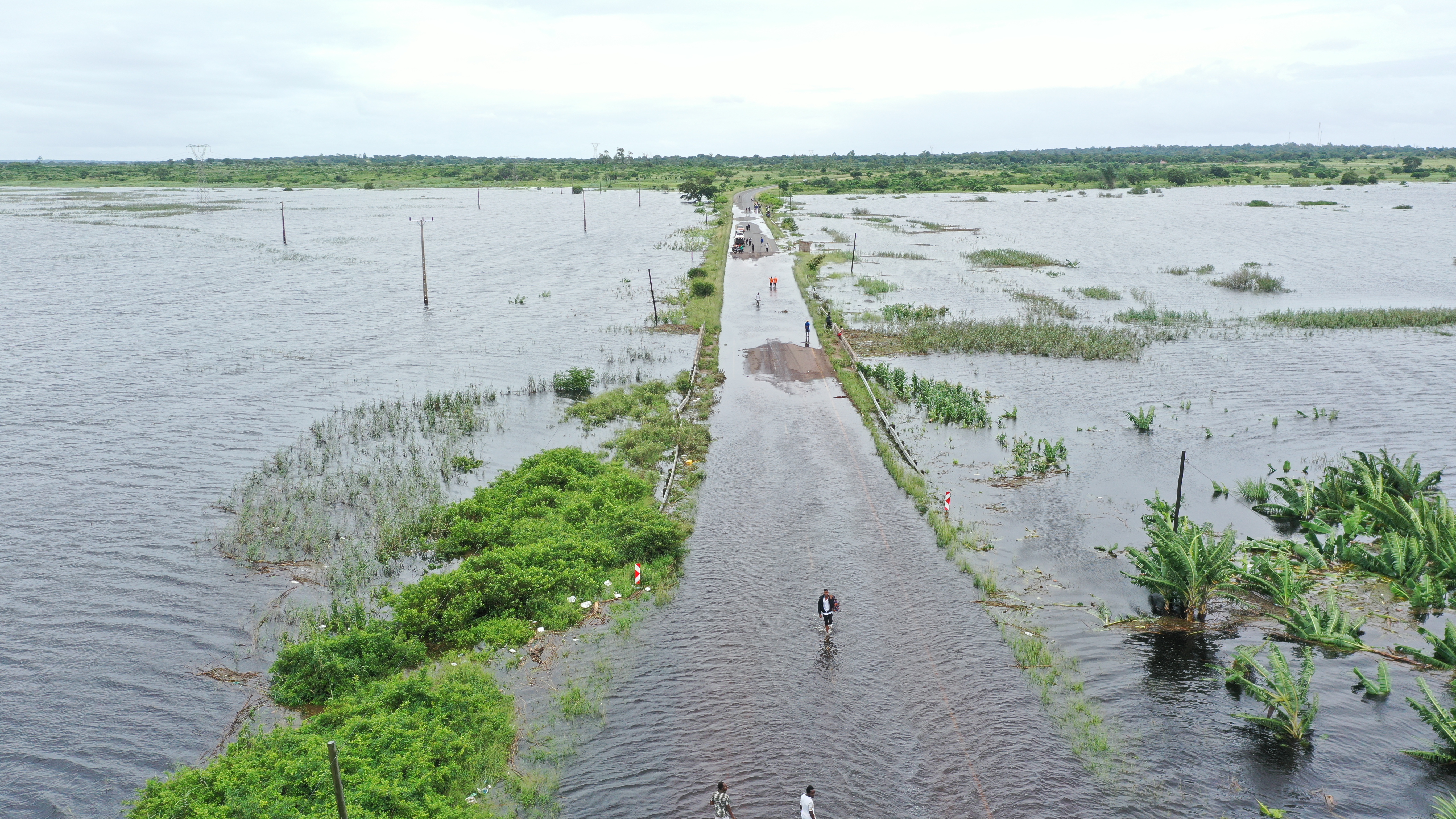
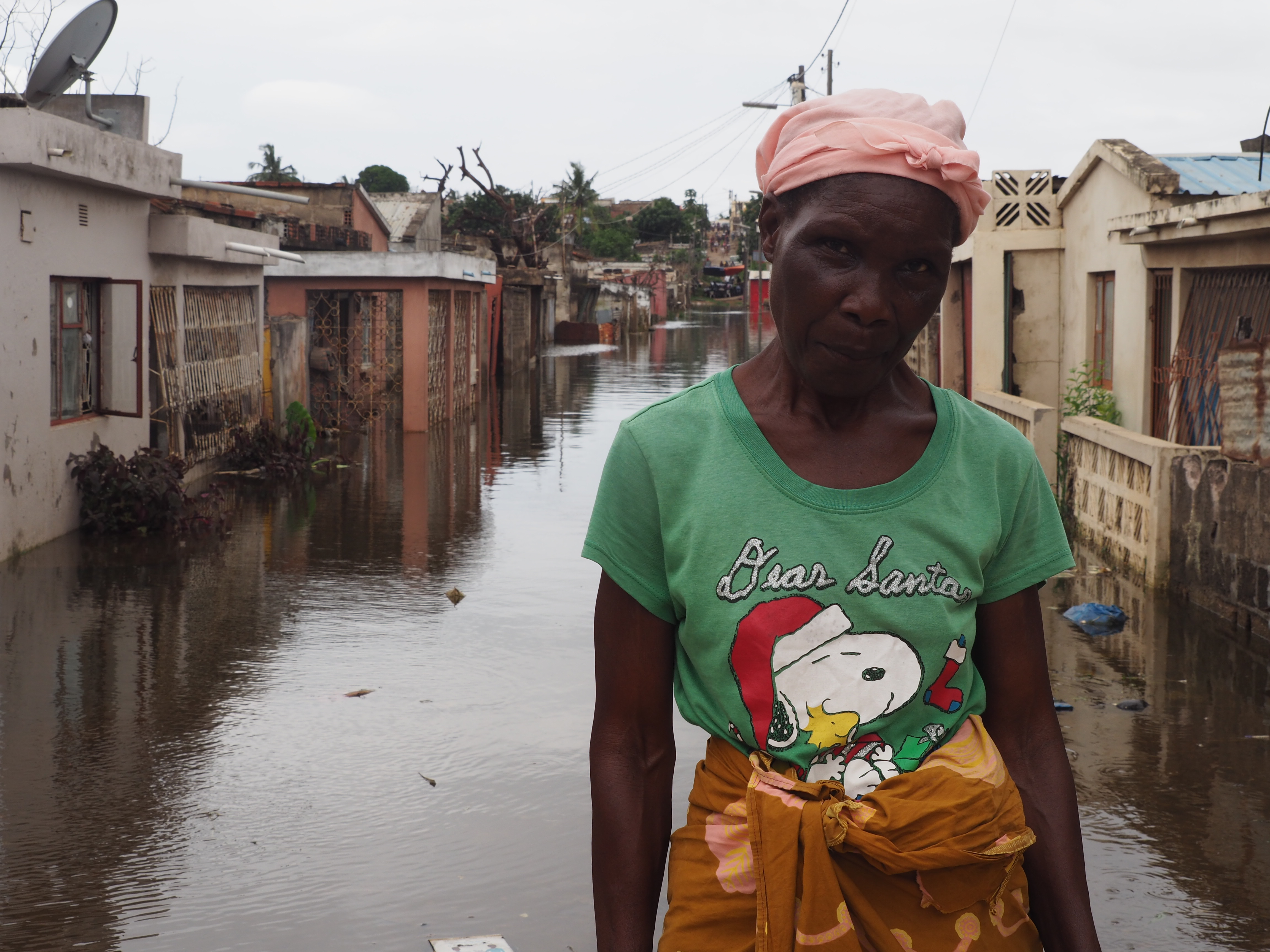
Southern Mozambique and parts of Zimbabwe and South Africa have been – and some areas still are – once again under water. Being a downstream country, Mozambique is one of the most climate vulnerable countries in the world. The reality of this is lived by our people almost annually now. Over 150 people are dead and 400,000 people have been displaced, with a total of almost 1 million affected people, due to the severe floods in January 2026. In 2000, the country suffered other terrible floods, and the iconic image of those floods was a baby being born on a tree before being rescued. The country and the world followed her story. Despite all the media attention and support, Rosita Pedro died last month at the age of 25 from treatable illnesses. It is impossible not to think of so many other people who continue to die across the country as a result of a state with misplaced priorities.
During this year’s floods, history repeated itself, with a few more “miracle babies”. A girl was born on 19 January on a school desk in the village of 3 de Fevereiro, in the district of Manhiça, Maputo province. Her mother, Erica Raimundo Mimbir, named her Rosita, certainly hoping she outlives the ill-fated miracle baby of 2000.
The severity of these floods were known for many months, probably since September 2025. Heavy rains were expected. Dams in the region had been on high alert, and as usual, ended up contributing to exacerbating the disaster instead of mitigating it. Our government was negligent: emergency response teams were not on site, and people already living in areas of poverty and high risk did not receive the resources they needed to survive the floods. Where were the evacuation plans, the preparation of public and private spaces to house the displaced, the practical information about where is safe to go when the water begins to flood our homes?
‘We all live downstream’ is a core part of environmental justice ethics, highlighting the principles of environmental responsibility and ecological stewardship, our interconnectedness as peoples and ecology. Our ubuntu.
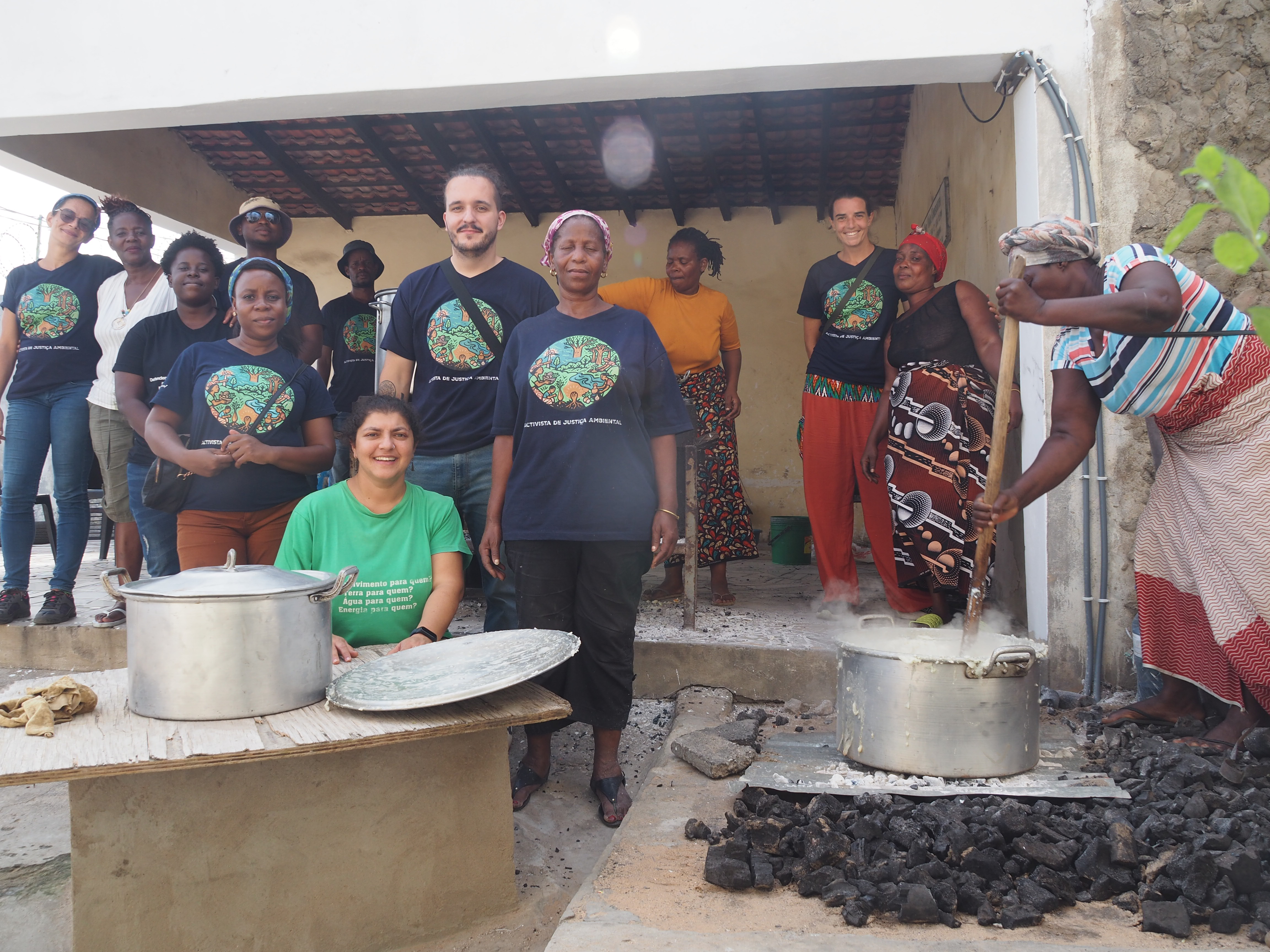
It is the recognition that what some do affects everyone, and for generations to come. At JA!, we are focused on building people power across the country, the continent and the world to dismantle the different systems that oppress us – such as capitalism, racism and patriarchy. We did not create JA! with the intention of being a humanitarian aid association. Yet the crisis escalates daily, impacting our neighbors, our families, our own homes. After visiting a few sites across Maputo city hosting floods survivors, we decided to focus our initial support on Escola Mariazinha, in Hulene neighbourhood. We have already taken supplies and our giant pots and pans multiple times now, running a solidarity kitchen and cooking and eating with more than 100 adults and children each time. Many are still sheltering at the school weeks later, with their homes still submerged.
We know that this emergency is not the end of this struggle, and so even as we contribute to meeting basic needs, we are assessing the next steps with the community – discussing what can be done to change conditions on the ground. An intervention with the Municipal Council to demand that they pump out the water that has accumulated there, denounce the corruption that exists in the emergency relief teams, and organise community clean-ups in the streets are among the ideas that have emerged from the affected people themselves. Meanwhile, comrades and partners from around the world are ready to mobilise and support their Mozambican brothers and sisters, but receiving this solidarity also means navigating bureaucracies that were designed to divide us: barriers to obtaining visas, accommodation costs, non-existent state infrastructure to coordinate international support. Our government
has become so addicted to cycles of international debt with neoliberal predators that it has forgotten the importance of true internationalist solidarity in times of crisis – something that was so crucial in our liberation struggle against the Portuguese colonial regime. Our government also seems to forget that, although Mozambique is on the front line of the impacts of climate catastrophe, we have contributed almost nothing to global greenhouse gas emissions, the main cause of climate change. We do not have to beg in international forums, we do not need charity – we are entitled to payment of a climate debt by the countries that have polluted the most.
The multiple interrelated crises will only continue to worsen. But we are not just victims: we are agents of change. Organised and united communities are capable of taking action to improve their lives today and in the long term. And because we believe this, we prioritise building and strengthening movements at the local level, but also internationally. JA! is part of, among other networks and alliances, the creation of the international movement of communities affected by dams and the climate crisis, launched in Belém in November 2025, which brings together people and collectives from all continents, united in the struggle for our rights and for a systemic change.
If we know that the waters will rise, we must work together to learn to swim, build boats, build communities, and demand change. As the waters rise, we must also rise. Our collective survival depends on it.