Monthly Archives: August 2022

An open letter to all African Heads of State and Ministers

To all African Heads of State and Ministers,

We are writing with concern about a proposal from a technical committee of the African Union for an “African Common Position on Energy Access and Transition” to be launched at COP27.

For the reasons set out below we, the undersigned organizations, representing movements and civil society groups from across Africa, urge you to reject the proposed “common position”.

We believe that the proposed “common position”, developed by a committee made up of national energy and transportation officials:

  • Has been prepared hurriedly and without adequate consultation with scientists, experts and officials responsible for climate change and, as a result, lacks a proper scientific or evidential basis;
  • Is inconsistent with the findings of the Intergovernmental Panel on Climate Change, the International Energy Agency and the UN Environment Programme; and lacks critical analysis about the causes of energy poverty, the energy transition required, long-term climate policy scenarios, the associated risks of stranded assets, the threat of fossil fuel production to sustainable development and much more.

We believe that the recommendation included in the proposed “common position” to make fossil fuels a “crucial part” of Africa’s short, medium and long-term energy mix:

  • Will not address the Committee’s own aims relating to energy access and transition;
  • Is inconsistent with the Paris Agreement’s climate target of 1.5 °C, the existing African Common Position on Climate Change, and the goals of COP27;
  • Risks levels of global heating with catastrophic consequences for Africa; and
  • Is inconsistent with Africa’s wider development objectives, putting Agenda 2063 and the UN Sustainable Development Goals at risk.

We join with other organisations in supporting the Memorandum exposing and rejecting the African Union proposal for a Common Position on African Energy Access and Transition, which describes in further detail the African Union Committee’s position, and details the many concerns listed above.

The Committee’s position has been hurriedly prepared, yet is now being advanced rapidly for adoption by African Heads of State, and for endorsement by AGN, AMCEN and CAHOSCC. Despite focussing on “energy access” and “energy transition” it makes no specific recommendations to scale up renewable energy production or to provide energy to 600 million Africans who currently lack access. Instead, it prioritises the interests of the fossil fuel industry and European governments by seeking to expand fossil fuel infrastructure, production and exports.

This development comes on the back of a recent vote by the European Union to re-classify both fossil gas and nuclear energy projects as “green,” making them eligible for low-cost loans and subsidies. The underlying reason for this is the Russian invasion of Ukraine, with Europe now pivoting to Africa to achieve its own energy security. Read together, we believe there is a risk Africa’s energy investments will be skewed into producing fossil fuels for European consumption, and not energy access or transition for Africans.

In particular, the “dash for gas” in Africa is dangerous and short-sighted. Investing limited resources in fossil gas will strand assets and economies while threatening potential investments into affordable, easily deployable, accessible, much-needed renewable energy for the people.

Rather than provide Europe with more climate-damaging fossil fuels, Africa’s development agenda and the climate emergency call on us to rapidly shift away from harmful fossil fuels-based technologies towards a renewable energy future.

If adopted by our Heads of State, the proposed position could clear the way for COP27 to be used as platforms to justify a massive scaling-up of fossil gas production in Africa, distracting from the clear case for renewables, locking the continent into fossil fuels for decades to come, while also shifting dangerous nuclear technologies that Europeans do not want onto African soil.

This is a moment that requires urgent action. We believe that the AU technical committee has made a serious mistake. We are calling on you as our Heads of State and Ministers responsible for the energy and climate future of our continent to reject the proposed common position, and to instead:

  1. Announce a fossil fuel policy in line with Africa’s development interests and the recommendations of the IPCC, IEA and other scientific organisations that confirms the African Union condemns and does not support new coal, oil or gas related projects on the African continent.
  1. Foster transparent and meaningful dialogue with citizens and policy-makers across the continent to build a shared African narrative and agenda to tackle the linked challenges of climate, energy and development; and
  1. Based on this dialogue, develop a science- and evidence-based African common position on energy access and transition that prioritizes Africa’s need to urgently move away from harmful fossil fuels towards a transformed energy system that is clean, renewable, democratic and actually serves its peoples.
To see the full list of signatories, access:www.dont-gas-africa.org/open-letter

For more information and other materials, visit: www.dont-gas-africa.org
Say No to Gas

Today the Say No to Gas! Campaign website is going live! The campaign, co-ordinated by JA! aims to bring an end to the gas industry in Mozambique and all over the world. We are focusing on the regions of Cabo Delgado, Inhambane and Nampula provinces in Mozambique, fighting an industry whose tentacles are spreading out around country, the African continent and the world.

We are working on the ground in Mozambique, and supported by an international coalition that challenges the impunity of the gas industry, exposing its violations and threats to human rights, environmental destruction and climate impact everywhere in the world, fighting the culprits in their own countries.

The website is a rich depository for anyone who wants to learn about the gas struggle, the devastating impacts, the facts about gas, companies, financiers and governments fuelling the industry, reports and regular updates.

http://www.stopmozgas.org

We look forward to your visit!
Aluta Continua!

The new EU directive on due diligence – a relevant step towards ending corporate impunity?

This is a critical time at the European Union (EU) when it comes to human suffering and climate impacts caused by transnational corporations, with particular emphasis on fossil fuel corporations, who continue to take deliberate actions to burn the planet. An important new law has been put forward,’called the EU Corporate Sustainability Due Diligence Directive’, which is still being discussed.

However, this law leaves much to be desired, and in its current form, can provide companies, investor states and financial institutions with an easy tick-box exercise, and loopholes, that will enable them to continue creating devastation of the earth, climate and peoples with impunity. The case of the gas industry in Cabo Delgado, northern Mozambique, is a concrete example of how this can happen and is already happening.

Many organisations in Europe including Friends of the Earth Europe have been fighting the passing of this law in its current form and partnered with JA!’s activists at the EU Commission in Brussels in May, to speak to Ministers in the European Parliament (MEP).

To see the full report by Friends of the Earth Europe, ‘‘INSIDE JOB: How business lobbyists used the Commission’s scrutiny procedures to weaken human rights and environmental legislation’’, click here: https://friendsoftheearth.eu/wp-content/uploads/2022/06/INSIDE-JOB_-How-business-lobbyists-used-the-Commissions-scrutiny-procedures.pdf

The majority of players in the Cabo Delgado gas industry are international, and many are from countries within the EU, such as Total from France, Eni from Italy, Galp from Portugal and French, Portuguese, Dutch, Swedish and Danish banks, to name a few.

Many of these oil, coal and gas companies register subsidiaries in the country where they operate, such as Mozambique, and because the current draft EU law says that only ‘big’ companies can be held accountable, this will enable these subsidiaries to get away with their abuses and violations at a domestic level, especially in countries with weakened systems of justice.

Another major issue is that the topic of Free Prior and Informed Consent (FPIC) needs to be clear and strong. For one, it is only mentioned in an annex, and uses the term ‘consultation’ rather than consent, meaning that communities will only have to be informed of the project. It fails to ensure a clear right to say ‘no’, when local communities do not accept a specific project in their territories for fearing its foreseeable impacts. Secondly, it does not take into account the difficulties that come with actually obtaining this consent, the fact that even consent can be bought, coerced or threatened into. This related to what is meant by ‘a legitimate consultation’. For example, in Cabo Delgado, Total’s consultation process with affected communities has been a sham. When Total representatives visited and visit communities for these consultation meetings, they are accompanied by a military entourage. This, along with the presence of leaders who have a beneficial relationship with the company, means that community members are too afraid to speak out and dissent, even if they disagree, and ultimately many signed compensation agreements in public and in a language they did not understand. Yet Total was able to tick the boxes required for a legitimate process.

In general, there is not enough emphasis on preventing harm, and far more on remedy. It does not deal with what should be the foundation of the discussion, which is that there should be no harm or violations committed in the first place, and that appropriate punitive and coercive sanctions must be put in place when they are committed.

Burden of proof is too high.

In many laws, including in this draft EU law, the burden is on the claimant to prove the crime, which in this case means that corporations are innocent until proven guilty, and the assumption is that communities are not telling the truth. Communities are expected to show that their human rights were violated, amongst all difficulties linked to the asymmetry of power and complicity with national governments, while companies will only need to show that they followed the required processes needed for a project to be developed in that area. In order for community complaints to be considered ‘credible’, they are expected to provide information that is not easy for them to come by, such as written documentation and emails, video and photographic evidence, and named testimonies and witnesses, to show that the companies did not act in compliance with the law and international norms and standards. Amidst global overlapping crisis strongly linked to the power and impunity of these transnational corporations, the burden of proof should be on the companies to prove they are not responsible for the harm, or that they cannot control companies in their global value chains.

The legislation does not recognise that people cannot provide this information – they often do not have access to technology, knowledge of the language used, information in writing and in many cases their lives would be at risk for speaking out.

In the case of Cabo Delgado many mainstream media articles coming out toe the government line and there have been instances where journalists who tell the truth have been arrested and tortured, or even disappeared. Media, civil society and government officials who enter the gas area are accompanied by a military and government entourage, which makes it unlikely that communities will talk about their experiences honestly. These obstacles are not taken into account.

And on climate change

The draft EU law is not clear about companies’ compliance with the Paris Agreement and keeping below the 1.5 oC degree emissions target. Instead, it speaks of ‘compatibility’ which leaves much room for industry to claim that the agreement is ‘open to interpretation’ as they have done before several times.

As long as essential issues in the draft EU law are not addressed, including binding law on compliance with climate agreements, the reversal of the burden of proof and the establishment of clear provisions to deal with neocolonial power dynamics and systemically exploitative nature of big transnational companies , it will be yet another stamp with which the industry will show off its deceiving processes to ‘meet requirements’.

When governments are questioned on their unwillingness to sanction companies and financiers, they often claim that ‘holding dialogue’ with these companies is more effective in the long run. They have said, in several instances, that sanctioning companies should be the last resort, and will lead to them having no input into companies’ actions whatsoever. This system of continued dialogue is clearly not working -companies are continuing to act with impunity – and instead, institutions like the EU need to take ‘take responsibility for the harms of its companies, with great impacts in the global South, and take a step further to actually sanctioning them.

The insufficiency and limitations of a regional legislation

At a broader level, and even though EU corporate regulation laws are undoubtedly needed, this Due Diligence directive will not solve the global problem of corporate impunity. A regional directive – especially one linked with such a weak concept as ‘due diligence’ – must complement the process towards a UN legally binding instrument to regulate transnational companies in international human rights law (the ‘UN binding treaty on TNCs’), ongoing since 2014. Surprisingly enough, the reluctance of the EU and most of its member States to adequately engage in the UN binding treaty negotiations has been reaffirmed session after session and, unsurprisingly, heavily criticized by civil society from across the world.

Without a global level playing field, companies will continue choosing the best places to violate human rights and cause economic, social, environmental and climate impacts. Or choosing the best jurisdiction to register their parent companies. Both the EU and UN laws must include direct legal obligations to companies, affirm the primacy of human rights over trade and investment agreements, and establish judicial enforcement mechanisms. The negotiations of these or any laws aimed at regulating corporate activities should logically be protected from corporate capture and influence. The EU must include several key elements in its new directive in order for it to be meaningful – and this effort must be accompanied by the EU finally taking up its responsibility to start engaging actively and constructively in the negotiations for an ambitious and effective UN binding treaty.

Ending corporate impunity must necessarily mean that we close the legal loopholes and gaps which allow transnational corporations to evade responsibility – at national, regional and international levels.

Tagged ,

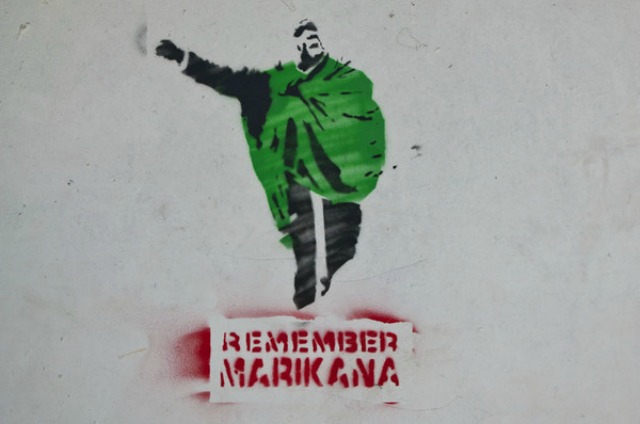
Ten years since the Marikana massacre and still no one has been punished

This week marks the 10th anniversary of the Marikana massacre, the day that striking South African mineworkers were violently attacked by the police, who killed 37 unarmed people. The police, government, company and even current President Cyril Ramaphosa, who were all directly involved, have not been held accountable for their crimes, and have gotten away, literally, with murder.

On the 16 August 2012, rockdrillers at Lonmin platinum mine were on strike, after a week of protests, demanding a basic, decent, liveable salary of R12 500 (MT 43 600 at the time) a month, on which the company refused to negotiate. The men were gathered on a hill, when the police opened live fire, unprovoked, and many men met horrific deaths – some of them were shot at close range, and some were even crushed by police vehicles.

Today, a full decade later, rockdrillers at the company are only earning R13 000 (MT 49 600). Lonmin never issued a formal apology for this massacre, not even to the families of those slain or the injured and has not provided all families with income compensation. In 2018, the company was bought by Sibanye-Stillwater. Lonmin has been a snake, slithering out of the country to avoid culpability.

No members of the police force. nor the government have been pinished or even legally charged for these blatant murders. President Ramphosa was a non-executive director of Lonmin at the time, and put pressure on the police to treat the strike as a criminal matter. Yet he has been exonerated of any responsibility for this massacre.

The families of the murdered mineworkers are continuing to go to court to obtain justice for their loved ones, for those guilty of these crimes to face some kind of punishment, and they will continue fight.

South Africans still live in an economic apartheid. The poor, including workers in the extractive and fossil fuel industries – the bodies on whom companies make as much as hundreds of billions every year – are still treated as less than human, as mere transactional tools to keep the capitalist system working for the wealthy, for local and international political and economic elite to benefit from their mere existence. This goes beyond South Africa – these exact same words can be used when talking about the extractive industries in Mozambique, Tanzania, Namibia, Lesotho, DRC, Sierra Leone, Central African Republic, Morocco, Colombia, Brazil, Argentina, Native American lands, to name very, very few.

Russian anarchist Pyotr Kropotkin once said: Everywhere you will find that the wealth of the wealthy stems from the poverty of the poor. We at JA! Stand in solidarity with the families of the murdered Lonmin mineworkers and those injured, with those fighting for basic humanity around the world, with those fighting for their lands, livelihoods, and the earth.

We urgently need the United Nations (UN) to implement a Binding Treaty on Business and Human Rights, an accountability tool that actually has teeth and that communities devastated by corporations and civil society have been demanding for years.

Guiding principles are not enough – corporations have shown that they have no interest in human rights, the climate and the environment, except when they need to tick a box- and guidelines are certainly not going to force them to act with humanity.

It is time for institutions of power – states, especially those in the North, the UN and European Union- to create, and enforce laws that will make companies like Lonmin pay for their crimes, and protect lives, like those of the Marikana miners, struggling for their basic right to be treated as human beings. We must continue to fight to ensure that this capitalist, imperialist and neo-colonialist system of exploitation ends right now!

Tagged , , ,

JA! amplifies the message of Mozambique’s fight for climate justice at the Stockholm +50 People’s Forum.

In early June, JA! Activists were in Stockholm to participate in the Stockholm +50 People’s Forum for Environmental and Climate Justice. This event was a gathering of activists and civil society taking place parallel to the United Nations (UN) Stockholm +50 Conference. This event is a commemoration of the 50 year anniversary of the 1972 UN Conference on the Human Environment. The UN refers to this as the summit “that first made the link between environment and poverty and placed it at the forefront of the international agenda.”

It also marked the first of parallel civil society meetings and protests that have been held during UN summits ever since. It was one of the foundations for the process of bringing together social movements from around the world, including from the global South, to discuss and strategise together and strengthen the work for social and environmental justice, while also broadening narratives and bringing critiques to the formal UN event. From this came a system where civil society began engaging in formal spaces at UN meetings.

The People’s Forum was three days of activities developed by the Stockholm +50 Coalition, who describe themselves as a “collective of civil society and social movements fighting for environmental, social and climate justice,” and the aim of the event was to be a place where “social movements are planning parallel activities to highlight principles, demands and actions that respond to the depth and seriousness of the crises we are facing – with global justice and challenging of power relations at the core.”

For more detailed information about the people’s forum go to: https://stockholmplus50.se/en/start-english/

JA! spoke on four panels which focused on some elements of our work. These were on the need to stop corporate abuse and privileges by saying ‘yes’ to a UN Binding Treaty on business and human rights and ‘no’ to ‘free’ trade agreements that threaten democracy; the danger of false climate solutions; the complicity of Swedish pension funds in fossil fuel destruction in Mozambique and elsewhere; and ideas for the way forward after 50 years of struggle for system change.

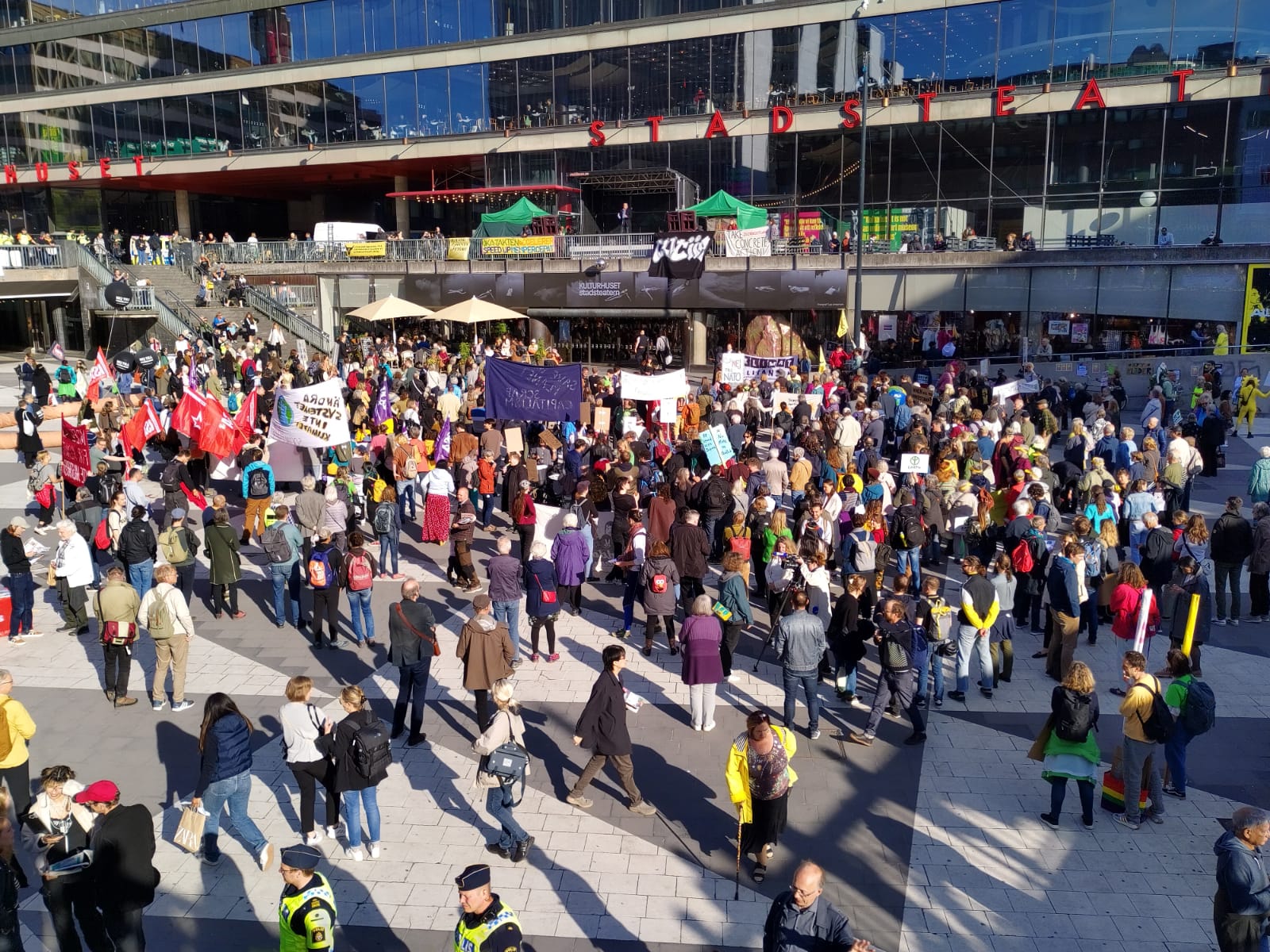
The forum included a manifestation, or protest, in the centre of Stockholm where activists from communities around the world, including JA! Spoke alongside activists including people from Mexico, Namibia, Colombia and Lebanon to a crowd of at least 300 people about what Swedish people can do to fight climate injustice, such as demanding that their pension funds divest from fossil fuels.

The forum raised the greater question of what has changed in these five decades of fighting for climate, environmental and social justice and how we can use learnings from this to collectively strengthen these struggles. But to answer these questions, it is important to look at what has not yet changed.

For example, even though companies like Shell were well aware of climate change in 1981 we still do not have a binding treaty at the United Nations level, which would force companies to act with basic humanity. Corporate capture has only become more prevalent, bilateral agreements remain advantageous to northern and former colonial states, and processes like Investor State Dispute Relations have strengthened the skewed unequal power relations even further towards wealthy transnational corporations.

The legacy of colonisation remains crippling to former colonies, with Mozambique being a good example of this. By looking just at the gas industry in Inhambane and Cabo Delgado provinces, countries like the UK, Portugal, Italy, the Netherlands and South Africa, are benefiting, or will continue to benefit from fossil gas projects led by Total, Eni, ExxonMobil, Sasol and many others, while Mozambique’s economy continues to collapse and its level of debt grows. Northern governments are well aware that their companies are destroying the global South but their narrative of ‘gas for development’ merely enables them to the benefit from the historical colonial structures of poverty, debt and corruption they themselves created.

There remains a lack of accountability for the impacts of the industry – communities losing their homes and livelihoods and being ripped apart, many in refugee centres and devastated by a violent war, fuelled by the industry, that has killed thousands and created almost one million refugees.

What has not changed is shown just by the very need to hold events like Stockholm +50. How is it that the most powerful countries and most respected international regulatory body in the world is still unable to control fossil fuel companies and banks, and still refuse to cut their investment into fossil fuels? How is it that we have treaties like the Paris and Glasgow Agreements and yet still have to fight for companies and northern states to invest in the vast renewable resources the earth has to offer? How do we still not have a Binding Treaty on Transnational Corporations at the UN when companies have shown time and again that they will not voluntarily abide by human rights regulations?

However, there are also those things that have changed. The introduction of the climate treaties mentioned above show that pressure from civil society and Southern peoples has been working. While there remains a struggle to get companies to act in accordance with them, and although they leave much to be desired, the mere fact that they exist means that institutions of power, like the UN and European Union are at least heading in the right direction. As governments of countries where extractivism is taking place are clamping down more and more on journalists and activists, people continue to stand up; as transnational corporations continue to evade tax in the countries where they operate, people continue to fight for their rights to basic services.

Another very promising thing the Peoples Forum showed was the large number of young people from around the world taking up the climate struggle, and radicalising their local fights. They made a crucial point: The narrative that needs to change, and has already begun changing, is that the struggle for climate justice must be inclusive, and a fight that goes beyond environmental damage, but is also a fight for justice for the poor, and people worst affected by climate change.

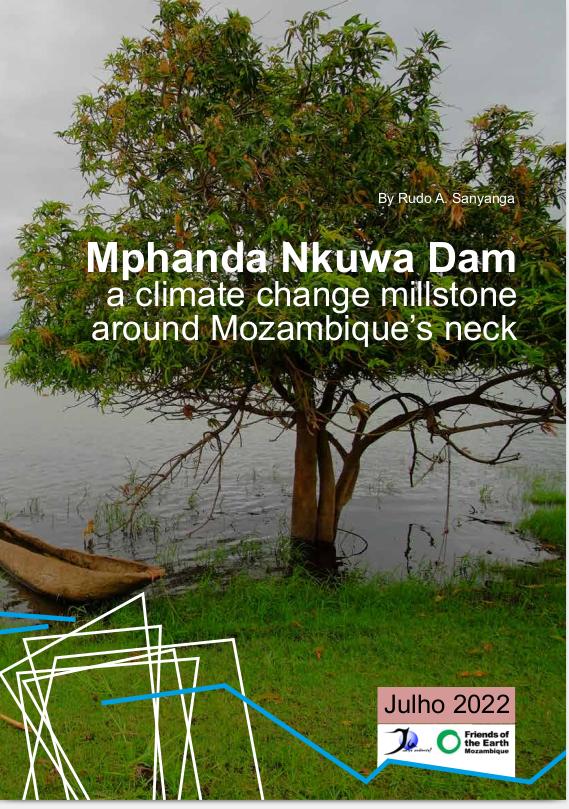
Mphanda Nkuwa Dam: a climate change millstone around Mozambique’s neck*

by Rudo A. Sanyanga

Executive Summary

The Mphanda Nkuwa hydropower dam project, mooted more than two decades ago, has re-emerged as a solution for increasing power exports to South Africa to enable Mozambique to increase its capacity for earning foreign currency. The project is now being promoted at a cost of USD 4.5 billion comprising USD 2.4 billion for the dam and power plant, plus USD 2.1 billion for transmission lines. This essay discusses the merits of the Mphanda Nkuwa hydropower project and its socio-economic and development benefits in the face of climate change impacts, at a time when the world is facing energy challenges that require rethinking the most sustainable types and sources of energy for the future.

The Mphanda Nkuwa Dam would be the third largest dam to be constructed on the main stem of the Zambezi River and one of many other dams in the basin when the Zambezi tributaries are considered. Its location in the lower Zambezi River basin, in Mozambique, gives it unique features and makes it vulnerable and also crucial in determining the health of the downstream ecosystems. As currently designed, the hydropower plant has a 1500 MW generation capacity, with 60% (900 MW) of this capacity committed for export to South Africa and the balance of 600 MW (40%) reserved for domestic consumption in Mozambique. Currently, over 60% of Mozambicans, most of whom live in widely dispersed settlements in remote rural areas, do not have access to modern electricity and are out of reach of the existing national electricity grid. Far much more than 600MW would be required to enable Mozambique reach 50% access to electricity by 2030.

The project is planned for commissioning in 2030, with about 2 years of this needed for planning and design, while construction is expected to take 6 years. The touted benefits of Mphanda Nkuwa are doubtful in the face of climate change and the fact that the dam will be detrimental to downstream ecosystems, as well as human health and safety while leading to the loss of livelihoods for downstream communities. As is the case in most similar large infrastructure projects, the Mphanda Nkuwa dam and hydropower project is drawing favor from international financial institutions such as the Africa Development Bank who view it purely from a macro-economic viewpoint as an avenue for spurring economic growth in the country through increased foreign currency earnings. The proponents of the project, however, overlook the several risks that are associated with the project and, thus, do not discuss how these risks will be addressed.

Of major concern among the risks is the issue of climate change. Following some detailed analysis, the IPCC found that, out of the 11 main river basins in Africa, the Zambezi Basin is the most vulnerable to climate change impacts. The Zambezi basin is predicted to experience severe extreme weather events in the form of prolonged drought periods, and extreme flooding events in the future, the worst of all other basins on the continent. Furthermore, the Lower Zambezi is directly affected by developments upstream, with the negative impacts of upstream developments being compounded at Mphanda Nkuwa and downstream. In the past decade, Mozambique has been the worst climate change affected country among all the SADC countries with numerous extreme weather events of cyclones and flooding being experienced. The operations of the upstream dams at Kariba, Kafue and Cahora Bassa, with their large combined storage capacity, will be key to the performance of Mphanda Nkuwa.

Being located downstream of the large dams, the major risk for Mphanda Nkuwa will be during drought periods when the upstream dams may not release water as the upstream countries may prioritize their own needs. The high risk of droughts in the Zambezi basin, wrought by climate change, will have a direct negative impact on the financial and economic viability of the project, as the projected revenue generation and foreign currency earnings will be severely curtailed by prolonged droughts. The withholding of water in upstream dams during droughts will also endanger the ecological flows of the river below Mphanda Nkuwa, with further detrimental effects to prawn fishing in the delta region.

Similarly, in the event of large floods, upstream dams will release water downstream, thereby creating risks of dam failure at Mphanda Nkuwa as well as worsening human safety downstream in the Zambezi valley. The risks to dam safety as a result of flooding may necessitate more expensive design features and higher construction costs. The high risk of loss of human lives and threat to human livelihoods in Mozambique due to floods has been fully demonstrated by numerous catastrophic flood events in the lower Zambezi valley in the past two decades. It therefore follows that Mphanda Nkuwa is highly susceptible to climate change impacts with respect to both droughts and floods.

Mphanda Nkuwa hydropower is touted as clean energy. However, emerging studies worldwide are indicating that dams emit considerable amounts of methane, with methane as a more potent greenhouse gas than carbon dioxide. At a time when the world is facing huge global warming and climate change risks, the decision to proceed with Mphanda Nkuwa is unfortunate and flies in the face of conventional wisdom.

Mphanda Nkuwa is premised on power being sold to the Southern African countries, with South Africa’s power utility company Eskom being the principal customer for the electricity. It is important to note that over the past 15 years Eskom has been experiencing serious long-standing governance and structural challenges resulting in a chronic debt problem amounting to over ZAR 500 billion, which is equivalent to USD30 billion at the time of writing. Thus, the South African power utility is facing serious financial viability challenges which render it a risky customer on which to base a huge investment of USD 4.5 billion. As a result of its worsening financial position, Eskom has been progressively increasing domestic electricity tariffs in the past decade, with the result that some of its major customers, especially the wealthy ones, have been moving off the grid, thereby creating risks to its revenue collection and also worsening the power utility’s financial viability. Clearly, this issue is a red flag that the proponents of the Mphanda Nkuwa dam project need to seriously interrogate in their market analyses. The delicacy of the viability of Mphanda Nkuwa becomes even more stark when viewed against a background of the current power purchase agreement of Cahora Bassa power to South Africa, whose electricity pricing is highly unfavourable for Mozambique.

Other concerns regarding Mphanda Nkuwa include the claimed increase in energy access for Mozambicans. While on paper the claim is made that 40% of the Mphanda Nkuwa power will be availed to Mozambicans, in reality the impact on access to power for Mozambicans will be insignificant. The dispersed, extensive rural settlement pattern of most of the Mozambicans who currently do not enjoy access to clean energy, and the absence of an extensive grid network renders the claim that Mphanda Nkuwa will increase access to electricity a fallacy. Mozambique lacks an extensive transmission and distribution network and, even with the proposed transmission line, the majority in the rural areas will still remain unconnected to modern electricity. Grid electricity will not be enough to increase access and spur development in the country. At any rate, the cost of the electricity, without subsidy, is unlikely to be affordable for the majority of the citizens.

The Mphanda Nkuwa dam development pays very little attention to the basin ecosystem health and social wellbeing of downstream communities. The operations of the Mphanda Nkuwa dam will significantly alter the flow regime of the downstream area, creating daily fluctuations that will affect aquatic biota as well as the livelihoods of over 200.000 inhabitants who live in the delta and who, to a large extent, rely on the natural resources of the basin. The livelihoods of the communities that reside in the area that will be inundated should not be discounted. Based on what has already transpired and been experienced in other mega infrastructure projects in Tete province and across the country, these people will likely be subjected to forced displacement, curtailed livelihoods, inadequate compensation, State violence and repression and other human rights violations. The people in the basin will be the main losers from this development.

In conclusion, the investment is unlikely to significantly increase industrialization and spur economic growth in Mozambique. Very limited direct permanent employment can be expected to emanate from this hydropower development. No gains will be made in terms of climate change GHG emissions, and sadly more emissions will result from the hydropower dam. The revenue from the electricity sales may not cover the costs of production with potential of failure to service the debt for the dam. Several studies have been done for South Africa and Mozambique that demonstrate that clean energy can be harnessed through wind and solar to reach the widely dispersed rural population at a much faster pace, creating jobs and comparatively having fewer negative social and environment impacts. Against this backdrop, Mozambique has a huge potential to turn to renewable energies, and change its energy trajectory for energy development, distribution and generation. If implemented, the Mphanda Nkuwa will be a millstone around the neck of Mozambique for many generations to come.

*This study was launched in Maputo on July 21st 2022. To get a copy of the study please go to Justiça Ambiental’s office on Rua Willy Waddington, 102, Bairro da Coop, Maputo, or download it from this link: www.drive.google.com/drive/folders/1FXkv0z4PzdOT6yhueYhPqXVCo_9di4Qz

For more information: +258 84 3106010 / jamoz2010@gmail.com

Tagged , , , , ,