
Understanding Mozambique’s post-electoral uprise through Orlando’s story
A Story of Resistance
We met with Orlando in Maputo. He was in town to undergo medical exams — the result of the
police violence he was subjected to during his arrests in the aftermath of last year’s presidential
elections in Mozambique and of the ensuing almost seven months of jail time he spent in one of
the country’s most infamous prisons.
A quiet and very timid man, Orlando is nonetheless very well spoken, and in spite of his current
noticeable physical frailty, his moral fiber and convictions remain as strong as ever.
Orlando is not a criminal. He is one of thousands of Mozambicans who were arrested in the
months following the October 2024 presidential elections — not because they were simply
rightfully protesting or happened to be in the wrong place at the wrong time like so many others
— but because they were deliberately targeted.
The regime, feeling extremely threatened by the more than justifiable wrath of its people after
yet another shamelessly and undeniably rigged election, called on its security forces to
suppress all known threats and dissident voices in an attempt to quiet things down.
A member of the Mudada community in southern Mozambique, which alongside Mudissa
community, were stripped of their lands to make way for Moçambique Dugongo Cimentos Co.,
SA, a cement factory with crystal-clear ties to the party in power, Orlando had long been
outspoken about the company’s unfulfilled promises and wrongdoings — jobs for community
members that never materialized as outsiders were hired instead, a hospital and a school that
were promised but never built, and a poorly planned and built resettlement village that floods
every time there are heavy rains, constructed only long after it was promised and after much
popular pressure. Many of the displaced families are still waiting for their promised resettlement
homes and compensations today, over fifteen years after being displaced…
More than a pattern, this is Africa’s most infamous tale. Used countless times to con
communities in Mozambique and across the continent in the name of “development”, presenting
foreign investments as transformative for local people while ultimately serving outsiders and
elite interests — a story with devastating consequences for people and the planet.
In spite of not being a community leader, Orlando’s outspokenness earned him the respect of
his peers but also the reputation — amid the local government and the government-captured
community power structures — of being a troublemaker and agitator. This reputation earned him
two brutal arrests.
The first 1 , on February 6 th 2025, at the hands of UIR — Mozambique’s riot police. Him and two
other men from his community were detained for three days after protesting the disappearance
of a local resident — Leonardo — who he claims was taken by the army and whose
whereabouts the authorities refused to explain or acknowledge. (Later on, during his seven
month imprisonment, Orlando would find Leonardo in jail — alive, but detained and facing the
same kind of charges.) After being arrested, Orlando was transported lying down in the back of
a police pick-up truck, blindfolded, under the feet of the policemen sitting above him, who kept
kicking him and hitting him with their rifles. He was brutally beaten and tortured, and released
after 3 days.
The second arrest 2 came just 10 days after this ordeal. This time on a sunday night,
Mozambique’s criminal investigation police (SERNIC) entered his home uninvited and without a
warrant, beat him up in front of his family, forced him into a car where he was brutally assaulted
on their way to Maputo and presented with a document containing a list of people he was asked
if he knew — a detail that clearly exposes the persecutory nature of these arrests.
When asked whether his imprisonment had instilled fear into his community, he was blatantly
honest: “Certainly. Even the community leader is now afraid to speak up.”
What happened to Orlando is not an isolated case. It mirrors the political climate that has been
increasingly defining Mozambique for decades now — a climate of fear, repression, and deep
institutional decay.
From Revolution to Repression
Mozambique’s current political crisis is rooted in a long and turbulent past. The country’s
troubles began with over four centuries of Portuguese rule, which deeply entrenched a system
built for colonial exploitation and domination.
In 1962, inspired by Marxist ideals, FRELIMO was founded with a clear mission: fight for
liberation and dismantle the imperialist system of oppression imposed by the Portuguese.
Independence came in 1975, following the downfall of Portugal’s fascist regime and over a
decade of armed struggle. Samora Machel, FRELIMO’s charismatic leader, became the
country’s first president. Under his rule, the government nationalized land and key industries
and launched mass literacy and health campaigns, aligning itself with global socialist
movements.
Though idealistic and widely supported, the new state faced serious challenges from the start:
Economic isolation – as Western powers pulled away because of its Marxist-Leninist stance,
and the Eastern bloc’s support wasn’t enough to prevent the hardship.
Sabotage by neighboring white-minority regimes – who saw Mozambique’s socialist
revolution as a threat to their own racial and colonial order.
State authoritarianism – despite its emancipatory rhetoric, Frelimo justified brutal missteps as
resistance against a genuine imperialist threat, framing any critique as counter-revolutionary
and being ruthless toward dissent.
Slowly but surely, the revolution’s egalitarian ideals began to erode under the strain of internal
contradictions and external sabotage.
In 1977, a brutal civil war broke out between Frelimo and Renamo, a rebel movement
sponsored by the South African apartheid regime. It would last for 16 years. Between combat
and starvation, over 1 million people died.
The untimely death of Machel in 1986 marked a significant turning point, leading to a change in
FRELIMO’s political direction. By the 1990s, FRELIMO had shed its Marxist ideals, embracing
neoliberalism and consolidating power through elite political and military networks – that make
the country virtually coup-proof – along with systemic corruption.
The IMF promoted the emergence of state oligarchs, who used their political status to gain
economic power. In exchange, the new oligarchs ensured that foreign companies and countries
benefitted from the gas, coal, rubies and hydroelectricity 3 .
The revolutionaries became oligarchs, and the oligarchs became the local administrators for a
new form of colonialism. The dream of liberation gave way to a reality of systemic inequality,
Hanlon, Joseph. 2025. Moçambique recolonizado através da corrupção.
state capture, and political decay. The very system FRELIMO once vowed to dismantle had won
– and it prevails to this day, ironically with FRELIMO’s own elite now sitting at its helm.
Over the past 30 years, corruption, inequality, and sheer marginalization deepened, but with the
advent of social media and mobile devices, it became harder to withhold information and control
the narrative. Public disillusionment grew exponentially, and as FRELIMO felt its grip slipping,
repression grew too, space for democracy shrank, and elections became a sham. Once hailed
as heroes of the liberation struggle, FRELIMO became estranged from the very people it had
fought to liberate.
The death of prominent hip hop artist Azagaia in March 2023 – a fierce and fearless critic of the
regime – ignited the dormant fire of Mozambique’s own “Arab Spring,” awakening a generation
hungry for justice, dignity, and economic emancipation. Just like in 2008 when he wrote “Povo
no Poder” amidst another wave of protests, his music became the soundtrack to the protests
that followed the rigged municipal elections later in 2023, and again during the general elections
in October 2024.
Last Year’s General Elections
On October 9th, 2024, Mozambique held its seventh general election since the introduction of
multiparty democracy in 1994. The ever-ruling FRELIMO party’s candidate, Daniel Chapo, was
declared the winner with over 70% of the vote.
His main challenger, Venâncio Mondlane – a populist preacher with conservative-leaning
political views and ties, who over the past few years built a strong following by cleverly using
social media to engage and mobilize his supporters – contested the results, claiming to have
won. Allegations of widespread electoral fraud – corroborated by independent observers –
pointed to ballot stuffing, voter intimidation, and manipulated results. Mozambique’s electoral
bodies turned a blind eye to these allegations. The Constitutional Council, seen as politically
captured, upheld the official results, dismissing allegations of fraud. This rubber-stamp decision
further eroded public trust and fueled continued protests.
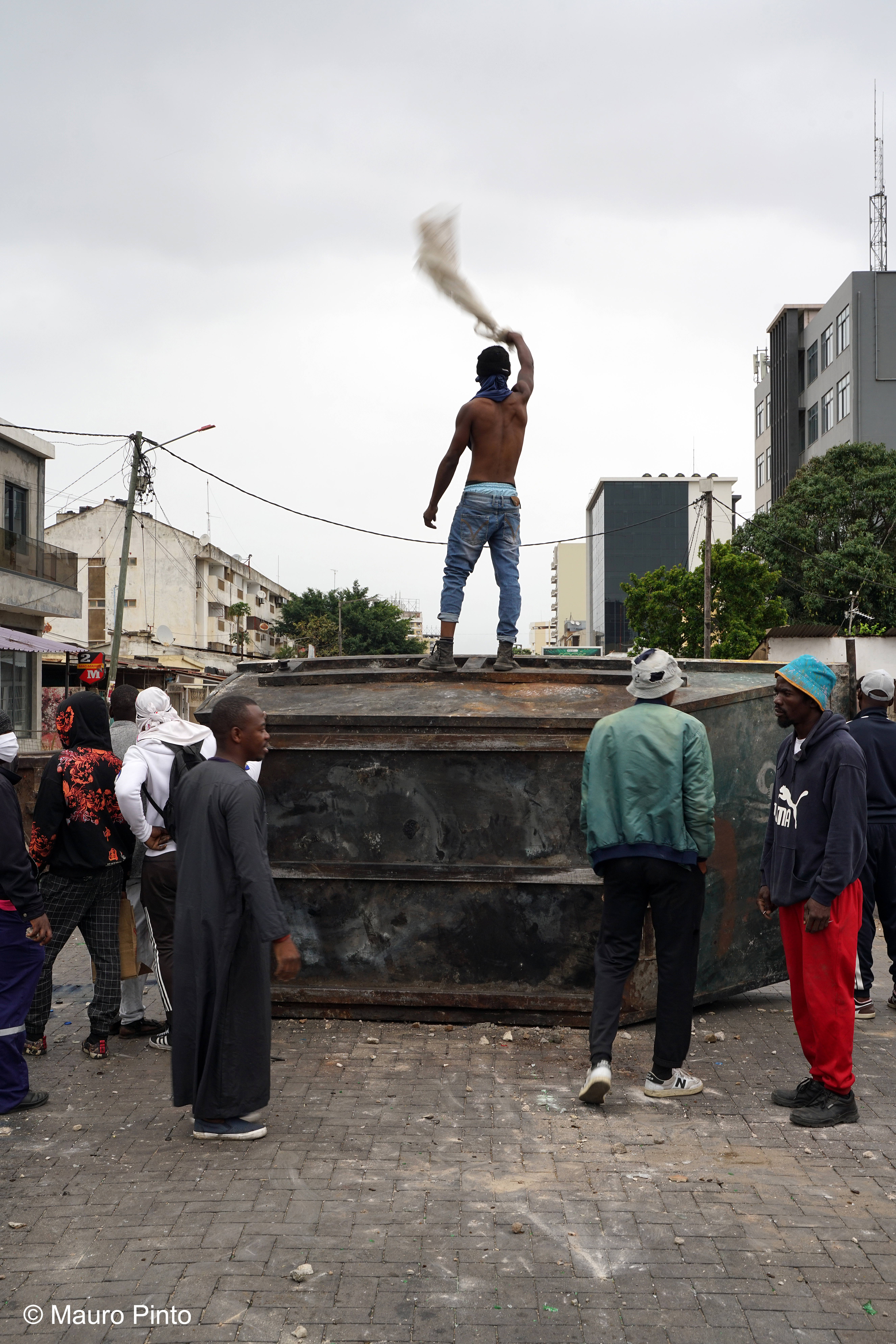
These fraud allegations sparked protests across the country, both spontaneous and coordinated
by Mondlane and his team. The government responded with denial, downplaying, and heavy-
handed repression, including live ammunition, arbitrary arrests, and beatings.
On October 19 th , two key opposition members – Elvino Dias, Mondlane’s lawyer, and Paulo
Guambe, a senior official in his campaign – were killed in a targeted attack in Maputo, shocking
civil society and intensifying unrest. Mondlane left the country citing serious threats and called
for 25 days of protest – one for each bullet fired at his colleagues.
From then until the end of January 2025, Amnesty International reports over 300 dead, more
than 3,000 injured, and over 3,500 arbitrarily detained. Many remain incarcerated until this day.
These protests were led primarily by young people, unimpressed and disconnected from
FRELIMO’s absence of leadership and vision, deprived and dispossessed by a government that
insists on prioritizing the interests of a few over the future of all. However, very soon it became
evident that the uprise was less of a generational mood and more of a structural socio-economic
crisis, gathering people from all tiers of society, reflecting a shared discontent that transcended
age, class, and background. This was further attested by the geography of the protests: clearly
concentrated around the main urban centers; extractive industries; and transport corridors.
Popular discontent was clearly a reflection of the neoliberal extractives-led and export oriented
paradygm of development in the country. 4
In early January 2025, Mondlane returned to Maputo, declaring himself “the people’s president”
outside the airport terminal in a symbolic performance aimed at his supporters. Six days later,
Chapo’s heavily secured inauguration took place at Independence Square with no opposition
presence and hardly no supporters, signaling a display of power rather than legitimacy.
Money talks
But this political crisis is not just about power – it’s also, and perhaps above all, about money. At
the heart of Mozambique’s turmoil lies a ruthless competition for control over the country’s vast
natural resources. FRELIMO’s grip on the state is not ideological or institutional; it is economic.
Political dominance provides access to lucrative contracts, influence over megaprojects, and
control over flows of foreign investment and development aid. In this context, elections are not a
mechanism for democratic choice – they are high-stakes contests to secure the keys to
exploitation. Global capital and their proxies (including foreign aid agencies, embassies, and
above all, transnational corporations) know well which hands to shake – and, as expected, they
also played a key role in legitimizing FRELIMO despite the electoral scandal, and therefore
securing the continuation of their economic interests in the country.
This scenario directly shapes the country’s development path. Rather than fostering inclusive
growth or building resilient, people-centered systems, successive governments have doubled
down on a model of extractivism that prioritizes short-term profits and foreign interests over
long-term national well-being. This corporate capture of the Mozambican state has
systematically eroded public institutions, transformed policy-making into a vehicle for private
profit, and subordinated national sovereignty to the demands of transnational capital. And
nowhere is this clearer than in Cabo Delgado, where offshore gas fields 5 – led by companies
like TotalEnergies, ENI and ExxonMobil and backed by national and foreign militaries – have
turned the region into a militarized enclave, displacing communities, fueling conflict, while
further enriching the elite.
The same logic applies to other megaprojects like the planned Mphanda Nkuwa project 6 – an
environmentally devastating and socially unjust hydropower dam that threatens to deepen the
country’s dependence on centralized, export-oriented energy systems. And then there are the
heavy sands, the rubies, the eucalyptus plantations, and so many other extractive ventures that
line the pockets of a few while leaving the majority of Mozambicans poorer, more vulnerable,
and increasingly dispossessed.
This is the real cost of a political regime held hostage by the tentacles of organized
transnational capital: a development model that is neither sustainable nor just – one that locks
the country into cycles of debt, dependency, ecological destruction and social unrest. So long as
political power remains the gatekeeper to economic privilege, and development is reduced to a
spreadsheet of megaprojects, Mozambique will continue to stumble forward, rich in resources
but bankrupt in justice. And every chapter of our past has taught us the same lesson: without
justice, there will be no peace.
Justice and Accountability
The road ahead for Mozambique must go beyond the cosmetic gestures of reform that have so
often been used to cleanse the regime’s image in the eyes of the international community. What
the country needs is not another “dialogue” process orchestrated by those in power, while we
continue to witness selective prosecutions designed to ‘calm things down’. True justice must be
people-centered — rooted in the lived experiences of survivors like Orlando, those who have
borne the weight of repression, poverty, and neglect, the families of those killed, and the
thousands who remain missing or unjustly imprisoned. It must be built on truth-telling,
restitution, and the dismantling of the structures that enable state violence and impunity. And to
be meaningful, it must come hand in hand with accountability – at all levels.
The process must recognize the depth of the wounds inflicted upon society and the systemic
nature of this violence, stemming from the necropolitics that sustain our neoliberal economic
policy. Only through genuine accountability, radical systemic transformation and the dismantling
of the neocolonial order can Mozambique begin to rebuild trust between citizens and the state.
Only through a structural overhaul of our development paradigm – one that rejects violent
dispossession and respects peoples’ right to self-determination, heals and restores our sacred
relationship with earth, and ensures a conscious use of our resources for the common good of
current and future generations – will we be able to rebuild a united nation and move forward
together.
As long as this remains a mirage and the new looks very similar to the old, as long as Cardosos,
Siba Sibas, Mataveles, Elvinos continue to be brutally murdered in front of our eyes as a
constant and pungent reminder of our lawlessness, as long as Orlandos are tortured and jailed
for protesting against the grabbing of their land or the stolen votes, the possibility of revolt will
continue to be one centimeter below the surface.
3- Hanlon, Joseph. 2025. Moçambique recolonizado através da corrupção.
https://drive.google.com/file/d/1jWmnGBxGXTQuKAd0Kr3ApmfvTqKPk6Sw/view
4- Feijó, João. 2025. Afinal “foi só Maputo”? – A geografia do protesto pós-eleitoral.
https://omrmz.org/destaque_rural/dr-324-afinal-foi-so-maputo-a-geografia-do-protesto-pos-eleitoral/5
 JA4change