"Only after the last tree has been cut down, Only after the last river has been poisoned, Only after the last fish has been caught, Only then will you find that money cannot be eaten." Cree Indian Prophecy
“African narratives on energy and climate Justice”
The right to live in an environment that is not harmful to one’s health and well-being, the right to self-determination, the right to work, the right to a dignified life, are just some of the fundamental human rights that are systematically violated by big corporations across the globe, with the support of coopted governments, and with particular incidence and severity in Africa and across the global South. Yet, despite overwhelming evidence and popular condemnation, corporations still manage to continue to destroy lives with impunity. The results of a neoliberal, corporate-led, extractives-based, patriarchal socio-economic model that places profits before people are there for everyone to see, as transnational corporations make record high profits amidst pandemics and other deepening crises, and externalize the impacts of their activities to society. From the climate crisis, to wars and genocide, to the biodiversity crisis, the role of big capital in fueling death and destruction has become a subject of research and analysis, but also of massive mobilizations, as social movements and civil society organizations from across the globe demand accountability, system change, a life of dignity for all and peoples’ centered alternatives to the current global order.
The Maputo Workshop on Corporate Impunity and Human Rights, now convened in its 8th consecutive year, has become a crucial space for grassroots communities, civil society organisations, activists, academics, lawyers and government representatives to discuss and learn from each other about the complex and obscure ways through which transnational corporations have managed to capture our democratic structures and processes. Through lobby, economic influence, corruption and other tactics, corporations have been slowly making these structures and processes work for the benefit of the corporate elites, and against the interests of the people. It is also a space to learn about iconic struggles against corporate power, get inspired by collective actions demanding the right to say no to harmful investments, and forge new ways of resisting, mobilizing and transforming our societies.
In 2024, our workshop will focus on African narratives around energy and climate justice, discussing topics such as:
– Who is at the frontlines of facing climate impacts?
– What have been the strategies used by fossil fuel companies to delay and weaken urgently needed climate action?
– Which narratives coming from within the continent help reinforce models of exploitation and carbon colonialism?
– What are false solutions, who is pushing them, and how do they distract us from the real solutions?
– What are some of the instruments and tools that corporations have at their disposal to reap profits out of crises?
– What hides behind the word ‘development’, as we see more and more dirty energy projects being promoted in our territories in the global South?
– And in what ways are the shrinking of civic space and increased government authoritarianism a reflection of the corporate hijack of our democracies?
As we debate and try to answer these and other questions, we will also look at solutions: what kind of clean and popular energy solutions are being implemented across the continent and across the globe, that not only present a solution to the climate and energy crisis, but also contribute to rolling back the unregulated power of transnational corporations?
As Justiça Ambiental JA! celebrates it’s 20th anniversary of its official founding, we invite you all to join us for this radically emancipatory event about understanding corporate power in its many forms, and taking collective action to dismantle it. Our purpose here will be to collectively understand how our daily problems have origins in systemic issues, and how we can address the injustices of the current systems by organizing our movements and taking collective action against the corporate take-over. Our climate, our planet, our humanity demand it!
The Workshop will take place in Maputo, on August 12th to 15th. To register, please write an e-mail with your name and institution to impunidade.corporativa@gmail.com or via phone on +258 86 8242893 / 21 496668.
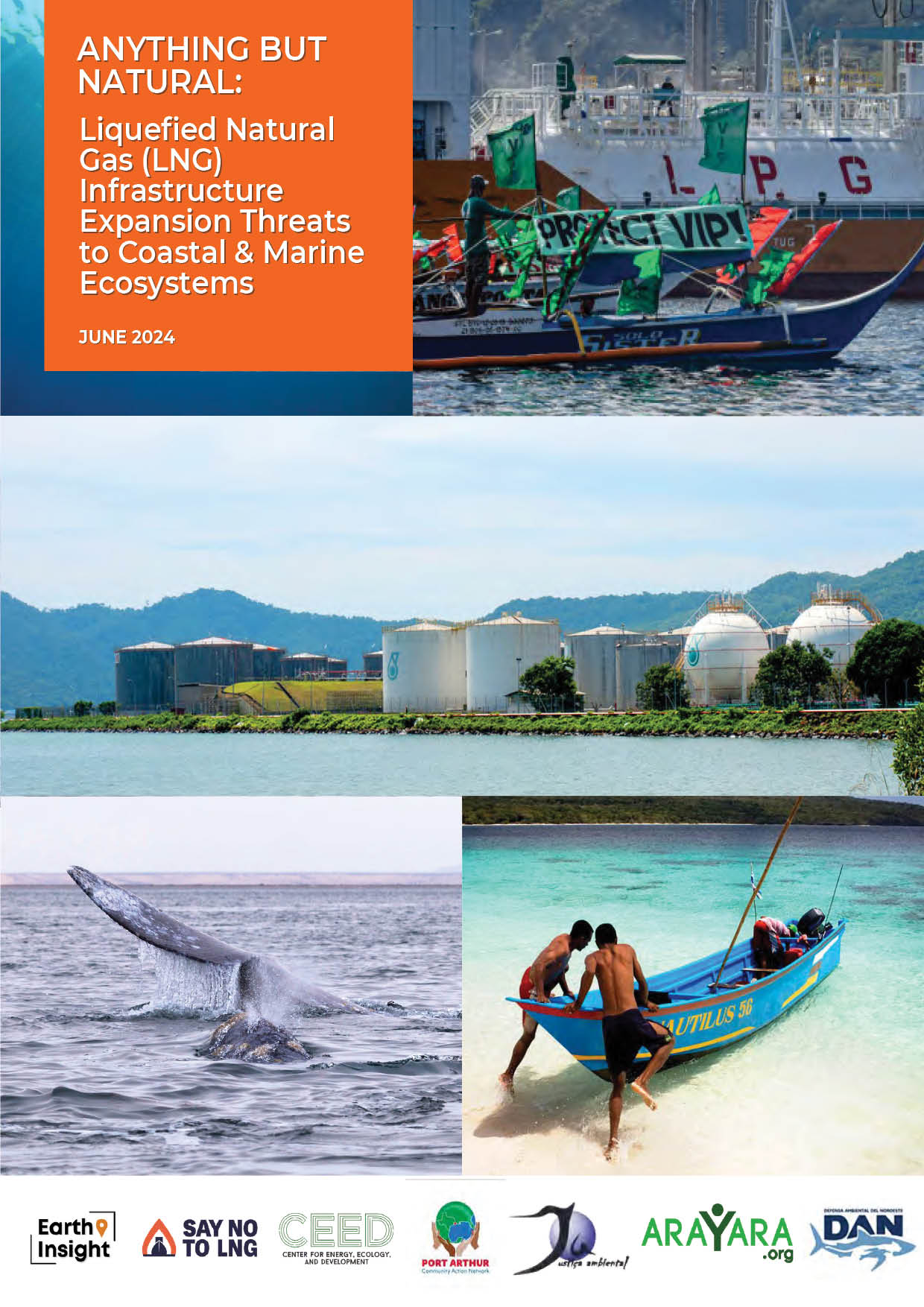
(LNG) expansion in globally-important marine biodiversity hotspots
Sacramento, USA (June 6, 2024) — New maps and analysis from research organization Earth Insight and partners — released ahead of World Oceans Day on June 8, 2024 — paint a sobering picture of current plans to expand Liquefied Natural Gas (LNG) infrastructure worldwide, posing threats to the global climate as well as significant hubs for biodiversity.
READ THE REPORT — Anything But Natural: Liquified Natural Gas (LNG) Infrastructure Expansion Threats to Coastal & Marine Ecosystems
LNG is mostly composed of methane gas. If cooled, the gas becomes liquid and can be stored and transported by sea using special tankers. When methane is burned to obtain energy, it produces less carbon dioxide than other fossil fuels, such as oil or gas. However, methane itself
🌐
is in itself a potent greenhouse gas, responsible for almost a third of all global warming we are experiencing today. The cost of developing planned natural gas infrastructure exceeds one trillion dollars, and will increase by threefold the world’s export capacity, and by two-thirds its import capacity. United States, Russia, China, Mexico, and Canada are leading the pack in planned LNG infrastructure expansion, while countries like the Philippines, Mozambique, and Brazil also feature in the top 20.
Case studies and regional maps in the report show:
● In the United States, developments along the Gulf Coast will disproportionately impact communities of color in some of the poorer states of the country. These communities already experience poor air quality from operating LNG facilities and regularly suffer downpours and floods caused by climate change-fueled hurricanes and storms;
● In Mexico’s Baja California state, new LNG infrastructure threatens “the world’s aquarium,” home to 40% of all marine mammals in the world and many endangered species. If current plans go ahead, eight new terminals will be built in a region that is a whale sanctuary and is listed as a UNESCO World heritage site;
● In the Philippines, building new LNG terminals will add more pressure to the Verde Island Passage, one of the world’s most biodiverse marine places. The region, often called “the Amazon of the Oceans,” is already one of the world’s busiest marine routes and was hit by an oil spill in 2023 with devastating consequences;
● In Mozambique and East Africa, gas developments have already caused the forced displacement of local communities and new plans threaten several critically endangered marine species. The offshore expansion will take place along a coastline full of mangroves and coral reefs;
● and, in Brazil, there are plans to build new LNG terminals along the Atlantic coast, a region that is already cluttered with oil and gas infrastructure. Whale populations will be particularly affected, as the new developments overlap with their breeding grounds and migration routes.The last 10 years have been the ocean’s warmest since at least the 1800s, with 2023 being the hottest ever recorded. Destructive marine heatwaves are becoming more frequent and intense across the world. Massive coral bleaching episodes are destroying reefs and all the natural life they support. And species are being displaced from their habitats, moving to cooler and deeper waters, disrupting ecological chains and impacting fisheries.New LNG facilities will increase shipping intensity and noise pollution in marine migration corridors, mating and nursery areas for species like whales and dolphins, and important fishing grounds.The report, launched just before World Oceans Day 2024, follows the 2024 United Nations Ocean Decade Conference in Barcelona, Spain (April 8-12, 2024) and the 9th Our Ocean Conference in Athens, Greece (April 16-17, 2024), a series of events first launched under the initiative of then-U.S. Department of State and the Secretary of State John Kerry in 2014. It also
follows an historic May 2024 ruling by the International Tribunal for the Law of the Sea dictating that emissions from fossil fuels — and other planet-warming gasses that are absorbed by the oceans — count as marine pollution; a first climate-related ruling from that body.
Maps
Look at the interactive heatmap here. Download static maps from the report here. Supplied underwater images of marine life (credit Lynsey Grosfield/Earth Insight) here.
Quotes and Interview Opportunities
“Investing in LNG infrastructure — especially in some of the world’s most important nurseries of marine life — just doesn’t make any sense. At this point in the energy transition and nature crisis, it’s a one way ticket to stranded assets and won’t help us solve the climate crisis.”
“The new report ‘’Anything But Natural: Liquefied Natural Gas (LNG) Infrastructure Expansion Threats to Coastal & Marine Ecosystems’ reveals the stark reality that LNG — often touted as a cleaner marine fuel — is far from the panacea it’s made out to be. Through strategic maps and data, we expose how LNG’s lifecycle — from extraction on land to combustion at sea — inflicts severe damage on our planet’s most vulnerable ecosystems and communities. By championing a lifecycle approach, we shed light on false solutions that cultivate crises on land and amplify environmental and social injustices. It’s time to navigate away from the illusion of LNG as a benign alternative and steer towards genuine marine solutions that do not compromise the health of our planet and its people.”
Elissama Menezes, Global Director, Say No to LNG director@saynotolng.org
“Maps can be powerful tools for understanding landscapes where there are a lot of competing needs. Our work in this report combines LNG data and biodiversity data, and it’s clear to see that for many of these projects, the risks to people and nature cross an unacceptable threshold. As a scientist I believe we need to really consider all the data and risks before investing in long-term fossil infrastructure in biodiversity hotspots that sustain all our lives. Creating transparency in the threats these developments pose is critical.”
Bart Wickel, Research Director, Earth Insight, bart@earth-insight.org
Mozambique: “It is obvious that the impacts of gas projects are not neatly contained within the formal project boundaries. The damage to seagrass beds, mangroves and coral reefs will impact on the success of many valuable species, including whales and dolphins, turtles, dugongs, and marine species that are important food sources for coastal communities. These systems are also valuable protection against severe weather events, which are noticeably more
frequent and destructive. Already, land grabs and forced displacement of communities for gas development have worsened local socio-economic conditions, contributed to disenfranchisement of the youth, and thus contributed to fuelling the violent insurgency in the region.”
Anabela Lemos, Justiça Ambiental! / Friends of the Earth Mozambique, anabela.ja.mz@gmail.com / stopmozgas@gmail.com
Brazil: “The report provides important data for managing the just energy transition in Brazil, highlighting areas where the LNG sector is rapidly developing. Additionally, this growth near the Abrolhos Land and Sea Territory, one of the main hotspots in the country for the preservation of the Atlantic Forest and the biggest coral reef bank in Brazil, is a cause for concern.”
Vinicius Nora, Gerente de Oceanos e Clima, vinicius.nora@arayara.org
Philippines: “LNG expansion is a major threat for the climate, biodiversity, and communities. In the Philippines, a buildout of LNG terminals and power plants threatens the Verde Island Passage – one of the most biodiverse marine ecosystems in the world. For a country that has so much renewable energy it could instead be developing, LNG is an unnecessary and detrimental distraction that only exacerbates our climate vulnerabilities. We need to be advancing real climate solutions and biodiversity protection, and not locking in more fossil fuel expansion.“
Gerry Arances, Executive Director of the Center for Energy, Ecology, and Development (CEED) and Co-Convenor of Protect Verde Island Passage. media@ceedphilippines.com | http://www.protectvip.org
US Gulf South: (Available for Interviews) John Beard Jr, CEO, Port Arthur Community Action Network (PACAN), pacanportarthur@gmail.com
Additional Resources
● Losing Ground: Fossil Fuel Extraction Threatens Protected Areas Around the World (Earth Insight, LINGO, and the IUCN-WCPA)
● LNG, Shipping, and the Amazon of the Oceans: Scoping Key Issues and Potential Impacts of the Massive Expansion of LNG in the Verde Island Passage (CEED Philippines)
● [Infographic] From land to sea: LNG impacts people, nature and the economy (Say No toLNG)
● [Press Release] The International Maritime Organization (IMO) and the Gaslight ofLiquefied Natural Gas (LNG) (Say no to LNG)
● [Podcast] ship.energy podcast on the the health connection of LNG shipping (Say No toLNG and the Canadian Association of Physicians for the Environment (CAPE))
● [Infographic] LNG does not belong in green corridors
Lynsey Grosfield, Head of Communications, Earth Insight +1 514 430-5203, lynsey@earth-insight.org
About Earth Insight
Earth Insight is a research and capacity building initiative that is a sponsored project of the Resources Legacy Fund, based in Sacramento, California. Staff and partners span the globe and represent a unique grouping of individuals and organizations with diverse backgrounds in mapping and spatial analysis, communications, and policy. Earth Insight is committed to advancing new tools, awareness, and momentum for protecting critical places and supporting civil society and indigenous and local communities in this effort.
Say No To LNG is a global shipping campaign debunking the myth that Liquefied Natural Gas (LNG) is a “climate friendly” marine fuel alternative and mobilizing stakeholders towards a fossil fuel-free shipping industry. We are a collective of subject matter experts and environmental advocates from across the world who collaborate to push back on the adoption of LNG as a marine fuel and educate key actors on its role in worsening global warming, financial losses, human rights issues, and public health.
Today, 14th of March 2024, the international day of action against dams, for rivers, water and life, Justiça Ambiental joins the communities living along the Zambezi River to celebrate rivers, water and life!
Did you know that the 14th of March was celebrated for the first time in 1997 in Curitiba, Brazil, during the first international meeting of people affected by dams? Since then, it has been celebrated every year on every continent by thousands of people defending rivers and life on the planet.
Did you know that rivers are essential to the survival of species and the maintenance of ecosystems? Rivers are the biological engines of the planet, and also the livelihoods of millions of people who live on riverbanks.Fishing and farming on the riverbanks are the livelihoods of many rural families around the world, using techniques and traditions passed down from generation to generation.
Did you know that rivers are habitats rich in biodiversity? They harbour an impressive variety of aquatic plant and animal species, many of which are found nowhere else.
Did you know that rivers are one of the main sources of fresh water on the planet? They provide drinking water for billions of people around the world.But water is a vulnerable and finite resource that must be protected.
Did you know that rivers play a critical role in flood control, helping to regulate the flow of water during periods of heavy rainfall? Contrary to what some people think, hydroelectric dams don’t help control floods or droughts; on the contrary, they tend to exacerbate them, as we’ve seen for years downstream of the Cahora Bassa Hydroelectric Power Station on the Zambezi River. Every year, riverside populations lose their crops and goods, not because of the river’s natural rhythm, which includes periods of drought and flood, but because of the dam’s discharges and the artificial flow it causes.
Did you know that rivers have a huge influence on the local climate? They help moderate temperature and humidity along their banks, not only in wild and rural areas, but also in urban areas.Rivers are also a key element in mitigating the effects of climate change.
Did you know that rivers promote human well-being, culture and quality of life? Rivers are where people and civilisations have always settled, where we celebrate our rituals and traditional practices, socialise and relax.They cross borders, languages and cultures.Rivers connect us, dams divide us!
Did you know that rivers are one of the most threatened natural habitats on the planet? Rivers are fragile ecosystems that must be protected.One third of freshwater species are at risk of disappearing forever.Pollution and dams are two of the main factors contributing to this decline.
Did you know that preserving rivers is fundamental to keeping alive the history and culture of many peoples? One of these riverside peoples is the Nyungwe, who live on the banks of the Zambezi in Mozambique.
Did you know that hydroelectric dams are not clean energy? Contrary to what is promoted by the dam industry, these infrastructures emit large quantities of methane (a potent greenhouse gas) due to the accumulation of organic matter in their reservoirs, which ends up decomposing.Without the dam, this organic matter would flow freely into the delta, contributing to its fertility.In addition to emissions, dams are also a means of progressive expansion of invasive species (such as toxic algae and parasites), altering the ecosystem balance of the river.
Did you know that some of the countries that have built the most dams are currently demolishing them? A total of 2,119 dams have already been removed in the United States of America since 1912, of which 80 were removed in 2023 alone! This initiative aims to restore the natural flow of rivers and protect their ecosystem.Unfortunately, many of the countries that are committed to demolishing dams on their territories promote their construction in other countries, as is the case of France.
Did you know that rivers are a common good? Rivers are part of humanity’s heritage.They don’t belong to anyone or any state – states are just the guardians of this heritage.At the same time, rivers belong to all of us!
Today and always, we reiterate our fight in defence of healthy, free-flowing rivers: NO to the Mphanda Nkuwa dam!For the survival of the Zambezi River, its ecosystems and its people!
Today, 8th of March, is International Women’s Day, we celebrate the political mobilization, the many struggles and achievements of women over the last century. Despite important achievements, the day must remain an important moment for reflection and continued struggle: against patriarchy, against capitalism, against gender-based violence and against all forms of oppression and discrimination that still persist.
According to a study by the Centro de Integridade Pública (Center for Public Integrity)(CIP, 2023), more than half of the Mozambican population is composed by women, of whom around 85.4% are available for the labor market. However, of these, more than 90% are in the informal, agricultural and commercial sector, with a high degree of precariousness, temporary jobs, low levels of social and legal protection, low and unstable incomes.
This scenario is the result of various factors, but mainly the low level of access to education for girls and women, and the persistent maintenance of the traditional role of women as subservient to men. Despite the various instruments and initiatives aimed at protecting and emancipating women and promoting equal rights and duties, to this day Mozambican society does not reserve the same rights for men and women. There is still an alarming rate of violence against women, rooted in the social understanding of women’s role of submission and subjection.
Wars, armed conflicts, forced displacement, extreme weather events, loss of land and livelihoods affect women and girls in a differentiated and more accentuated way, due to the vulnerability caused by the role they normally play. This is the scenario in Mozambique. On the one hand, the conflict in Cabo Delgado has been particularly cruel and impacting on women and children, the number of people displaced by this conflict is increasing every day and there is still no solution in sight, nor does there seem to be any political will to provide the necessary assistance and care for the displaced. On the other hand, and directly linked to this, the focus on extractive development and megaprojects led by transnational companies has not contributed to poverty reduction, has not contributed to better living conditions for the population, and has in fact aggravated the vulnerability and poverty of a large part of the population, particularly women and the most vulnerable groups, leading to forced displacement, loss of land and means of subsistence, violence and sexual harassment.
May International Women’s Day serve as a time for deep reflection, and may it not be used once again for ceremonies empty of sentiment, empty of justice that only serve to pretend that the countless challenges that women face every day around the world are really on the global agenda. We celebrate the day in solidarity with all the many women displaced by wars and conflicts fueled by the greed of a few, in solidarity with all the women who are fighting today and always to keep their territories and livelihoods!!!
Let nothing limit us, let nothing define us, let nothing hold us. Let freedom be our own substance
Published by Columbia Center on Sustainable Investment, February 2024
Salvatore and Gubeissi, ‘Billion-dollar exposure: Investor-state dispute settlement in Mozambique’s fossil fuel sector’, January 2024, Columbia Center on Sustainable Investment
Mozambique is endowed with extensive untapped natural resources, particularly gas and coal. The country’s gamble on fossil fuel-based economic growth comes with significant economic risks and crowds out investments in the country’s enormous renewable energy potential.
Mozambique faces a substantial economic risk due to its exposure to investor-state dispute settlement (ISDS) claims by foreign investors in its coal, oil, and gas sectors. The investment protections in the country’s international investment agreements and contracts, combined with ISDS, expose Mozambique to multi-billion-dollar financial liabilities. Even conservative estimations show that potential ISDS liabilities from oil and gas projects would cover almost a decade of Mozambique’s government expenditures for SDGs.
Mozambique’s international investment agreements and publicly available oil, gas, and coal contracts allow foreign investors to bypass the national judicial system and bring multi-billion-dollar ISDS claims against Mozambique. Such claims can result in significant costs for the country, and they also have a considerable chilling effect on any new public-interest regulation in areas such as health, environment, community rights or labor protections. ISDS can undermine attempts to adopt meaningful legislation to transition away from fossil fuels and achieve sustainable development goals. This regime can therefore contribute to locking the country into a high-carbon economy.
In addition, multiple stabilization clauses in the analyzed contracts lock the operations into specific legal and fiscal regimes for the duration of the contracts. Stabilization clauses protect investments from unexpected regulatory changes or new fiscal rules. If a host state does introduce such changes, stabilization clauses allow investors to demand measures or compensation that would ensure their same profitability absent such changes. These clauses thus exacerbate the limits to – and chilling effect on – states’ public interest regulation.
Mozambique and other countries can take actions to remove ISDS from their contracts and treaties, replacing the mechanism with alternative dispute resolution mechanisms. They can also take steps to terminate investment agreements in force. Home countries of Mozambique’s foreign investors have a responsibility to support such action, especially as they, themselves, remove ISDS from their own treaties.
To access this complete study, in the original English version, please visit the website:
Justiça Ambiental! (Friends of the Earth Mozambique), Friends of the Earth Europe, Milieudefensie (Friends of the Earth Netherlands) and Friends of the Earth U.S.
Press release
With clear signs that TotalEnergies is about to restart the development of its massive LNG project in the conflict-ridden province of Cabo Delgado in Mozambique, a new report points to how contracts with companies like TotalEnergies and ENI are exposing the people and government of Mozambique to multi-billion-dollar financial risk, while blocking the country’s path to the energy transition and development. Companies are entitled to claim billions in compensation when the government takes public interest measures that affect the profits of these companies, like increasing minimum wages, introducing environmental or health standards or increasing taxes on companies.
Fossil fuel corporations have touted the benefits of major oil and gas projects for Mozambique, but a new report written by Columbia University and commissioned by Justiça Ambiental! (Friends of the Earth Mozambique), Friends of the Earth Europe, Milieudefensie (Friends of the Earth Netherlands) and Friends of the Earth U.S. shows how Mozambique’s gamble on fossil fuel-based economic growth comes with significant economic risks and crowds out investments in the country’s enormous renewable energy potential. This happens in a country that is already struggling to afford the costs of damage caused by flooding, droughts and cyclones linked to climate change.
Mozambique faces an estimated USD 29 billion in financial risk due to the possibility of foreign fossil fuel investors, such as TotalEnergies and ENI, to directly sue the state through problematic investor-state dispute settlement (ISDS). This sum is equal to almost a decade of Mozambique’s government expenditures on poverty, health, and education. While it is claimed that Mozambique can use the profits from its fossil fuel projects to pay for development, other new research shows that Mozambique is not due to financially benefit from the LNG projects until the late 2030s, when global gas demand will likely have fallen and profits will be very low. The International Energy Agency confirms that Mozambique ‘may struggle to generate any real income’ from new fossil fuel projects.
Mozambique’s international investment agreements and publicly available oil, gas, and coal contracts allow foreign investors to bypass the national judicial system and bring multi-billion-dollar ISDS claims against Mozambique. Such claims can result in significant costs for the country, and they also have a chilling effect on new public-interest regulations in areas such as health, environment, community rights, or labour protections. ISDS can undermine attempts to adopt meaningful legislation to transition away from fossil fuels and achieve sustainable development goals.
Daniel Ribeiro, from Justiça Ambiental/Friends of the Earth Mozambique said:
“These financial risks just add more fuel to the fire created by big gas projects in Mozambique. These projects have contributed to insecurity and violence in the region and displaced local communities. Now it’s clear the economic arguments for continuing them don’t hold up to scrutiny. Mozambique should bring these toxic projects to an end.”
The report notes that European countries have already taken steps to limit their own exposure to ISDS. Mozambique can follow suit and take actions to remove ISDS from their contracts and treaties, replacing it with alternative dispute resolution mechanisms. They can also take steps to terminate investment agreements in force. On top of that, Mozambique should reexamine whether the costs of these projects are worth the risks and consider cancelling the projects.
Published by Solutions For Our Climate (SFOC), January 2024.
Kim & Oh, ‘Total Turmoil: Unveiling South Korea’s Stake in Mozambique’s Climate and Humanitarian Crisis’, January 2024, Solutions For Our Climate (SFOC)
The report identifies the participation of South Korean corporations in Mozambique’s liquified natural gas (LNG) projects and lays out the risks and flaws in the project that affect the economic feasibility and ethical correctness of the project. It is published by Solutions For Our Climate (SFOC).
SFOC has identified the significant participation of South Korean corporations in Mozambique’s LNG projects, as they play pivotal roles throughout the entire value chain of the Mozambique LNG business. With a 10% stake in the Area 4 block, Korea Gas Corporation (KOGAS) has been making substantial investments in project exploration and development. Notably, major Korean shipbuilders are actively involved in Area 1 and Area 4 projects. Samsung Heavy Industries is expected to provide offshore LNG production vessels for two of the four Mozambique gas field projects. Meanwhile, three Korean shipbuilders anticipate supplying a total of 23 LNG carriers for transporting the produced LNG volume. Six LNG carriers have already been constructed and are in use to transport LNG volumes from the Area 4 Coral Sul field, while 17 fleets for the Area 1 Mozambique LNG project await the final contract to be signed. Consequently, South Korean public financiers have become involved in the Mozambique gas projects, providing a total of USD 3.22 billion financial support to Korean companies engaged in these initiatives.
The LNG projects in Mozambique face significant risks, primarily in two key areas. Firstly, flawed resettlement processes for local communities near the LNG facilities have resulted in forced relocations, inadequate compensation, and the loss of livelihoods, especially among fishing communities. Secondly, there are substantial climate concerns associated with these projects, as they are expected to contribute significantly to greenhouse gas emissions when considering the project’s entire lifecycle. An independent report by Friends of the Earth and the New Economics Foundation estimated that the Mozambique LNG project alone could generate 3.3 to 4.5 billion tonnes of CO2 equivalents, surpassing the annual emissions of all EU countries.
The involvement of South Korean stakeholders in the LNG projects raises alarming concerns. By providing financial support for the LNG projects in Mozambique, public finance institutions have failed to adequately assess human rights, climate, environmental, and security risks associated with the projects in accordance with both international and internal guidelines. Samsung Heavy Industries faces criticism for its involvement in controversial LNG projects in Mozambique, which potentially conflicts with its sustainability initiatives and ESG commitments. Additionally, the economic feasibility of new gas projects in the Mozambique Area 4 basin, where the Korea Gas Corporation holds a 10% stake, is questionable due to factors such as low profitability, regional instability, declining gas demand, and fierce market competition.
Some key recommendations to relevant stakeholders are:
1. Public financiers should withdraw their financial backing from Mozambique gas projects and join the Clean Energy Transition Partnership (CETP) to end fossil fuel investment.
2. Public financiers should establish Human Rights, Environmental Impact, and Security Assessment processes.
3. KOGAS should consider divesting its stake in Area 4.
4. The South Korean shipbuilding industry should transition away from the fossil fuel business.
To access this complete study, in the original English version, please visit the website:
On December 13th, in Maputo, the Mozambican government and the companies Electricidade de Moçambique (EDM), Hidroeléctrica de Cahora Bassa (HCB), Électricité de France, TotalEnergies and Sumitomo, signed the partnership contract for the construction of the Mphanda Nkuwa hydroelectric dam on the Zambezi River.
A partnership contract that is signed before a single community consultation meeting with the people who live in the region has been carried out, only makes it even more clear that the project is not, and never has been, for the benefit of the local population. Our Constitution and Land Law guarantee customary land rights, and local communities should have their rights to public participation and fair and prior compensation respected. To add insult to injury, this unlawful contract was signed with all the pomp and circumstance, in the presence of the President of the Republic, the Ambassadors of France and Japan, among other personalities. It’s a blatant lack of respect for the People, celebrated in a luxury hotel in Maputo, and commemorated by the political elites and big international capital, who see Mphanda Nkuwa as an opportunity to play “energy transition” and trade carbon credits. But the power dynamic between those promoting the project and those who will be affected by it only underlines its neo-colonial nature: force them out of their land, because there are valuable resources to exploit – and export!
And as if this shocking obstruction of public participation was not enough, the interests behind the Mphanda Nkuwa project are also fuelling the repression of local communities. To counteract the misinformation created by the project’s promoters, Justiça Ambiental launching a video on the same day this shameful contract was being signed with first-hand accounts of what has been happening in the communities of Marara, Chiúta and Cahora Bassa to those who question the project or claim their rights.
This repression has taken place in various forms, it has been perpetrated by the local government and the Police of the Republic of Mozambique, and it includes:
– The intimidation and threats to community members who criticise the project;
– the violation of freedom of movement and community member being required ‘authorisation’ from the local government to travel;
– the violation of freedom of association and actions to prevent communities from meeting with civil society organisations such as JA!;
– the violation of freedom of expression and banning songs about the communities’ feelings about the project;
– the expulsion of community members from meetings related to the project;
– the arbitrary arrests of community members who travelled to Maputo to take part in legal trainings.
Once again, in the face of all these breaches of the law, we wonder where are the institutions that should be looking after the legality and rights of all Mozambicans. We need to think seriously about how megaprojects are being implemented in our country, about the social conflicts they are fuelling and about the impacts they are subjecting us to. How long are we to believe in this development paradigm?
Watch the video:
Nothing on our land without our free, prior and informed consent.
It has been 28 years of climate COPs, of empty talks without the necessary commitments, while emissions continue to rise and the countries of the global south, like Mozambique, are suffering the impacts of this crisis. This year, in the midst of a profound humanitarian crisis and a crisis of humanity due to the ongoing genocide in Gaza, and in total solidarity with the people of Palestine, Justiça Ambiental JA! is joining many other social movements in a complete boycott of COP28 in Dubai.
We also need to recognise that the hypocrisy of the climate negotiations has reached an unprecedented level. A COP taking place in a petro-state that commits war crimes, whose human rights record is appalling, which is chaired by an oil baron whose company has plans to increase fossil fuel exploitation, cannot possibly move towards the solutions we need.
This is a COP in which transnational agribusiness companies want to re-define food systems and accommodate them to their profit interests. It’s a COP in which false solutions such as REDD+, carbon markets, nature-based solutions, continue to gain traction instead of being recognised once and for all for what they are: a dangerous distraction. It’s a COP in which methane-emitting projects such as gas and mega-dams are promoted as if they were part of some just transition. It’s a COP that broke last year’s record – which in turn had already broken the previous year’s record – for the largest number of lobbyists for the fossil fuel industry.
The fact that year after year there are more representatives of the dirty energy industry than of the states most affected by climate change has had its effects. One example of this influence was in the Paris Agreement in 2015. Article 6 of this agreement instituted a system for exchanging carbon credits, which had long been one of the industry’s main proposals.
Let’s also not lose sight of Israel’s interest in these negotiations. COP28 is yet another element in its strategy to distract the world from the genocide it is perpetrating against the Palestinian people, with the support and arms of the United States. At the invitation of the United Arab Emirates (UAE), Israel is sending a large delegation to Dubai, including representatives of its main fossil fuel companies. In addition to dirty energy, in Dubai Israel will promote a series of technologies that were developed and tested thanks to the oppression and exploitation of the Palestinian people and land.
We refuse to contribute to legitimising or whitewashing this space.
On the contrary, we will continue to mobilise with movements around the world, such as at the Earth Social Conference, to debate the paths to a just energy transition in legitimate spaces, where affected communities set the agenda, not climate criminals. We will continue to fight for the Yasunisation of our territories. We will continue to stand united and in solidarity with all the peoples who are fighting for the right to say NO to extractivist projects. We will continue to demand that the industrialised countries pay off the climate debt to the countries of the South – but that this funding is not for the benefit of our economic and political elites. We will continue to support and amplify real solutions to the climate crisis – agroecology, community forest management, clean, decentralised and community-owned energy. These solutions are already being implemented around the world, by those on the frontline of the impacts of climate change.
The struggle continues, against companies and governments that whitewash Israel’s apartheid and promote false solutions to the climate crisis.
The struggle continues, driven by the principles of climate justice, in defence of our resources and territories, and in total repudiation of the climate colonialism that infests the halls and corridors of COP28 in Dubai!
Maputo and Paris, October 10, 2023 – A criminal complaint has just been filed in France against Total for manslaughter and failure to assist a person in danger, by survivors and families of victims of the devastating terrorist attack on March 24, 2021 in Palma, in Mozambique [1]. While Justiça Ambiental (JA!) / Friends of the Earth Mozambique and Friends of the Earth France had been warning since 2019 about Total’s responsibilities in developing its mega-gas project Mozambique LNG [2], despite the pre-existing and ongoing security and humanitarian situation, and the numerous human rights violations, this complaint confirms that the French multinational had not taken the necessary measures in view of the serious existing risks. While the situation in Cabo Delgado remains dramatic, JA! and Friends of the Earth France denounce Total’s intention to restart operations by the end of the year, with the support of French banks Crédit Agricole and Société Générale [3].
In June 2020, Friends of the Earth France, Mozambique and International published an investigative report entitled “Gas in Mozambique : a windfall for the industry, a curse for the country” [4], detailing the risks and impacts of the project on human rights, the environment and the climate, and the complicity of the French State. At the time, our organizations warned: “In a region plagued by escalating conflict, gas development is already turning into a nightmare for the people of Cabo Delgado”.
Following the terrorist attack in Palma, which caused the death of almost 1,200 civilians, Total declared force majeure and suspended operations in April 2021 [5]. Total was thus seeking to free itself from its contractual obligations with its subcontractors, many of whom are local. This not only affected the workers of Total’s subcontractors, but above all aggravated the situation of the local populations displaced by the gas project, who were abandoned without land or livelihoods, and with the compensation process halted without certainty around when or if it would resume.
The criminal complaint filed against Total confirms the transnational corporation’s scant regard for the local population and its subcontractors: despite being aware of the deteriorating security situation in Cabo Delgado and the likelihood of an imminent terrorist attack, the company was criticized for not even having adopted an evacuation plan. Worse still, according to the complaint, which is based in particular on the investigation by journalist Alex Perry [6], Total refused to provide assistance to the security company DAG, which had requested fuel for its rescue missions during the Palma attack. Prior to the attack, Total had pressured the Mozambican government to guarantee security to the gas area, which was reflected by the fact that, on the day of the attack, over 800 soldiers were protecting Total’s Afungi site whereas there was no security protecting the town nor the civilians [7].
Anabela Lemos, JA!’s Director, says: “Total’s negligence towards its subcontractors is another expression of the company’s criminal disregard for the people affected by its activities. We shall not forget that the majority of the victims of the Palma attack were the local people. We believe this legal action is important to challenge the impunity of these companies and we hope it expands the possibilities for Mozambican communities to pursue justice as well.”
The complaint also refers to the Uprights study, commissioned by Friends of the Earth Mozambique, France and Europe [8], which identified serious shortcomings in Total’s human rights impact assessments. In particular, the report highlights the company’s failure to account for the armed conflict and to address the human rights impact of its operations. As a result, the rights of local communities were violated.
Juliette Renaud, Corporate Regulation Senior Campaigner with Friends of the Earth France, says: “Since entering the gas business in Mozambique in 2019, Total has consistently underestimated the seriousness of the security and humanitarian situation, even failing in its duty to come to the aid of local communities and workers in mortal danger. Impunity must end and Total must be held accountable in court”.
Lorette Philippot, Private Finance Campaigner with Friends of the Earth France, says: “Today, Total is still trying to make its financiers and investors believe that the situation is under control and that the actions carried out by Mozambique LNG are having a positive impact on the living conditions of the population. Crédit Agricole and Société Générale need to urgently abandon this myth and stop supporting the oil and gas majors’ projects in Mozambique.”
On September 27, Total CEO Patrick Pouyanné announced to investors his goal of restarting the Mozambique LNG project by the end of 2023 [9]. However, on the ground, fundamental issues remain unresolved and most of the shortcomings identified by the Uprights report have still not been addressed by Total. Even though there are improvements in the security situation in Palma and around the project site, communities still don’t feel safe, civil society organizations and journalists are not operating freely, and the insurgency remains active in other areas of the province.
This project should not be resumed: the ground reality remains problematic, the gas contracts are unjust, and the risks to Mozambique’s people, climate and economy are extremely high.
Press contacts :
Justiça Ambiental JA! / Friends of the Earth Mozambique: Daniel Ribeiro, Technical and Research Officer – daniel.ja.mz@gmail.com ; +258 86 620 5608
Friends of the Earth France: Juliette Renaud, Corporate Regulation Senior Campaigner – juliette.renaud@amisdelaterre.org ; +33 6 37 65 56 40