Category Archives: Uncategorized

Jindal coal mining affected villagers revolt!

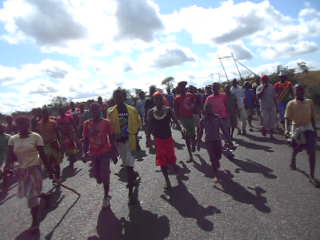
Last Tuesday, 12 May, hundreds of Jindal coal mining affected communities, held a spontaneous protest and paralysed the activities of the company. The protestors came from the 500 families of Cassoca villages, Luane, Cassica, Dzinda and Gulu, who are directly affected by the coal mine operated by Indian company JINDAL. JA! staff Mafigo Borges based in Tete was present for the protests, and recorded the short video available on JA facebook page. The video reveals how fed up the communities are with the way they are being treated.

vlcsnap-2015-05-20-16h58m05s184

Still shot from the video

The communities were protesting against the violation of their rights and against the failure of the promises made when the arrival of the mining company in the region. According to the communities, resettlement promises of agricultural land, employment and better living conditions, are today completely lacking, a situation that is compounded by the fact that these communities continue to live within the mine concession area subject to inhumane living conditions and are fully exposed to all impacts stemming from the operation of an open pit coal mine. These families are forced to breathe air polluted by coal clouds, consume contaminated water and they have less and less land to farm, their only source of livelihood.

Tired of being ignored, the women, men and children of these families rose up against the company, which has taken away land, has not provided any alternative housing or livelihood, has denied the right to a clean and healthy environment which is enshrined by law. There are constant reports of outbreaks of respiratory diseases and other health complications, said to affect both people and animals.

Till date, the company has been unwilling to provide any clarification. The government of Mozambique has often defended the company’s interests to the detriment of the interests and needs of the people. Some select local leaders, being the only ones to benefit from employment in the company, then control and repress the people, thus causing humiliation, abuse and marginalization for these families already impoverished. The communities have no free access to and contact with civil society and human rights institutions. It is as if, by living within the mining concession, communities have also been privately owned by the company.

This was neither the first nor the second time that the people have revolted. Since the beginning of the JINDAL operations, these demonstrations have been occurring regularly. In fact, the first one had shamefully taken place just days before then President Armando Guebuza personally inaugurated the immoral and illegal Jindal mine. This was just the formal inauguration, as we know that the mine was already operating before the Environmental Impact Study was approved.

But on 12 May, women with stones in their hands and children in their arms, men and kids with sticks, drums and other instruments, burned tyres on the roads and marched and chanted in the local language. Their songs and chants mirrored their dissatisfaction and helplessness:

“Even in our own land, JINDAL is making us suffer”

“Suca JINDAL Suca!” (curses)
As usual, in order to stop the demonstration, JINDAL called the Rapid Intervention Unit and the Civil Protection Police, which protects the safety of the private mining company. These so-called forces of public protection, fired several live ammunition into the air in an attempt to disperse the protesters, who refused to accept the order. The community remained defiant and fearless until the Marara district administrator arrived, and took responsibility to discuss their concerns with the company.

These families want nothing more than enjoy their right to a dignified life. Something that is constantly denied them in the name of development.

International Day of Rivers, The Zambezi and Mphanda Nkuwa

March 14th: International Day of the Rivers
To celebrate this date, JA! organized and held several events. The focus was the Zambezi River.
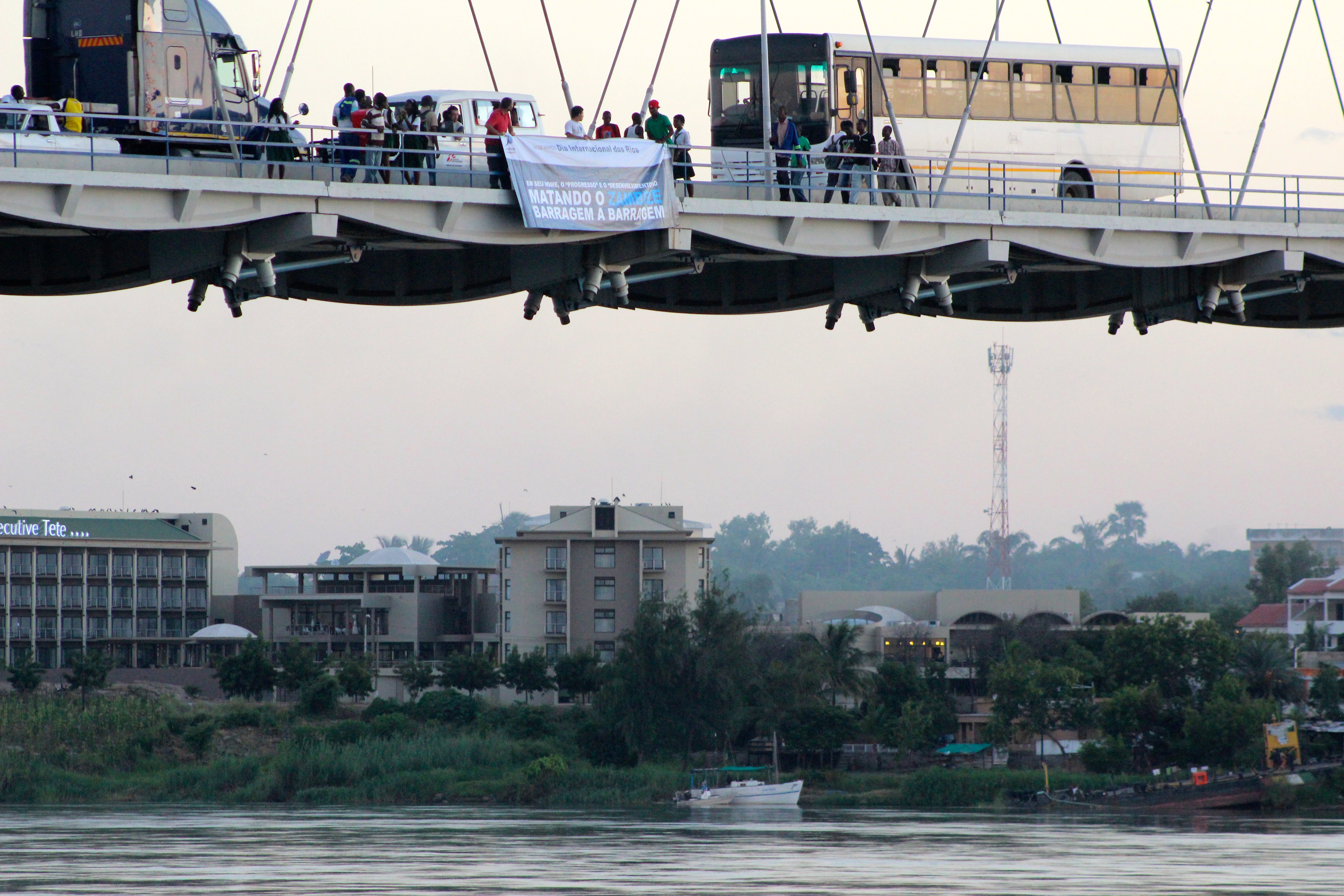
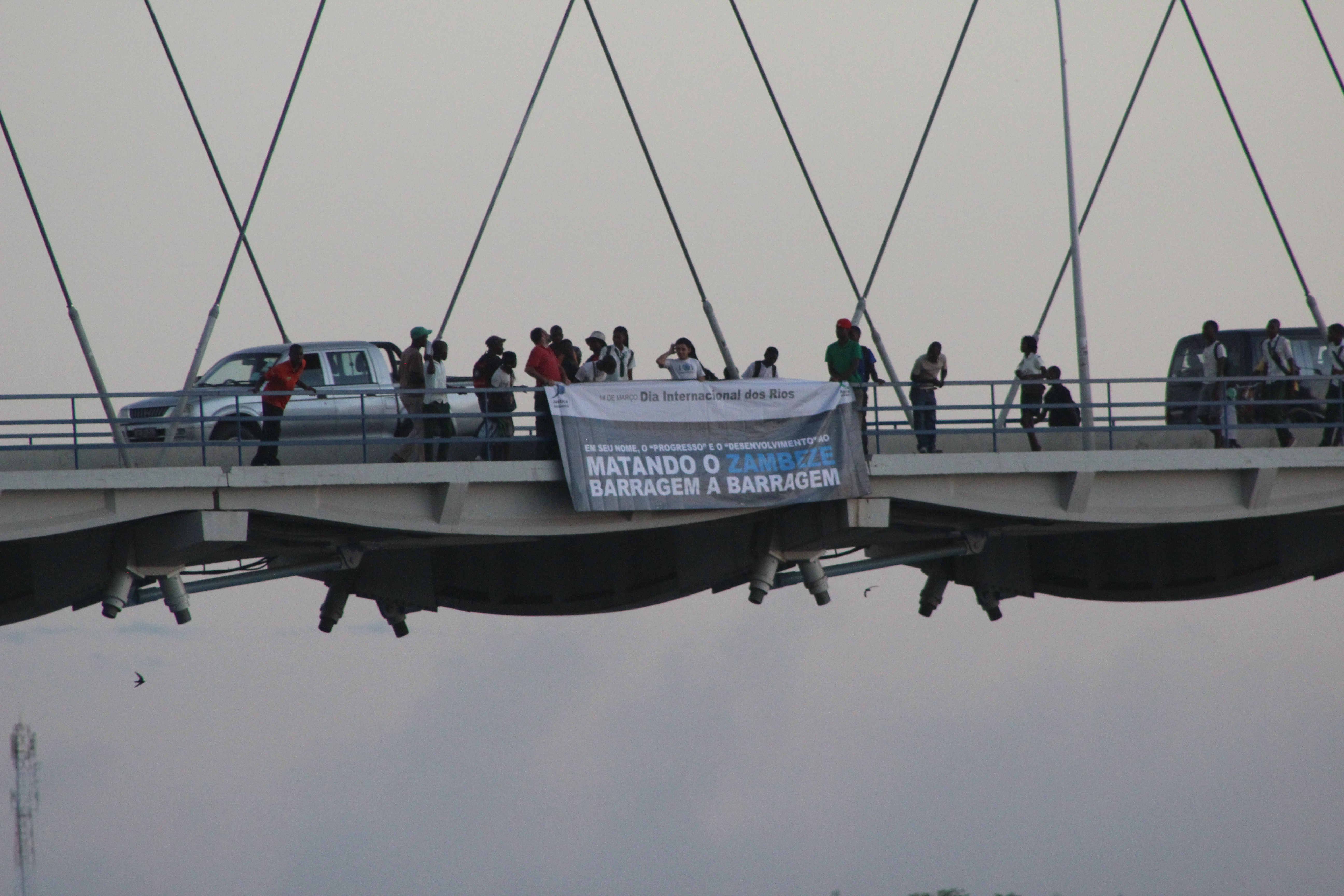
In Tete, we put up a banner on the Samora Machel Bridge in Tete which is the town closest to the proposed dam and also close to the coal mining-affected communities. The message on the banner was strong, and was directed at every single person who saw it: IN YOUR NAME, “PROGRESS” AND “DEVELOPMENT” ARE KILLING THE ZAMBEZI DAM BY DAM) We distributed leaflets about the consequences of the proposed Mphanda Nkuwa dam.

IMG_2673

IMG_2660

IMG_2701

(Photo credit: Gus Greenstein)

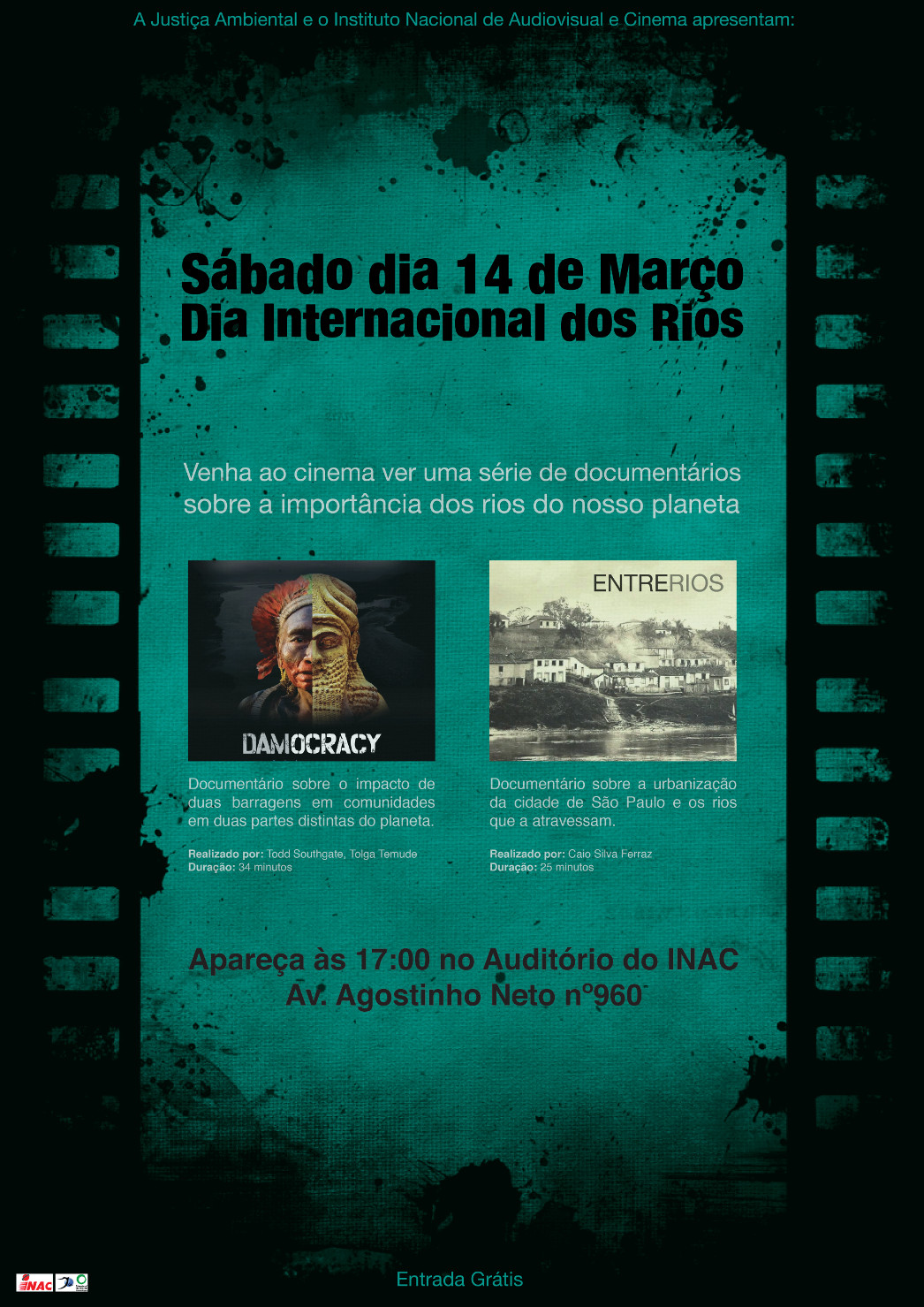
In Maputo and in partnership with the National Institute of Audiovisual and Cinema we also organized the screening of two documentaries about water: Entre Rios, which depicts the impacts of urbanization and expansion of the city of São Paulo on the rivers of the region, and Damocracy, which addresses the social and environmental impacts of the construction of mega dams in rivers. The aim of these projections was to create an awareness of the importance of rivers and water resources, which are vital for the planet and all of us. After the screening there was a very interactive discussion regarding the impact of human activity on the environment, its resources and their sustainability. Issues were also raised regarding the energy model that historically has caused serious social, economic, cultural and environmental consequences, and about the need to replace the use of dirty energy and the construction of mega dams (such as that intended to Mphanda Nkuwa) for the development and use of clean and renewable energy.

Dia dos Rios INAC

The Zambezi and Mphanda Nkuwa

In accordance to the mother of all geopolitical rules, as the developed countries stop building and actually begin to demolish their dams, the pressure from companies and financiers of such infrastructures over the underdeveloped and developing countries increases.

Unsurprisingly, the Mozambican government does not seem to be “getting the picture.” With a series of dams planned for our rivers in the coming years, fronted by the infamous Mphanda Nkuwa, the government’s agenda clearly indicates its commitment to send us the opposite direction to the course of development that they so often talk about.

In 2014, in the United States alone, at least 72 dams were demolished in order to restore rivers and preserve its people and biodiversity. In the US, the movement for the demolition of dams and river restoration is clearly becoming stronger, and much thanks to education and information campaigns, this increasing awareness regarding the impacts of dams in the past present and future is lessening the manoeuvring space for those who promote them within the political circles, and consequently, making it more difficult for politicians to foist them.

But who decides that a dam should be demolished? And why? Well, actually, there seems to be no rule. Sometimes governmental entities, for environmental and/or social reasons, determine it; sometimes the owners of the dam, when it is no longer profitable (if it ever was), come to the conclusion that maintenance costs are higher than demolition costs, and so, for financial and safety reasons choose to demolish it. Either way, nature says thank you.

The great victory in the fight against dams in 2014 was the overturning of the HidroAysén project, a 5 dams construction plan in the Baker and Pascua rivers in Patagonia. The Environmental Impact Assessment was approved in 2011, but a group of citizens opposed strongly and in 2014 the Minister for the Environment announced that her Ministry had rejected the project. She justified it by saying that the dam was jeopardizing biodiversity, traditional cultures, communities and even tourism in the region.

Another big win was to finally be able to hold the World Bank accountable for their involvement in human rights violations through its funding of dams. An example: the Rio Negro massacres caused during the building of the Chixoy Dam in Guatemala.

But what about us? How long will we keep pushing one way while the world moves in the opposite direction? We are different and want to continue to be different, but different for the better. We have to impose our will so that wise decisions on these matters are taken. Decisions upon which depend the welfare and livelihoods of millions of people and the balance of our environment. We agree that we cannot believe everything is said and written, but we cannot allow lightly taken decisions made in our name to be so obscenely wrong that a simple online search on any search engine disqualifies them peremptorily.

We need the decision makers of this country to promote a broad and open dialogue with society on the country’s energy needs, and allow it to participate in decision making. They could start by giving us answers to questions such as:

We need more dams to produce energy what and/or whom for?

What kind of energy do we want, and what options do we have?

In terms of social justice, we are certain that these decisions, taken together with the society, will be fairer, more valid, and certainly will not cost so much sweat, blood and tears to Mozambicans. Environmentally speaking, we have faith that this will also allow us to preserve our rivers, our water.

In the specific case of the Zambezi, the Intergovernmental Panel on Climate Change (IPCC) report warns that in the coming years “the Zambezi basin will potentially face the worst effects of climate change (…) and suffer probably a substantial reduction precipitation of about 10-15%”. We cannot afford to ignore these warnings from leading scientist panels and lightly build more dams on the Zambezi. The consequences can be disastrous.

Proud of our partners victories in the US and Chile, we remain resolute in our struggle and hopeful to the end that victory will smile to us too. And you may even be thinking that this much desired victory will not be yours; worse, that in case of defeat, nothing will change for you; or even worse, that this investment will certainly serve the country, create jobs and bring progress… Think again. This investment could irreparably affect the lives of millions of Mozambicans living on the banks of the Zambezi. It can take the fish and the xima out of their tables, because the “health” of a river depends on an entire ecosystem, including the fields it irrigates. And how will the thousands of fishermen and farmers living by and of the river survive?

And the possible repercussions in the Zambezi delta and the shrimp industry?

What if we told you that Mphanda Nkuwa is not meant to help fix our country’s poor electrification rate? Would you be surprised? What if we told you that behind Mphanda Nkuwa there are other plans for energy-intensive dirty industries, that will in turn bring the country other social and environmental problems and the same development that the Cahora Bassa, Mozal, Vale and Jindal, among others, bring us today: insufficient when compared to what we sacrificed and disproportionately distributed.

There is only one Zambezi, and yet, there are many projects that the executive seems to have for him, as if it was inexhaustible and indestructible… Don’t you find it strange that none of them are directly aimed at benefiting its people?

Do you really believe that is progress?

For more information about the HidroAysén project and dam demolition:

http://news.nationalgeographic.com/news/energy/2014/06/140610-chile-hidroaysen-dam-patagonia-energy-environment/

http://www.americanrivers.org/initiative/dams/projects/2014-dam-removals/#sthash.PNG8jVEs.dpuf

Someone’s Republic

Thank goodness we are nobodies. We nobodies can speak freely with other nobodies like us about what we think, without having to worry that Someone might not like our ideas.

The thing is Someone does not like those who think differently. His message is clear: if you think differently, think silently.

Someone is dangerous and wants us all to know it.

Someone has long been trying to annihilate all those who are noble and competent in Mozambique. Trying to condemn us all to his mediocrity, to his predictable and repeatedly sterile, selfish and monochromatic ideas.

In November 2000 Someone ordered the hit on Cardoso and doomed our media to an era of opacity, of subordination, of dictated news, of amazing fables featuring ducks, partridges, monkeys, pigs and other characters in plots and intrigues so poorly staged that only a moron would mistake them for reality.

Less than a year later, Someone ordered the killing of Siba-Siba Macuácua, allegedly to cover up a big shady bank fraud that the economist was trying to unveil. How many like Siba-Siba has Someone “pushed over the handrail” to cover up his manoeuvres?

In 2010, Orlando José, the late Director of Audit, Research and Information of Customs, also paid with his life for the grotesque mistake of saying that Someone should pay the same taxes as the rest of us common mortals.

And now, after nearly five years of absence (in what concerns political assassinations of obvious intimidating nature), on Tuesday the 3rd of this month, Someone ordered another hit. Gilles Cistac was the victim. He was shot because Someone certainly found inconceivable that a teacher, a mentor, a renowned academic could have an opinion so further apart from his. Surely Someone considered that Cistac was thinking too loud. Moreover, Cistac occupied a social position too dangerous for a politically misaligned individual.

Now what?

Are we all supposed to cheep quietly like a good flock of nobodies?

Are we expected to, yet again, accept Someone’s impunity and pretend to believe in the guilt of yet another Anibalzinho? To accept Someone’s oppression as an amorphous, gagged and subdued society?

Are the other intellectuals of our society, who put themselves on the line for the millions of nobodies like us, supposed to feel intimidated and keep quiet from now on?

Although it seems obvious that the wellbeing and the future of the country depend now, and perhaps more than ever, on the courage of these men and women, it does not seem fair that we demand of them that they alone risk their lives to protect our future.

We can no longer be nobodies, we must leave our quiet and safe insignificance, give voice to our discontent and fight for the rights that so many have fallen to defend.

We have had enough comrades. Enough.

The Nobodies By Eduardo Galeano

Fleas dream of buying themselves a dog, and nobodies dream
of escaping poverty: that one magical day good luck will
suddenly rain down on them- will rain down in buckets. But 
good luck doesn’t even fall in a fine drizzle, no matter
how hard the nobodies summon it, even if their left hand is
tickling, or if they begin the new day with their right foot, or
start the new year with a change of brooms.

The nobodies: nobody’s children, owners of nothing.

The 
nobodies: the no ones, the nobodied, running like rabbits, 
dying through life, screwed every which way.

Who don’t speak languages, but dialects.

Who don’t have religions, but superstitions.

Who don’t create art, but handicrafts.

Who don’t have culture, but folklore.

Who are not human beings, but human resources.

Who do not have names, but numbers.

Who do not appear in the history of the world, but in the 
police blotter of the local paper.

The nobodies, who are not worth the bullet that kills them.

Mozambique’s Dirty Elections: Not Free, Not Fair, Not Transparent

For over a year and a half, since April 2013, Mozambique has been going through a tense political atmosphere. Many parts of the country were going through an undeclared war between the party in power (Frelimo) and the main opposition party (Renamo). We reported on this situation in our New Year JA blog. It was because of this tense atmosphere, increased insecurity for citizens and clamp down on civil society that an unprecedented 30,000 people marched on the streets of Maputo on 31 October 2013, demanding peace, justice and solidarity, and an end to insecurity and war (see photos on the New Year blog).

After much negotiations, the parties decided to go ahead with elections scheduled for 15 October 2014, although the tense atmosphere had clearly not yet abated.

Elections took place on 15 October. On the same day, media and observers already reported several irregularities. There are many instances of violence including a young man killed in Beira. Opposition party observers were deliberately kept out of voting rooms and were unable to observe. There were reports of ballot boxes disappearing in some places, being burnt and destroyed in others. Several people were caught with multiple ballots in their hands already marked in the ruling party’s name and ready to be put into ballot boxes. Many election booths opened many hours after they were supposed to. Social scientist Joseph Hanlon’s page in English registers several issues with the voting.

All these and many more reports were actively covered in the media and are substantiated by two renowned Mozambican organisations, Liga dos Direitos Humanos (LDH, Human Rights League) and Centro de Integridade Publica (CIP, Centre for Public Integrity). They were both civil society observers of this election. These organisations were already raising these issues and irregularities on the day of the elections itself.

These irregularities were reported to the National Election Commission right away on the same day! However the official response was that these incidents were minimal and did not affect the overall outcome!

The Mozambican people are livid. The tension across Mozambique around this issue is evident and everyone is talking about the lack of democracy. Front page headline on Canal de Moçambique on 22 October stated “Filipe Nyusi: Uma Fraude Retumbante” (Fipile Nyusi [ruling party candidate]: A Reverberating Fraud). Social media including facebook has been ripe with discontent about the elections scenario.

Given the sentiment in the country, and the terrible official response, 4 Mozambican organisations today submitted a formal complaint to the National Election Commission. The 4 organisations include:

  • Liga dos Direitos Humanos,
  • Centro de Integridade Publica,
  • Justiça Ambiental (JA, Friends of the Earth Mozambique) and
  • Acção Académica para o Desenvolvimento das Comunidades Rurais (ADECRU, Action for Development of Rural Communities).

The complaint has nothing to do with who wins or who loses the elections. It is about governance, transparency, justice and democracy. We as Mozambicans demand free, fair and transparent elections. We demand justice. We know there will be backlash on our organisations from the government; however it is a matter of justice for all Mozambicans. It is also important to note that the Electoral Law does not provide any legal avenues for civil society or citizens to be able to make any complaints about the electoral process and get a response. However, the outrage is huge, so we decided to go ahead with a complaint anyway.

It is really sad that some big advocacy Mozambican groups who usually work together with us on issues, and who are criticising the election irregularities, yet did not have the courage to bring their voices to such an important complaint.

Just now the government has released the final results of the elections and has claimed a victory for the ruling party.

But what is the truth? Where is our democracy?

A luta continua (the struggle continues)…

A Positive Example

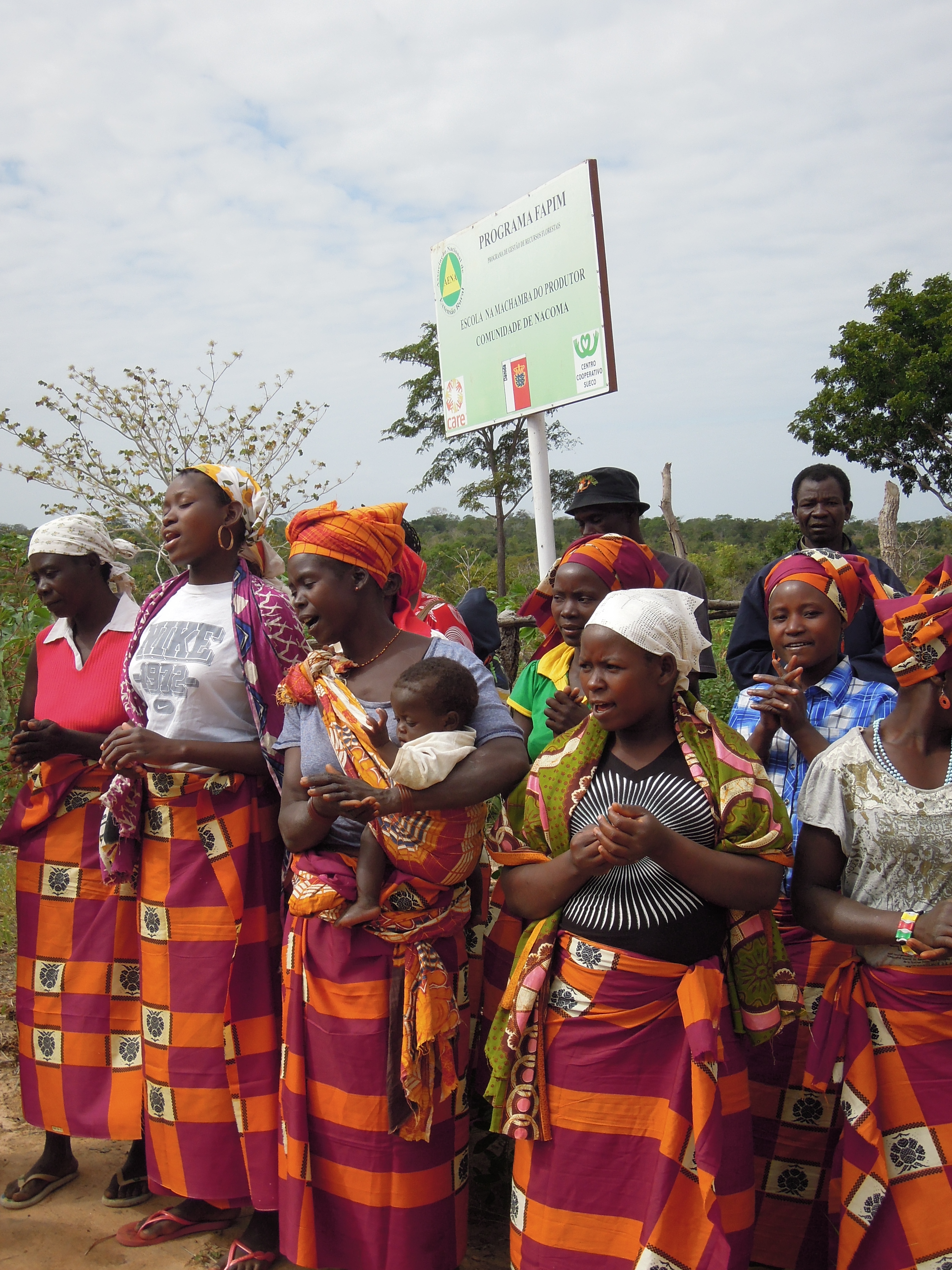
During a trip to Nampula for a meeting with AGIR (Action Programme for a Responsible and Inclusive Governance) and its partners, we were told that we would visit the community of Nacoma in the village of Mele, Meconta district, about 83 km from the city of Nampula, where, with the support of the National Association of Rural Extension (AENA), the community formed an association composed of 20 members (13 women and 7 men) to improve their crops. This association would be presented to us as a good example of a farming, savings and literacy project (for the community even created a school in the farm area itself).

 Image

After an almost two hours journey, we finally arrived to the place. Several women with colourful scarves and capulanas, clapping and singing welcoming songs for us, greeted us at our arrival. There were barely any men, only three were present.

From there, always singing and clapping, they led us to a small plot of land next to a dirt road where they showed us an example of the good practices and crop improvements they had learned for a more efficient agriculture on poor soils. These women, with the help of a partner of AGIR in Nampula who shared its knowledge with them, improved the soil of the area, which was not the best for agriculture, through the practice of techniques such as the use of dry grass to conserve soil moisture and thus retain its nutrients. From AGIR’s partner, they mentioned they also learned that setting fire to a plot before using it, a widely used method in the area to prepare the soil, when done systematically ends up reducing the nutrients and weakening the soil. They further demonstrated, using only water grass and sand, rudimentary examples of other methods used to enhance and improve their harvests, and showed us how they had arranged between them to monetize the goods they produce (cassava, pigeon pea, sweet potato, peanut, etc… ) and thus increased their income allowing it to improved their lives and their families. Finally, they showed us a peanut dryer made by the association, made with simple poles and grass where it was protected from rain, insects and other animals.

 Image

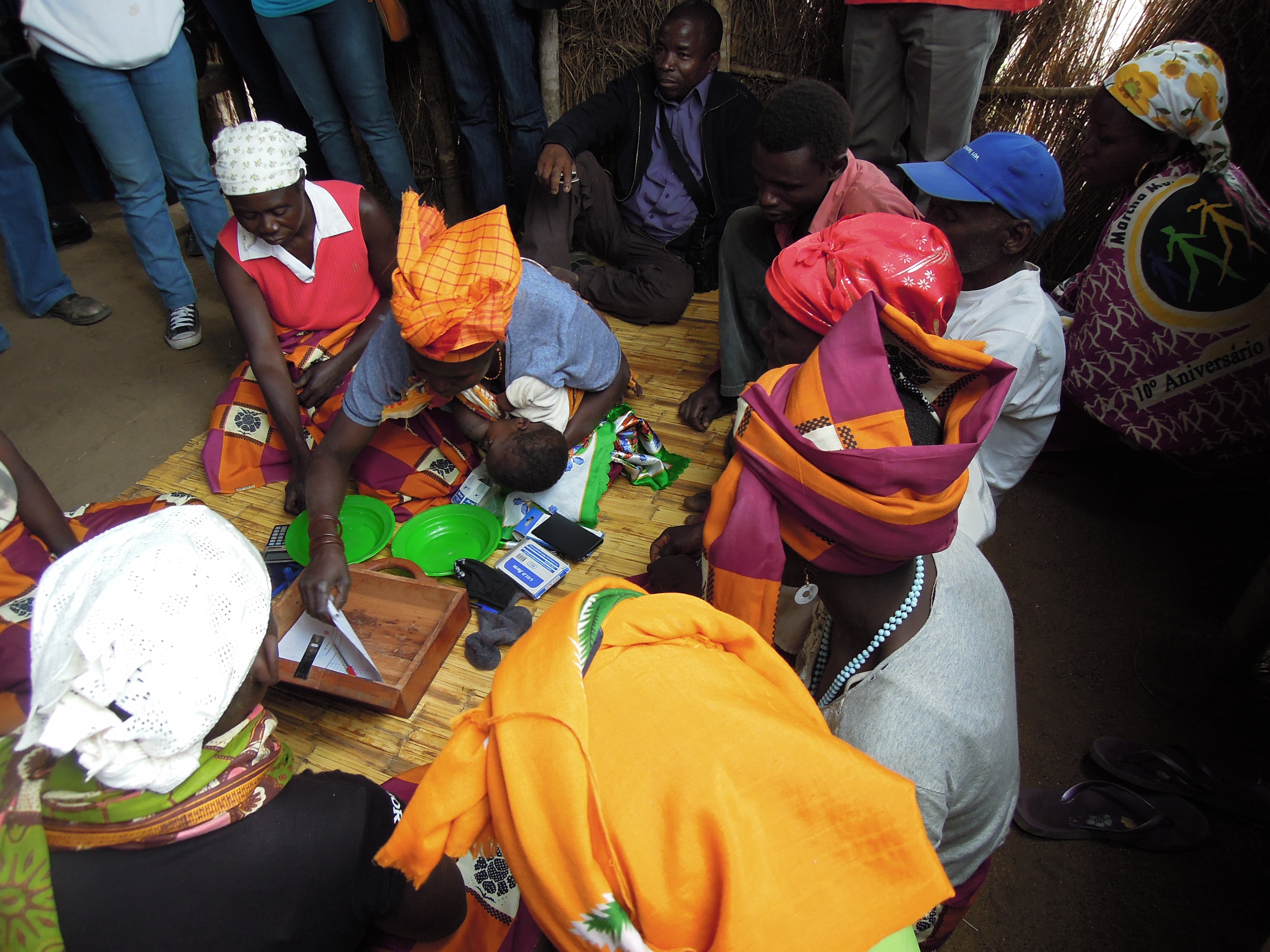
After visiting the peanut dryer, our group informed that visitors would also like to see and know the method of collecting income from all who were part of the association. Then showed us a wooden suitcase, where not only they deposited their earnings, but where they also kept the register of their loans, as well as their savings, each amount in its place (in three man socks of different colors). They explained to us that the suitcase had two keys and that they were never in the same place or with the same person. The keys were handed over to two different people in the group and when the suitcase was opened everyone should be present to count the money together, a measure of security for all.

We were impressed by the organization, methodology and capacity of a group so small yet so effective in managing their own interests. A good example of community empowerment, with which all present were astonished. However, for us it was more than that. It was once again a confirmation of the power of the people of Mozambique and Mozambican women in particular, their ability, courage and perseverance in trying to resolve their difficulties and strive for a better future. For us it was a true life lesson!

To finish, we would like to leave you with some food for thought: What will happen to these women in the community of Nacoma when the giant and controversial ProSavana is implemented? We know that Meconta is one of the areas covered by it… Will it be the “early death” of another good example in Mozambique? Or will it survive?