Tag Archives: energy

Why financial institutions should politely look away from ENI’s Coral North FLNGU

Update from ReCommon and Justiça Ambiental!

In January, Italian company ENI announced it would be ready for the Final Investment
Decision for its Coral North FLNG project, but now states it is still negotiating with private
banks for financing, and seems to blame the delay on the Mozambican authorities. In the
meanwhile, one investor has been sued by a civil society organization, and four private
banks have already excluded financing for the project.
Coral North FLNG, a planned floating platform to extract and liquefy gas off the coast of
Mozambique, is still looking for backers. Although Eni declared in January that it was ready
to take the FID on the project, last week, in the context of its AGM, it admitted to
shareholders that “negotiations with private financial institutions are underway”. When
asked about the reasons for the delay in closing the deal, ENI only replied that the
development plan was approved by the Mozambican authorities in April 2025, implying
they were responsible.
ENI leads work on Coral South FLNG, the only operational project in the Rovuma Basin. It is a
floating processing plant anchored in deep ocean that has been exporting LNG since
November 2022. Coral North FLNG would be a replica, gouging its claws into the sea floor
just 10 kilometres away, compounding the impacts on the ecology of the area.
Answering to the AGM questions, ENI also confirmed that “part of the project requirements
are planned to be financed through debt” and with “support from a number of Export Credit
Agencies”, as for Coral South FLNG. However, different private finance actors are moving
towards withdrawal from unconventional upstream oil and gas in order to achieve carbon
neutrality by 2050. At least four of the banks that supported the first project – BNP Paribas,
Credit Agricole, UniCredit and ABN Amro – say they are no longer interested in financing the
replica because it is not in line with their updated climate change policy.
Just over three years since the massive vessel arrived in the Cabo Delgado region, Coral
South has seen multiple cases of excessive flaring – the burning of excess extracted gas,
which results in significant carbon emissions. As a replica, Coral North would likely be
subject to similar issues. An investigation published in April by Italian civil society
organization, ReCommon, revealed that total emissions from Coral South have been
assessed at levels seven times higher than declared in the original environmental impact
assessment (EIA). Between June and December 2022 alone, flaring emissions from the Coral
South FLNG project accounted for 11.2% of Mozambique’s annual emissions, reflecting an
11.68% increase compared to 2021.Proceeding with gas development in the Rovuma Basin ignores the International Institute for
Sustainable Development findings indicating that investment in additional gas infrastructure
is incompatible with the goal of limiting global warming to 1.5°C. International Energy
Agency analysis also reveals that, in a 1.5°C scenario, existing LNG export capacity would
already be sufficient to meet current and future demand.
With gas demand declining worldwide, Coral North carries high financial risk, prompting
South Korean civil society organisation, Solutions for Our Climate (SFOC) to attempt to stop
state investment in the project. In February, Korea Gas Corporation (KOGAS) announced a
decision to invest USD 562 million in the project through equity and a loan to its subsidiary,
KG Mozambique. In March, SFOC sued KOGAS, arguing that the investment is economically
risky for South Korea, and the project would contribute significantly to climate change
impacts and therefore violate the rights of future generations to a healthy environment.
Between 2008 and April 2024, KOGAS had already invested around USD 1 billion in
Mozambique gas development, but has refused to disclose the preliminary feasibility study
(PFS) for Coral North. SFOC also has an ongoing case against KOGAS for disclosure of the
PFS.
Two other projects in the Rovuma Basin are planning significantly larger onshore processing
facilities, intending to pipe gas from wells about 50 km offshore, Mozambique LNG and
Rovuma LNG. The environmental impacts of the four gas projects together over their entire
lifetimes could be devastating for the Rovuma Basin and the west Indian ocean. The
Environmental Impact Assessment for the Coral North Project has been criticised for failing
to meet legal and scientific standards in assessing environmental and climate risks.
The Mozambique LNG project, led by French fossil giant TotalEnergies remains under
international scrutiny. The project is under force majeure since April 2021, following a
violent insurgent attack. It is now under investigation following reported allegations of a
massacre of civilians that was allegedly committed near the Afungi gas complex in mid 2021
by public security forces. Mozambique LNG shares land-use rights and some infrastructure
with the Rovuma LNG project, which is led by ExxonMobil, with ENI and China National
Petroleum Corporation as major partners. The project also remains without a final
investment decision.
The development of LNG projects in Mozambique also presents severe concerns about
erosion of sovereignty, due to the legal agreements that limit the government’s ability to
regulate these projects and capture fair revenues. Since gas exploitation began around 2010,
the industry has been linked to significant corruption-driven debt, and the government
supports its national oil company’s participation in LNG projects, creating fiscal risk without
guaranteed returns. Local communities have already lost agricultural lands and access to thesea because of the infrastructure development, and hundreds of families were required to
relocate.
Gas revenues so far amount to just over USD 200 million, of which 40% is intended for the
Sovereign Wealth Fund, which was established for stability and savings for future
generations. Last week the Mozambique Administrative Court reported numerous
irregularities in the Financial State Account for 2023 that represent an alleged
“embezzlement” of USD 33 million from Rovuma Gas revenues. In addition, Mozambican
civil society is raising concerns about the funds being allocated to social and economic
projects as provided for in the State Budget.
Developing Mozambique’s LNG industry promises only more harm – ecological destruction
and climate change impact, the destruction of people’s livelihoods, and increased
disenfranchisement and inequality. This is risky business for public and private financial
investors.
Ends

Tagged , , , , , , ,

Activists across the globe call on banks and investors to stop financing TotalEnergies

[New York/Frankfurt/Paris, 2nd October 2024] – On Wednesday 2nd October, climate activists are protesting in New York, where TotalEnergies is hosting its main investors. Actions are also taking place this week at the headquarters of TotalEnergies’ investors and banks in Frankfurt and Paris. Activists are calling on investors and banks to make an immediate commitment to stop issuing or buying new bonds from TotalEnergies, as well as to stop all support for companies developing new oil and gas projects.

Bonds represented more than two-thirds of TotalEnergies’ external financing in recent years (1). In 2024, TotalEnergies raised $7.25 billion through bonds, which the company will fully reimburse over decades (2). 

Earlier this year some 60 NGOs called on banks and investors to stop lending to TotalEnergies, due to the energy giant’s ‘climate-wrecking strategy’ (3). Following the letter, French banks BNP Paribas and Crédit Agricole announced that they would no longer participate in conventional bond issuances for companies in the oil and gas sector (4). 

Climate justice movements, organizations and activist –  including 350.org Justiça Ambiental, Liveable Arlington, MilieuDefensie, Stop Total France, the Toxic Bonds Network and urgewald – are urging other financial institutions to follow suit and stop support – including participating in the issuance and purchase of new bonds – for TotalEnergies and other companies developing new oil and gas projects.

While TotalEnergies’ investors will be shaking hands at its Investor Day in New York over financial support that will fund the company’s oil expansion 40 years into the future, activists will remind them of what this means for the climate. They will in particular denounce the EACOP project, which TotalEnergies continues to promote despite the heavy repression faced by communities and activists opposing it (5). So far 27 commercial banks have publicly committed not to support the EACOP project (6). The project has so far been financed by equity capital from its shareholders, including TotalEnergies (7). Bonds are likely to be significant to the development of such projects, as they allow the company to raise large amounts of money without conditions regarding their use (8). 

Molly Ornati from 350Brooklyn.org : “In Uganda, community members and activists are constantly intimidated, arrested and prosecuted for defending their basic rights. Demonstrations which simply demand fair compensation, an end to displacement, and a halt to environmental destruction are met with police violence and arrests. While international banks across the globe have turned their backs on the EACOP project, they continue allowing the company to go ahead with its oil and gas projects through other financing methods such as bonds. Financiers should immediately stop distributing blank cheques to TotalEnergies.”

Protesters will also denounce the Mozambique LNG project, which has been suspended for 3 years and was recently under criticism due to reports of alleged atrocities committed by Mozambican armed forces near the project’s premises (9) and TotalEnergies’ shale gas projects in Texas (10).

Ranjana Bhandari, director of Liveable Arlington in Arlington, Texas and home to 400,000 residents exposed to Total’s ongoing urban fracking operations stated:  “The ongoing fracking operations of the French energy giant TotalEnergies’ are placing thousands of families and children at risk in the city of Arlington, around Texas, and other locations across the nation and worldwide. It’s time consumers and investors demand American banks such as Citi, JP Morgan, and Bank of America stop funding these long-term bonds that are harming the very residents in the cities where these banks are operating.” 

Anabela Lemos, from Justiça Ambiental, Mozambique: “The TotalEnergies gas project in Cabo Delgado is associated with land grabbing, lost livelihoods and human rights violations, alongside a violent conflict. TotalEnergies is now planning to co-develop the controversial Mphanda Nkuwa mega dam in the Zambezi river. Even before construction has started, local communities are reporting intimidations and human rights violations to force them to accept the project. If the dam goes ahead, this biodiversity hotspot might suffer irreversible damage and thousands of families will lose their lands, livelihoods and futures.  Financiers are ethically bound to refuse support for TotalEnergies trail of destruction across the world.

END

**********************

Press contacts : 

Anabela Lemos, Justiça Ambiental, anabela.ja.mz@gmail.com

Ranjana Bandhari, Liveable Arlington, liveablearlington@gmail.com 

Melanie Smith, 350.org US melanie.smith@350.org 

About the actions:

  • New York City : the action is taking place at 8:00AM at the headquarters of Citibank. Press is welcome]. Citi is the most important underwriter of TotalEnergies’s ongoing bonds (11), top bank in the US between 2021 and 2023 (12) and participated in underwriting TotalEnergies’ $3 billion bonds issue on September 10th 2024. 
  • Frankfurt: onThursday 26 October, a protest took place in front of Deutsche Bank’s Headquarters in Frankfurt. Pictures are available here Deutsche Bank is the third most important underwriter of TotalEnergies’s ongoing bonds (11), top bank in Germany between 2021 and 2023 (12) and participated in underwriting TotalEnergies’ $4.25 billion bonds issue on April 5th 2024. DWS, Deutsche Bank’s asset management subsidiary, is the first investor of TotalEnergies in Germany (12). 

Pictures are available upon request to the press contacts. 

Notes : 

(1) Between 2016 and 2023, 69.8% of TotalEnergies’ financing came from bonds, according to data from Banking On Climate Chaos, 2024

(2) The average maturity (date on which the bond matures and must be repaid by the issuing company) of bonds issued by TotalEnergies between 2020 and 2024 was 22 years compared to 6 years for those issued between 2000 and 2004, according to a recent study by AFII, 2024.

(3) The Brussels Times, Nearly 60 NGOs call on banks and investors to stop lending to TotalEnergies, 2024

(4) Reclaim Finance, BNP Paribas and Crédit Agricole Say No to Bonds for the Oil and Gas Sector, 2024

(5) #STOPEACOP, Uganda Silences EACOP Critics: Activists and Affected Communities Detained, 2024

(6)  #STOPEACOP Who’s Behind EACOP?, 2024

(7) The project’s shareholders are TotalEnergies, China National Offshore Corporation, Uganda National Oil Company and Tanzanian Petroleum Development Corporation.

(8)  Reclaim Finance, TotalEnergies and financial markets: Financial institutions engaged for decades of pollution, 2024

(9) Politico, All must be beheaded”: Allegations of atrocities at French energy giant’s African stronghold, 2024

and Say No to Gas ! in Mozambique, Call for investigation into reports of atrocities committed near TotalEnergies’ Mozambique LNG premises, 2024

(10) Liveable Arlington

(11) For a more global view on TotalEnergies’ most significant underwriters and facilitators since 2016, refer to the Banking on Climate Chaos report

(12) Defund TotalEnergies, Who is financing TotalEnergies? 

Tagged , , , ,

International NGOs call for immediate official investigation into reports of series of atrocities committed by Mozambican security forces near TotalEnergies’ Mozambique LNG premises

 Joint NGO statement

26 September 2024. Statement by: Justiça Ambiental  / Friends of the Earth Mozambique; Les Amis de la Terre France / Friends of the Earth France; Milieudefensie / Friends of the Earth Netherlands; Friends of the Earth Europe; Friends of the Earth Japan; Friends of the Earth US; ReCommon; Reclaim Finance.

On September 26, 2024, Politico published an article by independent journalist Alex Perry [1] which reveals information about an alleged massacre of civilians, reported to have been committed near TotalEnergies’ premises in mid 2021 by Mozambican public security forces.

Anabela Lemos, Director of Justiça Ambiental / Friends of the Earth Mozambique, says: “This information cannot be ignored by the financial institutions supporting the French fossil fuel giant’s activities in Mozambique, including the financial arms of the United States, the United Kingdom, the Netherlands and Italy. In multiple reports and meetings, we and our partners have warned companies, banks and states about the risks associated with this project and the serious flaws in the human rights due diligence carried out by TotalEnergies [2]. TotalEnergies’ responsibility is again today called into question by this reporting on further alleged atrocities surrounding the gas project”.

The article outlines alleged events in July-September 2021, three months after a major insurgent attack on Palma town that spurred increased militarisation of the region. According to the article, Mozambican troops assaulted hundreds of civilians who were seeking safety, and imprisoned the men in windowless, metal shipping containers near the entrance of the Mozambique LNG site. The article reports that men – 180 to 250 individuals – were detained for 3 months, denied water, starved, beaten, suffocated, tortured, stabbed and, finally, most of them “disappeared”. Only 26 of the prisoners are estimated by the investigation team to have survived.” Women were subjected to humiliation and repeated sexual assault for a day or two, before being released.

Alex Perry has previously published articles about the violent conflict in the province of Cabo Delgado and the controversial impacts of the Mozambique LNG project. In the aftermath of the March and April 2021 insurgent attacks on the town of Palma, he conducted in-depth research to uncover the number of fatalities incurred during the massacre [3]. The attacks led to TotalEnergies’ declaration of force majeure and the suspension of the project in April 2021.

A legal complaint was filed in 2023 by victims’ families and attack survivors, accusing the French energy company of failing to protect its subcontractors and failing to provide fuel so that helicopters could evacuate civilians during the Palma attack [4]. Following the complaint, the French public prosecutor asked TotalEnergies’ for comments on the complaint to then decide whether to pursue the case, close it or carry out further investigations [5]. 

Amnesty International accused the Mozambican security forces of war crimes in 2021 [6]. Until recently, TotalEnergies was directly providing equipment and financial compensation to the Joint Task Force (JTF) of the Mozambican army under an agreement that the JTF would “ensure the security” of the project activities – and now pays the government instead ​​​[7]. A 2023 report commissioned by TotalEnergies itself concluded that a permanent link between Mozambique LNG and the Mozambican army “would have the effect […] of making the project a party to the conflict” in the meaning of the Geneva Convention. [8].

State and private actors involved in the financial support [9] of the project have been warned about the threats the project poses to regional security and human rights, as well as the climate and environmental impacts [10]. Information obtained via Freedom of Information requests has revealed that despite these warnings, as well as concerns expressed by decision makers, support for the project was pushed through [11].

The Politico journalistic investigation into this massacre draws fresh attention to TotalEnergies’ controversial links to the Mozambican army, and specifically its relationship with the forces accused of severe crimes that might be considered war crimes. According to the article, “The commandos were based on TotalEnergies’ compound. They ran their detention-and-execution operation from the petroleum giant’s gatehouse.” The Mozambican commando unit was furthermore reported to be led by an officer who said his mission was to protect the “project of Total”. The managing director of Mozambique LNG project, Maxime Rabilloud, says TotalEnergies had “no knowledge of the alleged events described”, nor “any information indicating that such events took place”. In addition, Rabilloud stated that the company had no presence on the ground at the time of the alleged events and is taking the “message very seriously given the gravity of the allegations”. The article reports that the Mozambican ministry of defense and the Mozambican presidency did not reply to requests for comment.

The article asserts, “there are grounds for a prosecutor to think that Mozambique LNG and its parent company TotalEnergies had sufficient cause to investigate whether human rights abuses were being committed by its defenders in its absence.”

The NGOs behind the “Say No to Gas! in Mozambique” campaign call on all public and private actors involved in the project and its financing to immediately act to ensure truth, justice and reparation for the survivors and the victims’ families. They call for an immediate official investigation on the events and on TotalEnergies’ potential role, due to its cooperation with security forces that are accused of severe crimes, including rape, murder, torture, which may constitute war crimes.

Press contacts

  • Justiça Ambiental / Friends of the Earth Mozambique: Daniel Ribeiro, daniel.ja.mz@gmail.com, +258 86 620 5608, Anabela Lemos, anabela.ja.mz@gmail.com, +258 87 195 3602 
  • Les Amis de la Terre France / Friends of the Earth France: Lorette Philippot, lorette.philippot@amisdelaterre.org, +33 640188284
  • ReCommon (Italy): Simone Ogno, simoneogno@recommon.org, +39 3491303455
  • Milieudefensie / Friends of the Earth Netherlands: Isabelle Geuskens, isabelle.geuskens@milieudefensie.nl, 0031621829589; Marie-Sol Reindl, marie-sol.reindl@milieudefensie.nl, +31611084291
  • Friends of the Earth Europe: Paul de Clerck, paul.declerck@foeeurope.org, +32494380959
  • Friends of the Earth Japan: Ayumi Fukakusa, fukakusa@foejapan.org, +818069170794
  • Friends of the Earth US: Kate de Angelis, kdeangelis@foe.org, +0012023204742
  • Reclaim Finance : Antoine Bouhey, +33781846775

Notes

[1] Perry, A. 2024. ‘”All must be beheaded”: Allegations of atrocities at French energy giant’s African stronghold’. Politco. Published 26 September 2024. https://www.politico.eu/article/totalenergies-mozambique-patrick-pouyanne-atrocites-afungi-palma-cabo-delgado-al-shabab-isis/

[2] Uprights, July 2023, ‘Assessment of TotalEnergies’ Mozambique LNG Project Human Rights due diligence’​.​https://friendsoftheearth.eu/publication/totalenergies-fails-on-human-rights-in-mozambique-lng-project/ 

[3] Perry, 2023. ‘Palma massacre’.https://www.alex-perry.com/palma-massacre/
The findings are published on the research platform ACLED (Armed Conflict Location & Event Data). https://acleddata.com/knowledge-base/9-april-2024-update-new-fatality-estimate-for-the-2021-attack-on-palma-mozambique/
Perry’s research established that 1,193 Mozambican civilians were killed or went missing, and The Armed Conflict Location and Event Data Project (ACLED) confirmed 801 deaths.

[4] www.amisdelaterre.org/communique-presse/total-faces-criminal-charges-in-french-courts-for-its-negligence-during-the-palma-attack-in-northern-mozambique/ 

[5] www.lemonde.fr/en/france/article/2024/05/04/france-probes-totalenergies-over-2021-mozambique-attack_6670395_7.html 

[6] Amnesty International, 2021. ‘What I saw is death: war crimes in Mozambique’s forgotten Cape’.https://www.amnesty.org/en/documents/afr41/3545/2021/en/

[7] www.zitamar.com/inside-the-new-security-deal-between-mozambique-and-gas-project-investors/
TotalEnergies, 2020, ‘Total signs agreement with the Government of Mozambique regarding the security of Mozambique LNG project’.https://totalenergies.com/media/news/press-releases/total-signs-agreement-government-mozambique-regarding-security-mozambique

[8] Rufin and Glowacki, 2023. ‘Report on the socioeconomic, humanitarian and human rights situation in the Palma-Afungi-Mocímboa area‘, page 20. Commissioned by TotalEnergies. https://totalenergies.com/sites/g/files/nytnzq121/files/documents/2023-05/Mozambique_LNG_report.pdf

[9] 28 financial institutions took part in the 14.9 billion dollars project financing in July 2020. ECAs include Export Import Bank of the United States (US EXIM), UK Export Finance (UKEF), Servizi Assicurativi del Commercio Estero (SACE), Atradius Dutch State Business (ADSB). Commercial banks include Société Générale (the financial advisor of TotalEnergies for the project), Crédit Agricole, JPMorgan, Mizuho Bank, Standard Chartered Bank. See full list: www.amisdelaterre.org/wp-content/uploads/2024/07/summary—-financial-institutions-involvement-in-the-mozambique-lng-gas-project-2.pdf 

[10] The Mozambique LNG project will produce between 3.3 and 4.5 billion tonnes of CO2 equivalent over its lifecycle, more than the combined annual greenhouse gas emissions of all 27 EU countries. Friends of the Earth EWNI and the New Economics Foundation, October 2021. Tip of the iceberg : the future of fossil fuel extraction.
https://policy.friendsoftheearth.uk/print/pdf/node/237

[11] Knoote and Rosenhard, ‘Acceptable Risk? How the security threat in Cabo Delgado was ignored for the benefit of ‘The Netherlands Ltd.’, June 2024, Milieudefensie and Both Ends. https://en.milieudefensie.nl/news/government-wrong-again-mozambique-gas

Tagged , , , ,

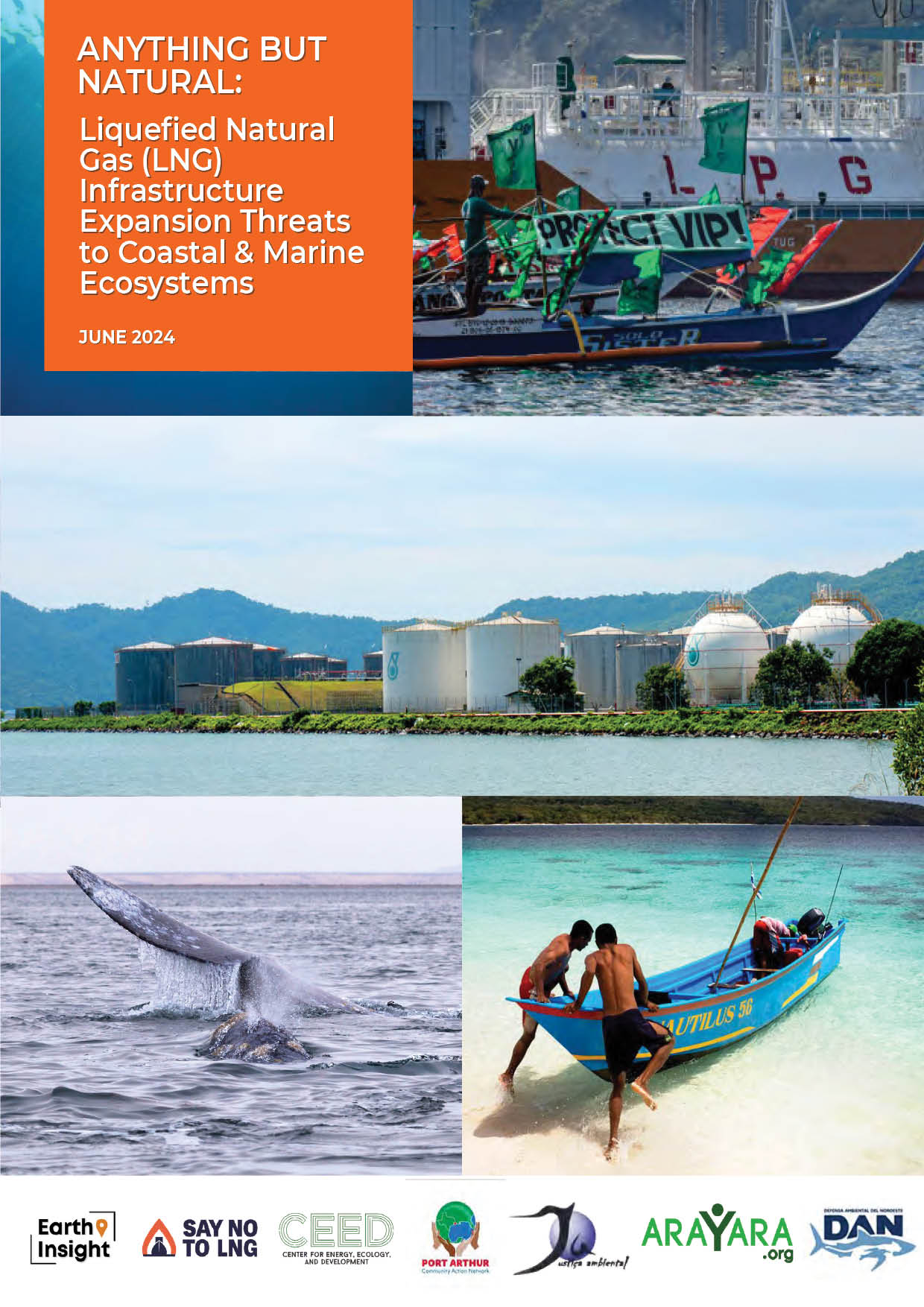
New LNG developments lock in fossil fuels and threaten fisheries, human health, ecosystems, and the global climate

Report: Heatmap shows Liquefied Natural Gas

(LNG) expansion in globally-important marine biodiversity hotspots

Sacramento, USA (June 6, 2024) — New maps and analysis from research organization Earth Insight and partners — released ahead of World Oceans Day on June 8, 2024 — paint a sobering picture of current plans to expand Liquefied Natural Gas (LNG) infrastructure worldwide, posing threats to the global climate as well as significant hubs for biodiversity.

READ THE REPORT — Anything But Natural: Liquified Natural Gas (LNG) Infrastructure Expansion Threats to Coastal & Marine Ecosystems

LNG is mostly composed of methane gas. If cooled, the gas becomes liquid and can be stored and transported by sea using special tankers. When methane is burned to obtain energy, it produces less carbon dioxide than other fossil fuels, such as oil or gas. However, methane itself

🌐

 page1image1383992000

is in itself a potent greenhouse gas, responsible for almost a third of all global warming we are experiencing today. The cost of developing planned natural gas infrastructure exceeds one trillion dollars, and will increase by threefold the world’s export capacity, and by two-thirds its import capacity. United States, Russia, China, Mexico, and Canada are leading the pack in planned LNG infrastructure expansion, while countries like the Philippines, Mozambique, and Brazil also feature in the top 20.

Case studies and regional maps in the report show:

  • ●  In the United States, developments along the Gulf Coast will disproportionately impact communities of color in some of the poorer states of the country. These communities already experience poor air quality from operating LNG facilities and regularly suffer downpours and floods caused by climate change-fueled hurricanes and storms;
  • ●  In Mexico’s Baja California state, new LNG infrastructure threatens “the world’s aquarium,” home to 40% of all marine mammals in the world and many endangered species. If current plans go ahead, eight new terminals will be built in a region that is a whale sanctuary and is listed as a UNESCO World heritage site;
  • ●  In the Philippines, building new LNG terminals will add more pressure to the Verde Island Passage, one of the world’s most biodiverse marine places. The region, often called “the Amazon of the Oceans,” is already one of the world’s busiest marine routes and was hit by an oil spill in 2023 with devastating consequences;
  • ●  In Mozambique and East Africa, gas developments have already caused the forced displacement of local communities and new plans threaten several critically endangered marine species. The offshore expansion will take place along a coastline full of mangroves and coral reefs;
  • ●  and, in Brazil, there are plans to build new LNG terminals along the Atlantic coast, a region that is already cluttered with oil and gas infrastructure. Whale populations will be particularly affected, as the new developments overlap with their breeding grounds and migration routes.The last 10 years have been the ocean’s warmest since at least the 1800s, with 2023 being the hottest ever recorded. Destructive marine heatwaves are becoming more frequent and intense across the world. Massive coral bleaching episodes are destroying reefs and all the natural life they support. And species are being displaced from their habitats, moving to cooler and deeper waters, disrupting ecological chains and impacting fisheries.New LNG facilities will increase shipping intensity and noise pollution in marine migration corridors, mating and nursery areas for species like whales and dolphins, and important fishing grounds.The report, launched just before World Oceans Day 2024, follows the 2024 United Nations Ocean Decade Conference in Barcelona, Spain (April 8-12, 2024) and the 9th Our Ocean Conference in Athens, Greece (April 16-17, 2024), a series of events first launched under the initiative of then-U.S. Department of State and the Secretary of State John Kerry in 2014. It also

follows an historic May 2024 ruling by the International Tribunal for the Law of the Sea dictating that emissions from fossil fuels — and other planet-warming gasses that are absorbed by the oceans — count as marine pollution; a first climate-related ruling from that body.

Maps

Look at the interactive heatmap here.
Download static maps from the report here.
Supplied underwater images of marine life (credit Lynsey Grosfield/Earth Insight) here.

Quotes and Interview Opportunities

“Investing in LNG infrastructure — especially in some of the world’s most important nurseries of marine life — just doesn’t make any sense. At this point in the energy transition and nature crisis, it’s a one way ticket to stranded assets and won’t help us solve the climate crisis.”

Tyson Miller, Executive Director, Earth Insight: +1 (828) 279-2343,

tyson@earth-insight.org

“The new report ‘’Anything But Natural: Liquefied Natural Gas (LNG) Infrastructure Expansion Threats to Coastal & Marine Ecosystems’ reveals the stark reality that LNG — often touted as a cleaner marine fuel — is far from the panacea it’s made out to be. Through strategic maps and data, we expose how LNG’s lifecycle — from extraction on land to combustion at sea — inflicts severe damage on our planet’s most vulnerable ecosystems and communities. By championing a lifecycle approach, we shed light on false solutions that cultivate crises on land and amplify environmental and social injustices. It’s time to navigate away from the illusion of LNG as a benign alternative and steer towards genuine marine solutions that do not compromise the health of our planet and its people.”

Elissama Menezes, Global Director, Say No to LNG director@saynotolng.org

“Maps can be powerful tools for understanding landscapes where there are a lot of competing needs. Our work in this report combines LNG data and biodiversity data, and it’s clear to see that for many of these projects, the risks to people and nature cross an unacceptable threshold. As a scientist I believe we need to really consider all the data and risks before investing in long-term fossil infrastructure in biodiversity hotspots that sustain all our lives. Creating transparency in the threats these developments pose is critical.”

Bart Wickel, Research Director, Earth Insight, bart@earth-insight.org

Mozambique“It is obvious that the impacts of gas projects are not neatly contained within the formal project boundaries. The damage to seagrass beds, mangroves and coral reefs will impact on the success of many valuable species, including whales and dolphins, turtles, dugongs, and marine species that are important food sources for coastal communities. These systems are also valuable protection against severe weather events, which are noticeably more

frequent and destructive. Already, land grabs and forced displacement of communities for gas development have worsened local socio-economic conditions, contributed to disenfranchisement of the youth, and thus contributed to fuelling the violent insurgency in the region.”

Anabela Lemos, Justiça Ambiental! / Friends of the Earth Mozambique, anabela.ja.mz@gmail.com stopmozgas@gmail.com

Brazil: The report provides important data for managing the just energy transition in Brazil, highlighting areas where the LNG sector is rapidly developing. Additionally, this growth near the Abrolhos Land and Sea Territory, one of the main hotspots in the country for the preservation of the Atlantic Forest and the biggest coral reef bank in Brazil, is a cause for concern.”

Vinicius Nora, Gerente de Oceanos e Clima, vinicius.nora@arayara.org

Philippines: LNG expansion is a major threat for the climate, biodiversity, and communities. In the Philippines, a buildout of LNG terminals and power plants threatens the Verde Island Passage – one of the most biodiverse marine ecosystems in the world. For a country that has so much renewable energy it could instead be developing, LNG is an unnecessary and detrimental distraction that only exacerbates our climate vulnerabilities. We need to be advancing real climate solutions and biodiversity protection, and not locking in more fossil fuel expansion.

Gerry Arances, Executive Director of the Center for Energy, Ecology, and Development (CEED) and Co-Convenor of Protect Verde Island Passage. media@ceedphilippines.com http://www.protectvip.org

US Gulf South: (Available for Interviews) John Beard Jr, CEO, Port Arthur Community Action Network (PACAN), pacanportarthur@gmail.com

Additional Resources

  • ●  Losing Ground: Fossil Fuel Extraction Threatens Protected Areas Around the World (Earth Insight, LINGO, and the IUCN-WCPA)
  • ●  LNG, Shipping, and the Amazon of the Oceans: Scoping Key Issues and Potential Impacts of the Massive Expansion of LNG in the Verde Island Passage (CEED Philippines)
  • ●  Amazon Fossil-Free Monitor (Arayara & Climate Observatory)
  • ●  [Infographic] From land to sea: LNG impacts people, nature and the economy (Say No toLNG)
  • ●  [Press Release] The International Maritime Organization (IMO) and the Gaslight ofLiquefied Natural Gas (LNG) (Say no to LNG)
  • ●  [Podcast] ship.energy podcast on the the health connection of LNG shipping (Say No toLNG and the Canadian Association of Physicians for the Environment (CAPE))
  • ●  [Infographic] LNG does not belong in green corridors

● LNG WEBSERIES (Arayara & Say No To LNG)

https://youtube.com/playlist?list=PLjP_vdypoljZfG_CINpmMvRCyKJ6rJACM&si=9Oo0Cj zdSW94qypU

Press and media contact

Lynsey Grosfield, Head of Communications, Earth Insight +1 514 430-5203, lynsey@earth-insight.org

About Earth Insight

Earth Insight is a research and capacity building initiative that is a sponsored project of the Resources Legacy Fund, based in Sacramento, California. Staff and partners span the globe and represent a unique grouping of individuals and organizations with diverse backgrounds in mapping and spatial analysis, communications, and policy. Earth Insight is committed to advancing new tools, awareness, and momentum for protecting critical places and supporting civil society and indigenous and local communities in this effort.

http://www.earth-insight.org

About Say No to LNG

Say No To LNG is a global shipping campaign debunking the myth that Liquefied Natural Gas (LNG) is a “climate friendly” marine fuel alternative and mobilizing stakeholders towards a fossil fuel-free shipping industry. We are a collective of subject matter experts and environmental advocates from across the world who collaborate to push back on the adoption of LNG as a marine fuel and educate key actors on its role in worsening global warming, financial losses, human rights issues, and public health.

http://www.saynotolng.org

Tagged , , , ,