"Only after the last tree has been cut down, Only after the last river has been poisoned, Only after the last fish has been caught, Only then will you find that money cannot be eaten." Cree Indian Prophecy
In the early hours of 19 October, 2024, Elvino Dias and Paulo Guambe were brutally murdered, their bodies riddled with bullets, at the behest of someone who believed that this would silence the VOICE of the people that these two citizens made a point to defend! Five months ago today. In the last five months, the murderers have not been identified, nor have the masterminds, nor is there any effort to solve this and other heinous crimes that have been committed in our country. There is no justice! Since then, many more Mozambican citizens have been silenced in the same brutal way, many others have simply disappeared, and even more remain lost in the meanders of our prison system… deliberately forgotten and mistreated in our police stations and prisons, in a deliberate strategy to stifle and repress our constitutional right to protest. While this and other unsolved crimes remain like a gangrene in our social fabric, our Attorney General’s Office is carrying out investigations that are exposing their politicised and partisan nature.
It is with great anger and sadness that we remember our comrade Elvino, who was always ready to defend the rights of the poorest, most forgotten and most vulnerable people in our country… it is with even greater anger that we continue to witness the total devaluation of the lives of Mozambicans, we are killed for demonstrating, killed for passing near a gathering, killed for thinking differently, killed for no longer agreeing to stand by and watch our country being squandered, killed for pointing out the serious violations of the law, the rampant corruption that everyone swears to fight only to show that it is possible to loot even more… killed for denouncing the constant and endless plunder of the state coffers, the abuse of power, the arrogance and incompetence that is paraded in our public institutions.
Never before in the history of independent Mozambique has our ethical and moral compass pointed to such a deep abyss. From electoral fraud, which Elvino decided to fight “to the end”, to corruption at the highest levels, to the partisanship of the state, to the serious and constant violations of human rights, to the open incitement to hatred and violence by those who misrule our country, we have never sunk so low. However, despite the evidence and the current state of our country, the support of the Global North remains… just so that they can continue to exploit and profit, their greed to exploit our wealth is so superior and “makes impossible” the countless hollow commitments to freedom, democracy, justice and human rights! But we don’t even need to go that far, even African governments, our own brothers and sisters, also pretend not to see while the Mozambican government violates all the precepts of freedom of expression, of demonstration and the most basic human rights, the right to life, perhaps in the hope that the awakening of the people will not spread to their own dynasties.
Today, 18 March, we write these lines and remember Elvino Dias, to the sound of gunfire, because today the People have decided to honor and celebrate their heroes by decreeing a People’s holiday. 18 March marks 2 years since our beloved rapper-activist Azagaia died and the police attacked the mourners as we mourned our fallen hero at his funeral. The police have decided to maintain “order” and “tranquility” in the way they do best, by arresting and killing! As dead, we certainly won’t be able to protest! As dead, we certainly won’t be able to shut down roads or display our posters with our heroes! How many more will have to die before they realize that the more of us they kill, the more revolt they create? How many more have to die before the country comes to a standstill? What do they think, that guns will guarantee peace? We can’t all be silenced!
As dissenting voices are silenced one by one, or two by two with bullets in their cars, we are not just witnessing political crimes, but the crumbling of the very moral fabric that should unite us as a nation. To all those who stubbornly continue to raise their voices, who stubbornly continue to demand justice, freedom and rights for all… the struggle continues!
The Maputo City Administrative Court (TACM in its Portuguese abbreviation) has just ordered the Mphanda Nkuwa Hydroelectric Project Implementation Office (GMNK) and the Ministry of Mineral Resources and Energy (MIREME) to provide the information requested by Mozambican organisation Justiça Ambiental (JA!). In case no. 63/2024, JA! had appealed to the Court requesting that the GMNK and MIREME be ordered to provide information on safeguarding the fundamental rights of local communities affected by the implementation of the controversial Mphanda Nkuwa dam, proposed to be built on the Zambezi River in Tete province.
Background
The battle for access to information relating to the latest stage of the Mphanda Nkuwa project has been going on since 2019. Since then, JA! has made numerous and successive attempts to obtain information from the GMNK, through letters and even meetings, about the studies that will be carried out and their respective terms of reference, how new components will be integrated into the studies (bearing in mind that issues such as climate change, for example, have never been covered in previous studies), how the project will ensure that the voices and rights of local communities will be respected, among many other questions. Despite an apparent openness to dialogue with JA!, the GMNK has always limited itself to evasive, superficial answers, without providing any of the documents requested.
On March 6th 2024, JA! once again formally requested information on measures to protect the fundamental rights of local communities. However, the GMNK’s response was once again superficial, limiting itself to saying that the process of updating the technical studies was underway (an excuse that has been served up to us since April 2021). MIREME, for its part, didn’t even respond to the request, completely ignoring the letter sent by JA!
This stance by both GMNK and MIREME denotes a disastrous attempt to shirk their responsibility to provide information that is essential to the process of implementing the project. The information requested should be available, as it would serve to guarantee transparency, legality and preventive monitoring of the impacts on the rights of the affected communities. The secrecy and obscurantism that have permeated this project from the outset (including in stages long prior to 2018), in addition to the serious risks and impacts already identified by numerous experts and organisations, raise serious doubts about the alleged benefits touted by the government. At the same time, local communities have been reporting situations of intimidation, threats and even arbitrary arrests against those who question the development of the project. How can Mphanda Nkuwa really contribute to the country’s development if it needs to hide the steps it is taking and repress those most affected?
On 2 April 2024, JA! decided to escalate the issue to the Court (TACM), and submitted a request for it to order the government to make the requested information available.
The arguments used by the government
After being notified by the court, GMNK claimed that local communities had been actively involved, and that it holds meetings with local leaders, civil society and the media to share information about the project. The GMNK also tried to justify the lack of information by claiming that the studies had not yet reached the public participation stage. However, GMNK’s claim that community participation is restricted to the ‘public hearing’ process – the stage at which the environmental and social feasibility studies will actually be presented – does not reflect a real commitment to consulting communities, nor does it comply with the Administrative Procedures Act, a fact that the court did not hesitate to clarify. Law 07/2014 is clear: administrative authorities must guarantee public consultation and provide the information requested, except in the case of documents classified as secret or confidential, which is not the case here.
As for MIREME, it merely reproduced GMNK’s arguments and asked for the subpoena request to be rejected, claiming that our request was false, hasty and presumptuous. Apparently, MIREME thinks it’s ‘presumptuous’ for us to request public information about a project financed with public money, but it doesn’t think it’s presumptuous to decide the fate of entire communities without consulting them. Interesting definition of presumption!
A historical decision
The Maputo City Administrative Court then ruled in favour of JA!, determining that GMNK and MIREME must provide the requested information, regardless of the stage the studies are at, within 10 days. Failure to comply with this decision could result in the offence of qualified disobedience, as well as civil and disciplinary liability, according to article 110, no. 2 of the same law.
This historic decision by the TACM represents a decisive moment for the defence of the rights of local communities that are being threatened by the Mphanda Nkuwa dam project, and for the fight for the right to information in our country. The ruling reaffirms the constitutional right of access to information on projects that directly affect the environment and communities. By ordering the GMNK and MIREME to provide the information requested, the court establishes that transparency cannot be delayed or conditioned on arbitrary government timetables.
This decision also creates a legal tool that other civil society organisations and/or communities affected by megaprojects can use in similar cases, invoking this precedent to demand greater transparency.
“JA! welcomes this decision, and we reiterate that no so-called development project should go ahead without making available all the information needed and required by local communities and other social actors, so that this information can be properly evaluated, debated, and so that we can make better development decisions. This decision is also a big step towards materialising the right to say NO to megaprojects that cannot prove their alleged benefits, or that are already implicated in human rights violations, as is the case with Mphanda Nkuwa. Nothing about us without us!”
– Anabela Lemos, director of Justiça Ambiental JA!
Today, 14th of March 2024, the international day of action against dams, for rivers, water and life, Justiça Ambiental joins the communities living along the Zambezi River to celebrate rivers, water and life!
Did you know that the 14th of March was celebrated for the first time in 1997 in Curitiba, Brazil, during the first international meeting of people affected by dams? Since then, it has been celebrated every year on every continent by thousands of people defending rivers and life on the planet.
Did you know that rivers are essential to the survival of species and the maintenance of ecosystems? Rivers are the biological engines of the planet, and also the livelihoods of millions of people who live on riverbanks.Fishing and farming on the riverbanks are the livelihoods of many rural families around the world, using techniques and traditions passed down from generation to generation.
Did you know that rivers are habitats rich in biodiversity? They harbour an impressive variety of aquatic plant and animal species, many of which are found nowhere else.
Did you know that rivers are one of the main sources of fresh water on the planet? They provide drinking water for billions of people around the world.But water is a vulnerable and finite resource that must be protected.
Did you know that rivers play a critical role in flood control, helping to regulate the flow of water during periods of heavy rainfall? Contrary to what some people think, hydroelectric dams don’t help control floods or droughts; on the contrary, they tend to exacerbate them, as we’ve seen for years downstream of the Cahora Bassa Hydroelectric Power Station on the Zambezi River. Every year, riverside populations lose their crops and goods, not because of the river’s natural rhythm, which includes periods of drought and flood, but because of the dam’s discharges and the artificial flow it causes.
Did you know that rivers have a huge influence on the local climate? They help moderate temperature and humidity along their banks, not only in wild and rural areas, but also in urban areas.Rivers are also a key element in mitigating the effects of climate change.
Did you know that rivers promote human well-being, culture and quality of life? Rivers are where people and civilisations have always settled, where we celebrate our rituals and traditional practices, socialise and relax.They cross borders, languages and cultures.Rivers connect us, dams divide us!
Did you know that rivers are one of the most threatened natural habitats on the planet? Rivers are fragile ecosystems that must be protected.One third of freshwater species are at risk of disappearing forever.Pollution and dams are two of the main factors contributing to this decline.
Did you know that preserving rivers is fundamental to keeping alive the history and culture of many peoples? One of these riverside peoples is the Nyungwe, who live on the banks of the Zambezi in Mozambique.
Did you know that hydroelectric dams are not clean energy? Contrary to what is promoted by the dam industry, these infrastructures emit large quantities of methane (a potent greenhouse gas) due to the accumulation of organic matter in their reservoirs, which ends up decomposing.Without the dam, this organic matter would flow freely into the delta, contributing to its fertility.In addition to emissions, dams are also a means of progressive expansion of invasive species (such as toxic algae and parasites), altering the ecosystem balance of the river.
Did you know that some of the countries that have built the most dams are currently demolishing them? A total of 2,119 dams have already been removed in the United States of America since 1912, of which 80 were removed in 2023 alone! This initiative aims to restore the natural flow of rivers and protect their ecosystem.Unfortunately, many of the countries that are committed to demolishing dams on their territories promote their construction in other countries, as is the case of France.
Did you know that rivers are a common good? Rivers are part of humanity’s heritage.They don’t belong to anyone or any state – states are just the guardians of this heritage.At the same time, rivers belong to all of us!
Today and always, we reiterate our fight in defence of healthy, free-flowing rivers: NO to the Mphanda Nkuwa dam!For the survival of the Zambezi River, its ecosystems and its people!
Published by Solutions For Our Climate (SFOC), January 2024.
Kim & Oh, ‘Total Turmoil: Unveiling South Korea’s Stake in Mozambique’s Climate and Humanitarian Crisis’, January 2024, Solutions For Our Climate (SFOC)
The report identifies the participation of South Korean corporations in Mozambique’s liquified natural gas (LNG) projects and lays out the risks and flaws in the project that affect the economic feasibility and ethical correctness of the project. It is published by Solutions For Our Climate (SFOC).
SFOC has identified the significant participation of South Korean corporations in Mozambique’s LNG projects, as they play pivotal roles throughout the entire value chain of the Mozambique LNG business. With a 10% stake in the Area 4 block, Korea Gas Corporation (KOGAS) has been making substantial investments in project exploration and development. Notably, major Korean shipbuilders are actively involved in Area 1 and Area 4 projects. Samsung Heavy Industries is expected to provide offshore LNG production vessels for two of the four Mozambique gas field projects. Meanwhile, three Korean shipbuilders anticipate supplying a total of 23 LNG carriers for transporting the produced LNG volume. Six LNG carriers have already been constructed and are in use to transport LNG volumes from the Area 4 Coral Sul field, while 17 fleets for the Area 1 Mozambique LNG project await the final contract to be signed. Consequently, South Korean public financiers have become involved in the Mozambique gas projects, providing a total of USD 3.22 billion financial support to Korean companies engaged in these initiatives.
The LNG projects in Mozambique face significant risks, primarily in two key areas. Firstly, flawed resettlement processes for local communities near the LNG facilities have resulted in forced relocations, inadequate compensation, and the loss of livelihoods, especially among fishing communities. Secondly, there are substantial climate concerns associated with these projects, as they are expected to contribute significantly to greenhouse gas emissions when considering the project’s entire lifecycle. An independent report by Friends of the Earth and the New Economics Foundation estimated that the Mozambique LNG project alone could generate 3.3 to 4.5 billion tonnes of CO2 equivalents, surpassing the annual emissions of all EU countries.
The involvement of South Korean stakeholders in the LNG projects raises alarming concerns. By providing financial support for the LNG projects in Mozambique, public finance institutions have failed to adequately assess human rights, climate, environmental, and security risks associated with the projects in accordance with both international and internal guidelines. Samsung Heavy Industries faces criticism for its involvement in controversial LNG projects in Mozambique, which potentially conflicts with its sustainability initiatives and ESG commitments. Additionally, the economic feasibility of new gas projects in the Mozambique Area 4 basin, where the Korea Gas Corporation holds a 10% stake, is questionable due to factors such as low profitability, regional instability, declining gas demand, and fierce market competition.
Some key recommendations to relevant stakeholders are:
1. Public financiers should withdraw their financial backing from Mozambique gas projects and join the Clean Energy Transition Partnership (CETP) to end fossil fuel investment.
2. Public financiers should establish Human Rights, Environmental Impact, and Security Assessment processes.
3. KOGAS should consider divesting its stake in Area 4.
4. The South Korean shipbuilding industry should transition away from the fossil fuel business.
To access this complete study, in the original English version, please visit the website:
On December 13th, in Maputo, the Mozambican government and the companies Electricidade de Moçambique (EDM), Hidroeléctrica de Cahora Bassa (HCB), Électricité de France, TotalEnergies and Sumitomo, signed the partnership contract for the construction of the Mphanda Nkuwa hydroelectric dam on the Zambezi River.
A partnership contract that is signed before a single community consultation meeting with the people who live in the region has been carried out, only makes it even more clear that the project is not, and never has been, for the benefit of the local population. Our Constitution and Land Law guarantee customary land rights, and local communities should have their rights to public participation and fair and prior compensation respected. To add insult to injury, this unlawful contract was signed with all the pomp and circumstance, in the presence of the President of the Republic, the Ambassadors of France and Japan, among other personalities. It’s a blatant lack of respect for the People, celebrated in a luxury hotel in Maputo, and commemorated by the political elites and big international capital, who see Mphanda Nkuwa as an opportunity to play “energy transition” and trade carbon credits. But the power dynamic between those promoting the project and those who will be affected by it only underlines its neo-colonial nature: force them out of their land, because there are valuable resources to exploit – and export!
And as if this shocking obstruction of public participation was not enough, the interests behind the Mphanda Nkuwa project are also fuelling the repression of local communities. To counteract the misinformation created by the project’s promoters, Justiça Ambiental launching a video on the same day this shameful contract was being signed with first-hand accounts of what has been happening in the communities of Marara, Chiúta and Cahora Bassa to those who question the project or claim their rights.
This repression has taken place in various forms, it has been perpetrated by the local government and the Police of the Republic of Mozambique, and it includes:
– The intimidation and threats to community members who criticise the project;
– the violation of freedom of movement and community member being required ‘authorisation’ from the local government to travel;
– the violation of freedom of association and actions to prevent communities from meeting with civil society organisations such as JA!;
– the violation of freedom of expression and banning songs about the communities’ feelings about the project;
– the expulsion of community members from meetings related to the project;
– the arbitrary arrests of community members who travelled to Maputo to take part in legal trainings.
Once again, in the face of all these breaches of the law, we wonder where are the institutions that should be looking after the legality and rights of all Mozambicans. We need to think seriously about how megaprojects are being implemented in our country, about the social conflicts they are fuelling and about the impacts they are subjecting us to. How long are we to believe in this development paradigm?
Watch the video:
Nothing on our land without our free, prior and informed consent.
Global Campaign to Reclaim Peoples Sovereignty, Dismantle Corporate Power and Stop Impunity
September 2023
The Global Campaign to Reclaim Peoples Sovereignty, Dismantle Corporate Power and Stop Impunity (Global Campaign) is a worldwide network of over 250 social movements, civil society organisations, trade unions and communities affected by the activities of transnational corporations (TNCs). Having actively participated in the negotiations for a legally binding instrument to regulate the activities of TNCs in international human rights law, as mandated by Resolution 26/9, the Global Campaign would like to express profound concerns regarding the Updated Draft Treaty as published in July 2023 by the Chair of the Open-Ended Intergovernmental Working Group (OEIGWG), the Ambassador of the Permanent mission of the Republic of Ecuador.
It is alarming that the process in the lead up to the updated draft has been marked with an unacceptable level of arbitrariness by the Chair. For instance, the weeks leading up to the 8th session of the OEIGWG were riddled with inconsistencies that give rise to important procedural and ethical concerns. First, the Chair released a series of unsolicited and untimely “Suggested Chair proposals for select articles of the Legally Bindign Instrument”, completely unrelated to the negotiation process, which he then imposed as a parallel negotiating document. Furthermore, despite the clear wording of Resolution 26/9, which states that the future Treaty will apply to TNCs and other business enterprises of a transnational character, the Chair seeks to extend the scope to all types of enterprises, including SMEs and public companies with no transnational activity. Instead of facilitating negotiations over this matter, the Chair, through his“Guidelines for Intersessional Work”, dictated his own incoherent interpretation both of the Chair’s mandate and the UN negotiating process, and illegally arrogated upon himself the powers of a judge.
While the Chair should facilitate the course of negotiations, maintaining impartiality and relying on a comprehensive understanding of delegations’ proposals and manifestations — as laid out by the UN stipulations on the “Substantive role of the Chair” — this new text reveals the Chair has significantly overreached his mandate. It is evident that the Chair’s approach leans more towards judgment than facilitation as he cherry-picks proposals instead of consolidating the textual inputs supported by most States that have been active in the process. With this latest draft, the Chair sets us back at least three years in the negotiations, benefiting TNCs and their allies, to the detriment of social movements, workers, peasants, and affected communities.
Indeed, while the updated draft now incorporates some demands and proposals that came from some States and civil society organizationsi, an initial examination of the text reveals that its content was significantly weakened, including in Articles 6 to 9; these articles will constitute, once their wording is corrected, key pillars of the future Treaty. The Global Campaign will conduct a deep technical and legal analysis of the updated draft, article by article, which will be released before the 9th session. However, we would like to highlight here some concerning and pressing issues related to the update draft:
1) Several important proposals from committed States were excluded or weakened, even when they had been widely supported by other States and civil societyii. At the same time, proposals made by only one or a few States were retained, despite the absence of significant support from other delegationsiii.
2) Key provisions were weakened or inexplicably disappeared, even though no delegation had explicitly requested that this be doneiv.
3) Key proposals for the elaboration of a strong and effective instrument coming from social movements and affected communities were deleted, while those of the representatives of TNCs were imposedv.
Considering the above, we call on the Chair to facilitate negotiations at the 9th session in accordance with the mandate of Resolution 26/9 of the United Nations Human Rights Council, and on the basis of the updated revised draft Treaty with the track changes (the only legitimate basis for negotiations), which includes all the proposals presented by the States in the last two sessions. We also urge the States committed to the process in favor of a Binding Treaty to be vigilant and to oppose any kind of diversion strategy.
Last but not least, we also call on the Chair to convene an inclusive international consultation with all State missions and ensuring the participation of civil society organizations prior to the 9th session, to discuss the program, agenda and methodology for the 9th session.
It is time for transparency, coherence, collaboration, and, above all, it is time for justice.
i The right to information, collective claims, participation in reparations, precautionary measures, applicable law, among others.
iii For example, the word “obligations” was replaced by “responsibility”, as requested by the US (followed by some other countries). This proposal ignores the fact that TNCs already have obligations in human rights law. Furthermore, the concept of “adverse human rights impact” has been integrated in Article 1 and all along the whole Treaty, despite this concept being legally inappropriate for this kind of instrument and its objectives.
iv Essential paragraphs were inexplicably removed and/or strongly weakened, including the prohibition on the use of forum non conveniens in Articles 7 and 9, the provision on penalties in case of violations (6.7) and on the undue influence of TNCs (6.8). In Article 7, other important provisions on the reversal of burden of proof (7.5) and the application of remedies (7.6) were also weakened by new language. As for Article 8, each provision is now “Subject to the legal principles of the State…”. It is important to state that these changes substantially reduce the capacity of the future instrument to tackle corporate impunity, to ensure effective legal liability mechanisms, thus obstructing access to justice.
v For instance, the updated draft fails to establish international obligations and effective legal liability mechanisms for TNCs, turning the future Treaty into a mere set of a guidelines for States to develop their own Due Diligence Legislation. Thereafter, powerful States close to TNCs would argue that there is no longer any need for a legally binding instrument since DDL would suffice to make TNCs liable. The updated draft fails to even incorporate elements of what could be the basis of a solid national legislation, one which surely cannot rely on due diligence mechanisms alone. To consult the main proposals of the social movements and affected communities, represented here by the Global Campaign, please see: https://www.stopcorporateimpunity.org/frontiers-of-an-effective-binding-treaty/ and https://www.stopcorporateimpunity.org/written-contribution-in-the-framework-of-the-inter-sessional-period/
At a time when the power and influence that TotalEnergies has in our country is becoming increasingly evident and frightening – to the point of interfering in decisions that we should be making in a sovereign manner, linked to the security and defense of the state – little did the news surprise us that the consortium of EDF, TotalEnergies, Sumitomo Corporation and Kansai had been selected as a strategic partner for the Mphanda Nkuwa mega dam project.
Although expected, this news should concern and outrage us. After all, this consortium that the Mphanda Nkuwa Hydropower Project Implementation Office (GMNK) presents to us as robust and experienced, is composed of a number of transnational companies whose conduct in terms of respecting Human Rights and preserving the environment is highly reprehensible, and this should serve as a red alert.
Who’s who in the Franco-Japanese consortium
France’s largest energy company, EDF, whose majority shareholder is the French state, in addition to owning a number of nuclear power projects, was in charge of a project to build wind farms in the Oaxaca region of Mexico. EDF and its local partners have violated the Mexican law, which requires that any decision regarding land use in that region occupied by indigenous peoples must be taken by a community assembly. Quite the contrary: large contracts have been signed and concluded between the Eólica de Oaxaca company (a subsidiary of EDF) with individuals from the community, who have acted as if they were private landlords. Energy supply contracts and a memorandum of understanding with the Oaxaca state government for the construction of the Gunaa Sicarú wind farm were entered into without any prior proper consultation with members of the local community of Unión Hidalgo. When the community began to challenge the legality of the wind farm project using domestic legal procedures, arguing on the basis of their right to free, prior and informed consent, they began to suffer increasing attacks and were subjected to violence and threats due to their opposition to EDF’s project. After 5 long years of struggle in defense of their rights to land, territory and natural resources by the Zapotec community of Unión Hidalgo, together with the Mexican organization ProDESC, the Federal Electricity Commission of Mexico definitively canceled the contracts with EDF.
About Total, now renamed TotalEnergies, unfortunately the cases in which this French transnational is involved in human rights violations and environmental destruction abound.
The numerous legal cases that currently exist against the company explain this scenario. The cases range from allowing its gas plant to be used as a prison in Yemen, where serious human rights violations are taking place and there are accusations of torture; impacting over 100,000 people with its EACOP project in Uganda, with testimonies of numerous cases of intimidation and repression associated with the project, loss of livelihoods, and failure to meet its obligations to compensate Ugandan families who lost their land. The impacts of TotalEnergies in Cabo Delgado are already better known in our country, and Justiça Ambiental and other researchers and organizations have been publishing numerous reports on the subject, whether about its criminal contribution to the climate crisis, the human rights violations of local communities, the destruction of ecosystems and the environment, and its links to the violent insurgency. When these flagrant violations are denounced, TotalEnergies evades its responsibilities, either stating that the problems related to the resettlement process are the responsibility of the previous company Anadarko, or using international experts to pass on the responsibility for the conflict in Cabo Delgado entirely to the government of Mozambique.
The Japanese companies – Sumitomo Corporation and Kansai – also have a very tarnished image, especially in environmental and labor issues. Sumitomo Corporation, in particular, is accused of “repeated human rights violations” and of violating its own internal policies at its Miami office. The labor union accuses the company of threats, retaliation and other forms of intimidation to several of its members regarding their union organizing efforts.
What do all these companies have in common? Their destructive and inconsequential behavior towards the planet, the climate and the people directly affected by their activities, and their commitment to profit at any cost.
The meandering path we already know
The proposed Mphanda Nkuwa Dam on the Zambezi River is perhaps the most controversial mega-dam project on the African continent, and certainly the one that has faced local, national, and international resistance for the longest time. For more than 22 years, civil society organizations, experts, scientists, and academics have been warning the government about the risks of this project and its likely impacts, and numerous studies have denounced the impacts already caused even before the first stone had been laid. With some make-up in recent years, the project continues to remain silent about fundamental questions that have already been asked by Justiça Ambiental and various other stakeholders, such as:
Why have local populations been excluded from the decision-making process regarding this project, and they are only beginning to be visited 4 years after the GMNK was created?
Where and under what conditions are local populations to be resettled, given the serious levels of land conflict already existing in Marara District?
Why are the Terms of Reference of the studies being developed not shared, and why does GMNK evade due public scrutiny, while claiming to follow international best practices and procedures?
What other lower impact energy alternatives have been considered, and why is there no public debate about them?
Why have local community members, traditional leaders, and civil society organizations raising concerns about this project been intimidated, repressed, and even called terrorists?
What do we expect then from a project already with clear indications of being environmentally destructive, socially unjust, and exacerbating social tensions, when it is placed in the hands of transnational companies of greater economic power than our state, and who insistently evade responsibility whenever their activities contribute to the violation of human rights and the destruction of the environment?
And because we cannot afford more failed megaprojects in our country, Justiça Ambiental remains committed to stopping this project until these and other questions are properly answered, to contributing to studies and analyses that will shed light on the dark side of this project, and to working with local communities and national and international partners to safeguard peoples’ right to self-determination and sustainable and inclusive development. Until the benefits of this megaproject to the people and to Mozambique are properly and adequately proven, we reiterate: NO to Mphanda Nkuwa.
This article was originally published in the local newspaper Savana on June 09, 2023.
Karpowership, a highly controversial company, is planning to develop power-generation operations off the coast of Maputo. Karpowerships will be only a few kilometres from the shore, and will have a detrimental impact on the city’s people with heavy air pollution and safety risks. Even worse, much of this energy will not even go to Mozambicans, but to South Africa.
The company is a subsidiary of Turkish company Karadeniz, which is embroiled in scandals in several countries, and has been exposed for major corruption, threatening civil society and submitting faulty impact assessments.
Karpowerships are offshore vessels, floating power plants that use gas to produce power. Karpowership has partnered up with EDM (Electricidade de Mozambique), and much of the power generated from the ship in Maputo will go to South Africa, most likely Eskom, the state power electricity provider, which is currently facing a massive corruption disaster and crisis, with rolling blackouts for South Africans. It is also unclear where this gas will be supplied from.
The Constitution of Mozambique recognises that all citizens have the right to a healthy and balanced environment under Article 90, and establishes an obligation on the Government to protect the environment and the human quality of life. The Constitution also obliges the Government, within the framework of the right to a healthy and balanced environment, to ensure a rational use of resources safeguarding the environment capacity to regenerate, ecological stability and rights of the future generations.
The Karpowership will be terrible for the environment of Mozambique, which is already suffering because of the extractive and fossil fuels industries around the country. It runs on the massively-toxic heavy fuel oil (HFO), which is the dirtiest fuel left behind from the process of refining crude oil. HFO is not meant to be used near urban areas, and has been banned by the United Nations because of the high amount of toxic fumes of sulphur dioxide, nitrous oxide and other heavy metals, as well as cancer-causing chemicals it emits into the atmosphere. This will be emitted into the air that is directly breathed by the populations of Maputo and Matola. The Karpowership will also be dumping high amounts of hot water into the Maputo Bay, raising the temperatures to a point that drives away fish and sealife, in turn lowering catches for fishermen and destroying wildlife marine reserves like Inhaca Island which brings international tourists and scientists to Mozambique. Karpowership is already supplying electricity to Mozambique from a ship in Nacala, which has been running on HFO since they began operating in 2018, and will likely do so for the rest of the 10 year period.
A number of civil society organisations in Mozambique are challenging Karpowership’s Environmental Impact Assessment (EIA) for the project. Karpowership opened a period for public consultation in November 2022, when they presented an EIA that was inadequate and with many deficiencies. They claimed, incorrectly, that their project was part of Category A activities which made its EIA requirements more lenient and with less procedures, when in fact, the proposed activity involved stockage and transformation of fossil fuels that make it are part of a Category A+, which in turn requires their EIA to be submitted for an independent peer review. As a Category A+ project, it would be subjected to a stricter control by the authorities as well as by the public.
Karpowership has been trying to operate in neighbouring South Africa for years but has been facing resistance from civil society, while also flouting regulations. Perhaps now, realising that South Africa might be too difficult, they have decided to try Mozambique, where regulations are more soft and institutions are not as independent as in South Africa.
South African civil society stood up to oppose the first round of EIAs. On 31 March 2021, organisation groundWork made a submission to Triplo4, the consultant for Karpowership SA. The submission detailed all the issues with the project, and shared them with the Department of Forestry, Fisheries and the Environment (DFFE) and the Department of Mineral Resources (DMR), which included that:
Contrary to the government’s statements, the cost of Karpowerships is not the cheapest, and the vessels are actually meant for short-term supply, while the 20-year contract will create a lock-in leading to higher tariffs and less affordable and accessible energy
The EIA Scoping and Environmental Feasibility did not refer properly to a Climate Change Impact Assessment, as required by South African and also by Mozambique EIA regulations. They did not consider basic information such as emissions from gas production, gathering, processing, initial transport, and HFO liquefication. These omissions are a major problem, considering that they would show how gas will have an equivalent, or even worse, impact on the climate as coal.
They also used figures from the Intergovernmental Panel on Climate Change (IPCC) report from 2007, when the most recent one at the time gave updated figures showing that methane had between 28-36 times the global warming impact of C02 over a 100-year period. The 2007 report says that this number is much lower, at 21. Furthermore, the mitigation measures for the impacts of GHG emissions from the ships are entirely undeveloped and inadequate
Regarding air quality, Karpowerships are not supposed to be near urban areas, but the location of these vessels so close to the coastline mean that coastal communities would be exposed to the pollution from the vessels anytime the onshore wind is blowing.
The atmospheric impact report section of the EIA was highly flawed – it does not measure toxic emissions from natural gas combustion and natural gas leaks. It also does not consider the serious risk of an explosion which will be totally disastrous for the air and people living nearby.
Half of the jobs of the project will be short-term construction while the long term positions are skilled job that will likely be filled by Turkish crew. Several communities, including different types of fishing communities may be harmed and their livelihoods affected, but the EIA does not consider this.
Public participation was totally inadequate – neither fishing communities for tribal communities were recognised and important persons or even notified about the proposed development and consultation. Many communities who were notified did not receive sufficient information, or could not afford technology to access this information online. In the case of Mozambique, the Prosecuting Authority has the mandate to defend and protect collective and environmental interest and surprisingly did not participate in the consultation.
Furthermore, in South Africa, one of the reasons the government had put out a bid was because of the need for ‘emergency energy’, and planned to sign a 20 -year contract with Karpowership SA. However, groundWork says that this so-called emergency was due to poor decision-making skewed in favour of fossil fuel development, and that “dig a yet deeper hole and put a just transition to a low carbon economy further out of reach.” They added that “Signing a 20-year contract to procure power from Karpowerships is effectively locking in gas for that time, crowding out space for ever-cheaper and more reliable clean energy, and exacerbating the climate crisis”.
These, and other issues in the comments from civil society led to the DFFE refusing Karpowerships SA’s environmental authorisation.. After they amended their EIA based on the government’s refusal, it still was not good enough. In December 2022, more comments were submitted by groundWork, the South Durban Community Environmental Alliance (SDCEA) and the Green Connection supported by legal organisations Centre for Environmental Rights, Biodiversity Law Centre and Natural Justice.
Karpowership SA’s second EIA again failed on all three sites and in 2023, the DFFE suspended a secondary EIA for yet another powership at the port of Ngqura. .
While all of this is going on, a simultaneous process was being undertaken to stop the Karpowership license from another angle. The Organisation Undoing Tax Abuse (OUTA) launched a legal challenge to review South Africa’s National Energy Regulator (NERSA)’s decision to grant Karpowership SA three Independent Power Producer (IPP) generation licences. NERSA had awarded these licenses to Karpowership SA even though the projects had not get been given environmental authorisation by the DFFE, there were no port authority permits or gas pipeline permits, and Karpowership SA had not yet reached financial close despite this being a condition of the Department of Minerals and Resources’ award of Karpowership SA as the preferred bidder in its emergency procurement. This process is still ongoing.
At the end of 2022, CER published a report about the financiers of Karpower – Standard Chartered (United Kingdom), Investec Group (South Africa), Isbank (Turkey) and MCB Group (Mauritius) – who provided Karpowership with a US$ 140 million loan. Following this report, Karpowership tried to intimidate activists by sending them a lawyer’s letter, claiming they had made ‘defamatory statements’, but their claims were unfounded.
As shown above, South Africa is perfect example of Karpowership’s corruption and how they tried to undermine the processes of a country. In an interview in February with Andre de Ruyter, the former CEO of Eskom, he said Karpower had “an extensive legacy of alleged corruption, breaches of contract and abuse”, and that “There is absolutely no justification for concluding a 20-year agreement with a company that can raise the anchor, literally, and sail away with the asset the country has paid for.” Eskom is currently in a major crisis, with the government calling the ‘loadshedding’ a state of disaster.
Now, in Mozambique, The Scoping and Environmental Feasibility Report did not consider the impacts on marine ecology, like the waste discharge and leakage, and dismissed the impact that the vessel will have on the marine environment, as well as the risk of a gas spill. Sao Sebastiao estuary, where the Karpowership will be located, is also surrounded by mangroves. Mangroves have an exceptional ability to capture carbon and serve an additional role in mitigating severe storms, and serve as a habitat for fish and crustaceans. Karpowership and Electricidade de Moçambique (EDM) claimed that the impacts on mangroves will be temporary and due to power transport lines. The EIA regulations in Mozambique do not distinguish between temporary and non-temporary impacts on mangroves and require that all activities with impacts on mangroves to A+ category which requires an independent peer review.
The Scoping and Environmental Feasibility Report also has gaps regarding the qualitative noise impact on megafauna, including the dolphin and mangrove habitats, important birds and communities living around the area and cumulative impacts as the area is closest to a coal terminal port, and many other industries, including a cement factory. In South Africa DFFE’s refusal bore socio-economic and environmental considerations including the EIA’s gaps on qualitative noise impact assessment.
Mozambique has no regulations or standards on noise quality, and this fact makes Mozambique favourable to opportunistic investors, as environmental licence does not take into consideration noise impacts. Although the EIA regulations imposed an assessment of cumulative impacts and air and water quality standards, the absence of an environmental load capacity allowed more and more projects without any consideration of the impacts on the environment and quality of life as a whole. Karpower completely ignored the impacts of one more activity in an environment already under pressure.
Bit this is not the first time that Karpowership parent company, Karadeniz Holdings, which is registered in tax-haven Malta, is embroiled in major corruption controversy. In Lebanon, in 2021, the state’s financial prosecutor ordered two Karpowerships to be impounded following slapping it with a $25 million fine for corruption, after which Karpowership punished the government by shutting down energy supply to the country, leading to power blackouts.
In Mozambique the agreement signed between Karpower and EDM and the information about the financiers are not available to the public. financiers.
In Brazil, in 2022, the courts demanded a suspension of the installation and operations of the four Karpowership plants, due to this failure to submit an EIA, and the damage it would cause to the sensitive ecological Sepetida Bay and fishing communities, as well as fined the company for not meeting deadlines.
Karpowership has behaved badly in so many other countries, and with the lax regulations in Mozambique, it will be even easier for them to create irreversible implications here, for the environment, climate and health of people. Karpowership must be stopped before they can start with this destruction!
Conflicts between members of the communities affected by the Mozambique Holdings company’s plantations and its managers and employees in the Lugela district have been ongoing since the company begun its activities in the area. Until today, there is no information on how the land use title was transferred from Madal to Mozambique Holdings Lda, despite the numerous requests for information submitted to Government.
The affected communities claim that there was no community consultation process for the transfer of the land use title, and that they were allowed by Madal to use several areas under Madal’s title for food production. Since Mozambique Holdings Lda started operating, several community members lost their production areas without any compensation, as some of these areas were under Madal’s land title but always used by the communities.
JA! and the community associations have already denounced several situations of intimidation, threats, insults and even aggression against community members and the destruction of fields and stored foods. These situations were publicly denounced, and formal complaints were submitted to the relevant authorities, including the Police. The perpetrators of these acts are well known by all, they are and have been denounced and nothing has happened. Due to the increase and aggravation of conflict situations and the dissatisfaction of these communities, the District Administration intervened with the company in order to convince the company to allow the communities to use part of the lowlands for rice production and for the last two years this has been the case.
However, last Sunday, the 14th of May, two peasant women from the Namadoe community were in one of these low-lying areas planting cabbage when Mr. Binua, from Mozambique Holdings, who was driving by saw them there, he stopped his motorcycle and ran towards them. As they say, the two peasant sisters, as soon as Mr. Binua reached one of the peasant women, without saying a single word, he began to violently attack her. The sister ran away, but quickly realized that her sister was still being beaten and returned to defend her. The fear was quickly forgotten and together they defended themselves against Mr. Binua, having attacked him until he bit one of the ladies and fled on his motorbike taking with him the peasant women’s two machetes, but in the escape, he left his cell phone behind. This same man has already assaulted other members of the community, men, women and even a girl, with impunity, and continues to walk arrogantly through the communities as if he was untouchable. Last Sunday, he was not so lucky, and by all accounts he received a brave and well-deserved beating from the two sisters, acting in self-defense.
Mr. Binua, not happy with the outcome, went on to file a complaint with the Chief of Locality, who forwarded the case to the Police Station in Tacuane. We are following the situation in order to ensure protection and if needed legal assistance to these brave peasant women who are fed up of being disrespected, insulted and bullied by an outsider who believes to be above the law.
The reduction of the production areas of these communities has brought them countless challenges, these as many communities in our country depend on these lands to produce food and it is these same lands that have been granted to companies like this one, who do not respect local communities, their culture, traditions and ways of life and still think act as if they were above the law. The most recent cyclone Freddy destroyed several food production fields in these communities, and it is in this harsh context that these communities find themselves.
Due to all these issues Mozambique Holdings LDA is not welcome by the communities, it does not contribute in any way to improve the living conditions of these communities, the managers and foreign staff have a terrible relationship with the locals. Since the company begun its operations, it has only aggravated communities’ situation of poverty and vulnerability, and Government, by failing to act in the face of these crimes, is in fact supporting their criminal activity. Communities feel abandoned by the government in this situation, and impunity reigns.
Who is behind Mozambique Holdings? Who protects them? And who protects and defends the rights of these communities?
Digital surveillance and cyber attacks are part of the modern day reality for civil society, and one that most of us in the south do not have resources or skills to manage adequately. Even though JA staff had benefitted from some basic training and we made several decisions in order to improve security and decrease virus attacks (such as changing to linux based operating system more than 15 years ago), the cyber world moves at a fast pace, making training, software and systems outdated quickly.
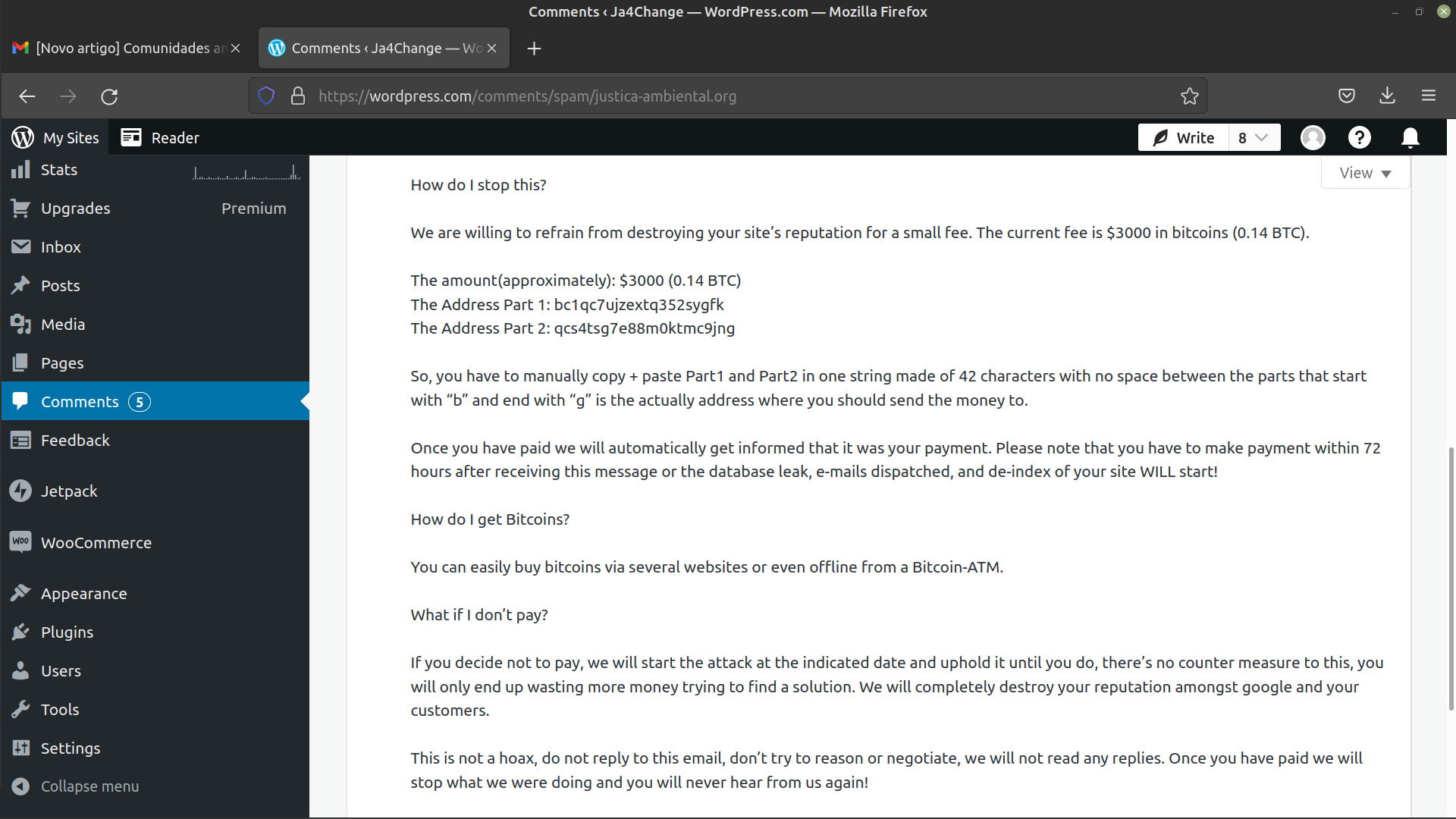
This weakness was recently exposed at JA in early January when we were hacked. Our web page was taken over and passwords changed, so we lost access to it. A ransom was demanded under the threat of deleting all the information. We first wondered if it was just a scam or bluff, but even if not, we do not entertain the option of ransom and do not reply or even attempt interacting with such threats. So we started the process of regaining access to our page. Unfortunately, while we were focused on recovering our web page, we hadn’t realize that the administrator’s laptop and JA’s main backup drive had also been hacked, only realizing this when the laptop stopped working and the backup drive deleted. This attack exceeded previous hacks or virus attacks, and exposed the effect of the smaller and regular cyber attacks in decreasing our alertness and urgency around the issue.
Luckily, we had a recent recovery drive for the laptop and we had received training on recovering deleted drives in the past. Unfortunately we didn’t manage to even get our linux based systems to identify the backup hard drive. After trying to recover the backup hard drive with other systems we gave up and had to take our backup drive to a specialist company that does data recovery at a high cost.
It took 3 weeks before we received the first batch of recovered data (almost 4TB), but the remaining data has been more complicated and we are still waiting for it, as well as the technical report from the company. However, we have been warned that the second batch of data has a lot of damaged files and is not organized in our original file system, it consists of thousands of files in dated folders that we will need to go through and reorganize.
The IT specialist also gave us some helpful information based on his findings. There was a common virus in the startup files and a concerning backdoor, similar to a well known old windows-based backdoor called “Banito”, but one that works on Linux systems. We also learnt that hackers had gained access to our accounts without needing to use passwords through the use of something called ‘session tokens’, that help you log in and out of your accounts without having to write the password. These tokens are stored on your computer cache and can be easily hacked through a redline stealer malware kit, in our case through a .scr screen saver file.
There were a few other odd/concerning threats found that were more complicated to understand, especially for us with our low IT IQ. Besides, the focus of the IT specialist was data recovery, they had not done a thorough analysis. Unfortunately, the cost to do a forensic analysis was too high and the most important part to analyse would be the hacked laptop, but by then we had already reformatted the laptop (with cycles of full hard drive rewrite and delete), and we could not hand it over for a forensic analysis due to it being in urgent use by the administrator.
Amidst such eventful weeks – with Cyclone Freddy, the flooding, the death of Mozambican rapper Azagaia and then the police violence at the march to honor him – we ended up delaying the publication of this post. Coincidentally, before we were about to post this, we found out that our Say No to Gas campaign site was also attacked by hackers, but given that the site was developed last year using more up to date software, and the developer was still doing the maintenance, he managed to block the attack.
We fear that these types of events may become more regular both from criminals and our governments, that have drastically increased investments in digital surveillance. Some countries, like Israel, have expanded their military oppression to digital surveillance and this has become a major business, with programs like Pegasus being exported to other regions such as Africa. This has contributed to African governments’ increased control and monitoring of civil society and oppression of critical voices. Digital surveillance has become central to these plans. Countries like Rwanda have shown the path forward for other African countries on how oppressive governments can control and suppress dissent, while not only getting a pat on the back from developed northern countries, but even turning their military and security sector into an economically productive sector servicing the northern countries dirty work. Digital surveillance and cyber attacks have become central to this model of oppression and human rights violations.







 JA4change