
Logo Florestal do Norte- Fonte: https://florestaldonorte.com/pt/pagina-inicial/
In the districts of Ribaué and Mecuburi, in Nampula Province, worrying signs are emerging of the continuation of practices that, in the recent past, gave rise to deep conflicts between local communities and the company Green Resources. Today, under a new name, Florestal do Norte SA, the same monoculture plantation model appears to be returning, shrouded in contradictions, lack of transparency, and serious doubts regarding the legality of the land access process.
In 2021, through document reference N/Ref. No 29/LGR-AA/2021, Green Resources announced the relinquishment of its Land Use and Benefit Rights (DUATs), in a process presented as a positive example of returning land to the Mozambican state. However, only a few years later, the same areas are once again the object of interest, now by Florestal do Norte SA.1
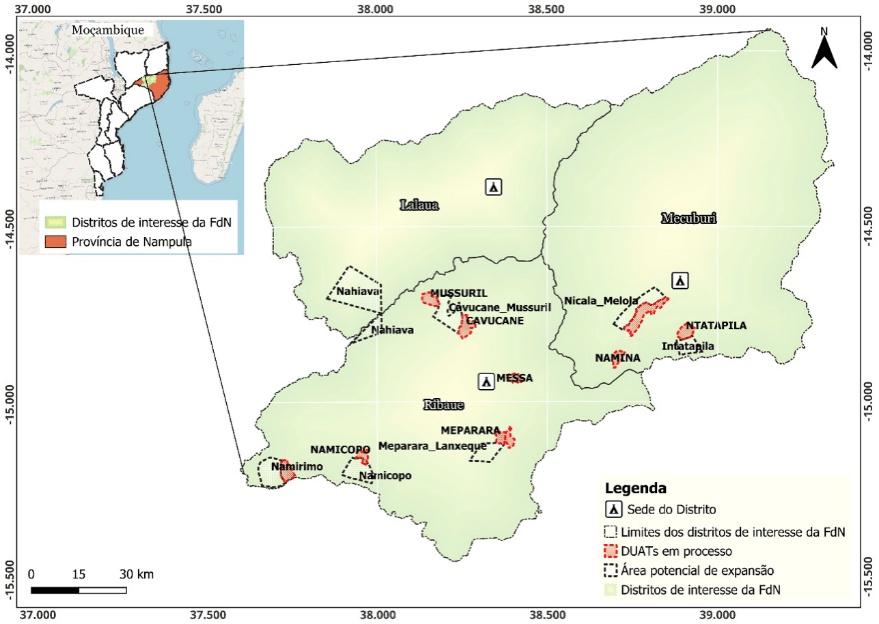
Área Florestal do Norte Fonte: https://florestaldonorte.com/
According to official information on its website, the new company, through the Nampula Reforestation Project, aims in the long term to restore, on a large scale, around 17,200 hectares of degraded land, using a combination of native and non-native tree planting, assisted natural regeneration, and agroforestry systems2—precisely in the areas previously occupied by Green Resources. According to representatives of the Provincial Environmental Services (SPA) in Nampula, it has already obtained provisional DUATs for some plots in 2024. This fact alone raises questions about the timing and unusual flexibility within Mozambique’s land administration system, whereby land recently returned to the state is reassigned to another entity. Once again, the law is being bypassed: according to provincial and district government authorities, Florestal do Norte SA already holds provisional DUATs, yet there is still no Environmental Impact Assessment process, which by law must precede the granting of DUATs, even on a provisional basis.
On the ground, the reality experienced by communities reinforces these concerns. In several localities, such as Messa and Cavucane, community members state that they did not participate in formal community consultations regarding the entry of the new company. Many confuse occasional meetings—often related to the land return process—with consultations for the installation of Florestal do Norte. In other cases, there were no consultations at all. This situation calls into question compliance with the principle of free, prior and informed consent, a fundamental right of indigenous peoples and local communities recognized internationally, which guarantees their ability to approve or reject projects, policies or activities affecting their lands, resources or way of life, free from coercion.3
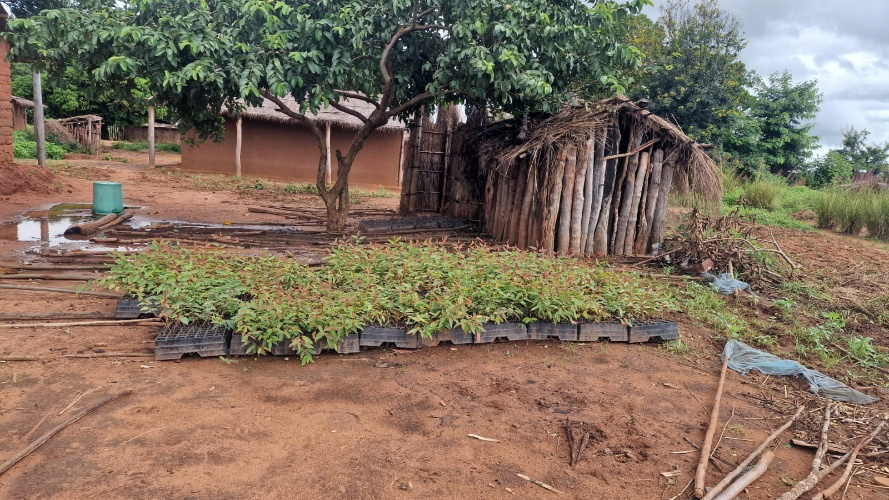
foto: Mudas de Eucalipto em Messa
The contradictions are not limited to the consultation process. While government representatives claim that the company has not yet begun activities on the ground, allegedly due to lack of funding, evidence on the ground suggests otherwise. In the communities of Messa and Intatapila, ongoing activities have been observed, including tree felling, land preparation, and the planting of eucalyptus and some native species. According to community members, these activities began as early as December 2025, information confirmed on the ground by Justiça Ambiental. Therefore, Florestal do Norte has been operating since December 2025 without an Environmental License, has now emerged as Director of Florestal do Norte SA—the company seeking to exploit the same areas and develop the same type of activity using the same strategies in clear violation of the law.
An additional factor reinforcing concern is the continuity of actors involved in this process. The former Director of Green Resources in Mozambique4 has now emerged as Director of Florestal do Norte SA—the company seeking to exploit the same areas and develop the same type of activity using the same strategies.5 It is important to note that, before serving as Director of Green Resources, he held several highly relevant positions within the state for many years, including as National Director of Land and Forests (DNTF) in the Ministry of Agriculture. As such, he had privileged access to land-related information, possessed deep knowledge of administrative processes, and maintains a well-established network of influence within the Ministry of Land and Environment. He likely knows exactly how to “accelerate” DUAT processes and how to navigate legal loopholes in community consultations. This overlap raises an unavoidable question: are we witnessing genuine change, or merely a reconfiguration of the same project under a different identity? Is this a classic example of how revolving doors between the state and the private sector facilitate the expansion of agribusiness and monocultures in Mozambique.
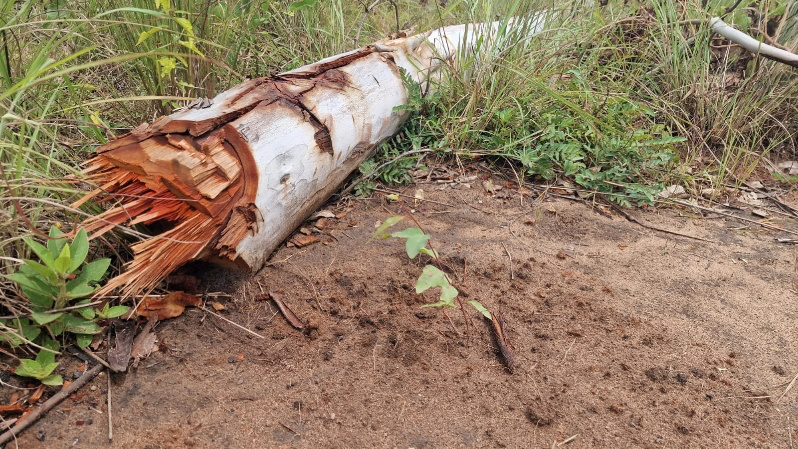
foto: Plantio de Eucalipto em Messa
It is important to emphasize that conflicts between communities and Green Resources remain unresolved. Many communities are still awaiting compensation, clarification, and justice6. Nevertheless, the Mozambican state, through its institutions, is moving forward with allocating these same lands to a new entity, without ensuring that inherited problems have been properly addressed.
It is worth recalling that Green Resources AS (GRAS), in partnership with USAID and the ILRG program, produced a report presenting a notable and innovative effort in the Mozambican context, implementing a divestment model aimed at repairing communities affected by land occupation for forest monocultures7. What initially appeared to be a positive example of land restitution to the state is now revealing more complex and troubling dimensions. The sequence of events—relinquishment, unresolved conflicts, rapid reassignment of the same areas, and continuity of actors—raises legitimate doubts about the transparency and integrity of the entire process.
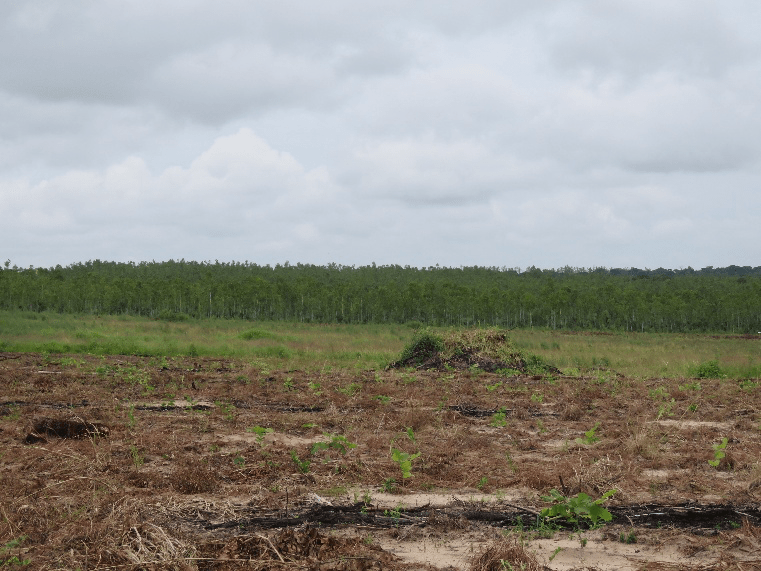
Foto: Plantio de Jambir em Intatapila
In this context, critical questions must be asked: who benefits from this reconfiguration? Who gains from the rapid reoccupation of the land? And what is the true role of public institutions in validating these processes? These questions become even more relevant at a time when Mozambique is undergoing a revision of its Land Legislation8. There is a risk that certain actors are seeking to secure control over large tracts of land before the approval of potentially more restrictive rules, in a kind of pre-emptive race to secure advantageous positions.
The facts observed in Nampula, together with the limited public information about the land return process, point to a troubling pattern: lack of transparency, limited community participation, and possible irregularities in land allocation processes. In this scenario, it becomes urgent to strengthen public scrutiny, ensure respect for community rights, and demand greater accountability from all stakeholders. Without this, the risk is clear: repeating the mistakes of the past—this time under new names, but with the same negative impacts on communities and the environment.
1 https://florestaldonorte.com/pt/anuncio-de-consulta-publica-projecto-de-restauracao-paisagistica-e-
reflorestamento-em-nampula-florestal-do-norte/
2 https://florestaldonorte.com/pt/projecto/
3 https://www.un.org/development/desa/indigenouspeoples/publications/2016/10/free-prior-and-informed-
consent-an-indigenous-peoples-right-and-a-good-practice-for-local-communities-fao/
4 https://www.wrm.org.uy//wp-
content/uploads/2017/04/The_Progress_of_Forest_Plantations_on_the_Farmers_Territories_in_the_Nacala_
Corridor_the_case_of_Green_Resources_Mocambique.pdf
5 https://www.wrm.org.uy/bulletin-articles/green-resources-mozambique-more-false-promises
6 https://justica-ambiental.org/2018/07/18/carta-com-as-demandas-das-comunidades-afectadas-pela-green-
resources/
7 Terra Firma (2023). Final Report on Responsible Land Disinvestment Activity with Green Resources AS:
Activities, Results, and Lessons Learned. USAID Integrated Land and Resource Governance Task Order under
the Strengthening Tenure and Resource Rights II (STARR II) IDIQ.
8 https://omrmz.org/wp-content/uploads/2023/05/Directrizes-Para-Um-Quadro-Politico-Legal-Sobre-Terras-
Inclusivo-e-Sustentavel.pdf

