Tag Archives: mozambique

Trapped – How to break a community that resists?

The case of Quitupo

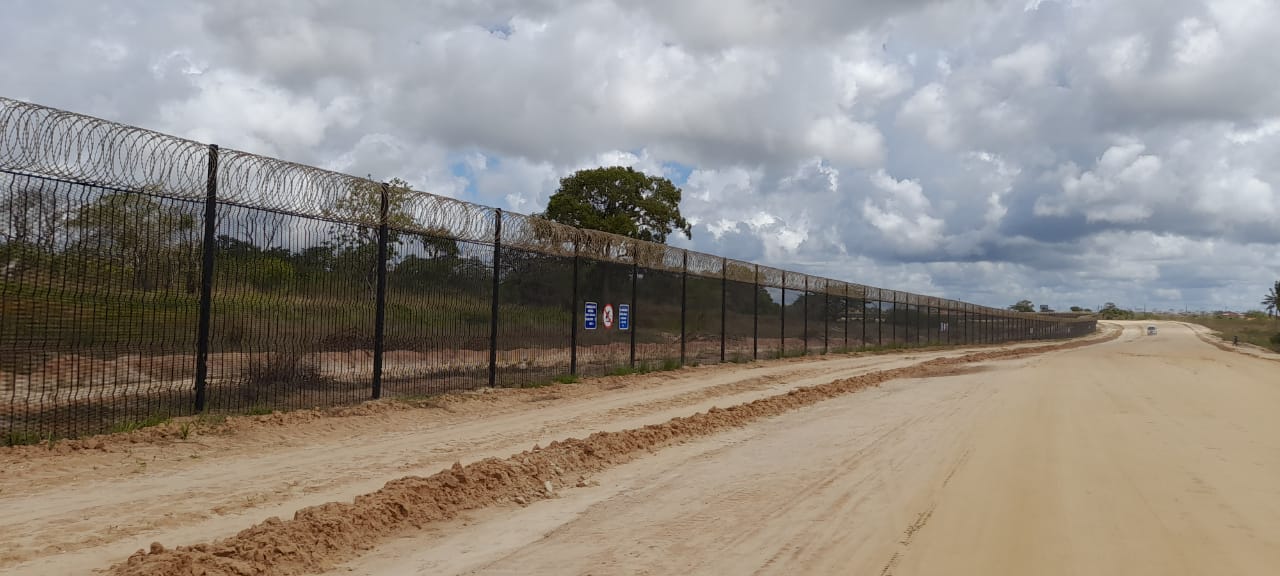
Located in the district of Palma, in the northern province of Cabo Delgado, the village of Quitupo is one of the district’s 63 villages1. In 2010, with the discovery of marketable quantities of natural gas in the Rovuma Basin, Quitupo joined the list of communities affected by the liquefied natural gas (LNG) production plant project, to be developed by TotalEnergies (formerly Total) in Palma. In the initial phase of the project, public consultation meetings in Quitupo were some of the most intense ever to be seen in the history of megaprojects in Mozambique. Indeed, the community of Quitupo hasn’t made life easy for gas investors. At the time, back in 2013, the process was led by Anadarko. The company came across a population that was, to some extent, informed about its rights, which resulted in local residents often walking out on meetings when the company failed to provide them with answers that satisfied their concerns. The community challenged the company – and the government – on the authenticity of the minutes of the public consultation meetings that paved the way for Anadarko’s acquisition of its land use title (DUAT) totaling 7,000 hectares (about 17,300 acres). The community of Quitupo even had to request emergency technical support and legal advice from civil society organizations such as Centro Terra Viva (CTV) and the Iniciativa para Terras Comunitárias (ITC), both of which already supported the community to build its capacity on legal issues. The village chiefs did not verify the signatures on the alleged minutes of the community consultation meetings2, instead claiming to have signed an attendance sheet of a meeting they were summoned to with the sole purpose of informing them there were investors who were interested in working in the district, offering employment and developing communities. Around 7,000 hectares (some 17,300 acres) were alocated to the project without the communities’ knowledge and consent. Clearly, the process was riddled with glaring irregularities and illegalities which the government has gone to great lengths to prevent from coming to light – irregularities that should put the government to shame. In a clear attempt to discredit and belittle the excellent work that was done on behalf of the communities, it was claimed that those civil society organizations involved in the process were against development, among other unflattering adjectives3. In a desperate attempt to prove that the process complied with legal requirements, the then Ministry for the Coordination of Environmental Action (MICOA), through the National Directorate for Environmental Impact Assessment (DNAIA) – the entity responsible for issuing environmental licenses –, even took part in a meeting which was most likely organized following a suggestion from the environmental consultants responsible for carrying out the environmental impact assessment study. Civil society organizations and other interested parties were invited to take part in the meeting, which was held at one of Maputo’s luxurious hotels. In a clear attempt to corroborate the transparency of the project, CSOs were summoned so that all the issues they raised could be addressed. Even so, it was not possible to clarify how the land use title was assigned before the environmental license process was completed. Through this meeting, it became clear that the process did not comply with legally defined steps. At one point in the meeting, it was impossible to distinguish who belonged to the government and who belonged to the company, given the need for both parties to justify and substantiate violations of laws approved and recognized by the government itself. During the consultations in Quitupo, the maps presented by Total were completely rejected by the communities. People said that the maps didn’t matter to them because they didn’t know how to read them, they would rather be shown the project’s boundaries on the ground4. The population did not feel intimidated by Anadarko’s technical teams boots and dark glasses, nor by the speeches of the then district administrator and not even by the elaborate speeches of the provincial directors for environment and mineral resources. The latter ones had to participate in the meetings to try to appease the feelings of the communities. None of these actions managed to convince the Quitupo community that they had to transfer their burial grounds and give up their fishing and farming areas in order to prioritize the exploration of natural gas. This process showed the strength of a community that was united and aware of its rights, and demanded to negotiate on its own terms. Regrettably, our communities are never given the opportunity to say NO; from an early age they are taught that what the government wants, the government gets – and if the government is our father, then we owe it respect even if that means overriding the respect that we are also owed. On the other hand, the communities are expected to pay eternal tribute to the ones who freed us from colonialism, which is why no decision should be challenged, only accepted. However, the reason why this whole situation was sorted out was when it was cleverly decided to create the famous ”resettlement committees” – groups that would represent the interests of the communities in the meetings with the project, and thereby avoid the “hassles” that were present in the initial meetings. These committees were initially made up of influential people who were respected by the communities and who played the role of mediators in the process of signing the agreements between community members and the company. The truth is that the idea of setting up these committees included the subtle courtesy of paying the members of said committees a monthly fee, the humble amount (for people living on the poverty line) of 7 thousand meticais, paid for by Anadarko. Many of the concerns expressed by the communities in the initial meetings quickly ceased to be of concern, without ever having been properly addressed. After receiving some of the fees paid for by the company, the committees started to no longer truly represent the interests of the communities. One of the first steps that were taken was to expel the members of the committees who insisted on raising questions considered to be from the past, especially questions relating to the submission of minutes from the community consultation meetings regarding the acquisition of the land use title, new fishing areas and transfer of graveyards. In addition to the exclusion of members who refused to be manipulated, complaints began to emerge about the committees’ inability to deal with the numerous complaints made by those who felt economically or physically impacted. Especially in cases where there were internal squabbles typical of small villages, people would not even bother going to the committees because they felt that, if one has personal issues with a committee member, your matter would not even reach the company, where the appropriate channels could be used to submit complaints and restitute rights as was often necessary. Stunned by the number of complaints that our focal point received, Justiça Ambiental actually tried, in August 2019, to contact the committee to better understand what was going on. We were surprised by the fact that, in order to see a civil society organization, the committee requested a government credential and that we be accompanied by a government official. At that moment, we realized that these committees no longer served the interests of the people who appointed them to represent them, which – unfortunately for the people of Mozambique – is nothing new. In a fuzzy way, and in Mozambican style, the comments regarding the legality of the minutes of the community consultation meetings that cleared the way for the attribution of land to the American multinational were muffled. The project kicked off and all the measures foreseen in the resettlement process were initiated so that the transfer of families could proceed according to plan. Then, in 2016, the Mozambican Bar Association (OAM) requested that the Administrative Court5 nullify the document, which was issued after project activities began. However, once again the government and the institutions that represent it came to the project’s defense6. Without apparently analyzing the essence of the application, the Administrative Court simply argued that the communities were satisfied with the resettlement process and the financial compensations; however, no reference was made to the illegality of the land use title. Anadarko’s original project, which is now owned by Total, provided for the resettlement of around 733 families from Quitupo. The community resettlement process started in July 2019 with the residents of Milamba village being the first to be resettled. The village’s 33 families were the first to receive the houses built by Anadarko. The resettlement process in Quitupo began in March 2020, but only 161 families from the community were resettled, with the majority remaining in the village awaiting their turn. While the resettlement process was under way, a fence began to be erected around the supposed limits of the production plant, leaving the Quitupo community trapped and without permission to develop farming and fishing activities within the fenced area. Currently, the community is forced to leave the fenced area to look for alternatives to their survival in areas where they are allowed to farm or fish in Senga, Maganja, Monjane, Macala and Palma Sede.

When questioned about the need to support the communities that remain in Quitupo without any means of subsistence and without support from the company while they wait for their resettlement, Total’s team replied there wasn’t much that could be done. They said that they don’t provide support and do not allow the land inside the fence to be used to avoid future conflicts with the communities as they fear that activities may resume at any time; if that happens, families which have crops in the fields will demand compensation for the loss, whereas Quitupo has already gone through the compensation process and people already received compensation up for their losses. They even expressed willingness to receive proposals to solve the problem that they recognize the community is facing due to the construction of this fence. Construction of this fence raised great concern on the part of the communities, and their greatest fear gradually materialized: the total loss of their land. However, after the attack in Palma on March 24, 2021, Total – which heads the Mozambique LNG consortium – suspended its activities by issuing a declaration of force majeure, thus also suspending the ongoing resettlement process. This interruption left at least 572 families from the community of Quitupo fenced in and trapped within their own village. In addition to losing their land, these families have not yet received the lands they were promised as compensation. In fact, it is clear that farming land compensations are the great Achilles heel of megaprojects in Mozambique and the giant Total doesn’t have much room to guarantee land to the resettled communities. Those few who managed to secure land compensations in Senga and Macala are engaged in conflict with the host communities who complain about irregularities in the compensation process. Families who remain in Quitupo are living in total uncertainty, without even knowing if they will receive a house given that some of the houses are still under construction; they also feel restricted about making improvements to the houses they currently live in since a moratorium was declared in 2017. Following the attacks that took place in Palma on March 24, 2021, Total declared force majeure7, which covers the occurrence of unforeseen events. However, considering the area has been under attack for the past five years and one of the attacks in 2019 took place about 7km from Total’s camp, it seems a bit simplistic to regard the attack on the village of Palma as unpredictable. The reality is that, once force majeure was declared, activities in Palma, including the resettlement process, were suspended. While Total decides whether or not it is safe to return to Afungi, families from Quitupo and other families already resettled in Vila de Quitunda who find themselves in a similar situation – with no land, no compensation (especially due to complaints) and no support – have no option but to look for other ways to survive and to guarantee adequate food for their families, not to mention the situation of constant insecurity they live in. More than two years after they lost their land, and more than a year since they started living in a fenced area, the families of the community of Quitupo have not yet seen and do not see the alleged benefits of gas exploration projects in Cabo Delgado. Their suspicions and resistance proved right. Despite their union and courage, they are still trapped by a development model that disregards the rights and wishes of the people, and leaves the door wide open for large multinational companies.

  References:

Mário, T.V e Bila, I.M (2015), Indústria Extractiva e Comunidade: Questões sobre comunicação, Consultas Públicas, e impactos económicos, sociais e ambientais sobre comunidades rurais em Tete e Cabo Delgado - sekelekani.org.mz

Salomão, A. (2021), Governação Participativa de Terras em Moçambique: Breve Revisão do Quadro Legal e Desafios de Implementação, Revista Ambiente & Sociedade, São Paulo. Vol. 24.

Oliveira, L.T (2018), “Na República de Moçambique temos a lei” Política de terras, sentidos da terra e conflito no litoral norte de Moçambique, Universidade de Brasília, Centro de Estudos Avançados Multidisciplinares.

Tagged , ,

Petition to stop the Mphanda Nkuwa dam project submitted to the Assembly of the Republic

Mozambican organisation Justiça Ambiental (JA!) last Wednesday (December 21st) submitted a petition with more than 2,600 signatures from Mozambican citizens to demand that the controversial Mphanda Nkuwa dam project, proposed for the Zambezi River, cease immediately.

The terms under which the Mphanda Nkuwa hydroelectric project was conceived, and under which it is proceeding, do not comply with the fundamental objectives of the Mozambican State enshrined in Article 11 of the Constitution of the Republic, especially with regard to human rights and equitable development. Furthermore, this project entails very high environmental, ecosystem, climate, seismic, social and economic risks, which have not yet been properly assessed and studied by the Mozambican government. Despite these risks, and the numerous requests for clarification and information submitted by Justiça Ambiental to the government and to the Mphanda Nkuwa Hydroelectric Project Implementation Office (GMNK), the project has been moving forward, in this new phase, since 2018, in an accelerated manner and without due public scrutiny.

Furthermore, the project is also in violation of articles 21, 22 and 24 of the African Charter on Human and Peoples’ Rights, which establish peoples’ right to the free disposal of the use of natural resources and prevent them from being deprived of their use; the right to choose the model of economic development, social and cultural with strict respect for their freedoms and identity; and the right to a balanced environment conducive to their development.

It should be noted that, although the project has been under way for 4 (four) years in this new stage, no public consultation related to the project has yet been carried out, nor has any consultation taken place with the local communities that will be directly and indirectly affected by it. This is in clear violation of several guidelines and principles followed by Mozambique regarding the protection and promotion of the right of free, prior and informed consent (FPIC).

With this petition, the more than 2,600 undersigned Mozambican men and women demand that an open, inclusive and comprehensive dialogue is promoted and that the Mozambican government fully clarify the outlines, objectives and rationale behind this “priority” project, including:

• Where does the investment come from and what is the trade-off?

• Why is this project a priority for the country, considering our levels of poverty and inequality; that thousands of children have no place in school, and that there aren’t adequate health services for everyone?

• What is the reason for insisting on this project, which has already been abandoned so many times? What other interests exist behind a project of this dimension?

• Have other energy alternatives been considered? If yes, which ones?

• Who will be responsible for compensating the communities that have had their future mortgaged for the past 20 years, unable to invest in their community and in necessary infrastructure due to fear of losing their investments, since in 2000 they were advised by the government not to build any new infrastructure?

• What is the real purpose of the dam and what supposed gains do they believe the country would reap in the short and long term, including how do they intend to generate financial returns?

We also demand the elaboration of scientifically valid and impartial studies that respond to all the questions that have been raised since the approval of the environmental impact study in 2011, such as:

• Uncertainty about the flow regime under which the dam will operate (base-load or mid-merit);

• Lack of definition on the area chosen for resettlement of the communities directly affected by the dam;

• Poor sediment analysis elaborated with insufficient data, which does not allow for a valid scientific analysis;

• Weak seismic analysis, without concrete data and with results and conclusions that contradict other studies by renowned specialists;

• Weak analysis of the potential impacts of climate change and changes in upstream water demand, which will affect the project’s economic viability;

• The fact that the guidelines of the Worldwide Commission on Dams were not considered or followed, particularly with regard to social and environmental rights and justice, among others;

• Viable energy alternatives for the country, comparing and analyzing the respective benefits and impacts;

• How the project will ensure that the gains generated by the dam will not be appropriated by a small economic and political national elite, and by large multinational companies.

We furthermore demand that an open, inclusive and comprehensive dialogue be promoted around clean, fair and accessible energy solutions for all Mozambican men and women, so that we can embark on a sustainable development that ensures the protection of the important ecosystems that guarantee life on the planet.

Justiça Ambiental also calls for this matter to be dealt with as a matter of urgency, considering the growing and concerning scenario of intimidation and threats that we have observed in the context of our work in the District of Marara, including accusations of terrorism, demand for “authorisation to work on site”, and indication that local communities should not receive legal training on their rights or information on the impacts of dams. Several members of the communities that will have to be resettled to make room for this mega-project have also reported threats, intimidation and ‘warnings’ not to speak out against the project.

In addition to the signatures collected in the District of Marara, in Maputo City and throughout the country, more than 70 national, regional and international non-governmental organisations also signed the petition in online format, in solidarity.

It’s time to say STOP to a development model that enriches our elites and large multinational corporations, at the expense of most of the population and of nature. Let’s together demand clean, decentralised energy projects that benefit the Mozambican people!

Read the full text of the petition on the Justica Ambiental webpage:

In English: https://ja4change.org/2020/12/16/save-the-zambezi-river-from-the-mphanda-nkuwa-dam/

In Portuguese: https://justica-ambiental.org/2020/12/16/salve-o-rio-zambeze-da-barragem-de-mphanda-nkuwa/

#MphandaNkuwaNão

Tagged , , , , , ,

Communities threatened by the Mphanda Nkuwa dam project are accused of being”terrorist” for having traveled to a workshop in Maputo


Being labelled 'terrorists' is the latest strategy to intimidate, threaten, and arbitrarily detain people who hold anti-government positions. This is happening in various parts of the country, in Mozambique, and in particular in the district of Marara, Tete province, where the government intends to build the Mphanda Nkuwa hydroelectric dam, a highly controversial project that has never responded to the numerous environmental, social, economic and climate change questions that have been raised by civil society organizations and experts from Mozambique and other countries.

Recently, from the 22nd to the 25th of November, the Mozambican organization Justiça Ambiental (JA!) organized its 6th Maputo Workshop on Corporate Impunity and Human Rights, which brought together representatives of various civil society organizations, government representatives, academics, lawyers, activists and people affected by megaprojects from across the country. Several participants came from the district of Marara in Tete province, including the community leader from Chirodzi-Nsanangue, one of the communities at risk of being resettled if the proposed Mphanda Nkuwa dam is built.

While in Maputo, the leader received several calls from community members warning him that the local authorities were very unhappy with his trip to Maputo and were mobilizing the community to elect a new leader.

A few days after returning home, the leader received a notification to report to the District Command of Marara in order to be interrogated. Arriving at the Command, the leader was retained for 10 hours, he was denied the right to be accompanied by the lawyer who was accompanying him, he was accused of being a terrorist and was questioned about his trip to Maputo by the District Commander of Marara, an agent of the National Criminal Investigation Services (SERNIC) and a representative of the Ministry of Defense. Finally, he was asked to list the names of all the members of his community who had traveled to Maputo to participate in the Workshop. The leader was released around 6:30pm without any further clarification.

JA! members who were on the site following the events were also accused of terrorism, and informed that they should not be providing information to local communities regarding the impacts of dams, or problems caused by other megaprojects in the country. All of this seems to be a strategy to intimidate members of communities that will be affected by the Mphanda Nkuwa dam project and prevent them from defending their rights.
A few days later, all the 10 other people from Chirodzi and Chococoma who had participated in the Workshop were also notified to report to the District Command of Marara on the 8th, including JA!’s focal person in the community, in order to be interrogated too.
A big movement of solidarity with the community members being threatened emerged, from several parts of the country and even other countries. By the time the 10 community members arrived at the District Command on the 8th, the news about this were circulating widely on social media and radio stations. They were brought inside to be questionned about the Workshop, but at this point, no further threats were made apart from the intimidating presence of armed police officers. JA!’s focal point was interrogated separately, and then asked to leave the room, and the rest of our team was not allowed inside. They were all released a few hours later.
It should be noted that these situations are not isolated cases, and are part of a series of other threats and restrictions that have been made to members of JA team! working in the District of Marara. On several occasions, the District Commander of Marara and the Heads of the Administrative Post and Locality of Marara requested JA!’s credentials and authorization from the police to work on the area, something that is not required by law. In addition, several other members of the Chirodzi-Nsanangue community who have raised criticisms or questions about the dam have reported increasing intimidation and threats since August 2022, when the government, its partners and interested companies began to visit the area in this new stage of the Mphanda Nkuwa dam project.
We demand clarification from the different State actors involved in these intimidations, including the Mphanda Nkuwa Hydroelectric Project Implementation Office: is this is how the local people are forced to accept 'development' projects?

We demand a positioning from government advisors, financiers and potential investors of the Mphanda Nkuwa project, such as the African Development Bank (ADB), the International Hydroelectric Association (IHA), the Norwegian Development Agency (NORAD), the Kingdom of Norway, the Government of Switzerland, the European Union (EU): are you willing to have your name on a project that is already contributing to the violation of human rights and fundamental freedoms of local communities?


For more information, please contact: jamoz2010@gmail.com
Tagged , , ,

Stop Gassing the Continent! – COMMUNIQUE OF OILWATCH AFRICA CONFERENCE 2022

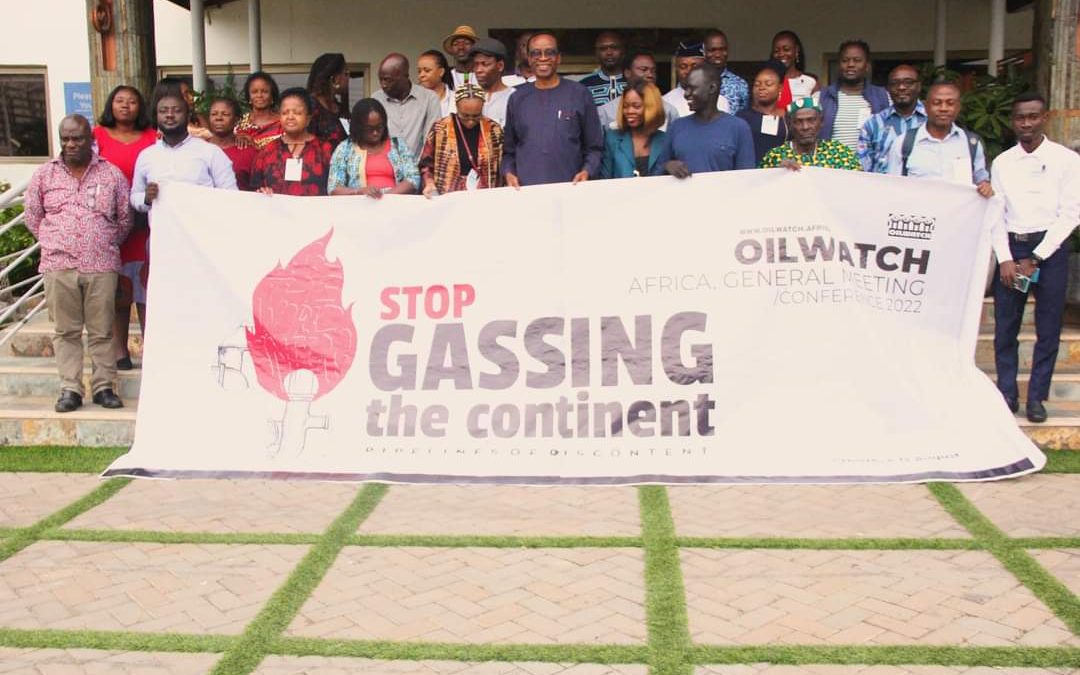
Oilwatch Africa (OWA) held the 2022 Conference and Annual General Meeting at Accra, Ghana between 8th -12th August. The theme of the continental gathering was Stop Gassing the continent: Pipelines of Discontent. The Conference had presentations and representation from CSOs, activists, scholars, journalists, fisherfolks and Eco-defenders from fossil fuels-affected communities across the continent and provided another opportunity to deepen OWA’s mission as a network of peoples and organisations building solidarity to end expansion of oil and gas activities given its negative impacts on people and the environment in Africa.


Key observations made by delegates included:

  • That the current rush for Africa’s oil, gas and mineral resources amounts to a perpetuation of extractive modes of colonial exploitation, which condemned the continent to predatory slave trade, followed by the massive raping of agricultural and forest resources, before the current iteration with its focus on minerals and fossil fuels.
  • That the argument that Africa deserves to utilise its natural resources for energy sufficiency and development belies the fact that extraction of natural resources has historically been export-driven for the benefit of the consumption needs of the global north and scarcely targets the needs of the continent and the rhetoric by African leaders that fossil fuels could be utilised by the continent as a “less harmful” transition fuel is a delusion as gas contributes massively to climate change through its methane content.

  • That the continuous financing and development of massive pipeline projects such as the East African Crude Oil Pipeline (EACOP) project, the West African Gas Pipeline Project WAGP, and the Trans-Saharan Gas Pipeline, among others constitute an aggression on the land rights of communities and portend massive livelihood disruptions, conflicts, human rights abuses, and environmental degradation across the continent.
  • That the current trend in which multinational oil and gas companies sell off their stakes in onshore oil and gas assets and move out of African countries or further offshore amounts to an abdication of responsibility for historical damage caused by their activities in these countries.
  • That the Paris Agreement and its 1.5 degrees Celsius target as driven by the so-called Nationally Determined Contributions (NDCs) is a huge betrayal for Africa as the continent warms at about 50% above the global average, meaning that going by the NDCs, Africa is condemned to literally burn at the best of scenarios.
  • That Africa is rich in renewable energies and given the growing competitiveness of clean energy technologies and has the potential to advance its energy transition along a zero-carbon pathway. For instance, Africa has the world’s highest solar potential but currently accounts for just one.
  • That industrialised countries have demonstrated insincerity by routinely spending close to $2 trillion annually on military hardware and warfare while foot-dragging on climate commitments, especially adaptation finance.
  • That emerging global and regional policy norms around a so-called blue economy revolution, constitute a massive threat to African coastal communities’ maritime and aquatic resources, and the continent’s environment, and will further incentivize illegal and overfishing in her waters.
  • That there has been a rise in the victimisation of Eco-defenders across the continent by oil companies and their state collaborators, and this repressive climate has been worsened in recent times by the proliferation of so-called oil and gas regulatory reforms (such as Nigeria’s Petroleum Industry Act 2021) that shrink civic space by constraining the voice and agency of extraction-affected communities in decision making related to their natural resources and environment.


Oilwatch Africa denounced efforts to lock Africa in the exploitative fossil fuels pathway to meet the energy needs of polluting nations and to feed the greed of the fossil fuels industry. To ensure a just transition and secure climate justice for our peoples, the conference made the following demands:

  1. There must be a halt to all new coal, oil, or gas exploration and extraction activities in Africa in line with the imperatives of the energy transition. We specifically demand the stoppage of oil exploration and expansion plans in the Virunga basin of the DRC, the Keta region of Ghana, the Okavango Delta of Botswana, the Orange River Basin in Namibia, and a halt on all plans for the West African Gas Pipeline Project, the Trans-Saharan Gas Pipeline Project, and the East African Crude Oil Pipeline Project, among others.
  2. That African governments must leverage the hosting of COP27 this year to demand far-reaching measures on climate adaptation and finance, including emissions cut at the source.
  3. African governments should demand from polluting industrialised countries an annual climate debt of $2 trillion being the amount they currently spend on military hardware and warfare annually. This will pay for loss and damage and serve as partial reparations for historical harms.
  4. That oil and gas multinationals currently planning to divest and escape responsibility for their historical damage to African communities (such as Shell and Exxon Mobil in Nigeria’s Niger Delta) should restore the environment and compensate communities for ecocide committed in their territories before their exit.
  5. African states must develop Africa-centred and just energy transition plans where such do not exist and where they do, to mainstream such plans into broader national development plans in ways that take cognizance of Africa’s huge renewable potential.
  6. African countries and the African Union must tread with caution to the so-called blue economy, and especially denounce unconditionally all attempts to normalise Deep Seabed Mining (DSM) within the continent.
  7. International Financial Institutions, including the African Development Bank and export credit agencies to cut all financing to fossil fuel projects in Africa
  8. African governments and international organisations to respect the right to life of human rights and Eco-defenders in the continent who are increasingly repressed.

Adopted on the 11th of August 2022, by Oilwatch Africa members and organisations from:

  1. Côte d’Ivoire
  2. Democratic Republic of Congo
  3. Ghana
  4. Kenya
  5. Mozambique
  6. Nigeria
  7. Senegal
  8. South Africa
  9. South Sudan
  10. Swaziland/Eswatini
  11. Tchad
  12. Togo
  13. Uganda

Organisations/Networks:

  1. FishNet Alliance
  2. Policy Alert
  3. We the People
  4. Peace Point Development Foundation
  5. Oilwatch Ghana
  6. Oil Change International
  7. Host Communities Network, Nigeria
  8. Environmental Rights Action/Friends of the Earth Nigeria
  9. Kebetkache Women Development Centre
  10. Foundation for Development in the Sahel (FDS)
  11. Health of Mother Earth Foundation
  12. Africa Institute for Energy Governance (AFIEGO)
  13. Jeunes Volontaires pour l’Environnement (JVE)
  14. Justiça Ambiental (JA)
  15. Ground Work
  16. Friends of Lake Turkana
  17. Femmes Solidaire (FESO)
  18. Centre for Research and Action on Economic, Social and Cultural Rights (CRADESC)
Tagged , , , , , ,

TOTAL’S 2021 15 BILLION EUROS PROFIT COMES AT THE EXPENSE OF THE PEOPLE OF THE GLOBAL SOUTH

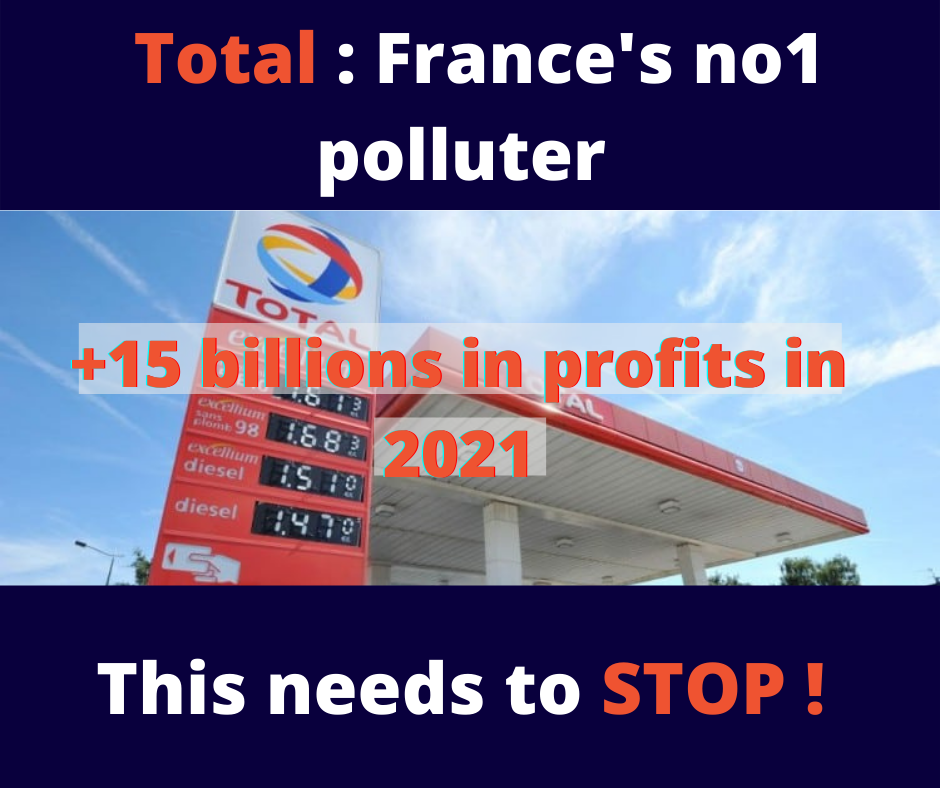
This week, Total announced that in 2021 it made 15 billion Euros, the biggest profits any company has ever made in French history. They are unashamedly boasting about this money, money that will go to wealthy European shareholders, money that they have made at the expense of the climate and people and the environment in the global South.

Total is one of the biggest players in Mozambique’s gas industry, leading the Mozambique liquid Natural Gas (LNG) project and is constructing the onshore Afungi LNG Park, which houses the aerodrome, treatment plants, port, offices and other support facilities for all the projects. To make way for the 70 square kilometre park, the company displaced over 550 families, thousands of people, from surrounding communities.

Even though extraction hasn’t even happened yet, fishing communities who had been living mere metres from the ocean for generations were displaced to a ‘relocation village’ more than 10 km inland, with no way of getting to the sea. Farmers who had now lost their land, were given small, inadequate pieces of land far from the relocation houses they had been given.

Their ‘consultation’ process with these communities has been a joke. In meetings between communities and companies, community leaders – many of whom have developed financially beneficial relationships with the industry – are present, and people avoided speaking out for fear of losing their compensation, or of physical threats. This is exacerbated by communities’ lack of basic knowledge law, thereby unable to demand their rights.

JA! works closely with communities on the ground in the gas region, and have seen how the only jobs created for locals were menial, unskilled and temporary. Communities’ complaints to Total about irregular compensation payments were waved away. And now that Total’s project was paused in April 2021, they have stopped compensation payments completely.

The project will also have irreversible impacts on the climate and destroy coral reefs and endangered species of the UNESCO Biosphere, the Quirimbas Archipelago.

But Total’s crimes go beyond Mozambique, to many other Southern countries. One of their planned projects, the East Africa crude Oil Pipeline (EACOP) has been the subject of major campaigns by civil society and even a lawsuit in France by Friends of the Earth France. According to the StopEACOP Campaign:

“Stretching for nearly 1,445 kilometers, the East African Crude Oil Pipeline (EACOP) would have disastrous consequences for local communities, for wildlife and for the entire planet – we have to stop it. The project threatens to displace thousands of families and farmers from their land. It poses significant risks to water resources and wetlands in both Uganda and Tanzania – including the Lake Victoria basin, which over 40 million people rely upon for drinking water and food production. The pipeline would rip through numerous sensitive biodiversity hotspots, and risk significantly degrading several nature reserves crucial to the preservation of threatened elephant, lion and chimpanzee species.”

To read more about EACOP see: https://www.stopeacop.net/

In Myanmar, Total was providing the oppressive military junta with the majority of its revenue, from its Yadana gas project. The military junta is known for ethnic cleansing of the Rohingya population, and mass human rights violations including rape, sexual abuse, torture and disappearances of protestors. Recently Total claimed it would stop its operations in Myanmar, but again, it will be getting away with the destruction it has left in is wake.

Total has also been active in the Taoudeni basin of Mali in the Sahel since 1998. Since 2013, over 3000 French troops have been in Mali, and 4 other Sahel countries, with France using the same rhetoric as they and Rwanda have done in Mozambique: to rid the area of ‘jihadists’.

In Yemen, the Balhaf LNG site of which Total owns 39% was exposed for housing the base for the Shabwani Elite, an UAE-backed tribal militia since 2016. Officially a counter-terrorism group, they have unofficially become known as a group created to protect fossil fuel interests. The site also has also been exposed to house UAE notorious ‘secret prisons’ holding Yemeni detainees.

For more see https://ja4change.org/2021/10/22/france-rwanda-and-total/

in the week of the announcement, many organisations from around the world held a social media storm, where tweeted about Total’s actions and ‘hijacked’ their twitter, facebook and linkedIn accounts.

It is inhumane that Total and its shareholders use their profits to have oysters and champagne in Paris’ restaurants, while this money comes by violating the rights of human beings, their bodies, the environment and the climate.

In Mozambique, Total must stop the gas exploitation entirely, but it cannot slink away from the mess it has already made. It must take responsibility and provide reparations for all the lives destroyed, all the lands grabbed, and the livelihoods lost.

Total must stop its destruction all over the global south, and the world, but that by itself does not erase years of abuse and dispossession overnight! Total and the fossil fuel industry gas industry must be held accountable for the impacts and human rights violations faced by affected communities and be obliged to fully compensate the communities and remediate the damage caused!

Tagged , , , , , , , ,

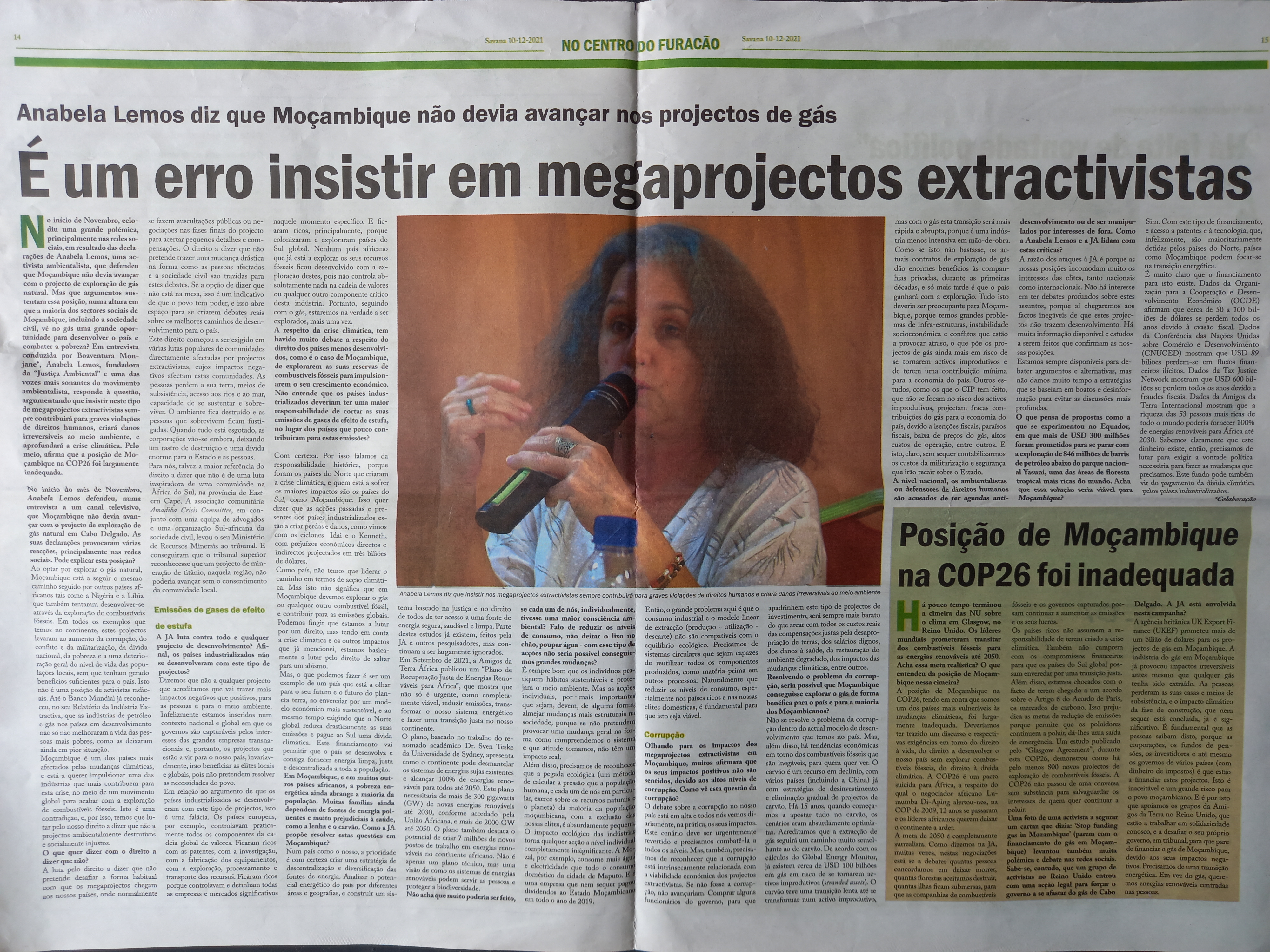
It is a mistake to insist on extractive mega-projects”

Anabela Lemos says Mozambique should not move forward with gas projects

This interview was originally published in Jornal Savana in Portuguese on 10th December, 2021.

At the beginning of November, a great controversy erupted, mainly on social networks, as a result of statements made by Anabela Lemos, an environmental activist, who argued that Mozambique should not proceed with the natural gas exploration project. But what arguments support this position, at a time when most social sectors in Mozambique, including civil society, see gas as a great opportunity to develop the country and fight poverty?

In an interview conducted by Boaventura Monjane*, Anabela Lemos, founder of “Justiça Ambiental” and one of the loudest voices in the environmental movement, responds to the question, arguing that insisting on this type of extractivist mega-projects will always contribute to serious violations of human rights, will cause irreversible damage to the environment, and will deepen the climate crisis. She also claims that Mozambique’s position at COP26 was largely inadequate.

At the beginning of November, in an interview to a television channel, Anabela Lemos stated and defended that Mozambique should not proceed with the natural gas exploration project in Cabo Delgado. Her statements provoked several reactions, mainly on social media. Can you explain this position?

By choosing to explore natural gas, Mozambique is following the same path followed by other African countries such as Nigeria and Libya that have also tried to develop through the exploration of fossil fuels. In all the examples we have on the continent, these projects have led to an increase in corruption, conflict and militarisation, national debt, poverty and a general deterioration in the standard of living of local populations, without having generated sufficient benefits for the country. This is not a position of radical activists. Even the World Bank has acknowledged, in its Extractive Industry Report, that the oil and gas industries in developing countries have not only failed to improve the lives of the poorest people, but have made them even worse off.

Mozambique is one of the countries most affected by climate change, and is looking to boost one of the industries that contributes most to this crisis, in the midst of a global movement calling to end the exploitation of fossil fuels. This is a contradiction and therefore we have to fight for our right to say no to environmentally destructive and socially unjust projects.

What do you mean by the right to say no?

The fight for the right to say no aims to challenge the usual way in which mega-projects are allowed in our countries, where public consultations or negotiations are carried out in the final stages of the project only to agree on small details and compensations. The right to say no aims to bring about a drastic change in the way affected people and civil society are brought into these debates. If the option of saying no is on the table, it is an indication that the people have power, and this opens up space for creating real debates about the best paths for development for the country.

This right started being demanded in several popular struggles of communities directly affected by extractivist projects, whose negative impacts affect these communities. People lose their land, livelihoods, access to rivers and the sea, ability to support themselves and to survive. The environment is destroyed and the people who survive are harassed. When everything is exhausted, corporations leave, leaving a trail of destruction and a huge debt for the State and the people.

For us perhaps the greatest reference to the right to say no is an inspiring struggle of a community in South Africa, in the Eastern Cape province. The community association Amadiba Crisis Committee, together with a team of lawyers and a South African civil society organisation, took its Ministry of Mineral Resources to court. And they got the higher court to recognise that a titanium mining project in that region could not proceed without the consent of the local community.

Does JA! fight against any and all development projects? After all, didn’t the industrialised countries develop with these types of projects?

We say no to any project that we believe will bring more negative than positive impacts for the people and the environment. Unfortunately, we are part of a national and global context in which governments are captured by the interests of large transnational corporations, and therefore the projects that are coming to our country will invariably benefit local and global elites, as they are not intended to solve the needs of the people.

Regarding the argument that industrialised countries developed with these types of projects, this is a misconception. European countries, for example, controlled virtually every component of the global value chain. They got rich from patents, from research, from manufacturing the equipment, from exploring, processing, and transporting resources. They became rich because they controlled and owned all the significant companies and markets at that particular time. And they got rich mainly because they colonised and exploited countries in the Global South. No African country that is already exploiting its fossil resources has developed from the exploitation of these, as it controls absolutely nothing in the value chain or any other critical component of this industry. So, regarding the gas, we’re actually being exploited once again.

Regarding the climate crisis, there has been a lot of debate about the right of less developed countries, such as Mozambique, to exploit their fossil fuel reserves to boost their economic growth. Don’t you think that industrialised countries should have a greater responsibility to cut their greenhouse gas emissions, rather than countries that have contributed little to these emissions?

Certainly. That is why we speak of historical responsibility, because it was the countries of the North that created the climate crisis, and the countries of the South, such as Mozambique, are suffering the greatest impacts. This means that the past and present actions of industrialised countries are creating damage and losses as we saw with cyclones Idai and Kenneth, with direct and indirect economic losses projected at $3 billion.

As a country, we don’t have to lead the way in terms of climate action. But this does not mean that in Mozambique we should explore gas or any other fossil fuel, and contribute to global emissions. We can pretend we’re fighting for a right, but given the climate crisis and the other impacts I’ve already mentioned, we’re basically fighting for the right to jump into an abyss.

But we can be an example of a country that is looking to its future and the future of planet earth, by moving towards a more sustainable economic model, while demanding that the Global North drastically reduce its emissions and pay the South a climate debt. This financing will allow the country to develop and be able to provide clean, just and decentralised energy to the entire population.

In Mozambique, and in many other African countries, energy poverty still affects the majority of the population. Many families still depend on polluting energy sources that are very harmful to health, such as firewood and charcoal. How does JA! propose to resolve these issues in Mozambique?

In a country like ours, the priority is certainly to create a strategy of decentralisation and diversification of energy sources, analyse the country’s energy potential by different areas and geographies, and build a system based on justice and the right of everyone to have access to a safe, healthy and clean energy source. Part of these studies already exist, completed by JA! and other researchers, but they continue to be largely ignored.

In September 2021, Friends of the Earth Africa published a “Just Recovery Renewable Energy Plan for Africa” which shows that it is not only urgent but completely feasible to reduce emissions, transform our energy system and make a just transition in our continent.

The plan, based on the work of renowned academic Dr Sven Teske of the University of Sydney, outlines how the continent can dismantle existing dirty energy systems and achieve 100% renewable energy for all by 2050. This plan would require more than 300 gigawatts (GW) of new renewable energy by 2030, as agreed by the African Union, and over 2000 GW by 2050. The plan also highlights the potential to create 7 million new jobs in renewable energy on the African continent. It is not just a technical plan, but a vision of how renewable energy systems can serve people and protect biodiversity.

Don’t you think that a lot could be done if each of us, individually, had greater environmental awareness? I’m talking about reducing consumption levels, not throwing garbage on the floor, saving water – with these types of actions wouldn’t we be able to achieve major changes?

It is always good for individuals to practice sustainable habits and protect the environment. But individual actions, as important as they are, must somehow aim at more structural changes in society, because if they are not intended to bring about a general change in how we understand the system and what attitude we take, they have no real impact.

Furthermore, we need to recognize the ecological footprint (a method of calculating the pressure that the human population, and each of us in particular, exerts on natural resources and the planet) of the majority of the Mozambican population; with the exclusion of our own elites, it is absurdly small. The huge ecological impact of industries makes any action at the individual level completely meaningless. Mozal, for example, consumes more water and electricity than all domestic consumption in the city of Maputo. And it is a company that did not even pay dividends to the Mozambican State throughout 2019.

So the big problem here is that industrial consumption and the linear model of extraction (production – use – disposal) are not compatible with ecological balance. We need circular systems that are capable of reusing all the components produced, as raw material in other processes. Of course, reducing consumption levels, especially in rich countries and our domestic elites, is fundamental for this to be viable.

Looking at the impacts of extractivist mega-projects in Mozambique, many claim that their positive impacts are not felt due to high levels of corruption. How do you see this issue of corruption?

The debate about corruption in our country is on the rise and we all see the impacts of corruption on a daily basis. This scenario must be urgently reversed and we need to fight it at all levels. But we also need to recognise that corruption is intrinsically related to the economic viability of extractive projects. If it weren’t for corruption, they wouldn’t advance. Buying off some government officials to sponsor this type of investment project will always be cheaper than bearing all the real costs of fair compensation for land expropriation, decent wages, damage to health, restoration of the degraded environment, and the impacts of climate change, among others things.

By solving the problem of corruption, would it be possible for Mozambique to be able to exploit the gas in a way that would benefit the country and the majority of Mozambicans?

The problem of corruption will not be resolved within the current development model that we have in the country. But beyond that, there are economic trends around fossil fuels that are undeniable, for anyone seeking to examine. Coal is a declining resource, with several countries (including China) already with divestment strategies and phasing out coal projects. Fifteen years ago when we started betting everything on coal, the scenarios were absurdly optimistic. We believe that gas extraction will follow a very similar path to coal. According to calculations by the Global Energy Monitor, there are already close to $100 billion in gas investments at risk of becoming stranded assets. Coal had a slow transition to become an unproductive asset, but with gas this risk will be faster and more abrupt, because it is a less labour-intensive industry.

As if this were not enough, current gas exploration contracts provide enormous benefits to private companies during the first decades, and only later will the country gain from exploration. All of this should be worrying for Mozambique, as we have major infrastructure problems, socio-economic instability and conflicts that are causing delays, putting gas projects even more at risk of becoming unproductive assets and having a minimal contribution to the country’s economy. Other studies such as those carried out by CIP, which do not focus on the risk of unproductive assets, still project weak gas contributions to the country’s economy, due to tax exemptions, tax havens, low gas prices, high operating costs, among others. And this, of course, without even counting the costs of militarisation and security that will fall on the State.

At the national level, some see environmentalists or human rights defenders as having anti-development agendas or accuse them of being manipulated by outside interests. How do you, Anabela Lemos and JA! deal with these criticisms?

The reason for the attacks on JA! because of our views is because our views are very upsetting to the interests of the elites – both national and international. There is no interest in having in-depth debates on these issues because then we will arrive at the undeniable facts that these projects do not bring development. There is a lot of information available and studies to be done that confirm our positions.

We are always available to debate views and alternatives, but we don’t waste too much time on strategies that are based on hearsay and misinformation and are intended to avoid deeper discussions.

What do you think of proposals like the one tried in Ecuador, in which more than 300 million dollars were pledged to stop the exploration of 846 million barrels of oil beneath the Yasuní National Park, one of the richest areas of tropical forest in the world. Do you think this solution would be viable for Mozambique?

Yes. With this kind of funding, and access to patents and technology that are unfortunately mostly owned by the Global North, countries like Mozambique can focus on energy transition.

It is very clear that funding for this exists. Data from the Organization for Economic Co-operation and Development (OECD) state that around $50 to $100 billion USD are lost each year due to tax evasion. Data from the United Nations Conference on Trade and Development (UNCTAD) show that $89 billion USD are lost in illicit financial flows. Data from the Tax Justice Network shows that $600 billion USD are lost every year due to tax fraud. Friends of the Earth International figures show that the wealth of the 53 richest people around the world could provide 100% renewable energy for Africa by 2030. We clearly know that this money exists, so we need to fight to demand the political will necessary to make the changes we need. This fund could also come from the payment of climate debts by industrialised countries.

The UN climate summit in Glasgow, UK, has just ended. World leaders have pledged to transition from fossil fuels to renewable energy by 2050. Do you find this goal realistic? What did you think of Mozambique’s position at that summit?

Mozambique’s position at COP26, given that we are one of the countries most vulnerable to climate change, was largely inadequate. We should have brought a discourse relaying respective demands around the right to life, the right to develop our country without exploring fossil fuels, and the right to the climate debt. COP26 is a suicide pact for Africa that African negotiator Lumumba Di-Aping warned us about at the 2009 COP. Twelve years have passed and African leaders want to set the continent on fire.

The 2050 goal is completely unrealistic. As we often say at JA!, these negotiations are debating how many people we agree to let die, how many forests we accept to destroy, how many islands will be submerged, so that fossil fuel companies and captured governments can continue to increase emissions and their profits.

Rich countries do not take responsibility for creating the climate crisis. They also fail to meet the financial commitments for countries in the Global South to embark on a just transition. Furthermore, we are shocked that they have reached an agreement on Article 6 of the Paris Agreement – carbon markets. This undermines emissions reduction targets because it allows polluters to continue to pollute, giving them an escape route. A study published by the “Glasgow Agreement” during COP26 demonstrated how there are at least 800 new fossil fuel projects under exploration. COP26 was nothing more than an insubstantial conversation to safeguard the interests of those who want to continue to pollute.

A photo of an activist holding a sign that said ‘Stop funding gas in Mozambique’ also raised a lot of controversy and debate on social media. It is known however that a group of activists in the UK have filed legal action to force the government to withdraw from Cabo Delgado gas. Is JA! involved in this campaign?

The British agency United Kingdom Export Finance (UKEF) has pledged more than $1 billion for gas projects in Mozambique. The gas industry in Mozambique has already had irreversible impacts even before any gas has been extracted. People have lost their homes and livelihoods, and the climate impact of the construction phase, which is not even complete, is already significant. It is essential that people know this, because corporations, pension funds, investors and even governments of various countries (with tax money) are financing these projects. This is unacceptable and a big risk for the Mozambican people. And that’s why we support Friends of the Earth groups in the UK, who are working in solidarity with us, and challenging their own government in court to stop funding Mozambique’s gas because of its negative impacts. We need an energy transition. Instead of gas, we want people-centred renewable energy.

This interview was originally published in Jornal Savana in Portuguese on 10th December, 2021.


Tagged , , , ,

PRESS RELEASE:

Global South states and civil society keep up momentum to regulate transnational corporations under international human rights law

2 November 2021, Geneva

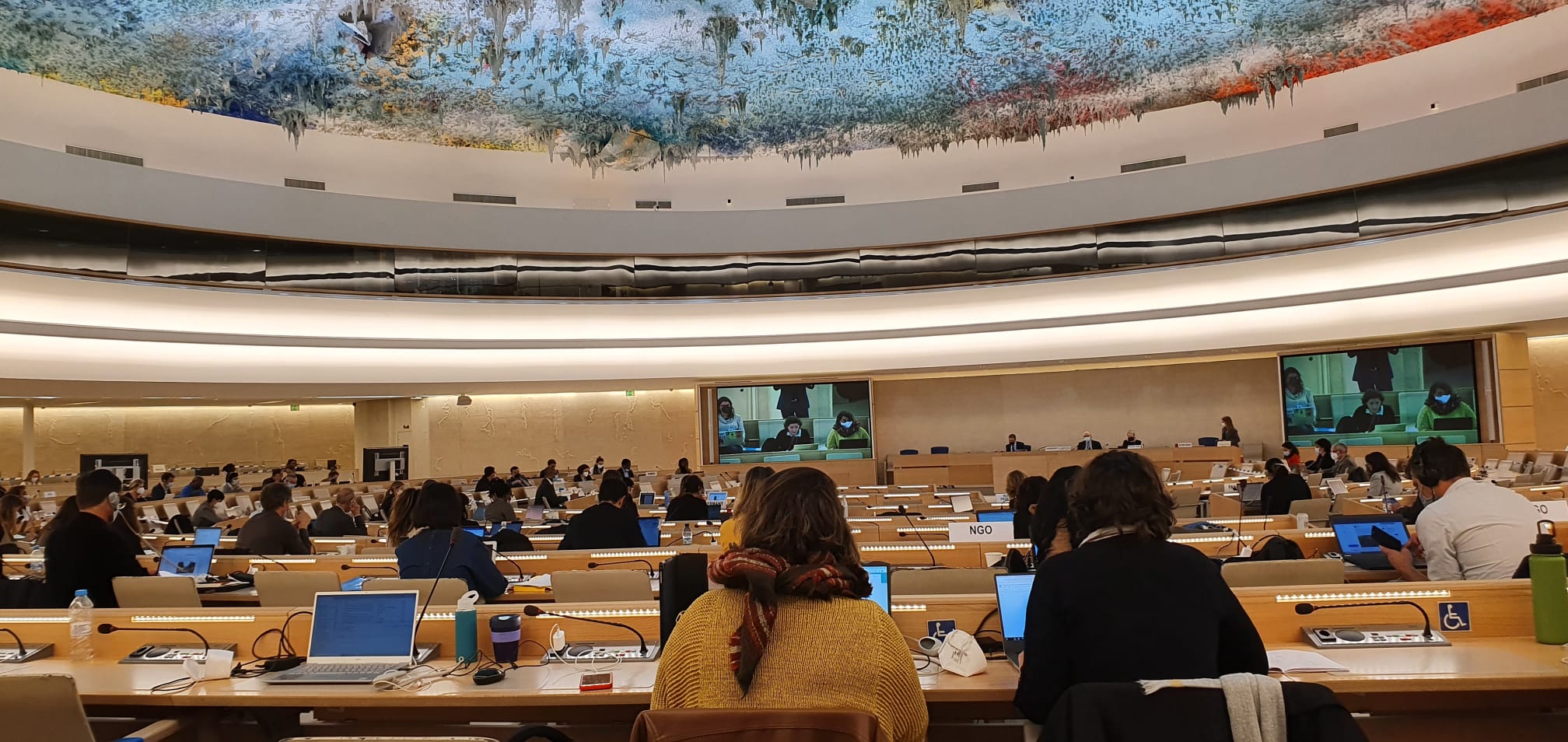
From 25 to 29 October United Nations member states continued the negotiations to elaborate an international Legally Binding Instrument (LBI) to regulate, in international human rights law, the activities of transnational corporations (TNCs) including all entities in their global production chains. This historic process celebrated its seventh session of the Open-Ended Intergovernmental Working Group (OEIGWG) hosted by the Human Rights Council in the Palais des Nations in Geneva.

The UN High Commissioner for Human Rights, Ms Michelle Bachelet, opened the session remarking that the world is witnessing a “growing consensus on the need of binding regulations on business and human rights.”

The UN Binding Treaty – as it is commonly known – negotiations have taken a qualitative leap forward with a new methodology adopted during this session, bringing transparency and encouraging States to take a position on concrete language of the draft treaty. A total of 69 States participated during the week. Most importantly, some major and indispensable content was reintroduced and defended by some States, in accordance with the mandate of Resolution 26/9, to close the gaps in international human rights law that enable the impunity of transnational corporations. Of note was the constructive participation of South Africa, Egypt, Palestine, Cameroon, Namibia, Panama and Cuba, among others.

Julia Garcia, from the Movement of People Affected by Dams (MAB) and coordinator of the Global Campaign said “We welcome the fact that many states are discussing direct and clear obligations for transnational corporations and other transnationally active entities, overcoming normative national limitations that contribute to impunity. We wish to highlight the importance of proposals that advocate the expressed inclusion of the primacy of human rights over corporate rights throughout the global production chain.”

As with every year, civil society played an essential role, defending the need for this process, driving its continuity and nurturing it with detailed analyses, strong arguments and concrete content proposals. The Global Campaign to Reclaim Peoples Sovereignty, Dismantle Corporate Power and Stop Impunity (Global Campaign), representing 260 million people globally affected by Transnational Corporations, participated directly in the negotiations, partially resuming the physical presence that last year was not possible due to the COVID-19 pandemic.

“Access to remedy and justice has become a generational struggle rife with obstacles,” stated Joseph Purugganan, from Focus on the Global South and the Asian Task Force on the Binding Treaty. He continued saying that “in the face of the asymmetries of power that pervade in most countries, the protection of affected individuals and communities through the establishment of strong mechanisms of access to justice and reparation must be a priority of this process”.

Hugo Barretto, Trade Unions Confederation of Americas (TUCA) advisor, reiterated that the Global Campaign is aiming for “an ambitious and effective Treaty with binding rules for transnational corporations and the entities along the global production chains, which play a major role in the climate and biodiversity crises, labour exploitation and historic levels of inequality. Their reprehensible behaviour puts the future of humanity and the planet at risk.”

Raffaele Morgantini, from CETIM and coordinator of the Global Campaign at the UN, explained how, “Some western states and business-representatives repeatedly defend the relevance of the existing voluntary frameworks and even made unsuccessful attempts to suggest alternatives to the Binding Treaty, as part of a strategy, led by the US, to water down the process and foster the adoption of new futile frameworks. Nevertheless, the need to take a significant step forward and find innovative ways to close the legal loopholes that still exist at the international level was overwhelmingly felt during the whole week. It is also worth underlining that several states acknowledged the importance of civil society participation and the value of our proposals.”

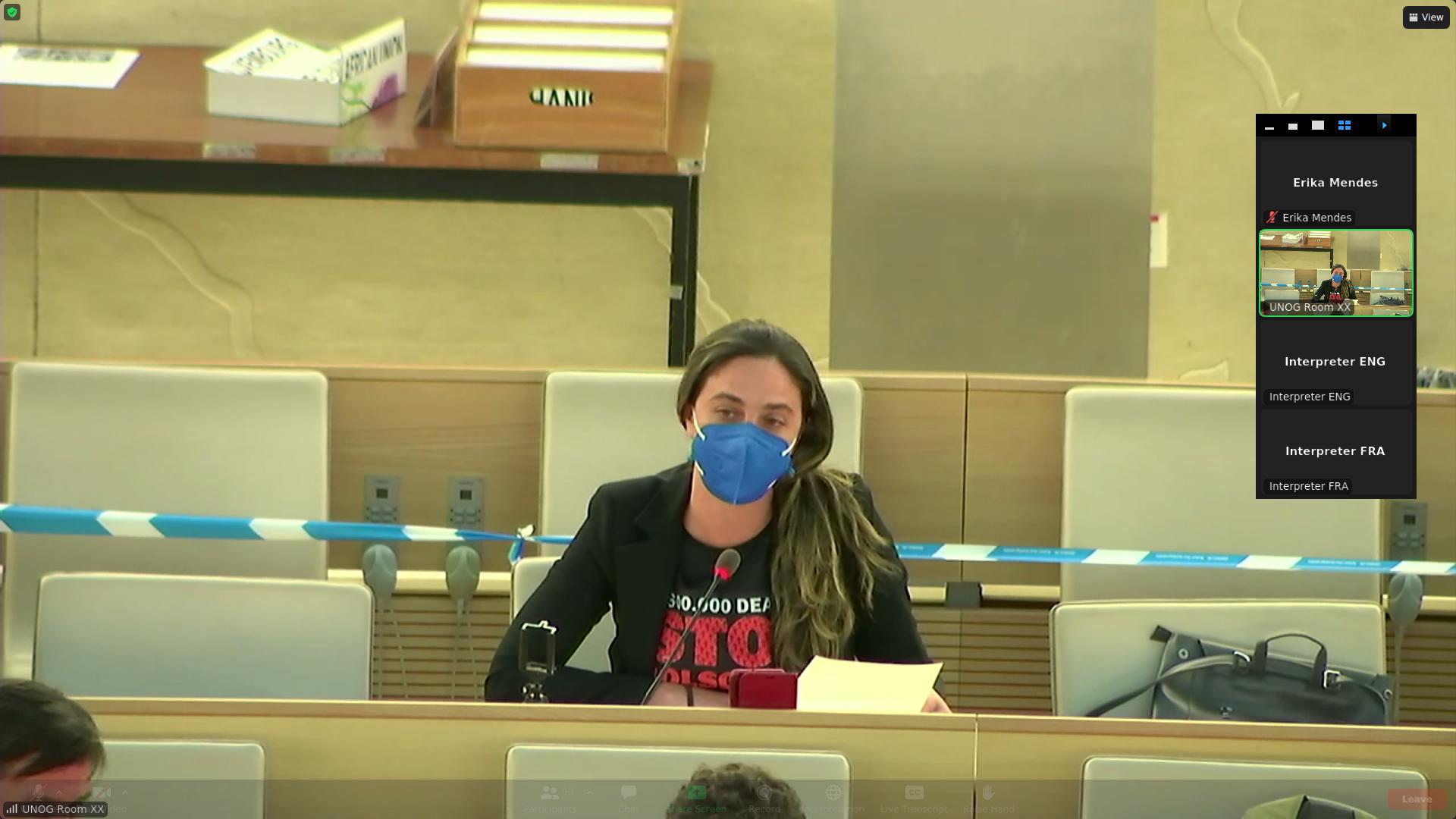
However, there are concerns about the risk of a loss of transparency in the process, as Erika Mendes, from Justiça Ambiental/Friends of the Earth Mozambique explains, particularly in relation to, “ the immediate future of the negotiations as it continues through the so-called “Group of Friends of the Chair” during the inter-sessional period. The new inter-state negotiation methodology must ensure social participation, so that the voice of affected communities is heard and considered. We urge the Chair and States to protect the process from undue influence from powerful corporate actors who, instead of upholding human rights, lobby for the protection of their own economic interests.”

Fernanda Melchionna, federal deputy of the Brazilian National Congress and part for the Global Interparliamentarian Network (GIN) in support of the Binding Treaty declared, “The struggle for a UN Binding Treaty to regulate the power of transnational corporations and place human and environmental rights above the corporate power of transnational corporations is a strategic and fundamental struggle for the world. The Global Campaign’s role in not allowing countries to remove the essence of the text demonstrates that civil society, affected populations and social movements have a fundamental role to play in the process.”

The Global Campaign continues its commitment to ensure that the UN Binding Treaty process retains the spirit and ambition of Resolution 26/9. To this end, the Global Campaign will continue to mobilise at the national level to ensure that our governments actively participate in these negotiations, representing the needs and aspirations of the social majorities and the peoples of each country.

NOTE TO EDITORS

For further information or to arrange interviews you can contact:

Sol Trumbo Vila, Email: soltrumbovila@tni.org

Julia García, +55 71 9246-2696 Email: facilitation@stopcorporateimpunity.org

Erika Mendes, Email: erikasmendes@gmail.com

The Global Campaign to Reclaim Peoples Sovereignty, Dismantle Corporate Power and Stop Impunity (Global Campaign) – a network of over 250 social movements, civil society organisations (CSOs), trade unions and communities affected by the activities of transnational corporations (TNCs), representing 260 million people globally. https://www.stopcorporateimpunity.org

This round of negotiations is revising the third draft of the binding treaty, published on August 17, 2021, which fits in the negotiation process started in 2014 with the adoption, by the Human Rights Council, of Resolution 26/9. UN information on the Mandate of the OEIGWG.

The global campaign published this statement in September 2021 in response to the release of the third revised draft.

The Global Interparliamentary network in support of the Binding Treaty is a global network of members of National Parliaments and the European Parliament supporting the UN Binding Treaty. https://bindingtreaty.org/

Tagged , , ,

Press Release: States resume historic UN negotiations amidst growing consensus on the need for binding regulations on transnational corporations and human rights

25 October 2021, Geneva

Today, United Nations member states resume negotiations in the seventh session of the Open-ended intergovernmental working group (OEIGWG) mandated to elaborate an international legally binding instrument to regulate, in international human rights law, the activities of transnational corporations. The UN High Commissioner for Human Rights, Ms Michele Bachelet, opened the session remarking that the world is witnessing a “growing consensus on the need of binding regulations on business and human rights”.

Global South countries intervened in strong support of the Binding Treaty process – South Africa, Namibia, India, Indonesia, Pakistan, Philippines, Bolivia, Venezuela, Cuba and Palestine among others. For the first time delegates from all major global economies shared their views on the Binding Treaty process and content. All of which goes to show that after seven rounds of negotiations states cannot ignore the urgent need for an effective instrument such as the UN Binding Treaty.

The Ecuadorian Chair of the OEIGWG opened the seventh session by affirming that the negotiations must be “State-led”, which raises concerns about how civil society´s contributions will be included.

The continuous broad participation of communities affected by transnational corporations’ activities, civil-society organisations, trade unions and social movements makes it one of the most strongly supported processes in the history of UN OEIGWGs. The Global Campaign to Reclaim Peoples Sovereignty, Dismantle Corporate Power and Stop Impunity (Global Campaign)1, representing 260 million people globally affected by Transnational Corporations has, once again, a strong presence in Geneva providing vital recommendations and critical analysis.

Tchenna Maso, from the Movement of Peoples Affected by Dams (MAB), La Via Campesina and the Global Campaign, remarked during the opening session, “Let me remind you of the basic problem that brings us together here. At the heart of the matter is the fact that, although the human rights violations committed by transnational corporations through their chains are obvious, States are usually unable to punish the culprits or to make reparations to the victims.”

Ubrei-Joe Mariere, from Friends of the Earth Africa spoke on behalf of the Global Campaign, “The climate, biodiversity and Covid crises are results of a socio-economic model that favours corporate profit over the protection of human rights and the environment. Travel restrictions due to the pandemic, unequal access to vaccines, financial barriers, digital connectivity and differing time zones limit the participation of the Global South, including States and affected peoples. For the Binding Treaty negotiations to be inclusive and fair, we must ensure that civil society – especially those most affected by the impunity of transnational corporations – are able to follow, intervene and influence the direction of the negotiations.”

Mary Ann Bayang, from the Indigenous Peoples Rights International in the Philippines, declared that, “The peoples, citizens, affected communities and social movements place great hope in the success of the process initiated in this OEIGWG to bring transnational corporations under the law. States also have an interest in the adoption of such a treaty that will allow them to recover their lost sovereignty. It is in this spirit that the Global Campaign has been engaged in the process of negotiating this Binding Treaty. We note with great regret that the current draft treaty falls far short of the OEIGWG’’s mandate. It is essential that this situation be rectified and the process put back on track.”

Participants in the negotiations emphasized the urgent need for binding regulations for Transnational Corporations in light of the Covid19 pandemic.

The Brazilian AIDS Interdisciplinary Association, member of the Global Campaign said, “Adopting a Binding Treaty is urgently needed to bring justice to people denied access to health technologies, and whose lives have been taken away by corporate greed. The treaty must include the primacy of Human Rights as a fundamental principle. Thus, interests included in trade and investment agreements must be subordinated and subjected to mandatory respect for Human Rights.”

A broad coalition of elected representatives, the Global Interparliamentary Network (GIN) supporting the UN Binding Treaty, also advocates for an ambitious and effective legally binding instrument.

Miguel Urbán, Member of the European Parliament for The Left and member of the Global Parliamentarian Network in support of the Binding Treaty added, “The absence of clear and binding international norms for the respect of human rights feeds the impunity and abuse of global corporate power.”

The Global Campaign will be in Geneva all week working to ensure that its proposals for the UN BInding Treaty are taken into account and included in the current drafting process.

NOTE TO EDITORS

For further information or to arrange interviews you can contact:

Sol Trumbo Vila, Email: soltrumbovila@tni.org

Julia García, +55 71 9246-2696 Email: facilitation@stopcorporateimpunity.org

Erika Mendes, +258 847713099 Email: erikasmendes@gmail.com

The Global Campaign to Reclaim Peoples Sovereignty, Dismantle Corporate Power and Stop Impunity (Global Campaign) – a network of over 250 social movements, civil society organisations (CSOs), trade unions and communities affected by the activities of transnational corporations (TNCs), representing 260 million people globally.

This round of negotiations is revising the third draft of the binding treaty, published on August 17, 2021, which fits in the negotiation process started in 2014 with the adoption, by the Human Rights Council, of Resolution 26/9. UN information on the Mandate of the OEIGWG

The global campaign published this statement in September 2021 in response to the release of the third revised draft.

The Global Interparliamentary network in support of the Binding Treaty is a global network of National Parliaments and the European Parliament members supporting the UN Binding Treaty.

Tagged , ,

France, Rwanda and Total:

a lethal threesome around Mozambique’s gas

For four years, the people of the province of Cabo Delgado, Mozambique, have been devastated by gas and violent conflict between insurgents, military and mercenaries. Eight hundred thousand people have become refugees from the violence, and thousands have lost their livelihoods and been displaced by the gas industry. To make things worse, they are now in the hands of the Rwandan army, which is notorious for horrific torture of Congolese and Rwandan alleged dissidents in military detention centres. And they have gone rogue.

According to Mozambican President Felipe Nyusi, the 1000-strong Rwandan army’s mandate since July has been to “restore peace and stability”.

But since the Rwandan state became involved, things have gone even further awry than they already were. Already, on 14 September, Rwandan businessman and chairman of the Rwandan Refugee Association in Mozambique, Révocat Karemangingo, who was exiled from Rwanda in 1994, was assassinated in Maputo.

Three months before, Rwandan journalist Ntamuhanga Cassien who had applied for asylum in Mozambique, was arrested by Mozambican police, and has not been seen since.

If experts and activists who have linked the murders to the Rwandan state are correct, even though the government has repeatedly denied it, this should not come as a surprise. The Rwandan government is known for killings of political opponents and journalists both inside and outside of the country, including South Africa and Kenya.

In July this year, Amnesty International and a consortium of journalists exposed that Rwanda was one of the countries using the Israeli surveillance company NSO Group’s Pegasus software. Since 2016, the Rwandan government has used the software to unlawfully surveil the phones of 3500 activists, politicians and journalists.

The Rwandan army itself has a terrible human rights record – in 2014 Human Rights Watch reported they had been fighting alongside the Rwanda- backed M23 rebels in the Democratic Republic of Congo (DRC). Over three days in 2016, M23 soldiers killed 62 people in anti-government protests.

Even though locals around Palma have highlighted the more professional conduct of Rwandan solders in comparison to the Mozambican soldiers, the Rwandan operation relies on local intelligence and information in order to be effective. But they are not doing the dirty work of actually acquiring this intelligence themselves. It has been the Mozambican soldiers that have carried out the interrogations, arrests and intimidations to obtain information. This has been one of the causes in the increase of disappearances, unlawful arrests and torture, sometimes targeting outspoken and critical civilians within the gas affected communities.

So if the Rwandan government doesn’t care about its own citizens and civilians in the DRC, why would it put its money and army on the line for foreign nationals? And who else has an interest in them being in Mozambique?

One of the factors that can’t be ignored is Rwanda’s dynamic relationship with France, and that French company Total is one of the leaders of Cabo Delgado’s $50 billion gas industry. Total owns 26% of the Mozambique Liquid Natural Gas (LNG) Project.

It is in the process of constructing the massive Afungi LNG Park, which will house the offices and support facilities for its project as well as ExxonMobil’s Rovuma LNG project and their contractors. The gas giants are building an industry that is pushing the debt-ridden country further into poverty and not benefiting the people. Until now, it has only brought destruction.

The French government has over $520 million invested in the Mozambique gas industry through a loan from the French export credit agency (BpiFrance) for the third project, Eni’s Coral South LNG. The four largest French banks, Crédit Agricole, Société Génerale, BNP Paribas and Natixis are also involved in the industry as financiers or financial advisors.

It is the construction of the Afungi Park that has forced thousands of local people out of their homes, and away from their farmland and fishing grounds creating an angry and further disenfranchised population.

And now that the insurgency has ruined Total’s plans, it has just closed shop and stopped compensation payments to communities. After a brutal attack on Palma town on 24 March, Total decided to claim ‘force majeure’ and pull its staff out of the area, pausing the project indefinitely and saying they would return only once the area was safe.

Even then it was clear that the military had Total’s best interests at heart, not the people’s. On the day of that attack, there were 800 soldiers defending the Afungi Park while civilians have said there were only a handful of soldiers protecting Palma village. Currently, Rwandan soldiers have been using the Afungi Park as their base.

It certainly won’t be the first time that French interests, politics and violent conflict have gone hand in hand with a Total project. Some examples that come to mind include Myanmar, where the military junta is known for ethnic cleansing of the Rohingya population, and mass human rights violations including rape, sexual abuse, torture and disappearances of protestors. Since the coup of February 2021, Total has been directing revenues from its Yadana gas project in Myanmar to the junta, its biggest source of income.

Total has also been active in the Taoudeni basin of Mali in the Sahel since 1998. Since 2013, over 3000 French troops have been in Mali, and 4 other Sahel countries, with France using the same rhetoric as they and Rwanda have done in Mozambique: to rid the area of ‘jihadists’.

In Yemen, the Balhaf LNG site of which Total owns 39% was exposed for housing the base for the Shabwani Elite, an UAE-backed tribal militia since 2016. Officially a counter-terrorism group, they have unofficially become known as a group created to protect fossil fuel interests. The site also has also been exposed to house UAE notorious ‘secret prisons’ holding Yemeni detainees.

So, Cabo Delgado, where the gas region sits nearly on the border between Mozambique and Tanzania, fits neatly in Total’s mixture of politics, gas and conflict.

So back to Rwanda – Out of all potential pawns, or proxies, for France, why pick them?

France has been embarrassed, but not enough for a full apology, about the exposure of the severity of its role in the Rwandan genocide, after a March 2021 report claimed France bears ‘overwhelming responsibilities’ for the horrors that killed over 800 000 people in the Tutsi minority. However, in 2005 complaints laid by human rights groups pushed French prosecutors to open an investigation into French soldiers’ actual complicity in the genocide, which seemed like it was going to be dropped in May this year. No former French soldiers have faced trial.

While Rwanda claims this military mission to Mozambique is self-funded, others say it is Mozambique footing the bill, and yet others, say that this might be one of France’s covert means of reparations, or an olive branch trying to fix bad Franco-Rwandan relations, by offering Rwanda a crucial job: protecting French gas assets. When asked by a journalist, the French Minister for Europe and Foreign Affairs, Jean-Yves Le Drian, neither confirmed nor denied whether it is financing the troops, although financing does not always come in the form of cash. It could be through aid or other means that are harder to track.

It’s part of a pattern of Rwanda becoming France’s new darling: in 2019, the Rwanda Development Board (RDB) signed a reported $11.6 million a year contract with French football club Paris St. Germain as its official tourism partner. ‘Visit Rwanda’ is boasted on the the back of the men’s training and pre-game warm up kits, in the club’s stadium and on the sleeves of the womens’ team kits, with the club having renewed its contract in 2019, also reported to be $11 million a year. A point to consider is that hospitality company Accor is paying PSG $58 million a year to be its official hotel partner.

There is the possibility that these teams are giving the RDB a friendly discount. What is more likely is that the sponsorships are being subsidized by a third party.

It is clear that there are a few parties getting something out of Rwandan troops being on the ground in the gas region – Total, Mozambique and Rwanda. But certainly the one gaining the most is France – its financial assets are being well protected on the ground and it is able to maintain the international ‘non-complicit’ image it wants to regarding the genocide while still nurturing a relationship with Rwanda. It would also be a way of having military protection of its assets while not being visible. This is definitely in their interests following France’s recognition of its disastrous mission in Mali by cutting the number of troops in June this year, and now, after the death of the 52nd French soldier in eight years, French President Emmanuel Macron has said they will have no more soldiers in the Sahel by the beginning of 2022. The deployment of Rwandan soldiers would mean they will have another army in public view and decrease the political risk of failed military interventions, especially ones linked to human rights violations.

But one group that is not benefiting, are the people of Mozambique, most of all – the communities of Cabo Delgado, who are pawns, dying and devastated so that local and international elites can save political face and defend their gas assets and bonuses by any means necessary.

I

Tagged , , , , , , , , ,

Public letter of the International Meeting

“How to Resist Monoculture Plantations”

21 September, 2021 – International Day of Struggle against Industrial Tree Plantations

We, about 60 members of rural communities facing industrial tree monocultures on their land, coming from the provinces of Manica, Sofala, Zambézia and Nampula in Mozambique and from the province of Iringa in Tanzania; together with allies who support these communities; met – due to the pandemic only in small groups and interconnected by computers and mobile phones – during the 21st and 22nd of September 2021 at the international event “How to Resist Monoculture Plantations”.

For years, these communities have resisted the eucalyptus monoculture plantations of the Green Resources company in Mozambique and Tanzania, and those of Portucel and Investimentos Florestais de Moçambique (IFM) in Mozambique, as well as the rubber tree monoculture plantations of Mozambique Holdings in Mozambique.

The members of the communities present decided to break the silence imposed by the pandemic and denounce once again that the eucalyptus and rubber tree companies arrived on their land – in some cases many years ago – with promises of development, a future with schools, hospitals, energy and bridges. However, they denounce that none of these promises were fulfilled. Worse still, eucalyptus and rubber trees occupied and destroyed the fertile farmland, and today families no longer have food and some have nowhere to live. If eucalyptus were food, it would be much better, but it is not. In addition, companies destroy native trees and use chemicals that contaminate the soil and water. Wells and rivers have dried up and drinking water has become scarce. Instead of building bridges, companies destroyed bridges with their heavy machinery, without concern they should repair them. Communities are afraid to cross plantation areas. Even already occupying large areas, companies want to take over even more land.

We see and analyse that this whole situation is causing a lot of suffering, a lot of hunger in the communities, and affects women in a particular way. The Government opened the door to foreign companies and investors, and closed it to the people. What is happening is a new form of colonialism where the company is the new colonizer of lands where communities have lived for many generations.

Even though the companies justify that they consulted with the communities, there was no consultation where they could accept or refuse the company; there was a lot of manipulation of information and broken promises. The promised jobs do not exist, just a few, but mostly seasonal and poorly paid. Compensation payments have been absolutely negligible, insufficient to acquire another farm outside the community.

When someone decides to farm on land that the company claims is theirs, the person is intimidated and threatened. This also occurs when someone lodges a complaint with their local leaders or officials. In this case, nothing is done because these authorities usually receive something from the companies or are equally intimidated and disrespected by the company. To make matters worse, in some cases it is not just the police and the company, but the community leaders themselves that intimidate and threaten members of their own community if they file a complaint. Nor are organizations that support communities spared from intimidation. Recently, the Suhode Foundation team in Tanzania was illegally detained by the police for 19 days. All their equipment was confiscated and remains in police possession to this day. Certainly, Green Resources is behind this, in an attempt not only to divide communities, but also to prevent civil society organizations from continuing to support them.

We demand that communities and organizations that support the communities have their rights – ensured in various national and international legal instruments – fully guaranteed; that our governments defend the people and not the companies; that intimidation and threats from companies and authorities as well as community leaders stop; that our governments, instead of protecting companies, order that they be investigated for the multiple violations they are committing; that officials discuss the future with communities, so that communities can actually participate in the planning that aims to guarantee their permanence on the land, today and in the future, and improve their living conditions going forward.

Even if companies do not stop expanding, even if they try to intimidate and threaten us, we are committed to continue to unite in the fight against monocultures and the destruction and encroachment of land; even if companies and governments insult us, we will continue to look for ways for communities to retake their territories – some communities in Tanzania have already done so; even if they threaten us, we will continue to raise our voices more and more, and together we will continue to expose the situation of communities and denounce the actions of companies; even if they won’t listen to us, we won’t give up calling on our governments to join with their communities, communities that they should defend and protect above all.

We believe that together we will be stronger to resist monocultures and all kinds of usurpation of our lands, especially on this 21st of September, the International Day of Struggle against Industrial Tree Monocultures.

September 21, 2021 – Plantations are not Forests!

Membros das comunidades Rurais

Ação Académica para o Desenvolvimento das Comunidades Rurais – Adecru

Associação de Jovens Combatentes Montes Errego – AJOCME

Fórum Carajás – Brasil

Fundação Suhode Tanzânia

Justiça Ambiental – JA! – Amigos da Terra Moçambique

Missão Tabita

Movimento Interestadual das Quebradeiras de Coco Babaçu (MIQCB) – Brasil

Movimento Mundial pelas Florestas Tropicais (WRM)

Tagged , ,