
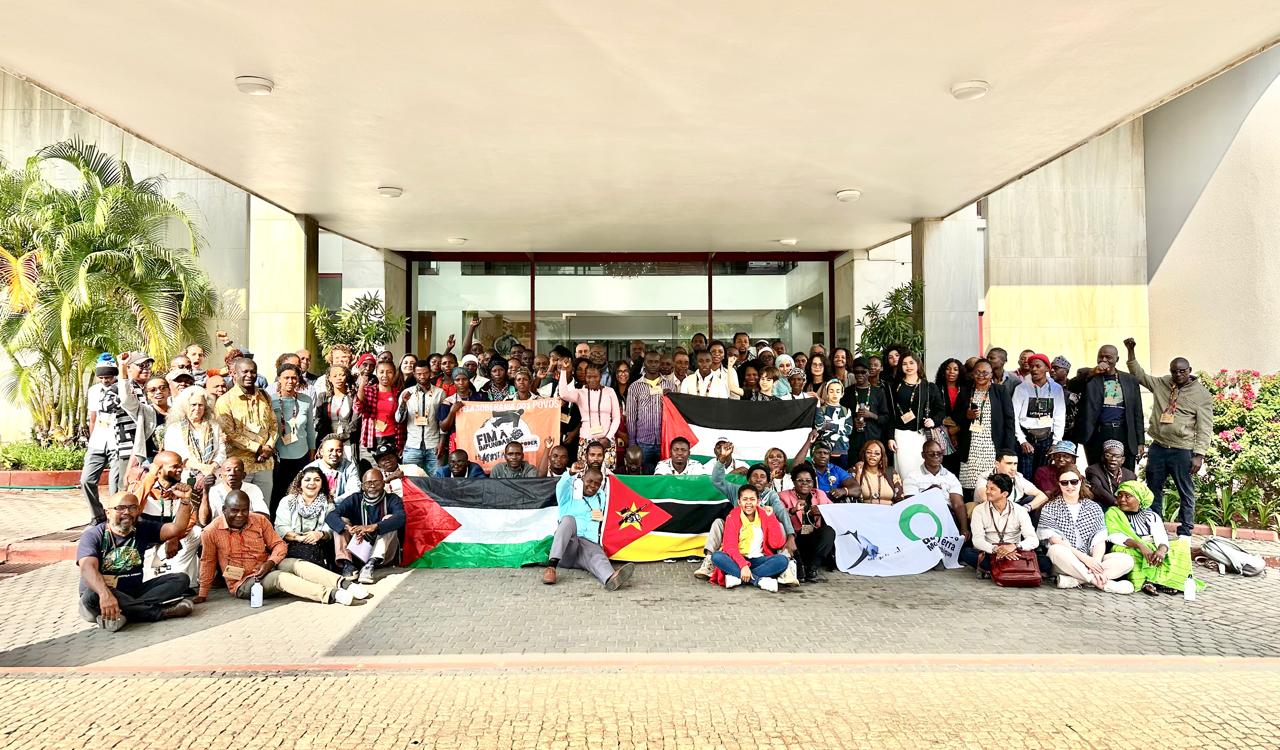
There are spaces that are events. And there are spaces that, over time, become political processes. The Maputo Workshop on Corporate Impunity and Human Rights, organised by Justiça Ambiental JA!, falls into the second category.
Now in its 10th edition, the Workshop is not merely marking an anniversary. It is celebrating a decade of resistance, collective endeavour, knowledge-building, and the strengthening of a movement that has sought to challenge one of the most powerful structures of our time: corporate power and the impunity that characterises it.
The forum has brought together affected communities, social movements, civil society organisations, academics, lawyers, journalists, artists and activists from different parts of Africa and the world. What unites us is both concern for specific cases of human rights violations, and understanding that, behind every case, there are economic, political and legal structures that enable exploitation.
As Anabela Lemos, Director of Justiça Ambiental JA!, stated:
“This year we are celebrating, with great pride, the 10th anniversary of the Workshop on Corporate Impunity and Human Rights. These have been 10 years of resistance, strengthening our movement so that we may all enjoy the same rights: the right to a healthy environment, the right to education, to healthcare, to a life of dignity, to our territories and cultures, and to our common goods.
Today we are fighting against the usurpation of our territories and against serious human rights violations committed by companies that are exploiting our resources – such as ENI, Total, EDF, Portucel and Jindal, to name a few – as well as by the State, which has a duty and an obligation to protect and defend the Mozambican people.
We are fighting to change this so-called ‘development’ model, that has already clearly shown that it is only exacerbating poverty, inequality, rights violations, violence, militarisation and environmental destruction in our country.
We are fighting to ensure that all Mozambicans – men and women alike – know their rights and organise themselves more and more to demand a country that belongs to everyone and is for everyone, where life is worth more than profit. A country at peace, free from war, murder and insurgency.”
This statement summarises the history and purpose of the Maputo Workshop.
Ten years on, what has changed?
The first answer would be an uncomfortable one: many of the structures we are fighting against remain in place. Communities are still forcibly displaced in the name of ‘development’ projects. Natural resources are still appropriated by large corporations. The state continues, in many cases, to present foreign investment as a magic solution to problems that are, to a large extent, created by the economic model itself. Our judicial system continues to bow to big business – and to refuse to hold the political elites who back it to account. The exploitation of gas, coal, minerals, forests and land is still accompanied by conflict, resettlement, loss of livelihoods, environmental destruction and militarisation.
In many cases, development is still measured by the volume of investment, economic growth or foreign exchange inflows, whilst the actual living conditions of communities remains the same or have worsened.
Yet something significant has changed. The ability to identify the problems and link different struggles has strengthened. There is now clear recognition that what happens in a community affected by a mine, a dam or a gas project is not an isolated incident, but the result of a system designed to bring about such outcomes. Above all, what has changed is the motivation to build solidarity and demand systemic change.
It is in this space that a community in Mozambique can engage in dialogue with a community in Kenya, Eswatini, South Africa, Mali or Brazil. It is in this space that a local struggle can be understood as part of a global struggle over land, natural resources, energy, climate and power.
From reporting cases to understanding the system
The Maputo Workshop has moved the discussion beyond isolated complaints to an analysis of the underlying structures.
This year, the workshop began with strengthening understanding of the system that produces impunity. Capitalism, racism, patriarchy, xenophobia and Afrophobia were analysed, not as separate phenomena, but as mutually reinforcing systems of oppression.
The question is no longer simply: who violated this right?
The question has also become: what system enables this violation to take place, to be repeated and to go unpunished?
This shift is fundamental. It is necessary and urgent to hold transnational corporations accountable for specific violations. But it is not enough if the system continues to produce new companies, new projects and new violations.
‘Development’ that produces dependency
On the second day, the discussion focused on the political economy of dependency. The Workshop has been a space for debating precisely the question: development for whom?
Africa continues to be integrated into the global economy primarily as a supplier of raw materials, energy and cheap labour. At the same time, it remains dependent on imports of technology, finished goods and finance. This model is presented as development.
Yet this model must be questioned. It is a model that leaves countries indebted, dependent and vulnerable, whilst resources generate profits abroad and poverty and violence at home.
The long experience of the Workshop shows that it is not possible to discuss the power of large corporations without addressing debt, colonialism, foreign investment, international treaties and global production chains.
The State: between obligation and capture
The relationship between the state and the companies is a key theme of the Workshop.
The State has a duty to protect human rights and the environment. However, in many contexts, public institutions prioritise the protection of investments over the protection of people. It is in this context that corporate capture arises.
When companies influence public policy, laws and institutional decisions; when investment treaties limit states’ legislative capacity; when communities are consulted only after decisions have already been taken; and when activists and journalists are persecuted for exposing violations, it becomes necessary to ask whether the state continues to act as the guardian of the public interest.
The statement made during the fourth panel sums up this reality:
“The people don’t need to know about the project once the tractor is already there.”
This is about power and self-determination, not merely a matter of procedure.
Who decides on land use? Who decides on resources? Who defines what development is? Who bears the costs when projects fail?
These are central issues in any serious debate on sovereignty.
The climate crisis and the need for a just transition
The climate crisis makes it even more urgent to challenge the dominant economic model. There is a dysfunction in the global climate system – an excess of greenhouse gases in the atmosphere, caused mainly by the burning of fossil fuels. Coastal and rural communities are already facing floods, droughts, cyclones, crop failures and the destruction of their livelihoods. Yet it is often the people who have contributed least to the climate crisis who bear its most severe impacts.
At the same time, the so-called energy transition risks reproducing the same patterns of exploitation.
If the transition to renewable energy depends on new mineral rushes, land grabs and the displacement of communities, we will simply be replacing one extractivist model with another.
A just transition cannot simply mean swapping fossil fuels for new centralised and privately owned energy sources. It must mean democratising energy, protecting communities, respecting human rights and ensuring that future generations have a habitable planet.
A space that fosters movements
The impact of the workshop cannot be measured solely by the number of panel discussions held or the number of participants in attendance. Its true impact lies in the relationships that are built. It lies in the community that finds support to continue its struggle, in the activist who realises that their struggle is not in isolation, in the journalist who finds solidarity to continue investigating, in the lawyer who turns a complaint into a legal strategy, in the academic who puts their knowledge at the service of communities, and in the organisation that finds partners for a campaign.
It is this network that makes the Workshop more than just an event.
Over the last ten years — and building on many more years of commitment to environmental justice — affected communities, social movements, civil society organisations, academics, experts, lawyers and artists have been working together to strengthen the movement against corporate power and impunity on the continent.
The Maputo Workshop has enabled us to conduct in-depth systemic analysis of the multiple crises affecting Africa, and to understand their global dimension. The response, therefore, cannot be merely national; we must build regional, continental and international solidarity.
A pan-Africanist solidarity, capable of recognising that one community’s local struggle against a dam, a mine or a gas project is linked to the local struggles of other peoples against the same system of exploitation.
Ten years on, “a luta continua”
This year, the 10th Workshop ended with strong commitments.
Participants reaffirmed:
their responsibility to take the discussions back to their communities, organisations and movements;
the importance of continuing to denounce injustices and corporate crimes;
the urgency of a strong and effective, legally binding United Nations treaty to regulate transnational corporations;
the centrality of the struggle for self-determination of the Sahrawi and Palestinian peoples;
their commitment to the Maputo Declaration against Corporate Impunity and for Human Rights and Climate Justice, adopted in August 2024.
Participants also reaffirmed something even more fundamental: active and radical solidarity with all those who are intimidated, pressured, imprisoned or murdered for resisting the power of large transnational corporations and the global capitalist system.
Ten years on, the importance of this forum lies precisely in its ability to resist fragmentation.
Despite decades of resistance, the structures we are fighting against remain standing: corporations remain powerful, states remain vulnerable to capture; communities remain under threat; rights defenders continue to be persecuted; and the economic model continues to prioritise profit over life.
There is also strong growth, including: the capacity of affected peoples and communities to organise and mobilise for a fairer system; the realisation that land and dignity are priceless; the certainty that no development project can be considered legitimate when it involves the creation of ‘sacrifice zones’; and the awareness that, just as other systems of oppression have been dismantled in the past through popular mobilisation and protest, so too will those that oppress us today.
The Maputo Workshop will continue to consolidate itself as a space built collectively by social movements, organisations and committed individuals from the African continent, working towards these objectives. The struggle continues – for justice, rights and sovereignty – until we are all free!

