Category Archives: Activism

‘Israel has decided to be a racist apartheid state and not a democracy’

Once again the full murderous force of Israel’s military machine is unleashed against defenceless Palestinians in Gaza, while world leaders just watch the genocide of a nation in real time and do nothing.  When I started writing this article the death toll was well above 100 Palestinians (over half women and children) and zero Israeli civilian casualties or even major injuries, despite extensive coverage by western media of the deadly rocket attacks from Gaza. Sadly by the time I had finished writing the article the Palestinian death toll had gone over 1000 and by the time you read this it would have probably more than doubled. As Israeli Professor, Ilan Pappé says, “Israel, in 2014, made a decision that it prefers to be a racist apartheid state and not a democracy.”

Israel’s aggression violates the UN Charter and fundamental international laws and principles, but this is not new and past commissions have found numerous war atrocities and violations carried out by Israel during past attacks that have not resulted in any concrete actions by the UN or our world leaders. The international reaction to this latest crisis confirms that neither law nor justice dominate the diplomacy of leading western states and the UN, but geopolitical alignments.

One just needs a quick look at the history of the conflict to confirm this bias and lack of action in the face of undeniable facts. The UN has defined Israel’s occupation as illegal and numerous UN resolutions have demanded the withdrawal of Israeli armed forces from the occupied territories. UN resolution 3379 from 1975 even went on to declare Israeli Zionism ideology as a form of racism, stating “the racist regime in occupied Palestine and the racist regime in Zimbabwe and South Africa have a common imperialist origin, forming a whole and having the same racist structure and being organically linked in their policy aimed at repression of the dignity and integrity of the human being.” Desmond Tutu, Ronnie Kasrils, and other ANC members that fought against apartheid, clearly see the parallels and define the Israeli occupation of Palestine as a form of apartheid. Yet the world denounced and ended apartheid in one place, but is allowing the other to continue. Even when Nelson Mandela stated that “we know too well that our freedom is incomplete without the freedom of the Palestinians”.

palestine map

Photo: Grabbing of Palestinian land by Israel

Numerous leaders and public figures have spoken out in support of Palestine, from Nobel Peace Prize winners such as Desmond Tutu, Mairead Maguire, Betty Williams and Adolfo Pérez Esquivel, to civil society groups around the world representing millions of people, such as Friends of the Earth, La Via Campesina, and many more. This criticism is not new, during the early days of the creation of Israel numerous influential individuals, such as Mahatma Gandhi and Albert Einstein, raised concerns and criticism. Today even celebrities that are not known to be political have voiced their support of the Palestinian cause, such as footballer Cristiano Ronaldo. For anyone that doesn’t have the time to look into the details or considers the history too complicated, there is an easier way to decide on which side you should belong, simply look at the people you admire, your moral leaders.

Here in Mozambique, Samora Machel was a strong supporter of the Palestinian peoples’ struggles, and Yasser Arafat was a close ally and even attended Samora’s funeral. In Zambia, Kenneth Kaunda was an outspoken supporter of the Palestinian struggle. Many more moral leaders have already done the homework for you. If we claim to be people that are guided by justice and morals it’s now time for us to show solidarity towards the Palestinian people and their struggle.
DSCF6705

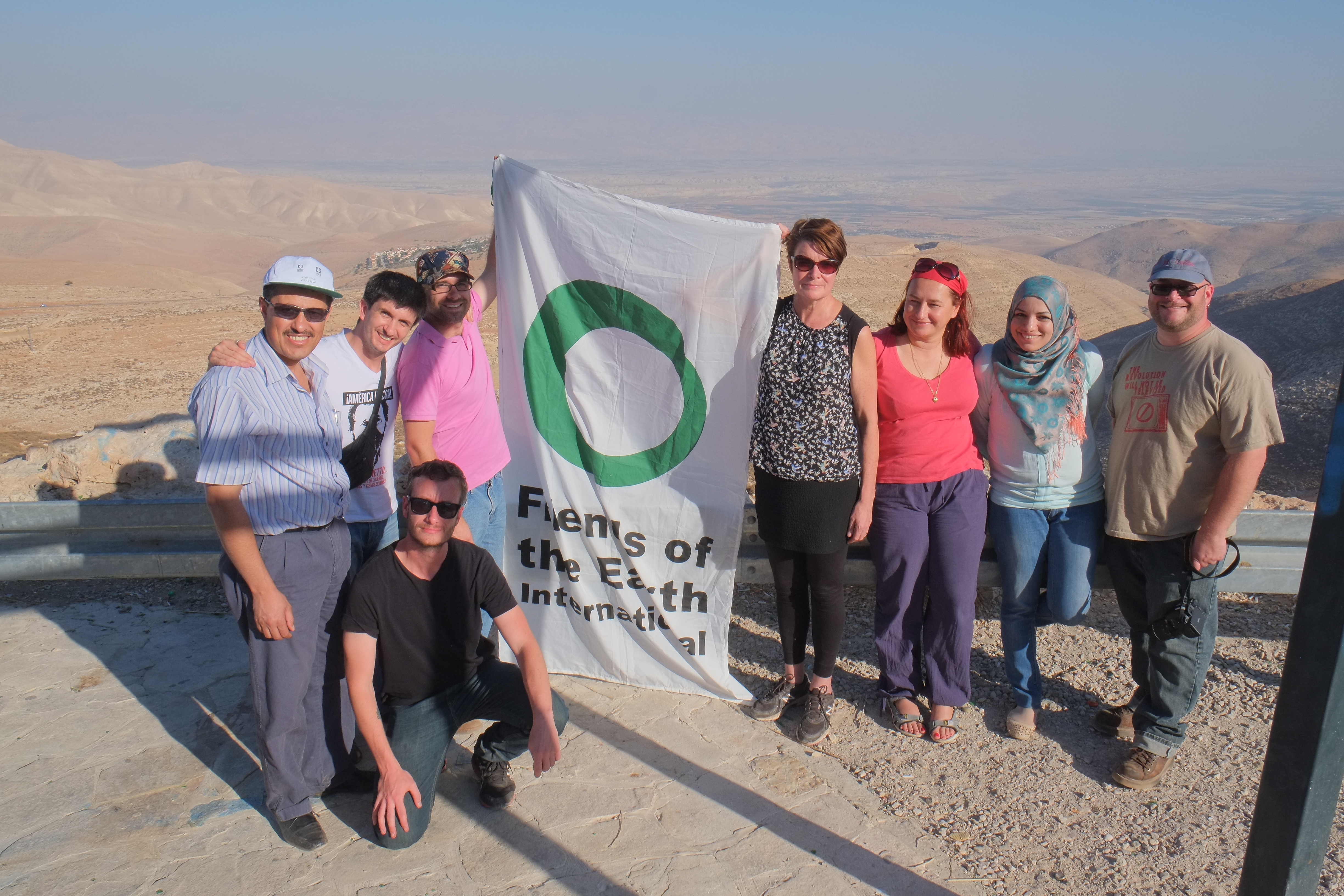
Photo: Friends of the Earth International solidarity mission to Palestine, October 2013

I was part of Friends of the Earth International’s latest solidarity mission to Palestine at the end of last year. Even though we were invited by Palestinians, they do not have the authority to invite us into their own country. Instead we had to get an Israeli visa. On arrival the first question asked by Israeli authorities is whether you plan on visiting the West Bank. If you answer yes you most likely will not be allowed entry at all. So we had to enter Palestine ‘unofficially’.

Heavy army presence is evident everywhere, there are road blocks and check points at the entrances to all cities in the West Bank. Israeli soldiers check everyone who passes, always and independent of the prevailing political tensions. This control has prevented over 11 million Palestinian refugees from returning home, even though they are entitled under the Geneva Convention on Refugees to return, which Israel continues to deny. Based on current borders only 17.7% of Palestine (all in the cities) is under Palestinian control, while the rest is controlled by the Israeli army. However, even in the areas under Palestinian control have numerous restrictions imposed by the Israeli army.

The Israeli occupation doesn´t stop with the control of land and movement, but an attack on all the fundamentals of human rights such as water, heath, education, childhood, labour, culture, etc. It is a total structured suppression of a nation to the point where it is a process of colonisation and ethnic cleansing.

During our visit, we realised that given the desert type of environment, water is a very valuable and vital resource for existence. All Palestinian water resources are under the complete control of the Israeli army, which regularly destroy Palestinian bore-holes and block construction of new ones. They impose inhumane water restrictions on Palestinians, while allowing excessive and unstainable use by Israeli settlers. The double standards and water grab by Israelis are impossible to hide. At present Isreali settlers consume daily almost 400 litres per person (more than double of London’s average use) and have swimming pools, exotic gardens and extensive agricultural lands with water-intensive crops that should never be planted in the desert. Meanwhile Palestinians don’t even come close to receiving the World Health Organisation’s daily recommended 100 litres per person and many survive on a little as 10 litres per day.

Water is just one of the fundamental pillars of life that is consistently being used by Israel to break the Palestinian nation and spirit, but it’s the same story for all sectors.

In health, Israel sends its waste to get dumped in Palestine and all high-polluting industries that were in Israel in the 1970s and were ordered by Courts to close due to risks to human health, were instead moved right next to Palestinian cities, like the Geshuri factories near Tulkarem. Israel is very aware of the health risks because, even today, if the wind starts blowing towards Israel, these factories have to halt production. But Palestinians have to just endure the toxins and cancer rates have increased significantly in the area.

The more time we spent in Palestine the more facts and details are continually exposed about the inhumane, unjust, illegal occupation of Palestine by Israel. We heard numerous accounts that the Israeli military arrests Palestinian children as young as 5 years old, a high number of whom are subjected to physical and verbal abuse and are threatened with sexual assault and death to themselves or their families. This abuse is confirmed by UN reports which also add that, in the last decade, over 7000 children are have been arrested and tortured.

pal

Palestinian children in a village where water & electricity access has been harmed by Israel (Daniel Ribeiro)

Everywhere we went, we saw the Israeli military abuse. In Zbeidat the military blocked the construction of a water and sewage system. Jobet Adeeb near Bethlehem has no electricity or water sewage system, and is barred from installing solar panels, electrical wiring, borehole or almost any structure that would improve the standard of living but the nearby Israeli settlement has all the modern luxuries and services. We visited a village that has been completely demolished, even though Israeli courts have recognised the rights to the land. Many more Palestinians that we met talked about the constant demolition notices they receive, that sometime are carried out immediately while others stay hanging over the family’s head for over a year, never knowing when the military would come to demolish their home. But just like in Gaza today, they know it will happen that one day they arrive home to a pile of rubble.

These experiences are all too common and regular that anyone that want to know the truth has to just spend some time in Palestine. I could carryon for pages and pages of the injustices and abuse by Israel. The evidence is clear. I often hear today’s younger generation asking our elders how did they let it happen – slavery, apartheid in South Africa, 2 World Wars, genocides and many other atrocities. I am sure that our children and grandchildren will ask us the same question. How and why did you allow the Palestinian genocide to happen? And in truth we have no excuses. As the saying goes: all that is necessary for the triumph of evil is that good people do nothing.

There are easy ways that all of us can help, such as supporting the Boycott, Disinvest and Sanctions (BDS) campaign. The campaign is non-violent and is inspired by the civil rights movement against segregation in the US and by the anti-apartheid movement in South Africa. It is based on three basic pillars or principles:

  • Ending occupation and colonisation of all Arab lands occupied in June 1967 and dismantling the Apartheid Wall;
  • Recognising the fundamental rights and full equality of the Arab-Palestinian citizens of Israel;
  • Respecting, protecting and promoting the rights of Palestinian refugees to return to their homes and properties as stipulated in UN Resolution 194.

All these demands have a basis in UN resolutions on Palestine and they are simply requesting implementation of international law. They are basic rights and first steps in the struggle for justice. I call on all of us to join.
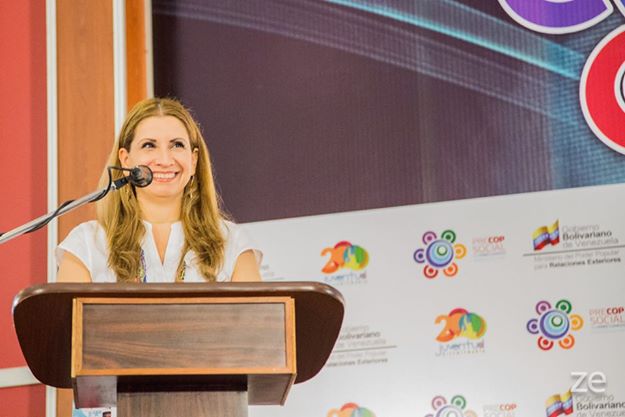
 

Margarita Declaration from Venezuela calls for eradication of dirty energy

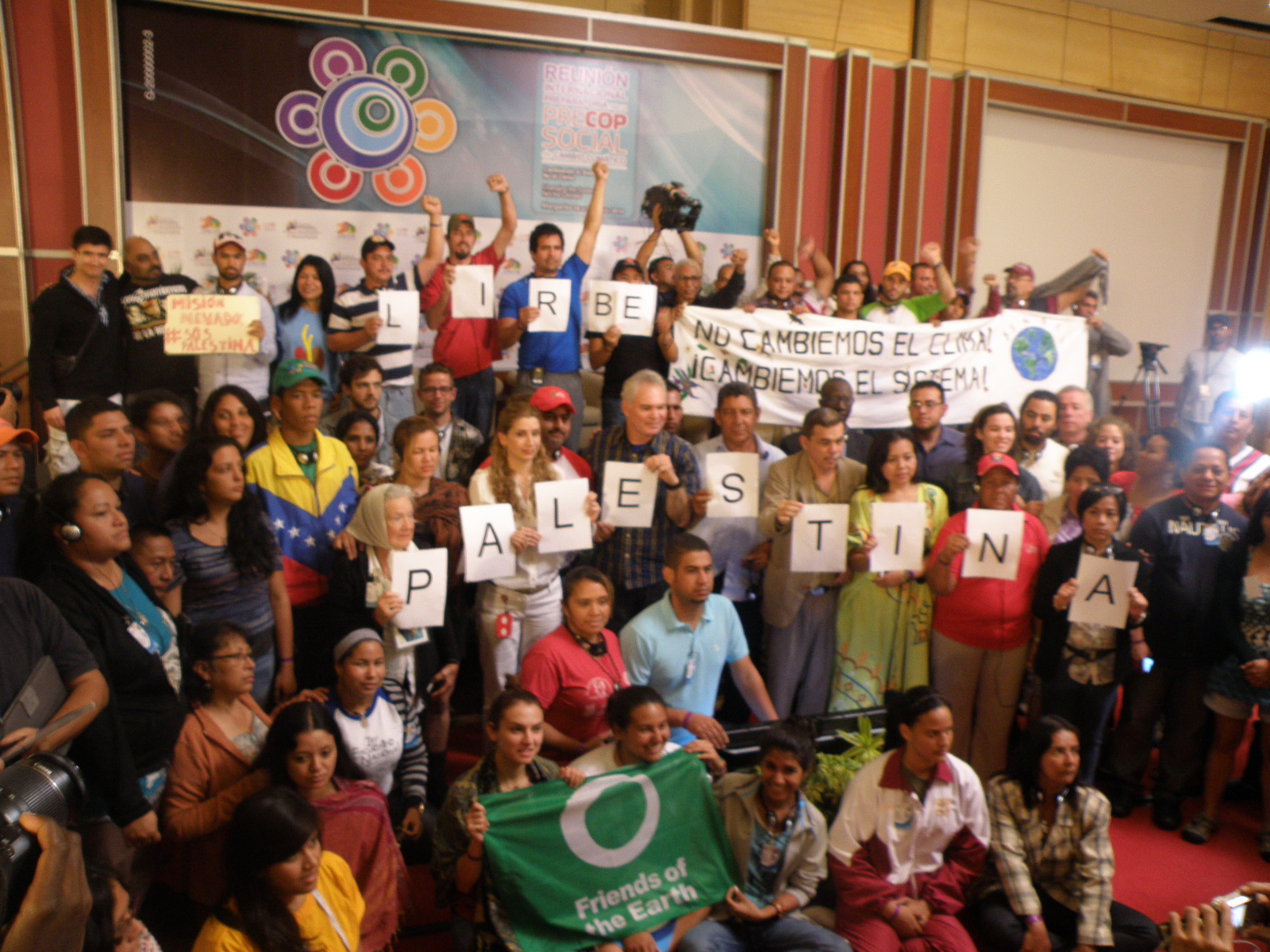
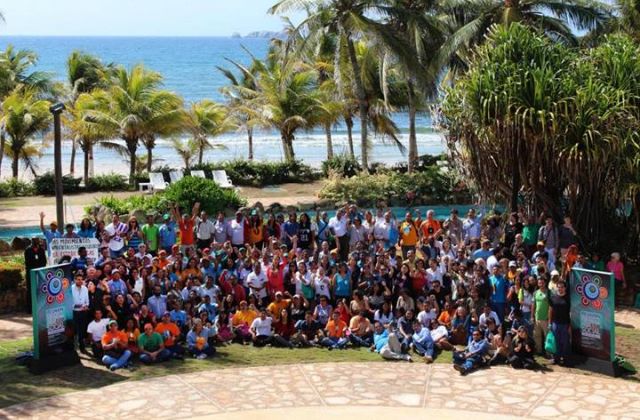
Activists from Friends of the Earth, including from Justiça Ambiental, were present at the preparatory meeting for the social pre-COP held in Venezuela in July 2014. We were among about 280 activists from 130 civil society organisations, from Venezuela and across the world. We met for 4 days at Isla Margarita, an island off the mainland of Venezuela, to move to defeat climate change.

margarita_2

Activists at Isla Margarita for the social pre-COP

This social pre-COP was a unique event. There is a pre-COP held every year before the UNFCCC (United Nations Framework Convention on Climate Change) COPs, which are the official UN climate change negotiations. However, civil society is usually never included in the pre-COP. This time, the Venezuelan government had a vision to involve civil society and make this a social pre-COP.

claudia

Claudia Salerno. Photo credit: Zack Embree

In fact, the Venezuela government had to make a special effort to politely decline the meddling of the UNFCCC Secretariat in this July meeting that just happened. The pre-COP is being held in 2 parts, one in July and the other in early November. The Secretariat was discouraged from attending the July meeting because the space was for civil society to speak to one another freely. This was a very positive step and allowed rich exchange between civil society organisations and social movements from 6 continents. There was also a bit of freedom to deviate from the strict, alienating language of the UNFCCC space. Usually, the UNFCCC requires people to learn a whole new language to engage with the space. “Do you speak climate change?” asked Claudia Salerno, the Vice-Minister of Venezuela, while she was addressing a climate justice assembly. The July meeting allowed the space for the peoples’ demands in our own words.

The content discussions took place in 5 mesas (roundtables), namely: (1) Social Impacts of Climate Change, (2) Climate and Ethics: differentiated responsibilities and respective capabilities, (3) Social participation to combat climate change, (4) Social Action for transformation, (5) Empowering Actions in Developing Countries.

Each mesa debated issues under their topic and finalised the language they would like to contribute to the final declaration. It was very important that the declaration process was driven almost entirely by the people, not by governments or by bureaucrats. When the final Margarita declaration was read out by the Venezuela government officials late afternoon on Friday, 18 July, the words were of the participants.

The Margarita Declaration was quite an inspiring document, and included strong statements like calling for the eradication of dirty energy and talked about leaving 80% of known fossil fuel reserves in the ground to stop catastrophic climate change.

Vice-Minister Salerno acknowledged that Venezuela also needs to change, and that developing countries need a just transition away from dirty energy. This was a big step. At a time when other governments, from USA to Australia, India to Indonesia, Argentina to Mozambique all want to ignore climate science and increase dirty energy, this acknowledgement is a step in the right direction.

The declaration acknowledged the historical responsibility of developed countries in creating the crisis and demanded them to reduce emissions drastically, while also providing finance and technology to developing countries so we can provide our people with energy and a life of dignity without dirty and harmful energy.

Responding to the corporate capture of UN spaces and governments, the declaration rejected the interference of corporations in UN decisions.

The declaration unequivocally rejected false solutions to the climate crisis, including carbon markets, commodification of life; geo-engineering, agrofuels, agrotoxics, ‘green economy’, intellectual property rights; the mega-dams, monocultures and nuclear energy.

Notably, the declaration stated that fighting climate change needs a transformation of the economic, political, social and cultural systems at all levels. We need to transform the consumption model into Buen Vivir (Good Living) and global cooperative societies. We agree and, interestingly, JA hosted a seminar on Buen Vivir in Catembe last September.

It was interesting to reflect on Mozambique’s experience while watching Venezuela’s reaction to the declaration. Mozambique also has no historical responsibility for climate change. However, our country is going full steam ahead with dirty energy development, most of which is not even for our people, but rather it is being sold to the highest bidder and shipped out of the ports. We demand community-owned renewable energy to meet the needs of our people, not large-scale dirty energy for elites. You can find the Margarita declaration in English and Spanish.

OLYMPUS DIGITAL CAMERA

 Activists at pre-COP showing solidarity with Gaza. Photo credit: Jagoda Munic

Ramesh Agrawal: Fighting Jindal’s bullets with information and solidarity

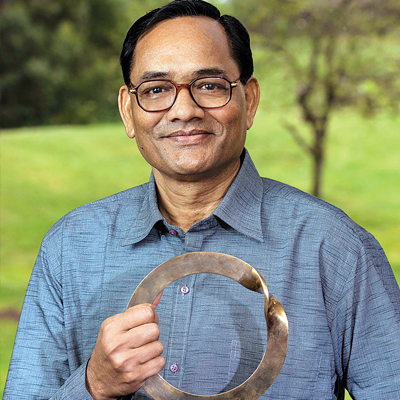
As he hobbled up to the stage with a walking stick on one side, and supported by his son on the other, the crowd cheered loudly. Ramesh Agrawal was one of the amazing people who won the coveted Goldman Environmental Prize this year. He was honoured at a ceremony in San Francisco, where JA staff where present. We also met and interviewed him a few days before the prize was announced.

ramesh

Photo courtesy: Goldman Environmental Prize

Ramesh Agrawal, who is respectfully called Rameshji in India, is from an organisation called Jan Chetna Manch, meaning a platform to raise peoples’ consciousness.


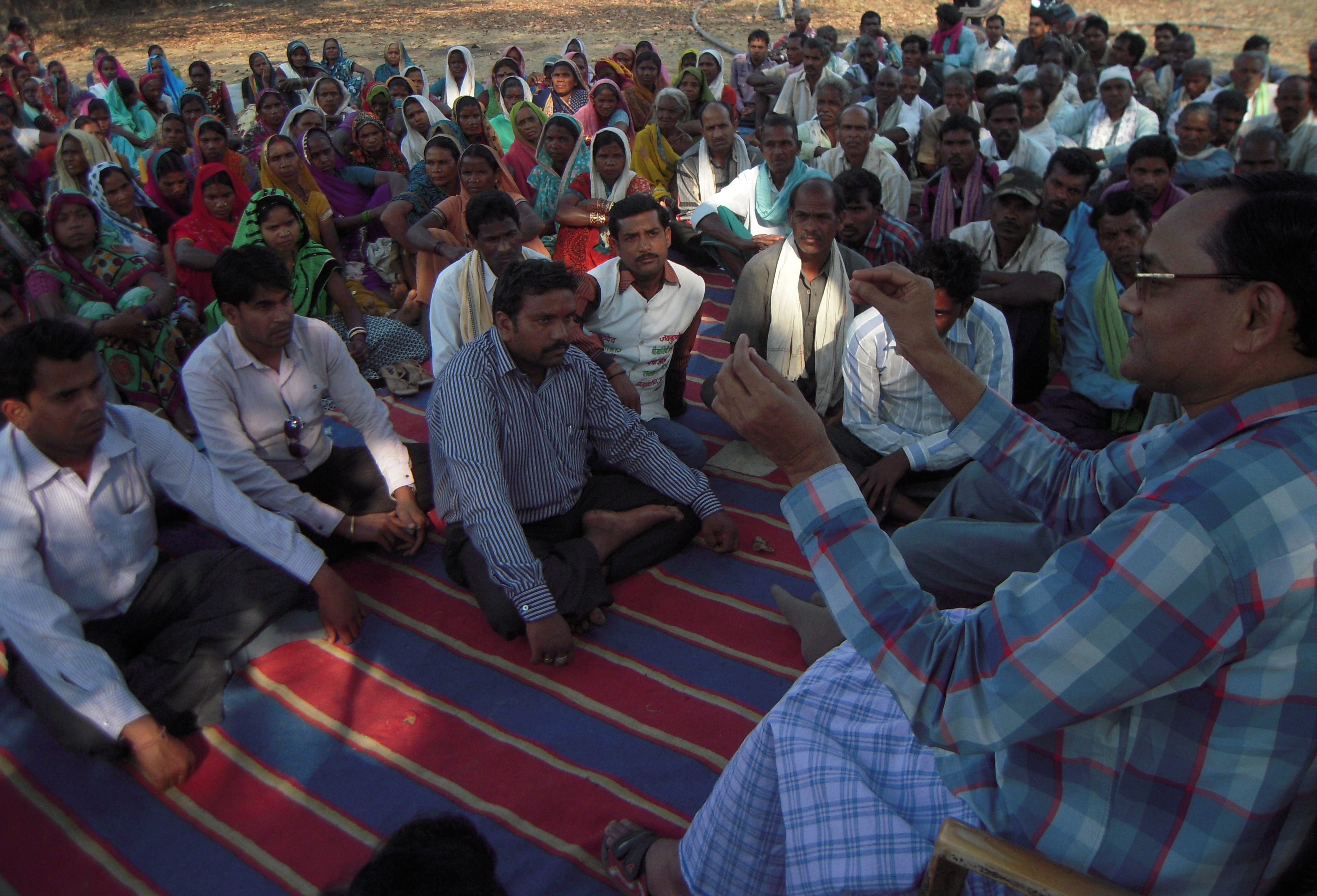
He lives in Chattisgarh state of eastern India, which is rich in mineral resources and because of this there has been a huge attack on the lands and resources of the local people by the state in conjunction with corporations. It is a state with a high percentage of tribal communities.


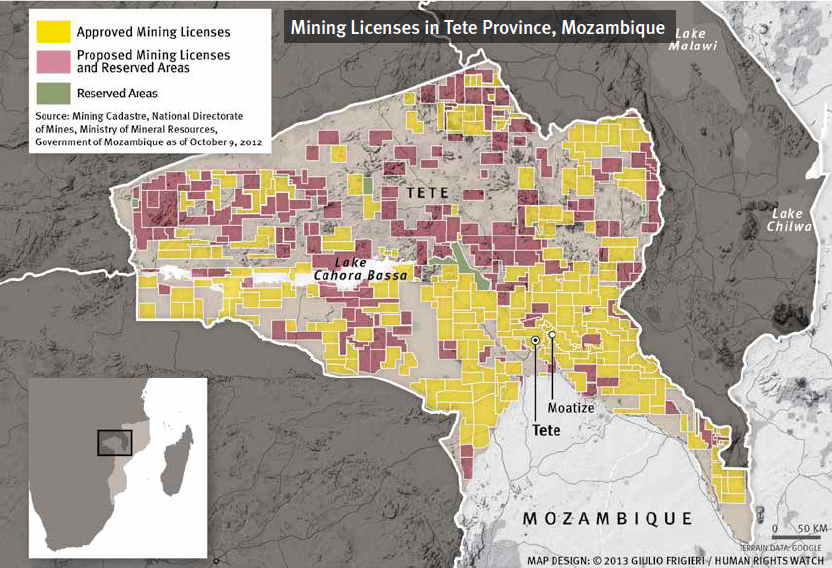
Through a small internet café which Rameshji runs, he organised local communities to use the right to information as a powerful tool to learn about and challenge ‘development’ projects planned in their areas. One of the main companies who he has been targeting is Jindal Steel & Power, the same company which is also currently mining coal in Tete province, Mozambique.


In July 2013, Jindal sent its goons who went into Rameshji’s internet café, shot at him and left him to die. They commented that he had been writing too much these days and needed to be taught a lesson. Somehow Rameshji managed to make a phone call and get help. But he has been severely harmed by the bullets that entered his body.


This wasn’t the first time Rameshji had been targeted by the state-corporate nexus. In May 2011, he was arrested on falsified charges of extortion and defamation. At 4am his house was surrounded and he was arrested and jailed for 72 days without bail. Surprisingly, the charges against him had been filed a year ago, in 2010. Yet he was arrested only a year later, making a mockery of the justice system.


Why was he being targeted? Rameshji was actively using information to organise people and to oppose irregularities in Jindal’s coal blocks in the state. They were doing construction on government land without proper land acquisition and without an environmental impact assessment (EIA).

????????????????????????????????????????????????????????????????????????????????????????????????????????????????????????????????????????????????????

Photo courtesy: Goldman Environmental Prize

This is really striking because Jindal in Mozambique has been operating in similar ways. They have been mining coal without an EIA and with communities still living in the mining zone; they are having health problems and even their right to movement has even been severely hampered.


Rameshji told us that Jindal’s coal mining is causing pollution and coal ash in the air. This has impacted the lives of people. They are unable to make their traditional food badi anymore because they have no place to dry it without contamination from the coal ash. It is interesting that communities are facing such a similar situation in Mozambique where they have no place to dry their mandioca without coal contamination.


Of course the threats of Jindal are well known in Mozambique too. Rameshji explained that Jindal’s policy on those calling out for justice is clear: bribe them, threaten them to make them back down, or if that fails then remove them.


Jindal is politically well-connected and they run an active public relations to portray a ‘clean image’. This is also their weakness, that they are quite concerned about their image with banks, share markets, consortiums, etc.


Through talking to Rameshji, we learnt of the struggles of communities in India against Jindal which are so similar to the struggles of communities in Mozambique against the same company. We need to strengthen communities on both sides to gain information and to fight for their rights together.

DSC_4459

Photo: Justiça Ambiental


2014 Message from JA!

Dear comrades,

As 2013 ends, we are forced to consider that the year saw the situation in Mozambique deteriorating quite a bit.  Already in 2012, there was a marked decrease in the civil society space and a lack of openness for serious and transparent dialogue with the government. We entered 2013 with hope, convinced that things certainly could not get worse. Today, we don’t know how to evaluate the year that ended yesterday, nor what to expect from what’s coming up. Across the country, human rights crimes and violations only increased, along with land grabbing, conflicts between communities and investors, and the destruction of our natural resources by corporations in the name of ‘development’. The denounces by civil society increased, but somehow we kept being ignored by our legal system, which should be sorting out the many injustices resulting from the investment boom, but instead is busy with other issues.

We needed to have a huge imagination to predict that 2013 could be worse than 2012. Who could have imagined that the military and political tension would bring us back to arms. This came along with the wave of kidnappings and total sense of public insecurity for the people

But despite the hostile climate, civil society in Mozambique continued its work. With all the threats, constraints and usual total disregard for our work, JA and other allied NGOs remained united in the fight against the large land-grabbing of ProSavana and support to subsistence farmers, support to communities displaced by coal mining in Tete province, in fighting the implementation of REDD projects in Africa, combating land-grabbing by Wambao agriculture and all over the country, in short, the usual fights.

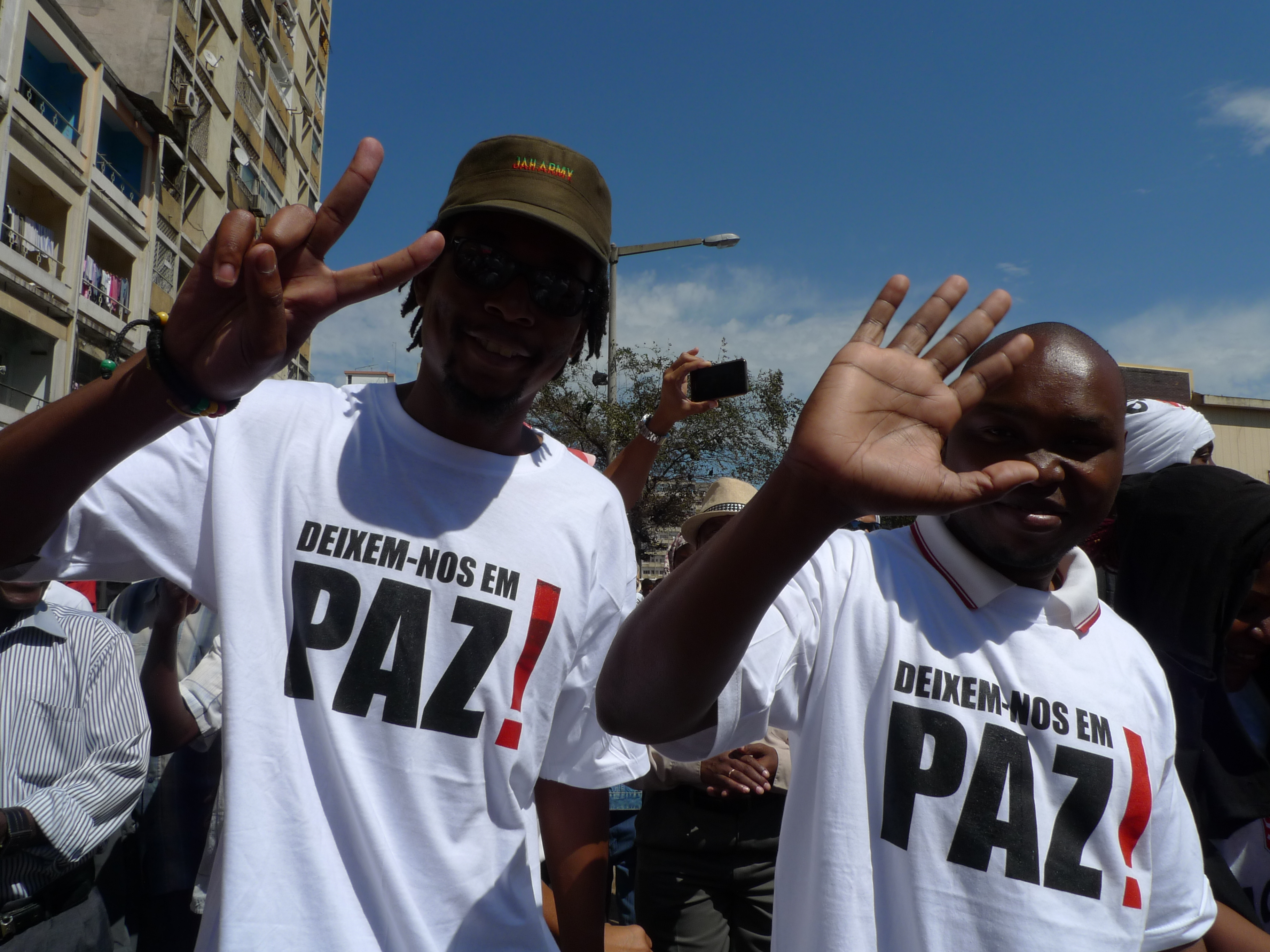
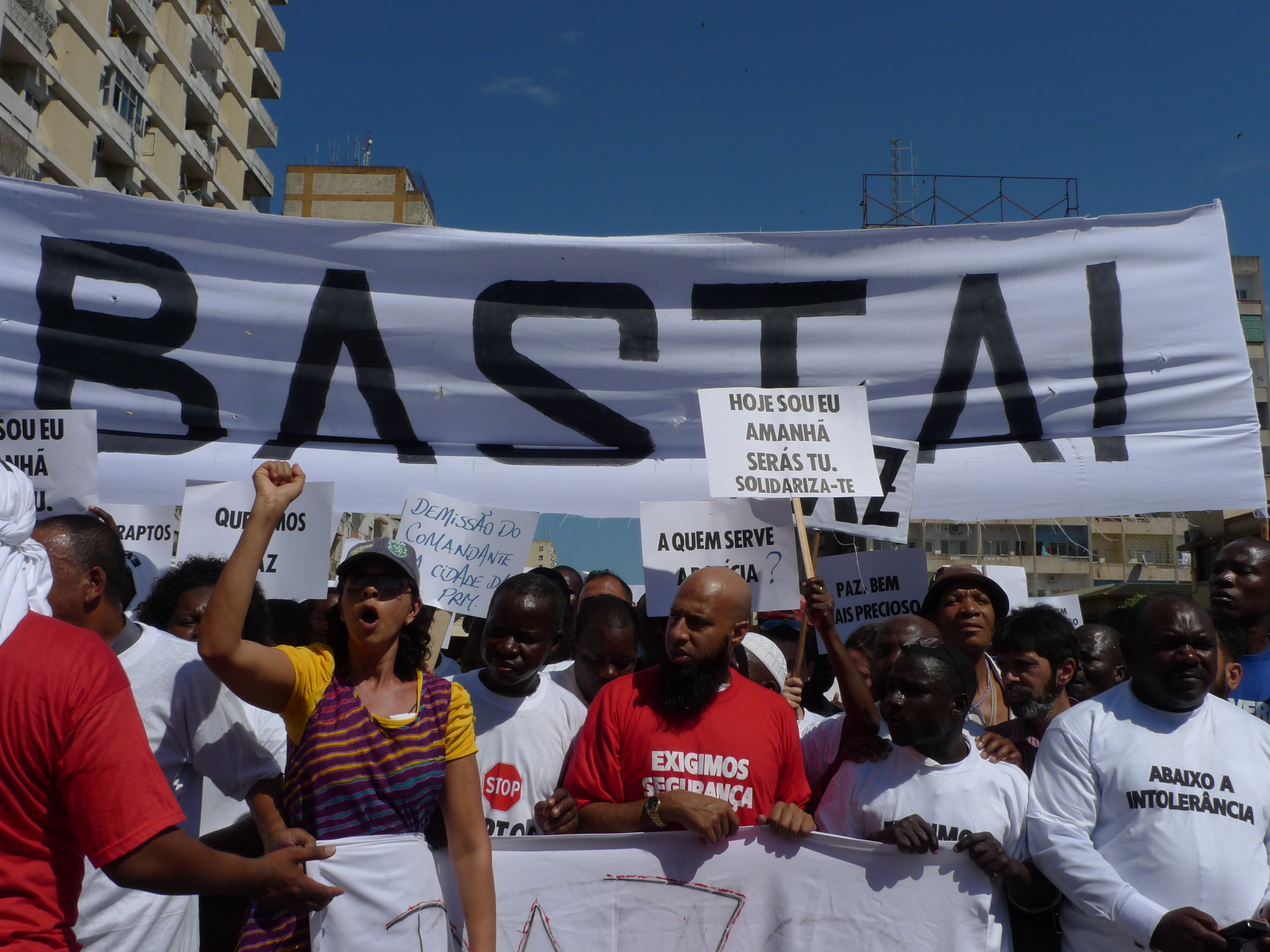
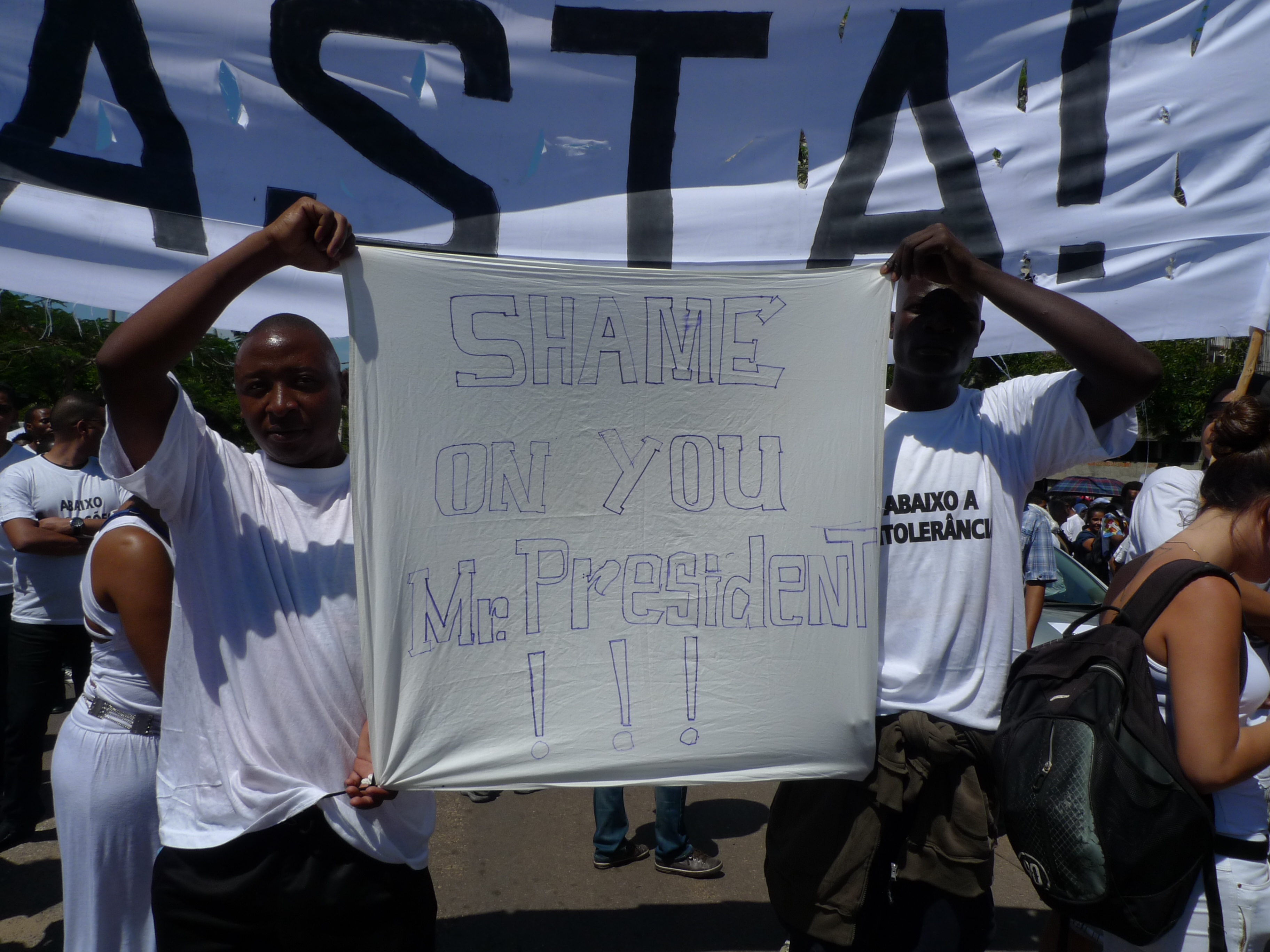
Although for the worst reasons, but 2013 saw an emotional, exciting and prominent event in Mozambique. On 31 October, more than 30,000 Mozambicans citizens took to the streets to participate in a vibrant peace march.

P1200809


Image

We protested peacefully with chants of ‘No to war!’ ‘No to corruption!’ ‘No to kidnaping abductions and insecurity!’ And, the big one, ‘Down with the government!’ was shouted in unison through the streets of Mozambique’s capital, Maputo, but also in other cities such as Beira, Pemba, Quelimane, Nampula and certainly to a lesser extent in many other parts of the country. It was a perfect demonstration of how the Mozambican people are tired of false promises and hollow speeches. The people took to the streets to say ‘BASTA!’ (Enough)

Image

But the year was not over yet…

In November we had local-level elections and all the problems that arise repeatedly in our country (with an absurd normalcy) of what should be a simple democratic exercise including deaths, fraud, assault and more. It was sad and shameful indeed. Attacks on civil society continued.

To close the year, the cherry on the cake was that in early December, Mozambican academic Carlos Nuno Castel-Branco was summoned by the Attorney General & criminal proceedings were brought against him and the media outlets, Canal de Moçambique and Mediafax. All this was because he wrote a harsh open letter to the President, Armando Guebuza criticizing his governance and the two media outlets published it.

Mediafax has explained that the two newspapers are accused of abuse of press freedom for publishing Castel-Branco’s letter. Once again the government has used imagination and creativity to shrink the space. Abuse of freedom! Are journalists no longer free to publish opinions of individuals? Worse, do citizens still have the right to give their opinions? Or are we about to lose one of our most fundamental rights?

Critical thinking and opinion are fundamental to the development of a society. If wrong, absurd and/ or radical, the ideas expressed should be challenged in the same way: BY WORDS.

Across the world, every day, governments and rulers are subject to criticism and always will be! Especially when they forget who they represent… Who does like being criticized, should not enter into politics.

“If the process moves forward and ends in conviction, our freedoms will be threatened,” wrote Dr Alice Mabote of Mozambican Human Rights League in an open solidarity letter to Castel-Branco, challenging the Prosecutor to also add to the prosecution list her and all other Mozambicans who criticize the “mis-governance” of Armando Guebuza.

These proceedings are absurd. JA joins civil society in denouncing them and we extend our full solidarity to Professor Carlos Nuno Castel-Branco, Canal de Moçambique and Mediafax and calls for civil society and the Mozambican media to not be intimidated.

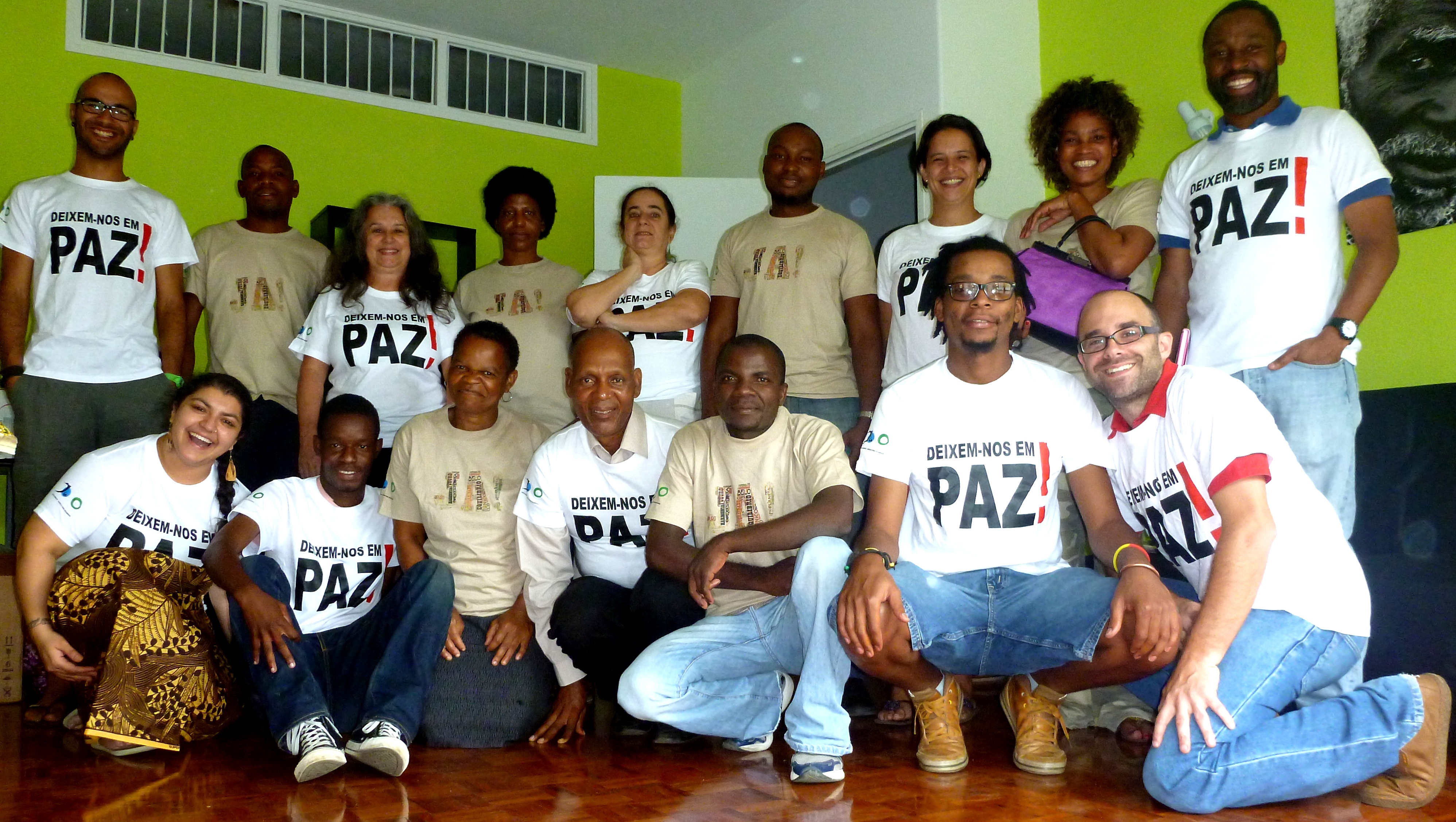
We will continue the struggle for environmental justice, social justice, for a better future for future generations and for a better world where differences are resolved by exchanging ideas and not bullets. Our words are our weapons, and because we are right, sooner or later we will win with them!

“In the pursuit of truth, it is forbidden to put words in handcuffs,” said Carlos Cardoso, Mozambican journalist assassinated in 2000.

A luta continua!

Image

The JA team wishes everyone a justice-filled 2014.

All photo credits: JA

What Lies Beyond?

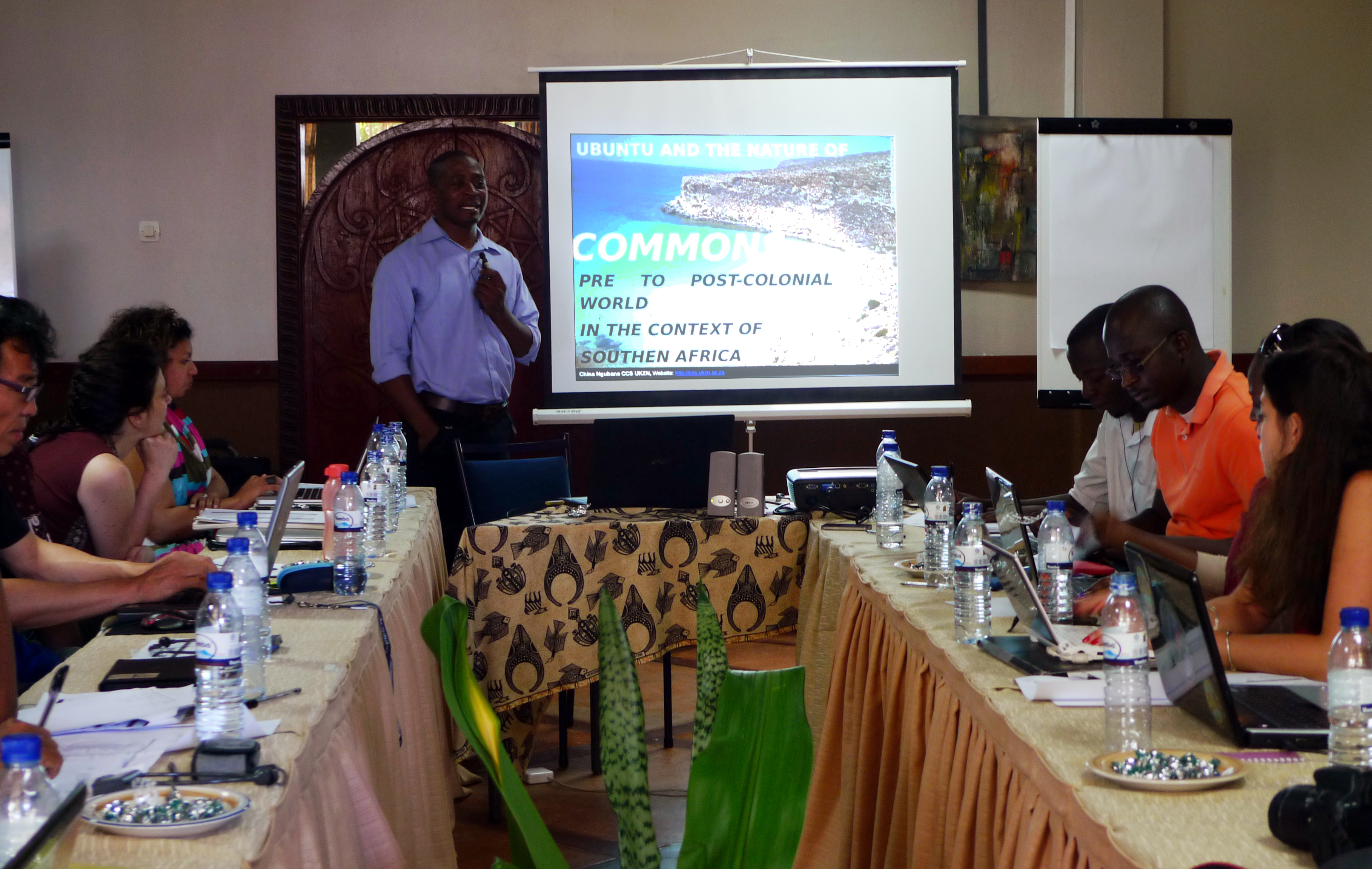
Last week, JA co-hosted an International Seminar called ‘Beyond Development, Extractivism, Globalization and Capitalism: Alternatives for Economic Justice’.

Image

The seminar was organised jointly by JA along with Friends of the Earth International, Transnational Institute and Center for Civil Society (CCS). The 3-day workshop pulled together diverse people, from grassroots struggles against coal in Tete province Mozambique to academics from South Korea. For three days, we discussed the main drivers of the extractive, neoliberal ‘development model’, the struggles for rights and for the commons and especially the concept of ‘development’ and what lies beyond it.

 Gloria Chicaiza from Acción Ecologica, an eco-feminist organisation from Ecuador shared the important concepts of Sumak Kawsay. Sumak kawsay is a Quechua term, from an indigenous language of the Andean region. Sumak Kawsay translates to Good Living in English, Buen Vivir in Spanish and Bem Viver in Portuguese. But this is not Good Living in the way the world understands it currently. The entire paradigm of Sumak Kawsay is different from today’s dominant capitalist culture, so totally consumed by, well, consumption. Instead of unlimited economic growth, sumak kawsay embodies a balance with nature and taking only what is needed. In Southern Africa, we call it ‘ubuntu’.

 So what does this mean? What is the definition of Good Living? What does it include and what doesn’t it include? Does it include CAT scans? And computers? And ARVs for AIDS? And Universities? If Buen Vivir includes these things, then we need to get the material inputs to make these things. Again, the paradigm is important; are we using aluminium for military hardware, or for making cooking pots. This is an important conversation that needs to continue.

 The dominant paradigm is to move everyone to a first world type of existence; but the simple question is whether it is feasible given our energy and planetary limitations.

We heard this staggering example from Tristen Taylor of Earthlife Africa:

Swedish energy use is not extravagant by First World standards and 45% of it comes from renewable energy. So, if we were to have everyone who is currently denied energy (1.4 billion people) living like the Swedes, we would need 5 times more oil than what Saudi Arabia currently produces, and in only 25 years we would exhaust the carbon budget that corresponds to a 2ºC temperature rise. We can’t all live like Swedes, so the fundamental issue is redistribution of wealth and power.

So, what lies beyond?

Image

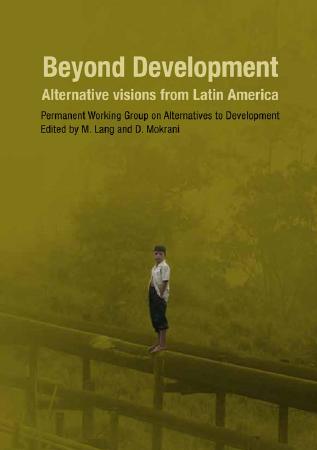
Well, Beyond Development: Alternative Visions from Latin America, the title of a book (written by The Permanent Working Group on Alternatives to Development and published by Rosa Luxemburg Foundation) released during the seminar, might be good reading material if you are curious.

 During the seminar, there was an interesting discussion on the need to deconstruct ‘development’. Some said the idea of development had to be scrapped. It couldn’t be modified with adjectives like sustainable, popular etc., because those are just reformist. We need to abandon the very idea of development, including exports, extractivism, everything about the way it exists now.

But is it a semantic dilemma? i.e., a problem with the word ‘development’? Because development also implies meeting people’s needs and basic necessities like water, sanitation, basic electricity, a simple house, a health clinic a school. So it’s hard to abandon the word, when it represents basic needs aspirations, as distinguished from hedonistic overconsumption.

But it was argued that it’s not just semantic – it is a problem of who gives meaning to the word, but it goes beyond. There is power associated with the word development; it is used to control territories and people on the basis of a certain dominant idea of development. That’s why the concept of Sumak Kawsay and Buen Vivir is being discussed by movements; the idea of a ‘dignified life’ not one based on the dominant notion of ‘development’.

On the other hand, others felt that saying, ‘we don’t want development’, might be extreme, perhaps what is needed is to investigate the question of ‘development for whom?’

These are the newer, ever newer strategies of capital, as it tries to reinvent and re-legitimise itself, while also generating more and more profits. After many decades of this ‘development’, we see that it doesn’t work and hasn’t worked; extraction and pollution continue; and now we are tottering on a cliff of ecological collapse and runaway climate change. And the re-legitimising tactics just continue. Carbon markets are just the latest tactics.

So what does this all mean? This blog doesn’t aim to provide answers, just to raise more important questions.

Life Compromised for Coal: Mozambique & the Importance of the IPCC report

Yesterday, JA celebrated the opening of our photo exhibition called “O Amanhã Comprometido: A Vida Por Carvão” which translates to ‘Tomorrow Jeopardized: Life for Coal’. This exhibition will run in the Associação Moçambicana de Fotografia in Maputo for a week until 1 October 2013. The exhibition features photos by Daniel Ribeiro, Mauro Pinto and Peter Steudtner.

(See the exhibition poster below)

 Image

This hard-hitting photo exhibition comes as the Intergovernmental Panel on Climate Change (IPCC) will release tomorrow yet another report about the dismal state of our atmosphere. The IPCC was constituted by the United Nations to study in depth the scientific, technical and socio-economic aspects of climate change. They release their assessment reports every 5 years; this week world leaders are meeting in Stockholm, Sweden, to release the Fifth Assessment Report (AR5) of Working Group 1 of the IPCC. Other chapters of AR5 will be released at different times next year, and we will keep you all posted about it.

Image

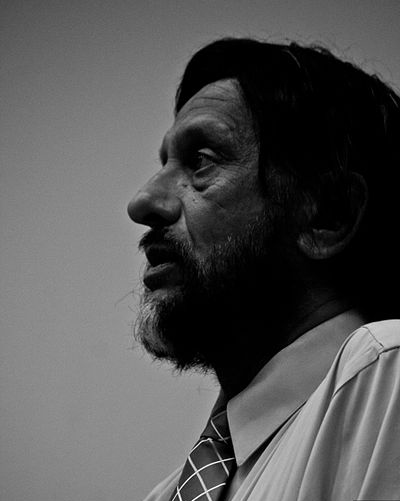
(Photo of the IPCC Chair Rajendra Pachauri by Marshall Niles)

Due to of the very technical nature of the process and the scientists involved, the AR5 report is likely to be conservative in its conclusions. But still, the verdict from the report is so clear. Parts of the report have been leaked beforehand. The report will conclude that climate change is definitely happening and it is driven by increased emissions from humans. The report will stress that each of the last three decades have been warmer than all of the preceding decades going back to 1850 and the decade from 2000-2010 has been the warmest. The report will conclude that an average temperature increase of 4 degrees Celsius is “as likely as not likely” by 2100. But this is just talking about global averages. The report is quite confident that the temperature increases over big land masses, including Africa and Asia, will be higher than the averages! Not just this, but the impacts faced by people will be worse that they originally predicted.

Already Mozambique is seeing elevated temperatures and huge variability in rainfall and river flows. In January 2013, over 150,000 people in Gaza district of Mozambique were temporarily forced out of their homes because of devastating floods. JA travelled to Chokwe to meet with communities and wrote about this in our February newsletter in Portuguese, available here: http://justicaambiental.org/index.php/en/resources/newsletter/2013

So what is the world doing about these dangerous scenarios? Dangerously little! The biggest and best way to reduce emissions today is to reduce the use of fossil fuels right now. Yet the world continues mining coal, drilling oil, fracking; all driving us closer to catastrophic climate change.

But what is worse, in spite of overwhelming scientific evidence of human caused climate change due to emissions, the Northern governments and big business find all possible ways to develop and push false solutions such as carbon trading, CDM, REDD, offsets, geo-engineering, etc., instead of reducing emissions.

Actually these constantly emerging and totally flawed false solutions are not a mistake but are very intentional; they are meant to give a free pass to polluters to carry on polluting. We are now heading towards the 19th meeting of the Conference of the Parties (COP) and in 19 years of trying to stop climate crisis, emissions have only gone up and false solutions are threatening more lives and livelihoods than ever before.

Of course, Mozambique has historically had a very small contribution to climate emissions. However, today Mozambique is aiming to be a major coal exporter, which is affecting communities locally and will put more carbon in the atmosphere than the world can bear. At this IPCC report’s release, we strongly say: Leave the coal in the hole! In Mozambique and everywhere in the world.

 For more information, see:

Africa is Sovereign and WILL NOT ACCEPT being Re-colonized

In response to Denmark’s Minister for Development Cooperation Christian Friis Bach recent controversial interview, Friends of the Earth Africa elaborated an Open Letter to be handed over to every Embassy of Denmark in African countries where FoEA is present. Based on that Open Letter and with the purpose of empowering it by allowing all of us, concerned citizens of the world to sign it,  we are now starting a petition with the same motto.  You can read the Open Letter bellow and if you share our concern, please sign our petition and add your voice to the struggle against the development models of capitalist neocolonialism.

Open Letter from the African Civil Society To The Representatives of Denmark in Africa

Subject: Africa is Sovereign and WILL NOT ACCEPT being Re-colonized

In light of the interview given by your Minister for Development Cooperation, Christian Friis Bach, on the 9th of this month to the Danish newspaper Politiken, and taking into account that the presence of Danish cooperations on the African continent dates long before the independence of most countries where they still operate today through various organizations that develop various projects and activities in various spheres of the political system, civil society and the business sector, we cannot refrain from expressing our deepest distaste for the disrespectful and peculiar ideological content of the above-mentioned interview.

Truth be told, Minister Christian Friis Bach said exactly what many politicians and leaders of developed countries think but cleverly would never dare say. Frankly, we prefer Christian Friis Bach to those other dodgy individuals. Petulant or reckless, your Minister of Development Cooperation said just what he thinks, giving us a chance to rebut, to contest and tell him that his notion of development is obsolete, that what he says he is willing to do is ethically despicable and offensive, that those who he claims would be the main beneficiaries of the policies he intends to impose will for sure become its main victims, and that even though unfortunately he may have the power to influence the decisions taken by the state apparatuses of some African countries, he definitely does not have the right to do so. We believe that he ought to know it. We Africans assure Christian Friis Bach and all who think like him, that even though we are already being pillaged, we will never allow Africa to be economically recolonized. Never.

It is instructive to remember that contrary to what Minister Friis Bach said in his interview, we Africans do have capacity to feed and sustain our people. African agriculture and food needs have been met over time through sustainable and multi-dimensional approaches, keeping to a minimum such externalities as artificial fertilizers, imported pesticides and herbicides, as well as practices that are alien to the socio-cultural settings of our people.

The support Africa needs right now is a decisive stand to maintain seed as well as cultural diversities and defend staple crops which are targeted by biotech even when there is no need for their engineered varieties or GM crops.

To you, as the highest representative of the Danish people in our territory, we would like to ask if you share the opinions of your Minister for Development Cooperation. If you do, please be kind enough to answer the following questions:

Do you think it is fair that the African continent should be held accountable “today” for the bad decisions rich countries such as yours made “yesterday”, and which led to over-exploitation of nature, animals and human beings by introducing unhealthy and destructive diets as well as excess energy consumption?

Do you consider it acceptable that countries like yours should impose their failed development models on Africa as if they were models of success and the only guaranteed path towards development?

Would you imagine a world in which Africa adopts your ideas of production, consumption, development and progress?

Do you think it right that we Africans must accept without question the responsibility of using our resources to support those who were obviously unable to manage theirs?

It honours us greatly that the world is turning to Africa and its leaders say they are counting on us. We Africans are hospitable and supportive and for long we have been wanting to contribute more and better to a development path that supports sustainable livelihoods. However, we do not have to sacrifice ourselves to accommodate the whims of those who think it is a mark of progress to destroy the planet. We want to rely on the support of all who are well intended, but such support must not trample on our sovereignty and dignity.

In this context, we, African organizations, movements and associations who hereby signed this letter, reiterate that we continue to consider much welcome the support of those who wish to walk with us towards a development path:

  1. That adequately serves our needs and those of our future generations;
  2. That is fair and just and not predicated on exploitation, resource grabs and denigration;
  3. That is logical and thoughtful and does not necessarily have to be traversed in pursuit of anything or anyone;
  4. In which we may not be sole beneficiaries, but we must not be denied our due;
  5. That not only respects the sovereignty of each African country, but also our diversity as a people, as well as the diversity of our cultures and traditions;
  6. That is guided by principles of honesty, transparency and inclusion, fundamental to the democratic exercise of any territory.
  7. That respects our Food sovereignty, which is built upon the inalienable rights of peoples to maintain their cultural as well as seed diversities. Cultural diversity permits peoples to maintain and enlarge their stock of local knowledge; produce, save and use their seeds and have control over farming practices developed over centuries of experimentation and experience. Food sovereignty ensures that farmers stay in business and that peoples are not forced to alter their diets.Naturally, we consider that any development project that ignores or disregards any of these principles is not in the best interest of Africa or Africans, and we reject and denounce the position taken by your government through your Minister of Development Cooperation.

For the sake of the good relations we wish to maintain with you, we would appreciate you would be so kind as to respond to this letter.

Signed by

African Organizations,

Friends of the Earth Africa

Justiça Ambiental/FOE Mozambique

ATPNE / Friends of the Earth Tunisia

Centre pour l’Environnement et le Développement / Friends of the Earth Cameroon

Environmental Rights Action / Friends of the Earth Nigeria

Friends of the Earth Ghana

Friends of the Earth Sierra Leone

GroundWork / Friends of the Earth South Africa

Guamina / Friends of the Earth Mali

Lawyers’ Environmental Action Team / Friends of the Earth Tanzania

Les Amis de la Terre / Friends of the Earth Togo

Maudesco / Friends of the Earth Mauritius

National Association of Professional Environmentalists / Friends of the Earth Uganda

Sustainable Development Institute (SDI) / Friends of the Earth Liberia

Yonge Nawe Environmental Action Group / Friends of the Earth Swaziland

Alliance For Food Sovereignty  In Africa (AFSA)

African Biodiversity Network (ABN)

Coalition for the Protection of African Genetic Heritage (COPAGEN)

Comparing and Supporting Endogenous Development (COMPAS) Africa

Indigenous Peoples of Africa Coordinating Committee (IPACC)

Participatory Ecological Land Use Management (PELUM) Association

Eastern and Southern African Small Scale Farmers Forum (ESSAFF)

La Via Campesina Africa

FAHAMU, World Neighbours

Network of Farmers’ and Agricultural Producers’ Organizations of West Africa (ROPPA)

Community Knowledge Systems (CKS)

Plateforme Sous Régionale des Organisations Paysannes d’Afrique Centrale (PROPAC)

Laurent Alex Badji COPAGEN Senegal

The Green Belt Movement Kenya

Health of Mother Earth Foundation, ((HOMEF) Nigeria

Committee on Vital Environmental Resources (COVER) Nigeria

The Young Environment Network (TYEN) Nigeria

Institute for Research and Promotion of Alternatives in Development (IRPAD/Afrque)

Mali Coalition pour la Protection du Patrimoine Génétique Africain Mali (COPAGEN-Mali)

Actions Pour le Développement Durable, Republic of Benin

Kenya Debt Relief Network(KENDREN) Kenya

African Centre for Biosafety (ACB) South Africa

The Rescope Programme Malawi

Host Communities Network Of Nigeria (HoCoN, Nation Wide) Nigeria

Students Environment Assembly Nigeria (SEAN Nation Wide) Nigeria

Community Forest Watch Group Nigeria

Green Alliance Nigeria (Nation wide) Nigeria

Abibiman Foundation Ghana

Oilwatch Ghana

Oilwatch Nigeria

Improving Livelihoods Through Agriculture (ILTA) Ghana

Acção Académica para o Desenvolvimento das Comunidades Rurais (ADECRU), Mozambique

Associação de Apoio e Assistência Jurídica às Comunidades (AAAJC), Mozambique

Fórum Mulher, Mozambique

Liga Moçambicana dos Direitos Humanos (LDH), Mozambique

Kulima, Mozambique

Non African Organizations:

Amigos da Terra América Latina e Caribas TALC

Amigu di Tera (FoE Curaçao), Curação

NOAH Denmark, Dinamarca

COECOCEIBA / FoE Costa Rica

Community Alliance for Global Justice Denmark, Dinamarca

Amigos de la Tierra México, México

Red Mexicana de Afectados por la Minería (REMA) México

Movimiento Mesoamericano contra el Modelo Extractivo Minero (M4) México

The Rescope Programme

Community Alliance for Global Justice

PLANT (Partners for the Land & Agricultural Needs of Traditional Peoples)

Various African Organizations and Movements are still signing in and several Non African movements and organizations are also subscribing to this letter.

Neocolonialism: Who Do You Think You Are?

Unbelievable…

Denmark’s Minister for Development Cooperation has done it. He has put it out there. In an interview given last week in Denmark, the Danish politician spoke his mind and told his constituents what he has in mind for Africa. Under the cloak of a very noble poverty eradication and gender equality speech, a shameless and shocking eyeopener of how some European leaders completely and utterly disregard our sovereignty, and of how comfortable they feel about taking decisions for us.

Read the translated full article below.

Image

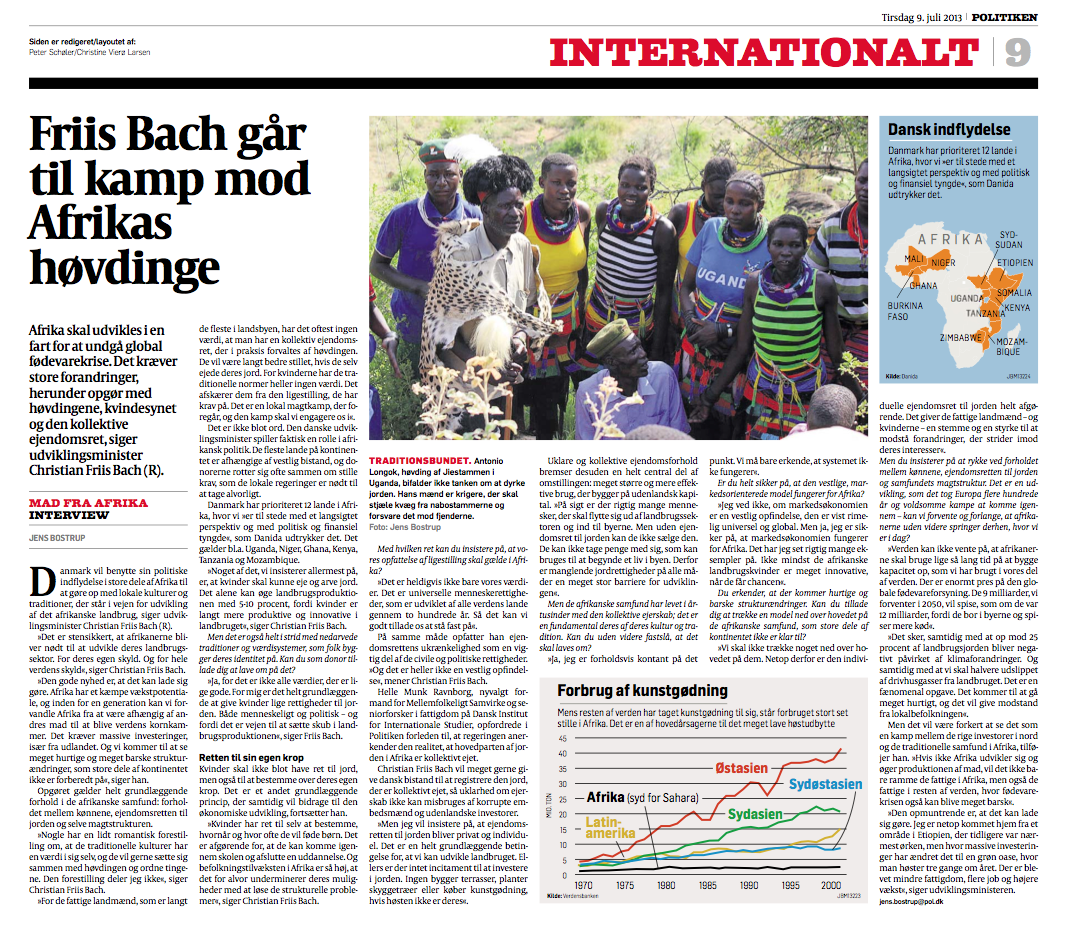
Politiken | 09.07.2013

Food from Africa, Interview by JENS Bostrup with Danish Minister for Development Cooperation, Christian Friis Bach

Friis Bach is Up for a Match Against the African Chiefs

Africa must be developed in a rush in order to avoid global food crisis. It requires huge changes, including a confrontation with chiefs, the role of women and the view upon collective property, says Danish Minister for Development Cooperation, Christian Friis Bach.

Denmark will use its political influence in large parts of Africa to get rid of local cultures and traditions that hinder the development of African agriculture, says Minister for Development Cooperation Christian Friis Bach.

“It is certain that Africans will have to develop their agriculture, for their own sake and for the entire world”, says Christian Friis Bach. “The good news is that it can be done. Africa has a huge growth potential, and within a generation, we can transform Africa from being dependent on others for food to being the world’s breadbasket. It will require massive investments, especially from abroad, and it will bring them very quick and very harsh structural changes, which large parts of the continent are not prepared for”, he says.

This confrontation must address fundamental issues in the African societies: gender relations, land ownership and the power structure.

“Some have a rather romantic belief that traditional cultures have a value in themselves, and they want to sit down with the chief and fix things. I do not share this belief”, says Christian Friis Bach. “For the poor farmers, who are the majority in the village, collective ownership, which is in practice administered by the chief, is usually of no value. They would be much better off if they owned their land. For women, the traditional norms has no value either. It prevents them from the equality they deserve. It is an ongoing local power struggle, and we must engage in this struggle”.

This is not just words. The Danish Minister for Development Cooperation actually plays a role in African politics. Most countries on the continent are dependent on Western aid, and donor countries often conspire to make demands that local governments have to acknowledge.

Denmark has prioritized 12 countries in Africa, where we “are present with a long-term perspective and with political and financial weight” as Danida puts it. This applies amongst others Uganda, Niger, Ghana, Kenya, Tanzania and Mozambique. “One of the things we particularly insist on is that women should be able to own and inherit land. This can increase agricultural production by 5-10 percent because women are far more productive and innovative in agriculture”, says Christian Friis Bach.

[Q] But this is also completely contrary to ancestral traditions and values on which people build their identity. Can you as a donor allow yourself to change that?

“Yes, because not all values ​​are equally worthy. For me it is fundamental to give women equal rights to the land, both human and political, besides, it is the way to boost agricultural production”, says Friis Bach.

The right over their own bodies

Women must not only have the right to land, but also the right to decide over their own bodies. This is another fundamental principle that, in time, will contribute to the economic development, he continues.

“Women should have the right to decide when and how often they will bear children. This is crucial in order to allow them to get through school and complete their education. And population growth in Africa is so high that it seriously undermines their ability to solve the structural problems”, says Christian Friis Bach.

[Q] By what right can you insist that our concept of equality should apply in Africa?

“Fortunately, these are not just our values. These are universal human rights, as developed by all countries worldwide throughout two hundred years. So we can allow ourselves to insist on them”. Similarly, he perceives the inviolability of property as an important part of the civil and political rights. “And that is not a Western invention either”, says Christian Friis Bach.

Helle Munk Ravnborg, newly elected president of Danish ActionAid and senior researcher in poverty at the Danish Institute for International Studies, recently appealed in Politiken [the newspaper in which this interview is also published] that the government recognizes the reality that the majority of the land in Africa is collectively owned.

Christian Friis Bach would very much like to offer Danish assistance to register the collectively owned land to avoid that uncertainty about ownership is misused by corrupt officials and foreign investors.

“But I will insist that land ownership becomes private and individual. It is a fundamental condition for us to develop agriculture. Otherwise there is no incentive to invest in the land. No one builds terraces, plants shade trees or buys fertilizers, if the harvest is not theirs”.

Unclear and collective ownership also slows down a key part of the transition: much larger and more effective farms based on foreign capital.

“In the long term there are very many people who need to move away from the agricultural sector and into the cities. But without ownership to the land, they cannot sell it. They cannot take money with them, which can be used to start a life in the city. Therefore, lack of land rights is in all ways a very large barrier to development”.

[Q] But the African societies have lived with collective ownership for millennia; it is a fundamental part of their culture and tradition. Can you without further ado establish that it needs to change?

“Yes, I am relatively clear on that point. We just have to recognize that the system is not functioning”.

[Q] Are you absolutely sure that the Western, market-oriented model works for Africa?

“I do not know if the market economy is a Western invention, I think it is rather universal and global. But yes, I am sure that the market economy functions for Africa. I have seen great many examples of this. African women farmers in particular are very innovative when they are given the chance”.

[Q] You recognize that there will be swift and harsh structural changes. Can you allow yourself to impose a model onto African societies that large parts of the continent are not ready for?

“We must not impose anything on them. That is precisely why the individual land ownership is crucial. It gives poor farmers and women a voice and a strength to resist changes that conflict with their interests”.

[Q] But you insist on changing the gender relations, the land ownership rights and the power structures of societies. It took Europe several hundred years and fierce fighting to get through a similar development. Can we expect and demand that Africans readily jumps to where we are today?

“The world cannot wait for Africans to take their time to build up capacity as we have done in our part of the world. There is an enormous pressure on the global food supply. The 9 billion, we expect to be in 2050, will eat as if they were 12 billion because they will live in the cities and eat more meat”. “While this takes place, up to 25 percent of the agricultural land will be adversely affected by climate change, and we will have to reduce greenhouse gas emissions from agriculture by half. It is a phenomenal task. It is going to happen very quickly, and it will find resistance in the local populations”.

But it would be wrong to see it as a battle between the rich investors in the North and the traditional societies in Africa, he adds. “If Africa does not develop and increase the production of food, it will not only hit the poor in Africa, but also the poor in the rest of the world where the food crisis also may be very harsh”. “What is encouraging is that it can be done. I have just returned from a region in Ethiopia that previously was almost a desert, but where massive investment has changed it into a green oasis where you can harvest three times a year. There is now less poverty, more jobs and higher growth”, says the minister.

Other texts in the article:

Photo text: Bound by tradition: Antonio Longok, chief of the Jie tripe in Uganda, does not welcome the idea of ​​cultivating the land. His men are warriors who must stealing cattle from neighboring tribes and defend it against enemies. (Photo: Jens Bostrup)

Figure text: Use of fertilizers: While the rest of the world has embraced fertilizers, the consumption in Africa is more or less steady. This is one of the main reasons for the very low yields. (Source the World Bank)

Map text: Danish influence: Denmark has prioritized 12 countries in Africa, where we “are present with a long-term perspective and with political and financial weight’, as Danida puts it. (Source: Danida JBM13224)

A Positive Example

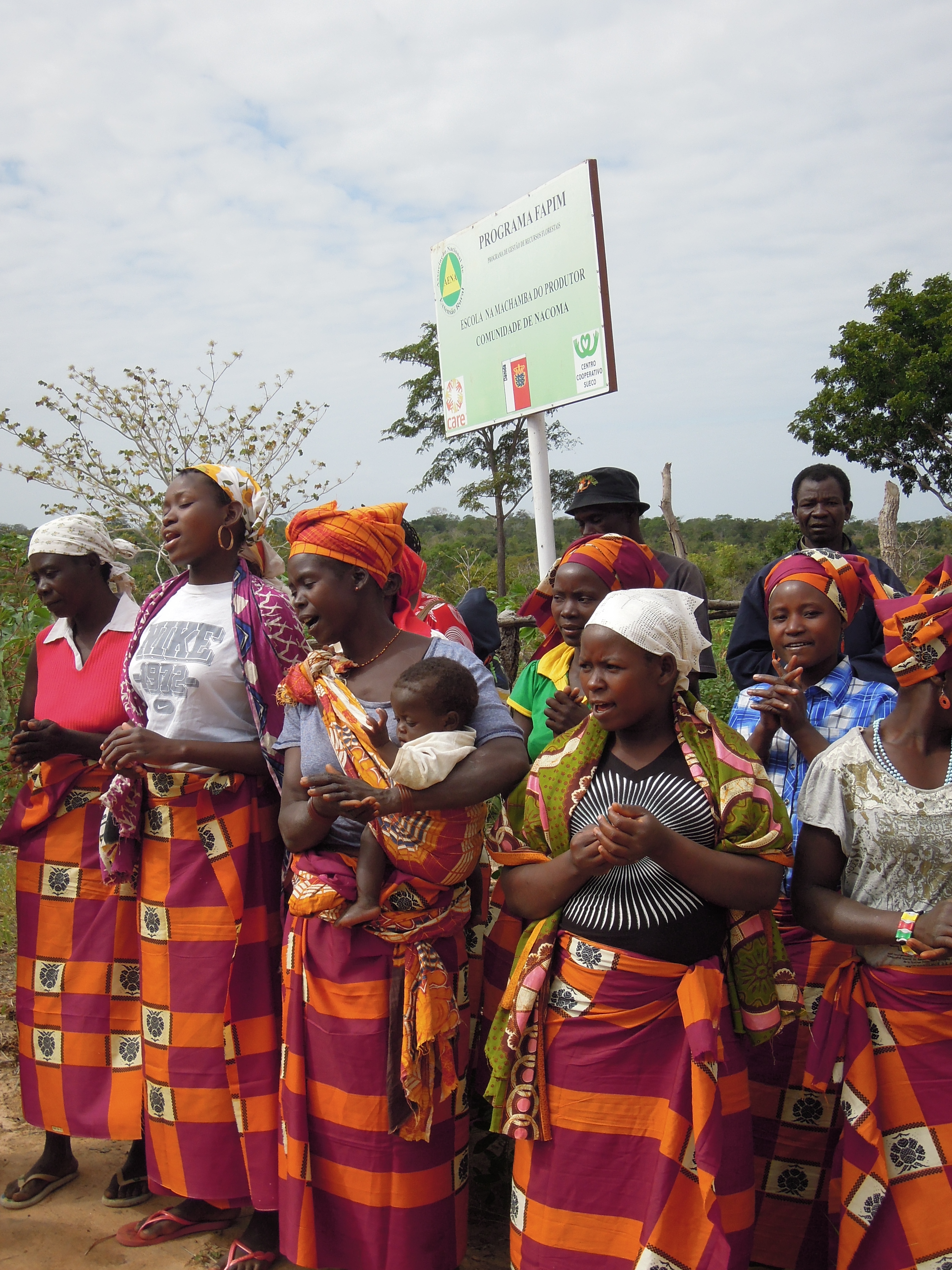
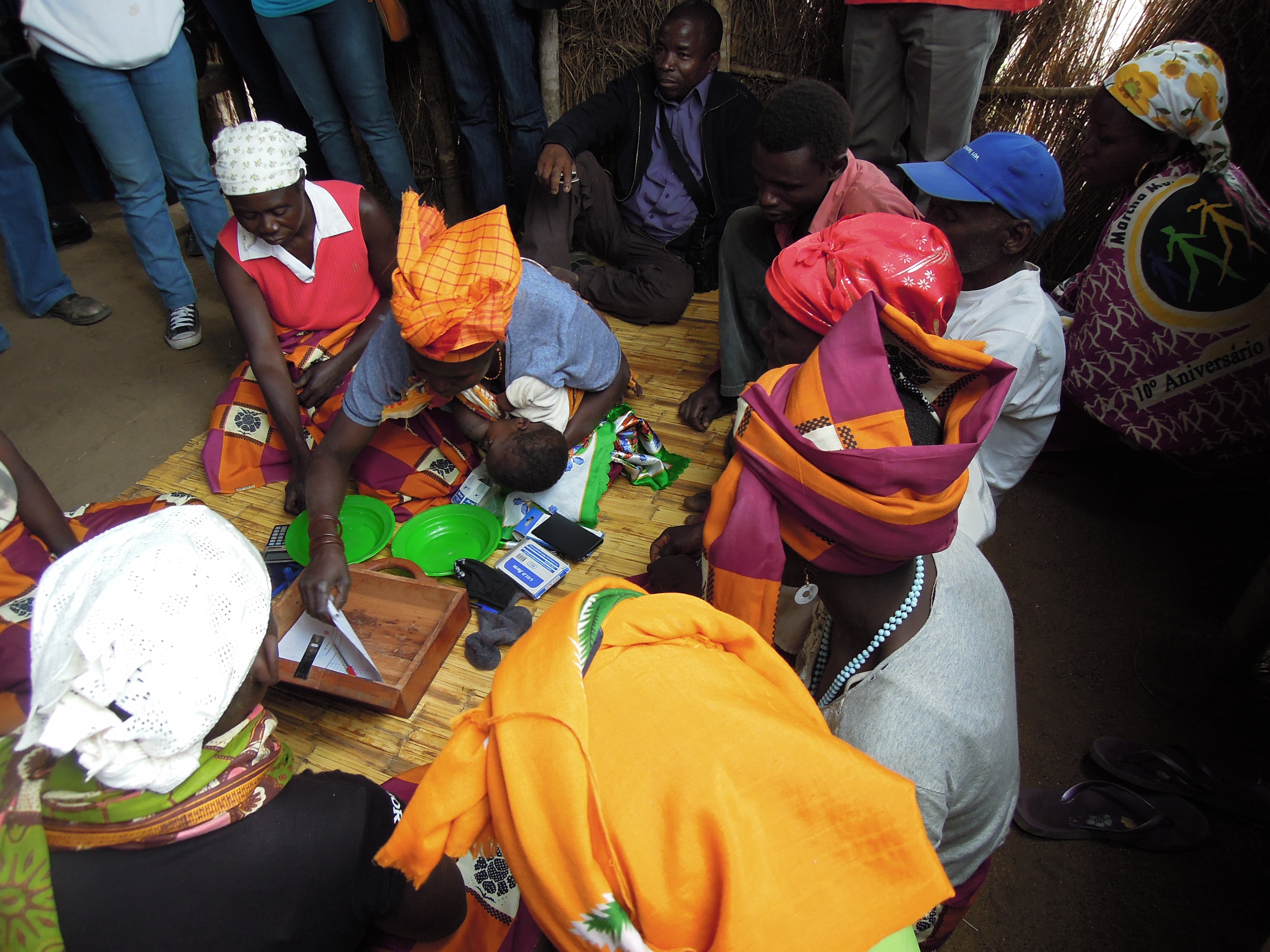
During a trip to Nampula for a meeting with AGIR (Action Programme for a Responsible and Inclusive Governance) and its partners, we were told that we would visit the community of Nacoma in the village of Mele, Meconta district, about 83 km from the city of Nampula, where, with the support of the National Association of Rural Extension (AENA), the community formed an association composed of 20 members (13 women and 7 men) to improve their crops. This association would be presented to us as a good example of a farming, savings and literacy project (for the community even created a school in the farm area itself).

 Image

After an almost two hours journey, we finally arrived to the place. Several women with colourful scarves and capulanas, clapping and singing welcoming songs for us, greeted us at our arrival. There were barely any men, only three were present.

From there, always singing and clapping, they led us to a small plot of land next to a dirt road where they showed us an example of the good practices and crop improvements they had learned for a more efficient agriculture on poor soils. These women, with the help of a partner of AGIR in Nampula who shared its knowledge with them, improved the soil of the area, which was not the best for agriculture, through the practice of techniques such as the use of dry grass to conserve soil moisture and thus retain its nutrients. From AGIR’s partner, they mentioned they also learned that setting fire to a plot before using it, a widely used method in the area to prepare the soil, when done systematically ends up reducing the nutrients and weakening the soil. They further demonstrated, using only water grass and sand, rudimentary examples of other methods used to enhance and improve their harvests, and showed us how they had arranged between them to monetize the goods they produce (cassava, pigeon pea, sweet potato, peanut, etc… ) and thus increased their income allowing it to improved their lives and their families. Finally, they showed us a peanut dryer made by the association, made with simple poles and grass where it was protected from rain, insects and other animals.

 Image

After visiting the peanut dryer, our group informed that visitors would also like to see and know the method of collecting income from all who were part of the association. Then showed us a wooden suitcase, where not only they deposited their earnings, but where they also kept the register of their loans, as well as their savings, each amount in its place (in three man socks of different colors). They explained to us that the suitcase had two keys and that they were never in the same place or with the same person. The keys were handed over to two different people in the group and when the suitcase was opened everyone should be present to count the money together, a measure of security for all.

We were impressed by the organization, methodology and capacity of a group so small yet so effective in managing their own interests. A good example of community empowerment, with which all present were astonished. However, for us it was more than that. It was once again a confirmation of the power of the people of Mozambique and Mozambican women in particular, their ability, courage and perseverance in trying to resolve their difficulties and strive for a better future. For us it was a true life lesson!

To finish, we would like to leave you with some food for thought: What will happen to these women in the community of Nacoma when the giant and controversial ProSavana is implemented? We know that Meconta is one of the areas covered by it… Will it be the “early death” of another good example in Mozambique? Or will it survive?

Ills and illogics of Coal

The coal monster is finally starting to show signs of illness and decline. The campaign against coal in the US has had some major victories and has sent coal into the sidelines in future energy planning, with even President Obama publicly mentioning the phasing out of coal in his speech on Tuesday at Georgetown University. With numerous coal power stations reaching the end of their lifespan, US coal consumption is on the decease and has placed the US in a situation where it can become a major global coal exporter instead of a user.

In China the first signs of change are already visible. In 2010 in China, coal was overtaken by renewables in newly-installed energy capacity, and China’s strategies and long-term planning are starting to reflect this move away from coal to a more diversified energy capacity. When even China starts to prioritize moving away from coal, then we know the tides are changing. These changes even though early and relatively small are starting to bear fruit. For example Mongolia’s future development path was set to be heavily based on exploration of their vast coal reserves to supply China’s coal needs, and Mongolia borrowed heavily on the usual assumption of revenues associated with coal. However, coals prices have been crashing and China’s increase in coal consumption has been slower than projected, while increase in using cleaner alternatives has been higher than projected. This has caused havoc to Mongolia’s debt and, in turn, its development future.

ImagemIn our own country, Mozambique, these risks are being felt. Both Vale and Rio Tinto (who according to our sources has already put their business in the country for sale) are feeling the impact of the infrastructural bottlenecks, with extensive delays and cost overruns affecting their profit margins. Coupled with decreasing coal prices, uncertain economic projects and over optimistic assessments of the quality and size of the Mozambican reserves have resulted in billions of dollars of losses. These losses are despite a very favourable, secret contract that the companies negotiated with the Mozambican government, which is unfair to Mozambique, in that it gives little benefits for Mozambique, but high negative impacts.

At a broader technical level, one starts to realise the difficulties that coal is facing. The construction cost for coal power stations have sky-rocketed and the extensive infrastructure and logical requirements (railways, ports, terminals, etc.) are facing bottlenecks around the world that further increases the overall costs. At an economical level, the risks are constantly increasing. A recent commodities report by Deutsch Bank showed dismal projections and further decreases in the possible returns from coal.

On the other hand, the cost of clean alternatives are steadily decreasing and options like wind are already cheaper at a dollar per Kilowatt produced rate, and within the next few years even solar will become cheaper. The investment world is also starting to understand and benefit from the positive components that alternative energy present. For example both wind and solar have very short periods between investment to profitability and are highly modular. Wind turbines can be installed and placed on grid in a very short time period and gradually increased in successive phases in direct correlation with demand. In contrast coal power stations are very large point investments with very long construction periods, often extended by delays. They depend more on long-term demand projects that are regularly over-optimistic or completely incorrect. Due to the long life span the production capacity is usually much higher than initial demand in order to cope with future projected demand increases, which makes the investment larger than required. Whereas alternatives start returning profits in a modular manner, as each phase is complete, traditional coal-based production has no returns until the full project has been completed and then it causes a huge peak in energy availability which can cause a decrease in energy prices due to over-supply. The need for forward planning and the regular energy peaks inherent in coal-based energy production has also been given as one of the reasons for the low priority of the energy sector for not focussing on energy efficiency.

Coal also developed as a sector during a time when economics were more open to subsidies and had a narrow notion of costs and responsibilities, if it were starting today it would be considered crazy. Unfortunatly, many of these issues are still part of common practices in the coal sector. Subsidies include direct spending, tax breaks or exemptions, low-interest loans, loan guarantees, loan forgiveness, grants, subsidised railways and ports, and much more. In terms of global subsidies in 2010 fossil fuels received almost 7 times more subsidies than renewables, and this value is based a narrow definition of subsidies. Then their is the external cost from coal. For example a Harvard medical study calculated that the additional heath and environmental cost from burning coal has cost the US $500 billion a year. Governments also lose extensive revenues from discounted royalty fees from lands, water and many others. It is common practice for mines and coal power station not to pay at all, or pay insignificant amounts for environmental services such as water (which they consume and pollute in copious amounts), nor do they restore the damage they cause. In fact just the indirect subsidies of fossil fuel, such as favorable access  to land, water and other breaks is valued to be equivilate to the total amout of subsidies received by the renewables sector. The Greenpeace South Africa report “The True Cost of Coal” highlights this absurdity of coal. Actually more than 200 different form of subsidies have been identified.

On top of this, coal is one of the main drivers of climate change, making it one of the main targets for the climate change debates. It is not a matter of “if”, but a matter of “when” serious carbon restrictions and limits start being imposed, at that time coal will be one of the most affected. However, even now with no true restrictions from the international climate change negotiations, the environmental and social problems associated with coal are so devastating and well-known that it is leading to an ever-increasing opposition to coal worldwide. It is getting ever more difficult to obtain public consent, which is becoming a growing requirement in democratic countries around the world.

In addition to competing with ever-improving clean alternatives, coal is also competing with other extractives. Most mining companies cover a host of extractive activities, but have limited resources to invest in new projects; therefore decisions have to be made between the different mining proposals. Given the increasing risks of coal it has fallen down the list of profitable investments.

Unfortunately, monsters like coal do not go down quietly. Whenever the illness of coal is exposed, a number of sector “specialists” proclaim its heath through hyper-positive projections and possible profits in the attempt to continue the investments into coal. As the industry starts realising the limited future in developed countries it turns to Africa and can always count on the short sightedness and corruption of our unaccountable leaders to allow for bad decisions. Let’s stop being the dumping ground of dying technologies.

At present coal is living through the latency associated with change and is still viable for already developed coal sectors in the near future, but dangerous for countries that are just starting to develop their coal development. Africa, and Mozambique in specific, doesn’t need to follow this destructive path to development, and the associated devastating impacts, that was used by the current powers. We can skip the potholes of development like we did with communication. Most of Africa did not have a wired line phone system, so we skipped this resource and time-extensive method, and went straight to the cleaner, more efficient wireless cellular communications route. Let’s do the same for our energy and revenue development path.