Category Archives: fossil fuels

Petitions to government institutions fall into oblivion

On the 21st of September 2016, Justiça Ambiental, in partnership with the World Rainforest Movement, submitted to the Ministry of Land, Environment and Rural Development, to the Ministry of Agriculture and Food, to Green Resources and to Portucel a petition signed by 12332 people exposing the numerous conflicts and social, environmental and economic impacts – especially in the local communities directly affected. The petition stated the following:

“On September 21st, on the occasion of the International Day of Struggle Against Tree Monocultures, we, the undersigned organizations, groups, movements and individuals, expressed our solidarity and support to the communities that are fighting against the expansion of these large plantations. We demand that Green Resources, Portucel and all other companies and financial capital investors who are usurping land or planning to support the capture of fertile agricultural land for tree monocultures in eastern and southern Africa return it to the communities. By doing so, they can help prevent new conflicts between plantation companies and governments and contribute to solve the many that already exist across the region. We demand that the Government of Mozambique maintain its Land Law and ensure that the rights of communities to land, water and food are duly respected.”

The conflicts and impacts of monoculture plantations are not exclusive to rural communities in Mozambique. In fact, they are a characteristic of this type of investment and can be found everywhere where plantations of this type are promoted.

The petition was submitted to the aforementioned bodies with the knowledge of:

The Office of the President of the Republic

The Parliament

The Attorney General’s Office

The Governor of the Province of Zambézia

The Governor of the Province of Niassa

The Governor of the Province of Nampula

However, to date, after more than 2 years, none of the institutions above deigned to respond…

These public institutions, that we are told exist to serve and defend the interests of the people, are the ones who systematically ignore their concerns, demands and petitions…

In August 2018, Justiça Ambiental, ADECRU (Academic Action for the Development of Rural Communities) and Nampula’s UPC (Provincial Peasants Union) facilitated the process of drafting and submitting a petition on behalf of the communities affected by Green Resources, which contained some 3406 signatures from members of affected communities. The petition exposed in detail the innumerable situations these communities were subjected to and the various attempts at conflict resolution that have had no results at all. This last petition was submitted to the following institutions:

Ministry of Agriculture and Food Safety, addressed to the Minister;

Ministry of Land, Environment and Rural Development, addressed to the Minister;

The Parliament’s 5th Committee – Committee on Agriculture, Economy and the Environment;

Green Resources Mozambique;

Mozambican Bar Association;

Norfund;

Embassy of Norway in Mozambique; and

National Commission on Human Rights

Of these institutions, only the National Human Rights Commission responded and was showed interest in investigating the matter, however, so far nothing else has happened.

Land conflicts persist, communities affected and deceived with promises of better living and employment are still waiting for a response, they continue to wait for a solution to their many complaints, and to believe that there will be answers to their many appeals !!!

More frightening than our government’s silence and inaction over these petitions and complaints regarding this type of investment, is that it continues to promote the monoculture plantations business, it continues to invite investors and distribute land that is not vacant, nor is it infertile or marginal – as they claim in order to defend their investments.

The latest versions of the Forestry Policy and Implementation Strategy, of the 2035 Forest Agenda and of the National Forestry Program, which are allegedly still under public discussion, clearly demonstrate that our government, particularly the environment and forest sectors, is far from realizing the scale of the social, environmental and even economic impacts of this investment.

Even more serious than the complete absence of current knowledge about the negative impacts of large monoculture plantations on the environment, in particular on maintaining the ecological balance on which we all depend, is the arrogance with which they refuse to learn from the many examples that exist throughout the world. It is completely unacceptable and absurd to hear a forestry technician effusively defend that monoculture plantations are forests and then insist by asking “are those not trees?”! It is equally unacceptable that the definition of forests can be altered to accommodate the interests of many false solutions such as REDD and the commodification of nature. Yet, this is precisely what is happening in the sector.

Important instruments such as the 2035 Forest Agenda and the National Forestry Program are being developed under the leadership of government’s “strategic partners”, with tremendous economic interests in the sector, such as the World Bank that has poured millions and millions of dollars in these “make-believe” processes. Yet we, the Mozambican organizations that stand our ground against the complete pillage of our resources, are the ones who are constantly accused of serving foreign interests. The influence and power enjoyed by these “strategic partners” who finance and direct these processes is visible and frightening. Who rules our country? Are we really sovereign? Or is that speech valid only when your “strategic partners” and our eternal “financiers” are angry with your crazy adventures with public money? Are we only sovereign then?

Public participation is still a huge challenge, and it does not seem to us that there is a real desire to improve, since this way it is much easier to conduct the processes without much resistance. Mozambican civil society barely participates in public discussion processes, whether about environmental aspects or other issues. The participants of these meetings are mostly representatives of civil society organizations and other organizations and sometimes some students. This weak participation also tells us a great deal about the way citizens feel about these processes and, above all, what can be expected of them.

In the case of the above-mentioned instruments, it should be noted that technical committees have been set up for the elaboration and discussion of these, but the space attributed to civil society organizations is always very small and it is not clear how organizations are “chosen” to participate . JA! participated in the technical committee and despite the numerous comments on the various versions of the document, nothing was really considered and properly analyzed. Our natural resources, our forests and ecosystems are only treated as profit-making resources, we do not consider their biological importance and the fact that we are part of this planet and depend on the biological services that these ecosystems provide us and that allow life on Earth.

It seems childish to remember that we do not own Planet Earth and nature, we are part of it. We are the most stupid and destructive part of it…

Our stupidity is demonstrated over and over again by the state of our planet, by the state of our forests, rivers and other ecosystems… We don’t see the other animals – the ones we call irrational – destroying their habitat as humans do… for profit!
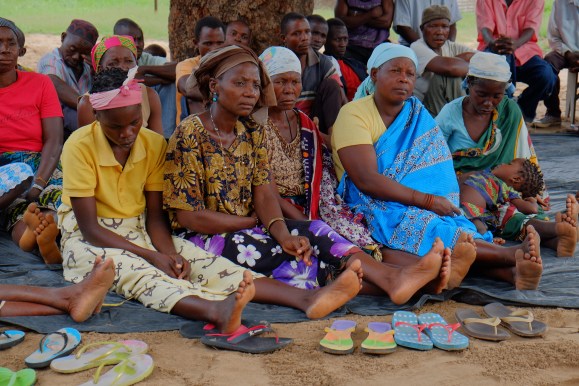
JA! Visit finds confusion and distrust in Cabo Delgado gas region

DSCF2153When JA! team visited Pemba at the end of February, 2019, the biggest city in Cabo Delgado province, to learn about the current situation of the ‘gas rush’ in northern Mozambique, it quickly became apparent to us that there is very little clarity and transparency about what is actually happening in the gas industry. Attacks on communities, land grabs, the stage of the companies’ operations, and even which companies are involved, have left people uncertain and confused.


The industry is constantly changing, with one example at the time being the pending takeover of US company Anadarko, which is the leader of one of the two major projects since it first ‘discovered’ gas in the Rovuma Basin in 2010. Just two weeks ago, Chevron put in a bit to purchase Anadarko for $ 33 billion, and a mere few days later, Occidental Petroleum tried to outbid them with $ 38 billion.

This has huge implications – communities who have been in communication with Anadarko about resettlement and compensation, or already signed agreements with them, the government’s financial agreements with Anadarko and investments in the project – these will all need to change, and more frighteningly, nobody knows how they will change.


Furthermore, the stages of the gas projects are constantly changing, new contractors come in and new deals are signed in the blink of eye. The official information out there is that In 2006, 10 trillion cubic feet of natural gas was discovered in the Rovuma Basin off the coast of northern Mozambique. There are two concession areas that the Mozambique government has already given the rights away to:

IMG_20190225_150151_9

Area 1, the location of the Mozambique LNG Project, which was led by Anadarko, but will now be led by Chevron and Occidental Petroleum, and Area 4, the location of the Coral LNG Project that is lead by Eni and Exxon.*

And both projects have secured purchasers which ultimately has given them the financial green light to operate.


Over the last year, there have been many violent attacks on villages in the gas region, and there are different theories about who is responsible and who benefits from them. Due to these attacks, on this trip the JA! Team was unable to travel to the communities with which we work near Palma.

Instead, our focal point that we work with closely, arranged to bring two community members to meet us in Pemba instead.


Even though we were unable to travel to Palma during this visit, just meeting with people in Pemba – NGOs, activists and journalists – pointed us to an increasing number of issues arising. Basically, the more people we spoke to, the more people we realized we needed to speak to.

Two people from communities being affected by the industry, Crisanto Silva from Senga, and Burahani Adinane from Milamba, traveled six hours to tell us about the situation they are facing now.


Mr Burahani told us how his community left Milamba in February and are staying with family in Palma because they felt very unsafe, in constant fear of being attacked. He says that at the end of last year, Anadarko made an agreement with the community telling them what they would receive as compensation. They have not yet signed that agreement with the government, and Anadarko has not returned that agreement document to them as they said they would, so they are in a constant state of uncertainty and limbo.


He says that the compensation assessment process has been ridiculous – one way the company assesses someone’s land is by counting their belongings and compensating them financially for those goods.


People with 5 hectares (ha) of land are going to get only 1.5 ha in compensation,” he says. “I have 64 ha but will only get 1.5 ha!  The company did the measurement by counting the number of trees in the plot. I had 583 trees, but how do I fit that in 1 hectare?”


The fishing community is being moved 10 km inland, away from the sea, where it will be very difficult for them to get to their fishing grounds, which will also be the location of a new port construction project. And actually, people have lost access to the sea even before the process has been completed.


Now we will be resettled from the sea,” says Mr Burahani,and personally, i don’t know how to do anything but fish”.


Crisanto Silva, from Senga, which is the village that the removed communities will be resettled in, told us about the problem of the military in the area. Following the violent attacks on villages, mainly those around or in the gas region,  that have been taking place since October 2017, the government has brought the military, allegedly to protect the communities from the attackers. Nobody is sure about who is responsible for the attacks, but there are many theories going around. The official government line is that they are carried out by Muslim extremists, but many others believe that gas companies, or powerful people in government are responsible themselves.


However, Mr Crisanto says that the military who is supposed to be protecting them, instill fear in the community instead. They stand around drinking beer, says Mr Crisanto, and give the people of Senga a curfew of 8pm, and then beat up people who are out after that. “But the army is only in the village till midnight,” Mr Crisanto says, “which I don’t understand… We are too afraid to go to the fields but the army refuses to escort us, so we are left without food.”


Mr Crisanto also says that he knows the ecosystem will be completely destroyed, and the Anadarko and Exxon factories are right next to the port that will be built. The port will go 2km into the sea, and the excavation is disturbing the sea bed. This is really affecting fishing patterns and the amount of fish in the area.


After speaking with the community members, we held several other meetings that provided important information. One of the other urgent issues is that of media oppression – two community journalists from Cabo Delgado were imprisoned for a long time, with one, Amade Abubacar, detained from 5 January to 23 April 2019. While the official reason for his arrest is unclear, Amnesty International says the he was arrested for documenting deadly attacks by armed groups against civilians.


This has left the few journalists who are not following the mainstream government rhetoric in constant fear of their lives or of losing their credibility if they write or say anything which does not align with it. The journalists we spoke with insisted on speaking to us in our hotel room because even being seen with us would put them in danger.


We spoke with a few NGO’s, some of whom provided us with very interesting information. We learnt about the vast current issues with the resettlement process. For example, the areas where Anadarko plans to give people machambas (farmlands) is at high risk of attacks, and it is very difficult for civil society to physically go there to protect people from these attacks. Communities feel that monetary compensation is not enough, as it is their ancestral land that is being taken from them. When they have meetings with companies about the process, they are not given the space to ask questions, and when they hold meetings with civil society, the military appears to disrupt the meeting. Anadarko is also known to hold resettlement meetings with individual families, which is divisive, and there is growing hostility over who gets which machambas.


We also learnt that many areas in Cabo Delgado, including areas where people are given machambas, are actually not arable, because Portuguese colonizers used them to grow cotton plantations which utilized many chemicals and degraded the soils.


Another rather disturbing piece of information is that while we met several NGOs doing interesting work, there are very few in Cabo Delgado working on the gas issue that do not receive funding for some or other service from Anadarko. It raises questions of independence and transparency for us when NGOs receive money from the very companies they are supposed to be challenging.


After those few days we spent in Pemba, it became clear that things are changing very quickly – the presence of the companies and private security is growing, fear of attacks and military is increasing and people are already losing their homes and livelihoods. There is a sense of unease in the air – many people don’t want to talk, or if they do, are afraid to say anything openly against the government or industry.


There is no doubt that the need to stop the industry is urgent, as the devastation we are already seeing may be irreversible. We will continue to work closely with the affected communities, as part of a campaign that uses different approaches – local and international to stop gas in Mozambique!

Broken Lives,Stolen Futures. A short documentary made by JA! of the sad situation of the communities in Cabo Delgado, Mozambique, affected by the gas exploration..


Of Coral FLNG, ExxonMobil owns a 35.7 percent interest in Eni East Africa S.p.A. (to be renamed Mozambique Rovuma Venture S.p.A.), which holds a 70 percent interest in Area 4, and is co-owned with Eni (35.7 percent) and CNPC (28.6 percent). The remaining interests in Area 4 are held by Empresa Nacional de Hidrocarbonetos E.P. (10 percent), Kogas (10 percent) and Galp Energia (10 percent).


In Mozambique LNG, Anadarko (soon to be taken over by Chevron or Occidental Petroleum or?) leads the LNG project with a 26.5 percent ownership stake. Other owners include the Mozambique state energy company, 15 percent; Japan’s Mitsui Group, 20 percent; India’s ONGC Videsh, 16 percent; India’s Bharat, 10 percent; Thailand’s PTT Exploration and Production, 8.5 percent; and Oil India Ltd., 4 percent.

Tagged , , , , , , , , , , ,