Category Archives: Land Use and Conservation

‘Israel has decided to be a racist apartheid state and not a democracy’

Once again the full murderous force of Israel’s military machine is unleashed against defenceless Palestinians in Gaza, while world leaders just watch the genocide of a nation in real time and do nothing.  When I started writing this article the death toll was well above 100 Palestinians (over half women and children) and zero Israeli civilian casualties or even major injuries, despite extensive coverage by western media of the deadly rocket attacks from Gaza. Sadly by the time I had finished writing the article the Palestinian death toll had gone over 1000 and by the time you read this it would have probably more than doubled. As Israeli Professor, Ilan Pappé says, “Israel, in 2014, made a decision that it prefers to be a racist apartheid state and not a democracy.”

Israel’s aggression violates the UN Charter and fundamental international laws and principles, but this is not new and past commissions have found numerous war atrocities and violations carried out by Israel during past attacks that have not resulted in any concrete actions by the UN or our world leaders. The international reaction to this latest crisis confirms that neither law nor justice dominate the diplomacy of leading western states and the UN, but geopolitical alignments.

One just needs a quick look at the history of the conflict to confirm this bias and lack of action in the face of undeniable facts. The UN has defined Israel’s occupation as illegal and numerous UN resolutions have demanded the withdrawal of Israeli armed forces from the occupied territories. UN resolution 3379 from 1975 even went on to declare Israeli Zionism ideology as a form of racism, stating “the racist regime in occupied Palestine and the racist regime in Zimbabwe and South Africa have a common imperialist origin, forming a whole and having the same racist structure and being organically linked in their policy aimed at repression of the dignity and integrity of the human being.” Desmond Tutu, Ronnie Kasrils, and other ANC members that fought against apartheid, clearly see the parallels and define the Israeli occupation of Palestine as a form of apartheid. Yet the world denounced and ended apartheid in one place, but is allowing the other to continue. Even when Nelson Mandela stated that “we know too well that our freedom is incomplete without the freedom of the Palestinians”.

palestine map

Photo: Grabbing of Palestinian land by Israel

Numerous leaders and public figures have spoken out in support of Palestine, from Nobel Peace Prize winners such as Desmond Tutu, Mairead Maguire, Betty Williams and Adolfo Pérez Esquivel, to civil society groups around the world representing millions of people, such as Friends of the Earth, La Via Campesina, and many more. This criticism is not new, during the early days of the creation of Israel numerous influential individuals, such as Mahatma Gandhi and Albert Einstein, raised concerns and criticism. Today even celebrities that are not known to be political have voiced their support of the Palestinian cause, such as footballer Cristiano Ronaldo. For anyone that doesn’t have the time to look into the details or considers the history too complicated, there is an easier way to decide on which side you should belong, simply look at the people you admire, your moral leaders.

Here in Mozambique, Samora Machel was a strong supporter of the Palestinian peoples’ struggles, and Yasser Arafat was a close ally and even attended Samora’s funeral. In Zambia, Kenneth Kaunda was an outspoken supporter of the Palestinian struggle. Many more moral leaders have already done the homework for you. If we claim to be people that are guided by justice and morals it’s now time for us to show solidarity towards the Palestinian people and their struggle.
DSCF6705

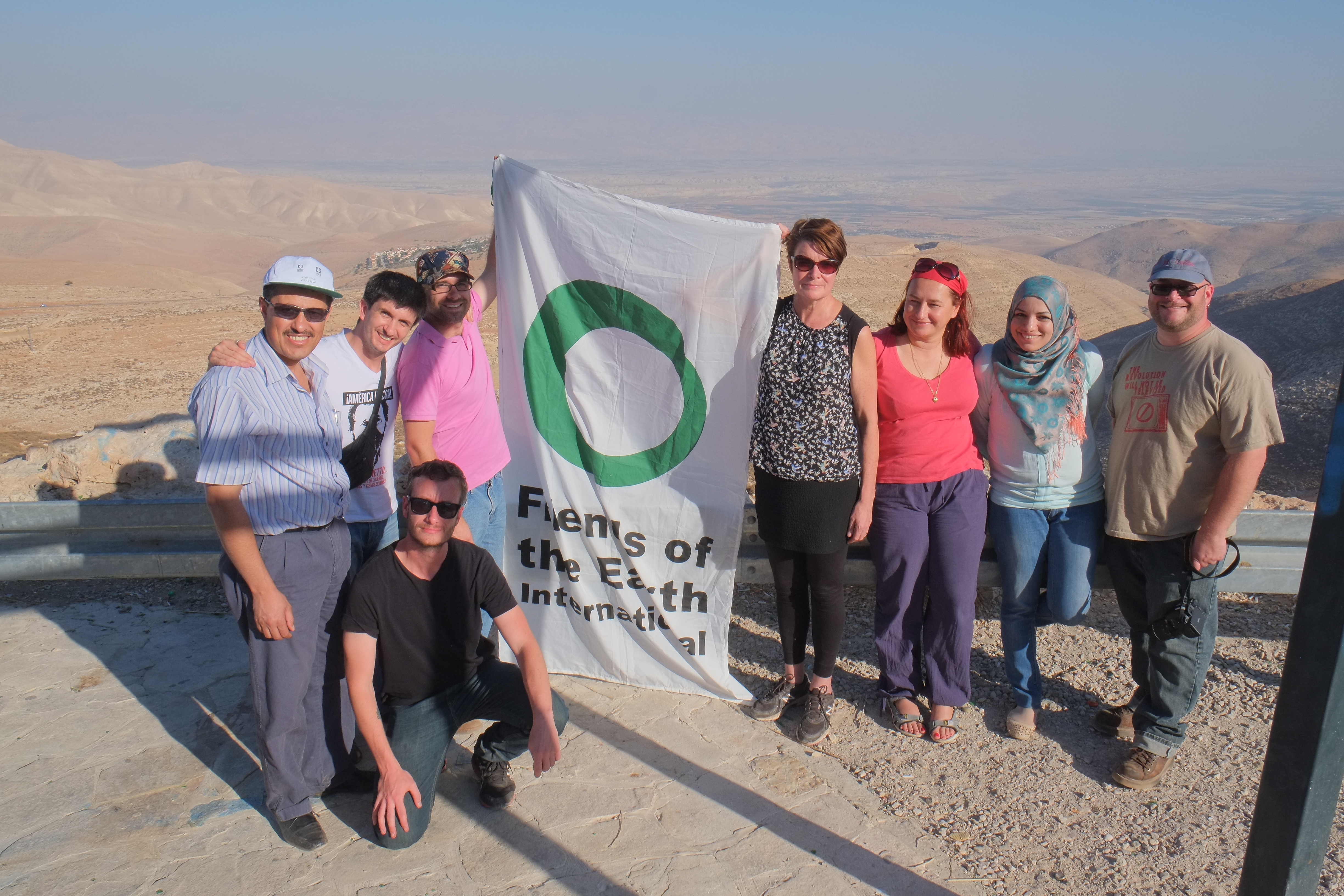
Photo: Friends of the Earth International solidarity mission to Palestine, October 2013

I was part of Friends of the Earth International’s latest solidarity mission to Palestine at the end of last year. Even though we were invited by Palestinians, they do not have the authority to invite us into their own country. Instead we had to get an Israeli visa. On arrival the first question asked by Israeli authorities is whether you plan on visiting the West Bank. If you answer yes you most likely will not be allowed entry at all. So we had to enter Palestine ‘unofficially’.

Heavy army presence is evident everywhere, there are road blocks and check points at the entrances to all cities in the West Bank. Israeli soldiers check everyone who passes, always and independent of the prevailing political tensions. This control has prevented over 11 million Palestinian refugees from returning home, even though they are entitled under the Geneva Convention on Refugees to return, which Israel continues to deny. Based on current borders only 17.7% of Palestine (all in the cities) is under Palestinian control, while the rest is controlled by the Israeli army. However, even in the areas under Palestinian control have numerous restrictions imposed by the Israeli army.

The Israeli occupation doesn´t stop with the control of land and movement, but an attack on all the fundamentals of human rights such as water, heath, education, childhood, labour, culture, etc. It is a total structured suppression of a nation to the point where it is a process of colonisation and ethnic cleansing.

During our visit, we realised that given the desert type of environment, water is a very valuable and vital resource for existence. All Palestinian water resources are under the complete control of the Israeli army, which regularly destroy Palestinian bore-holes and block construction of new ones. They impose inhumane water restrictions on Palestinians, while allowing excessive and unstainable use by Israeli settlers. The double standards and water grab by Israelis are impossible to hide. At present Isreali settlers consume daily almost 400 litres per person (more than double of London’s average use) and have swimming pools, exotic gardens and extensive agricultural lands with water-intensive crops that should never be planted in the desert. Meanwhile Palestinians don’t even come close to receiving the World Health Organisation’s daily recommended 100 litres per person and many survive on a little as 10 litres per day.

Water is just one of the fundamental pillars of life that is consistently being used by Israel to break the Palestinian nation and spirit, but it’s the same story for all sectors.

In health, Israel sends its waste to get dumped in Palestine and all high-polluting industries that were in Israel in the 1970s and were ordered by Courts to close due to risks to human health, were instead moved right next to Palestinian cities, like the Geshuri factories near Tulkarem. Israel is very aware of the health risks because, even today, if the wind starts blowing towards Israel, these factories have to halt production. But Palestinians have to just endure the toxins and cancer rates have increased significantly in the area.

The more time we spent in Palestine the more facts and details are continually exposed about the inhumane, unjust, illegal occupation of Palestine by Israel. We heard numerous accounts that the Israeli military arrests Palestinian children as young as 5 years old, a high number of whom are subjected to physical and verbal abuse and are threatened with sexual assault and death to themselves or their families. This abuse is confirmed by UN reports which also add that, in the last decade, over 7000 children are have been arrested and tortured.

pal

Palestinian children in a village where water & electricity access has been harmed by Israel (Daniel Ribeiro)

Everywhere we went, we saw the Israeli military abuse. In Zbeidat the military blocked the construction of a water and sewage system. Jobet Adeeb near Bethlehem has no electricity or water sewage system, and is barred from installing solar panels, electrical wiring, borehole or almost any structure that would improve the standard of living but the nearby Israeli settlement has all the modern luxuries and services. We visited a village that has been completely demolished, even though Israeli courts have recognised the rights to the land. Many more Palestinians that we met talked about the constant demolition notices they receive, that sometime are carried out immediately while others stay hanging over the family’s head for over a year, never knowing when the military would come to demolish their home. But just like in Gaza today, they know it will happen that one day they arrive home to a pile of rubble.

These experiences are all too common and regular that anyone that want to know the truth has to just spend some time in Palestine. I could carryon for pages and pages of the injustices and abuse by Israel. The evidence is clear. I often hear today’s younger generation asking our elders how did they let it happen – slavery, apartheid in South Africa, 2 World Wars, genocides and many other atrocities. I am sure that our children and grandchildren will ask us the same question. How and why did you allow the Palestinian genocide to happen? And in truth we have no excuses. As the saying goes: all that is necessary for the triumph of evil is that good people do nothing.

There are easy ways that all of us can help, such as supporting the Boycott, Disinvest and Sanctions (BDS) campaign. The campaign is non-violent and is inspired by the civil rights movement against segregation in the US and by the anti-apartheid movement in South Africa. It is based on three basic pillars or principles:

  • Ending occupation and colonisation of all Arab lands occupied in June 1967 and dismantling the Apartheid Wall;
  • Recognising the fundamental rights and full equality of the Arab-Palestinian citizens of Israel;
  • Respecting, protecting and promoting the rights of Palestinian refugees to return to their homes and properties as stipulated in UN Resolution 194.

All these demands have a basis in UN resolutions on Palestine and they are simply requesting implementation of international law. They are basic rights and first steps in the struggle for justice. I call on all of us to join.

 

REDD Alert

JA & NRAN Film Screening

Recently, JA and the No REDD in Africa Network (NRAN) held an event on REDD. The event was to commemorate the Week of Action Against False Solutions which was within the Reclaim Power: Global Month of Action on Energy. The Month of Action ended on Monday, with the opening day of COP19 in Warsaw, Poland, where once again world leaders will get together to postpone urgent action on climate and ignore the fact that we’re hurtling towards climate disaster.

For our REDD event, we gathered together in the Museum of Natural History in Maputo with a small but spirited group. Samuel Mondlane moderated the meeting. JA’s Director, Anabela Lemos introduced the debate around REDD (Reducing Emissions from Deforestation and forest Degradation), calling it a false solution for the climate crisis.

We showed a few films criticising carbon trading, offsetting and REDD, calling them dangerous distractions that were avoiding the real solutions from being applied to stop catastrophic climate change, such as reducing fossil fuel use.

After the films, we opened up for a discussion on what people had seen in the films. This discussion is very important, because, in Mozambique, the debate of whether or not REDD is good for the country, had not taken place. It was only assumed that since money was coming in, Mozambique should take it, without any discussion of the dangers and perverse incentives behind it. See below our flyer for the event.

Image

JA had sparked these discussions a few months ago, with the REDD workshop that we held in Maputo in August 2013. We were able to bring some key international people to Maputo, and facilitate their connections and information-sharing with Mozambican community people and NGOs.

The international key people that came together for the meeting were:

  • Tom Goldtooth, Indigenous Environmental Network
  • Nnimmo Bassey, Environmental Rights Action & Health of Mother Earth Foundation, Nigeria
  • Isaac Rojas, Coordinator, Forests & Biodiversity program, Friends of the Earth International
  • Winnie Overbeek, World Rainforest Movement
  • Cassandra Smithies, fierce anti-REDDs activist from the US
  • Blessing Karumbidza, Timberwatch, South Africa
  • Odey Oyama, Rainforest Resource and Development Centre, Cross River state, Nigeria
  • Jonas Aparecido, Landless Peoples’ Movement and community person, Brazil
  • Augusto Juncal, Landless Peoples’ Movement & Via Campesina Brazil
  • Diwirgui Anastacio Martinez Jimenez, community person from Kuna tribe, Panama
  • Makoma Lekalakala, earthlife Africa Johannesburg
  • Blessol Wambui, The Rules, Nairobi
  • Khadija Sharife, Center for Civil Society, South Africa
  • Abdullah Vawda, Forum of African Investigative Reporters, South Africa

It was also very important for JA to invite community people and farmers. We managed to bring farmers from 8 out of 10 provinces of Mozambique, including Niassa, Cabo Delgado, Nampula, Zambezia, Tete, Sofala, Gaza, and Maputo. There were multiple community people from some of these provinces. JA’s close partner, União Nacional de Camponeses (UNAC, National Farmers Union) allied with this process and sent many of their community members.

This was important because we felt it was crucial to open up a dialogue not just with people in Maputo, but people in the provinces who will be directly confronted and affected by REDD or REDD-type projects. The involvement of community people in decision-making is crucial to good governance structures and justice. We also invited NGOs and government people from Maputo, so that there could be a good, healthy discussion, which had not happened before.

The 1st day of the workshop – lots of information sharing and debate

The first day of the workshop provided a lot of information on REDD. Isaac and Winnie introduced REDD. Tom gave an emotive presentation about REDD in North America. Cassandra spoke about the opposition to REDD in many parts of Latin America, and explained the connections between the California Climate Change Bill trying to offset emissions by pushing REDD in Chiapas, Mexico and Acre, Brazil. Diwirgui and Jonas talked about the REDD opposition in their communities.

After this global perspective, we then starting talking about REDD in Africa. Odey of Nigeria and Blessing of South Africa provided perspectives of fierce REDD opposition in their contexts. The final case was presented by Boaventura of Via Campesina Mozambique, talking about a problematic REDD project right here in the country.

Main themes from the 1st day

The first day’s presentations and discussions were incredibly rich and detailed. We heard about climate change and what it means for our people. It increases droughts and floods; it increases temperatures especially here in Africa. It affects our lands, water and, more importantly, the farmers. Climate change impacts rivers and rain and weather patterns, that’s how it affects farmers. The crops start to fail, the land starts to get drier and more barren.

We heard from Tom about the links between dirty energy burning in the northern countries and these REDD projects in the south. We heard that those who created the climate problem to begin with, are continuing to make it worse. They are continuing to burn dirtier forms of coal, oil and gas, such as the tar sands.

Then they come to the southern countries, trying to ‘offset’ their emissions from burning the dirty energy. As JA Director Anabela Lemos explained, the carbon credits come from the Kyoto Protocol, it is abstract, and it doesn’t exist. So they come to the southern countries to ‘offset’ their emissions. In Africa, Asia, Latin America, where we still have forests left, they engage in large land grabs under the excuse that they will save the forests. We heard from Blessing regarding REDD in Tanzania. We heard from Odey regarding REDD in Nigeria and from Diwirgui about the struggle of the Kuna people against REDD in Panama. The story is the same everywhere in the world.

We heard some strong phrases about REDD and land grab and what it’s doing to this continent of Africa. We heard the phrase ‘green-grabbing’. We also heard the phrase ‘second colonialism’. Many countries in the south went through colonialism. They want the land, the resources under our land, and this is why people are calling it a ‘second colonialism’. Will we fight it again or not? We also heard the phrase ‘green masks’ that the big international conservation organisations are wearing and pretending as if REDD can save the forests. In reality, REDD is about buying the forests, cutting them down and turning them into plantations which are just green deserts.

The 2nd day of the workshop

For the 2nd day, we heard from Jonas and from Manito Lopes, a community member from Zambezia province, Mozambique, about community forest management providing much better options than REDD to safeguard forests.

The REDD workshop was a huge success. We had great participation from international, Mozambican community members as well as Maputo-based NGOs. We raised awareness about the very real dangers of REDD. We together released a Maputo Declaration on REDD, available here.

The 3rd day’s meeting was a closed NRAN strategy meeting. JA is committed to continuing the No REDD struggles in Mozambique, Africa and beyond.

A GOVERNMENT WITHOUT SHAME, A PEOPLE WITHOUT HOPE

THE PROTEST NO ONE TALKED ABOUT

Late last month, on the 22nd and 23rd of July, a protest took place in Chirodzi area, Tete province, in central inland Mozambique.  The local communities had gathered there to protest in the concession area grated to Jindal, an Indian mining company. Jindal is extracting coal from an open pit mine in Tete province, without an environmental impact study and without ensuring the safety of the local communities. Till date the communities have not been resettled, but continue to live in the concession area.

The communities have been raising their voices, asking for their rights. On this day, the frustration and desperation of the communities mounted, and the protest turned violent. The communities attacked four Indian Jindal employees. Of the four Jindal people attacked, one was attacked in his office and the other three in their homes, all within the concession mining area. There was a security company, who usually secures the gates and the whole perimeter of the concession area, were also attacked, and with no place to hide from the public anger, they ran away. The police were also present, but were outnumbered by the irate people.

The protest involved four communities: Chirodzi / Cahora Bassa, Chirodzi / Changara, Cassoca and Nyantsanga. These last two communities are located within the concession area of ​​the mine, while the first two are on the periphery. But it is very important to note all these communities have communal lands which have now been taken by the company.

According to community testimonies, the protest erupted because of Jindal’s failure to fulfil the promises they made to the communities when their settled here in 2008.

  • They promised they would not extract coal before resettlement of the communities, yet they have been doing exactly that for over eight months;
  • They promised not to occupy lands, specifically the fields of local communities, without first negotiating with their legitimate owners;
  • They assured the communities that there would provide a water supply;
  • They also promised jobs for community members.

The communities and Cassoca and Nyantsanga stated that in December Jindal usurped part of their farms with standing crops, without any warning, thereby seriously undermining their food sovereignty. As for resettlement, it is not happening but the coal is being mined. On 9th of May 2013, Macauhub news reported that a ship left from Beira port, heading for India, carrying 36,000 tons of coal mined by Jindal Mozambique Minerals.

Image

The communities constantly face respiratory and other serious problems, from being so close to the open pit mining. Air pollution resulting from mining activity is visibly hanging in the air; the black dust settles on everything. How will the lungs of people cope with this? How much longer will children continue to have their classes in this atmosphere?

Their frustration is what led to this protest. The communities also promised that if their rights continue to be ignored and trampled, and if the company does not fulfil the promises made to them, there will be more protests. This protest revealed how bad the relationship is between Jindal and these four surrounding communities.

The relationship between employees and employers in Jindal is also bad. According to company officials who agreed to talk to us, there are many quarrels about alleged discrepancies in pay and subsidies to employees. Even the workers who operate the mine say they do not have the protective equipment that is required.

But Jindal reportedly seems to have a excellent relationship with the government. This is substantiated by the fact that some people even said that the government collects “taxes” from the company.

At the end of the day, according to the laws in force in the Republic of Mozambique and international conventions, Jindal is in the wrong, but the government is partly responsible for this, because of their passivity and permissiveness (or should we say say collusion).

Jindal declined to provide any information to us, but they summoned a meeting with community leaders and “informed” them not to provide any information to civil society organisations, and they threatened not to renew contracts with those who did communicate.

The silence of the media is also shocking. It is extremely sad that, even though we know that there were several teams of national media in the middle of all this circus in Chirodzi, but other than the Diário de Moçambique, nobody published this story.

Less than a month after this transpired in Chirodzi, the communities still continue to wait for their rights to be recognised. But meanwhile, the complicity of the government was proved. While the communities were protesting the way this company is operating and protesting against unfulfilled promises, the Mozambican President, Armando Guebuza, visited Chirodzi to officially inaugurate the project, and doing so, legitimized what Jindal is doing. Basically, he gave his approval to what was happening, to mining being carried out without an Environmental Impact Study, to mining being carried out while communities are still living there, with about 563 families still waiting to be resettled. Adults and children. All living in an environment extremely dangerous and harmful to their health, not to mention that their livelihoods and futures are being silently trampled on. They have been forgotten and made invisible by those who should protect them. A shameless government leading a hopeless people. This is our Mozambique.

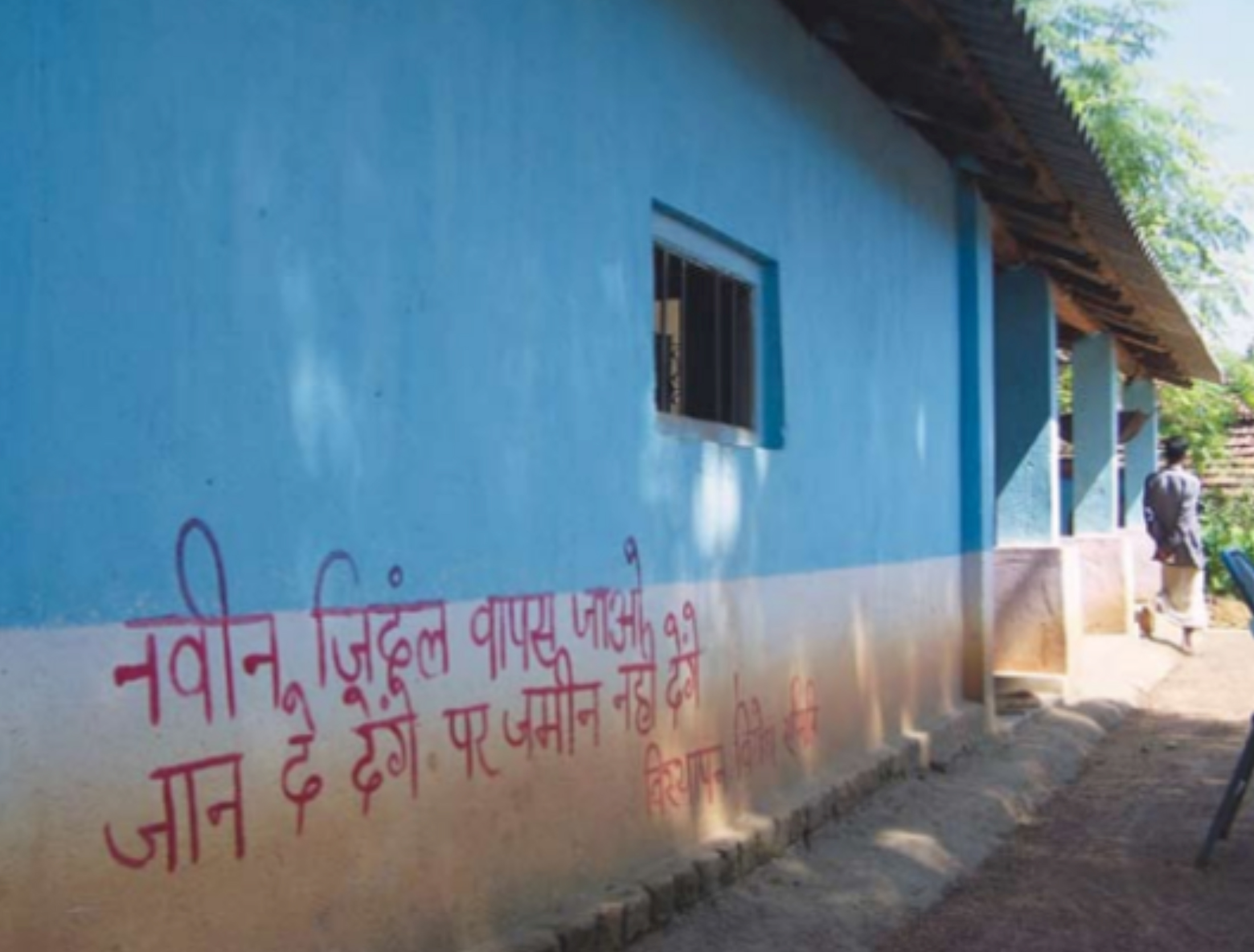
Meanwhile, protests against Jindal are not new. In their home country of India too, Jindal has been exploiting local communities with impunity. In the Indian states of Odisha, Jharkhand and Chattisgarh, which are states with large populations of tribal people, Jindal has been devastating farms, villages and lives for many years now. But, same as in Mozambique, the communities have not been silent. In Asanbani village in Jharkhand, the houses are marked with signs in Hindi such as “Naveen Jindal go back! We will give our lives but we will not give our lands” (see photo below). This is the Visthapan Virodhi Samiti (Committee against Displacement).

Image

Photo credit: Panos South Asia, Alchemy of Iniquity: Resistance and Repression in India’s Mines. A Photographic enquiry.

We are moving towards building bridges between these communities fighting again a common enemy, Jindal, across India and Mozambique.

A recent book called ‘A New Scramble For Africa?: Imperialism, Investment And Development’, carried a great quote of Gandhi to help us contextualise why the presence of Indian company Jindal in Africa is so problematic.

Gandhi said, “The commerce between India and Africa will be the commerce of ideas, not manufactured goods against raw materials after the fashion of western exploiters.”

Africa is Sovereign and WILL NOT ACCEPT being Re-colonized

In response to Denmark’s Minister for Development Cooperation Christian Friis Bach recent controversial interview, Friends of the Earth Africa elaborated an Open Letter to be handed over to every Embassy of Denmark in African countries where FoEA is present. Based on that Open Letter and with the purpose of empowering it by allowing all of us, concerned citizens of the world to sign it,  we are now starting a petition with the same motto.  You can read the Open Letter bellow and if you share our concern, please sign our petition and add your voice to the struggle against the development models of capitalist neocolonialism.

Open Letter from the African Civil Society To The Representatives of Denmark in Africa

Subject: Africa is Sovereign and WILL NOT ACCEPT being Re-colonized

In light of the interview given by your Minister for Development Cooperation, Christian Friis Bach, on the 9th of this month to the Danish newspaper Politiken, and taking into account that the presence of Danish cooperations on the African continent dates long before the independence of most countries where they still operate today through various organizations that develop various projects and activities in various spheres of the political system, civil society and the business sector, we cannot refrain from expressing our deepest distaste for the disrespectful and peculiar ideological content of the above-mentioned interview.

Truth be told, Minister Christian Friis Bach said exactly what many politicians and leaders of developed countries think but cleverly would never dare say. Frankly, we prefer Christian Friis Bach to those other dodgy individuals. Petulant or reckless, your Minister of Development Cooperation said just what he thinks, giving us a chance to rebut, to contest and tell him that his notion of development is obsolete, that what he says he is willing to do is ethically despicable and offensive, that those who he claims would be the main beneficiaries of the policies he intends to impose will for sure become its main victims, and that even though unfortunately he may have the power to influence the decisions taken by the state apparatuses of some African countries, he definitely does not have the right to do so. We believe that he ought to know it. We Africans assure Christian Friis Bach and all who think like him, that even though we are already being pillaged, we will never allow Africa to be economically recolonized. Never.

It is instructive to remember that contrary to what Minister Friis Bach said in his interview, we Africans do have capacity to feed and sustain our people. African agriculture and food needs have been met over time through sustainable and multi-dimensional approaches, keeping to a minimum such externalities as artificial fertilizers, imported pesticides and herbicides, as well as practices that are alien to the socio-cultural settings of our people.

The support Africa needs right now is a decisive stand to maintain seed as well as cultural diversities and defend staple crops which are targeted by biotech even when there is no need for their engineered varieties or GM crops.

To you, as the highest representative of the Danish people in our territory, we would like to ask if you share the opinions of your Minister for Development Cooperation. If you do, please be kind enough to answer the following questions:

Do you think it is fair that the African continent should be held accountable “today” for the bad decisions rich countries such as yours made “yesterday”, and which led to over-exploitation of nature, animals and human beings by introducing unhealthy and destructive diets as well as excess energy consumption?

Do you consider it acceptable that countries like yours should impose their failed development models on Africa as if they were models of success and the only guaranteed path towards development?

Would you imagine a world in which Africa adopts your ideas of production, consumption, development and progress?

Do you think it right that we Africans must accept without question the responsibility of using our resources to support those who were obviously unable to manage theirs?

It honours us greatly that the world is turning to Africa and its leaders say they are counting on us. We Africans are hospitable and supportive and for long we have been wanting to contribute more and better to a development path that supports sustainable livelihoods. However, we do not have to sacrifice ourselves to accommodate the whims of those who think it is a mark of progress to destroy the planet. We want to rely on the support of all who are well intended, but such support must not trample on our sovereignty and dignity.

In this context, we, African organizations, movements and associations who hereby signed this letter, reiterate that we continue to consider much welcome the support of those who wish to walk with us towards a development path:

  1. That adequately serves our needs and those of our future generations;
  2. That is fair and just and not predicated on exploitation, resource grabs and denigration;
  3. That is logical and thoughtful and does not necessarily have to be traversed in pursuit of anything or anyone;
  4. In which we may not be sole beneficiaries, but we must not be denied our due;
  5. That not only respects the sovereignty of each African country, but also our diversity as a people, as well as the diversity of our cultures and traditions;
  6. That is guided by principles of honesty, transparency and inclusion, fundamental to the democratic exercise of any territory.
  7. That respects our Food sovereignty, which is built upon the inalienable rights of peoples to maintain their cultural as well as seed diversities. Cultural diversity permits peoples to maintain and enlarge their stock of local knowledge; produce, save and use their seeds and have control over farming practices developed over centuries of experimentation and experience. Food sovereignty ensures that farmers stay in business and that peoples are not forced to alter their diets.Naturally, we consider that any development project that ignores or disregards any of these principles is not in the best interest of Africa or Africans, and we reject and denounce the position taken by your government through your Minister of Development Cooperation.

For the sake of the good relations we wish to maintain with you, we would appreciate you would be so kind as to respond to this letter.

Signed by

African Organizations,

Friends of the Earth Africa

Justiça Ambiental/FOE Mozambique

ATPNE / Friends of the Earth Tunisia

Centre pour l’Environnement et le Développement / Friends of the Earth Cameroon

Environmental Rights Action / Friends of the Earth Nigeria

Friends of the Earth Ghana

Friends of the Earth Sierra Leone

GroundWork / Friends of the Earth South Africa

Guamina / Friends of the Earth Mali

Lawyers’ Environmental Action Team / Friends of the Earth Tanzania

Les Amis de la Terre / Friends of the Earth Togo

Maudesco / Friends of the Earth Mauritius

National Association of Professional Environmentalists / Friends of the Earth Uganda

Sustainable Development Institute (SDI) / Friends of the Earth Liberia

Yonge Nawe Environmental Action Group / Friends of the Earth Swaziland

Alliance For Food Sovereignty  In Africa (AFSA)

African Biodiversity Network (ABN)

Coalition for the Protection of African Genetic Heritage (COPAGEN)

Comparing and Supporting Endogenous Development (COMPAS) Africa

Indigenous Peoples of Africa Coordinating Committee (IPACC)

Participatory Ecological Land Use Management (PELUM) Association

Eastern and Southern African Small Scale Farmers Forum (ESSAFF)

La Via Campesina Africa

FAHAMU, World Neighbours

Network of Farmers’ and Agricultural Producers’ Organizations of West Africa (ROPPA)

Community Knowledge Systems (CKS)

Plateforme Sous Régionale des Organisations Paysannes d’Afrique Centrale (PROPAC)

Laurent Alex Badji COPAGEN Senegal

The Green Belt Movement Kenya

Health of Mother Earth Foundation, ((HOMEF) Nigeria

Committee on Vital Environmental Resources (COVER) Nigeria

The Young Environment Network (TYEN) Nigeria

Institute for Research and Promotion of Alternatives in Development (IRPAD/Afrque)

Mali Coalition pour la Protection du Patrimoine Génétique Africain Mali (COPAGEN-Mali)

Actions Pour le Développement Durable, Republic of Benin

Kenya Debt Relief Network(KENDREN) Kenya

African Centre for Biosafety (ACB) South Africa

The Rescope Programme Malawi

Host Communities Network Of Nigeria (HoCoN, Nation Wide) Nigeria

Students Environment Assembly Nigeria (SEAN Nation Wide) Nigeria

Community Forest Watch Group Nigeria

Green Alliance Nigeria (Nation wide) Nigeria

Abibiman Foundation Ghana

Oilwatch Ghana

Oilwatch Nigeria

Improving Livelihoods Through Agriculture (ILTA) Ghana

Acção Académica para o Desenvolvimento das Comunidades Rurais (ADECRU), Mozambique

Associação de Apoio e Assistência Jurídica às Comunidades (AAAJC), Mozambique

Fórum Mulher, Mozambique

Liga Moçambicana dos Direitos Humanos (LDH), Mozambique

Kulima, Mozambique

Non African Organizations:

Amigos da Terra América Latina e Caribas TALC

Amigu di Tera (FoE Curaçao), Curação

NOAH Denmark, Dinamarca

COECOCEIBA / FoE Costa Rica

Community Alliance for Global Justice Denmark, Dinamarca

Amigos de la Tierra México, México

Red Mexicana de Afectados por la Minería (REMA) México

Movimiento Mesoamericano contra el Modelo Extractivo Minero (M4) México

The Rescope Programme

Community Alliance for Global Justice

PLANT (Partners for the Land & Agricultural Needs of Traditional Peoples)

Various African Organizations and Movements are still signing in and several Non African movements and organizations are also subscribing to this letter.

Neocolonialism: Who Do You Think You Are?

Unbelievable…

Denmark’s Minister for Development Cooperation has done it. He has put it out there. In an interview given last week in Denmark, the Danish politician spoke his mind and told his constituents what he has in mind for Africa. Under the cloak of a very noble poverty eradication and gender equality speech, a shameless and shocking eyeopener of how some European leaders completely and utterly disregard our sovereignty, and of how comfortable they feel about taking decisions for us.

Read the translated full article below.

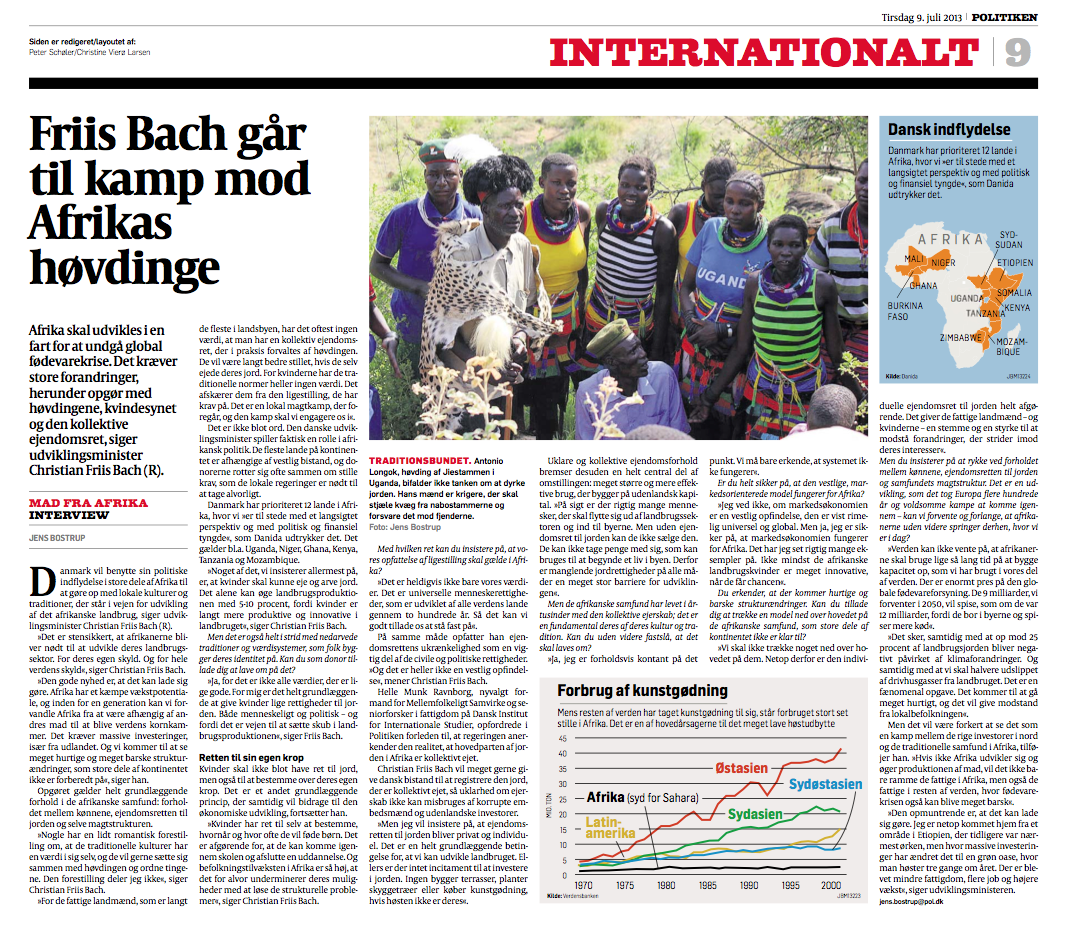
Image

Politiken | 09.07.2013

Food from Africa, Interview by JENS Bostrup with Danish Minister for Development Cooperation, Christian Friis Bach

Friis Bach is Up for a Match Against the African Chiefs

Africa must be developed in a rush in order to avoid global food crisis. It requires huge changes, including a confrontation with chiefs, the role of women and the view upon collective property, says Danish Minister for Development Cooperation, Christian Friis Bach.

Denmark will use its political influence in large parts of Africa to get rid of local cultures and traditions that hinder the development of African agriculture, says Minister for Development Cooperation Christian Friis Bach.

“It is certain that Africans will have to develop their agriculture, for their own sake and for the entire world”, says Christian Friis Bach. “The good news is that it can be done. Africa has a huge growth potential, and within a generation, we can transform Africa from being dependent on others for food to being the world’s breadbasket. It will require massive investments, especially from abroad, and it will bring them very quick and very harsh structural changes, which large parts of the continent are not prepared for”, he says.

This confrontation must address fundamental issues in the African societies: gender relations, land ownership and the power structure.

“Some have a rather romantic belief that traditional cultures have a value in themselves, and they want to sit down with the chief and fix things. I do not share this belief”, says Christian Friis Bach. “For the poor farmers, who are the majority in the village, collective ownership, which is in practice administered by the chief, is usually of no value. They would be much better off if they owned their land. For women, the traditional norms has no value either. It prevents them from the equality they deserve. It is an ongoing local power struggle, and we must engage in this struggle”.

This is not just words. The Danish Minister for Development Cooperation actually plays a role in African politics. Most countries on the continent are dependent on Western aid, and donor countries often conspire to make demands that local governments have to acknowledge.

Denmark has prioritized 12 countries in Africa, where we “are present with a long-term perspective and with political and financial weight” as Danida puts it. This applies amongst others Uganda, Niger, Ghana, Kenya, Tanzania and Mozambique. “One of the things we particularly insist on is that women should be able to own and inherit land. This can increase agricultural production by 5-10 percent because women are far more productive and innovative in agriculture”, says Christian Friis Bach.

[Q] But this is also completely contrary to ancestral traditions and values on which people build their identity. Can you as a donor allow yourself to change that?

“Yes, because not all values ​​are equally worthy. For me it is fundamental to give women equal rights to the land, both human and political, besides, it is the way to boost agricultural production”, says Friis Bach.

The right over their own bodies

Women must not only have the right to land, but also the right to decide over their own bodies. This is another fundamental principle that, in time, will contribute to the economic development, he continues.

“Women should have the right to decide when and how often they will bear children. This is crucial in order to allow them to get through school and complete their education. And population growth in Africa is so high that it seriously undermines their ability to solve the structural problems”, says Christian Friis Bach.

[Q] By what right can you insist that our concept of equality should apply in Africa?

“Fortunately, these are not just our values. These are universal human rights, as developed by all countries worldwide throughout two hundred years. So we can allow ourselves to insist on them”. Similarly, he perceives the inviolability of property as an important part of the civil and political rights. “And that is not a Western invention either”, says Christian Friis Bach.

Helle Munk Ravnborg, newly elected president of Danish ActionAid and senior researcher in poverty at the Danish Institute for International Studies, recently appealed in Politiken [the newspaper in which this interview is also published] that the government recognizes the reality that the majority of the land in Africa is collectively owned.

Christian Friis Bach would very much like to offer Danish assistance to register the collectively owned land to avoid that uncertainty about ownership is misused by corrupt officials and foreign investors.

“But I will insist that land ownership becomes private and individual. It is a fundamental condition for us to develop agriculture. Otherwise there is no incentive to invest in the land. No one builds terraces, plants shade trees or buys fertilizers, if the harvest is not theirs”.

Unclear and collective ownership also slows down a key part of the transition: much larger and more effective farms based on foreign capital.

“In the long term there are very many people who need to move away from the agricultural sector and into the cities. But without ownership to the land, they cannot sell it. They cannot take money with them, which can be used to start a life in the city. Therefore, lack of land rights is in all ways a very large barrier to development”.

[Q] But the African societies have lived with collective ownership for millennia; it is a fundamental part of their culture and tradition. Can you without further ado establish that it needs to change?

“Yes, I am relatively clear on that point. We just have to recognize that the system is not functioning”.

[Q] Are you absolutely sure that the Western, market-oriented model works for Africa?

“I do not know if the market economy is a Western invention, I think it is rather universal and global. But yes, I am sure that the market economy functions for Africa. I have seen great many examples of this. African women farmers in particular are very innovative when they are given the chance”.

[Q] You recognize that there will be swift and harsh structural changes. Can you allow yourself to impose a model onto African societies that large parts of the continent are not ready for?

“We must not impose anything on them. That is precisely why the individual land ownership is crucial. It gives poor farmers and women a voice and a strength to resist changes that conflict with their interests”.

[Q] But you insist on changing the gender relations, the land ownership rights and the power structures of societies. It took Europe several hundred years and fierce fighting to get through a similar development. Can we expect and demand that Africans readily jumps to where we are today?

“The world cannot wait for Africans to take their time to build up capacity as we have done in our part of the world. There is an enormous pressure on the global food supply. The 9 billion, we expect to be in 2050, will eat as if they were 12 billion because they will live in the cities and eat more meat”. “While this takes place, up to 25 percent of the agricultural land will be adversely affected by climate change, and we will have to reduce greenhouse gas emissions from agriculture by half. It is a phenomenal task. It is going to happen very quickly, and it will find resistance in the local populations”.

But it would be wrong to see it as a battle between the rich investors in the North and the traditional societies in Africa, he adds. “If Africa does not develop and increase the production of food, it will not only hit the poor in Africa, but also the poor in the rest of the world where the food crisis also may be very harsh”. “What is encouraging is that it can be done. I have just returned from a region in Ethiopia that previously was almost a desert, but where massive investment has changed it into a green oasis where you can harvest three times a year. There is now less poverty, more jobs and higher growth”, says the minister.

Other texts in the article:

Photo text: Bound by tradition: Antonio Longok, chief of the Jie tripe in Uganda, does not welcome the idea of ​​cultivating the land. His men are warriors who must stealing cattle from neighboring tribes and defend it against enemies. (Photo: Jens Bostrup)

Figure text: Use of fertilizers: While the rest of the world has embraced fertilizers, the consumption in Africa is more or less steady. This is one of the main reasons for the very low yields. (Source the World Bank)

Map text: Danish influence: Denmark has prioritized 12 countries in Africa, where we “are present with a long-term perspective and with political and financial weight’, as Danida puts it. (Source: Danida JBM13224)

A Positive Example

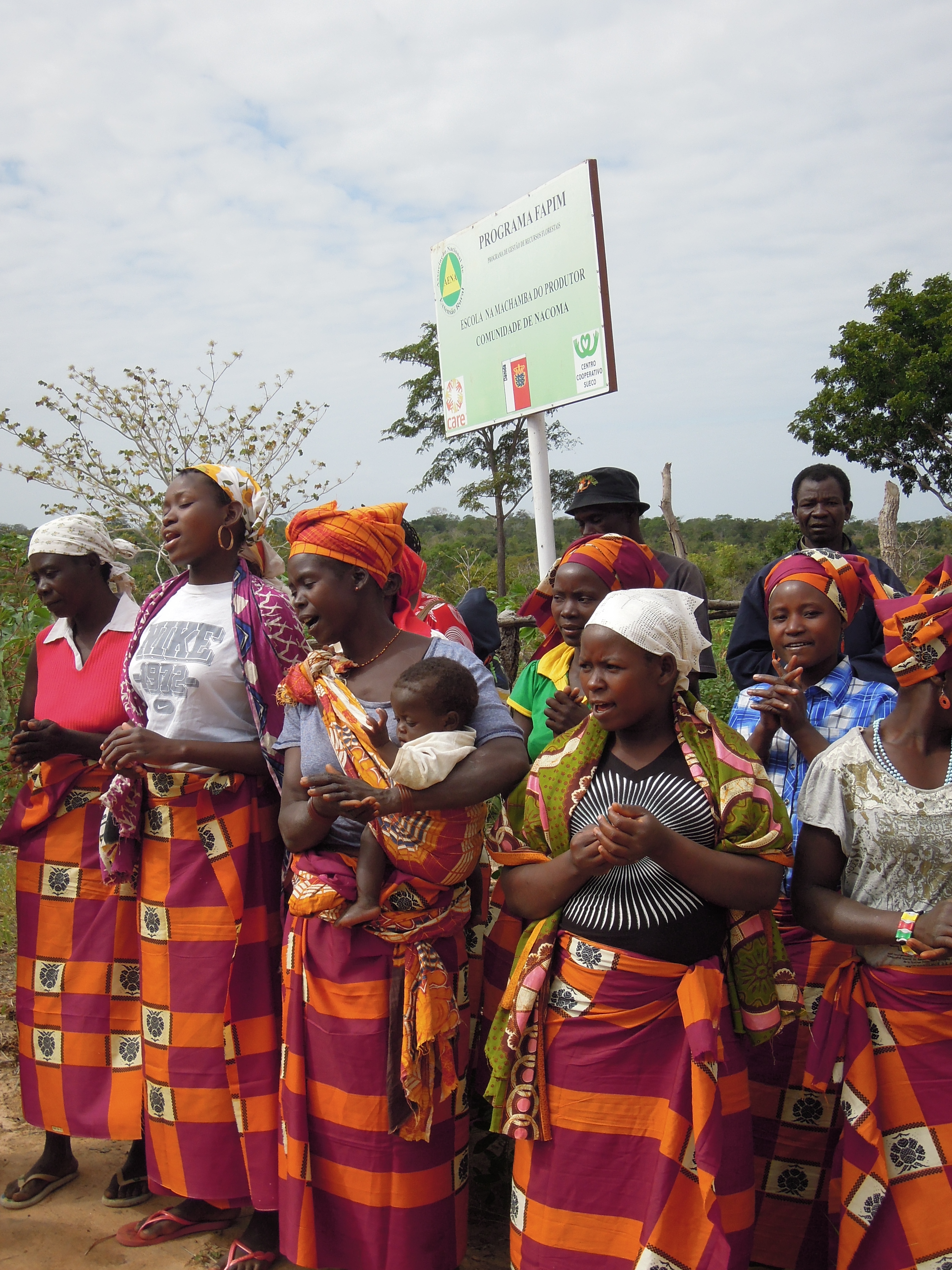
During a trip to Nampula for a meeting with AGIR (Action Programme for a Responsible and Inclusive Governance) and its partners, we were told that we would visit the community of Nacoma in the village of Mele, Meconta district, about 83 km from the city of Nampula, where, with the support of the National Association of Rural Extension (AENA), the community formed an association composed of 20 members (13 women and 7 men) to improve their crops. This association would be presented to us as a good example of a farming, savings and literacy project (for the community even created a school in the farm area itself).

 Image

After an almost two hours journey, we finally arrived to the place. Several women with colourful scarves and capulanas, clapping and singing welcoming songs for us, greeted us at our arrival. There were barely any men, only three were present.

From there, always singing and clapping, they led us to a small plot of land next to a dirt road where they showed us an example of the good practices and crop improvements they had learned for a more efficient agriculture on poor soils. These women, with the help of a partner of AGIR in Nampula who shared its knowledge with them, improved the soil of the area, which was not the best for agriculture, through the practice of techniques such as the use of dry grass to conserve soil moisture and thus retain its nutrients. From AGIR’s partner, they mentioned they also learned that setting fire to a plot before using it, a widely used method in the area to prepare the soil, when done systematically ends up reducing the nutrients and weakening the soil. They further demonstrated, using only water grass and sand, rudimentary examples of other methods used to enhance and improve their harvests, and showed us how they had arranged between them to monetize the goods they produce (cassava, pigeon pea, sweet potato, peanut, etc… ) and thus increased their income allowing it to improved their lives and their families. Finally, they showed us a peanut dryer made by the association, made with simple poles and grass where it was protected from rain, insects and other animals.

 Image

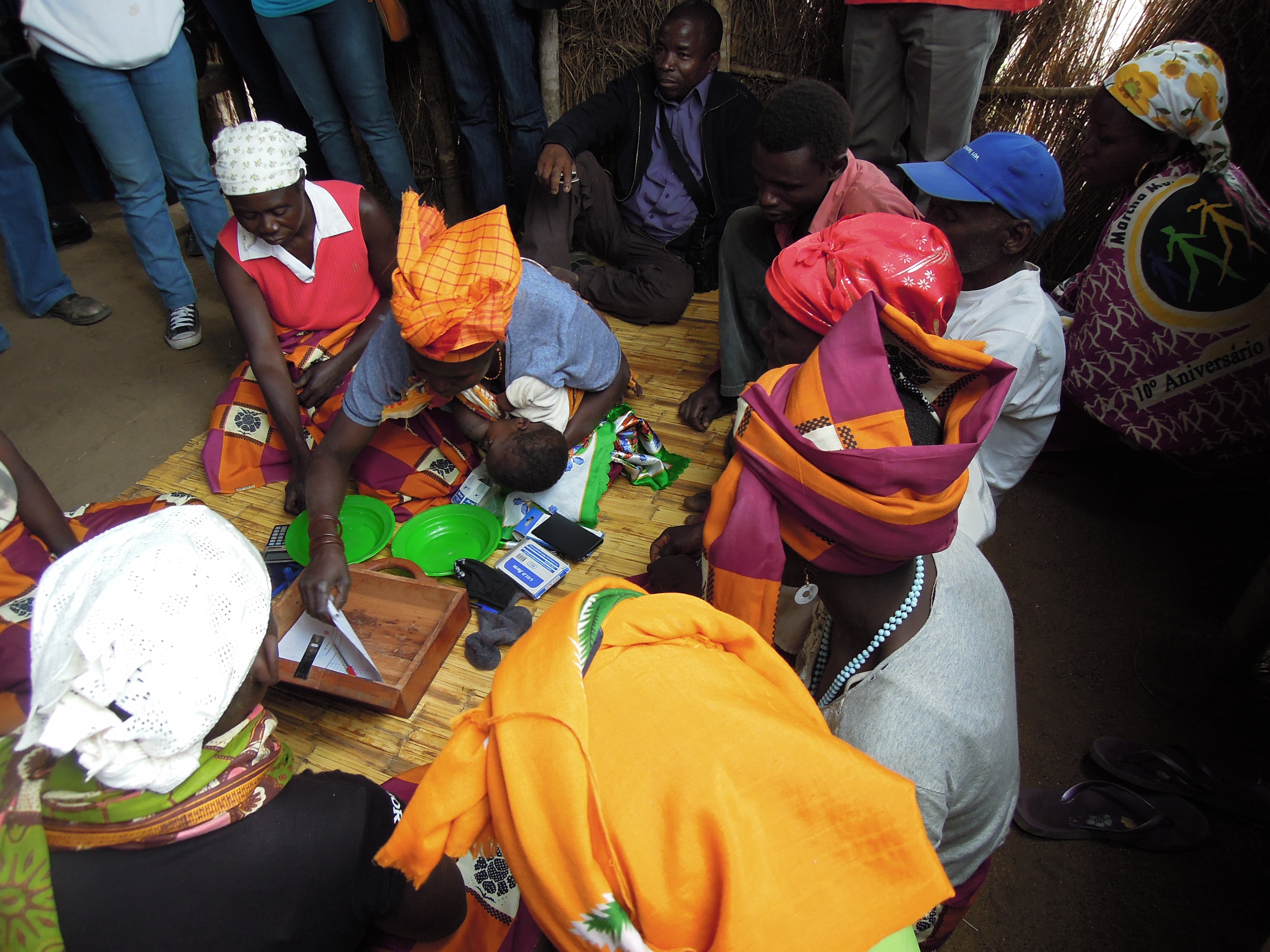
After visiting the peanut dryer, our group informed that visitors would also like to see and know the method of collecting income from all who were part of the association. Then showed us a wooden suitcase, where not only they deposited their earnings, but where they also kept the register of their loans, as well as their savings, each amount in its place (in three man socks of different colors). They explained to us that the suitcase had two keys and that they were never in the same place or with the same person. The keys were handed over to two different people in the group and when the suitcase was opened everyone should be present to count the money together, a measure of security for all.

We were impressed by the organization, methodology and capacity of a group so small yet so effective in managing their own interests. A good example of community empowerment, with which all present were astonished. However, for us it was more than that. It was once again a confirmation of the power of the people of Mozambique and Mozambican women in particular, their ability, courage and perseverance in trying to resolve their difficulties and strive for a better future. For us it was a true life lesson!

To finish, we would like to leave you with some food for thought: What will happen to these women in the community of Nacoma when the giant and controversial ProSavana is implemented? We know that Meconta is one of the areas covered by it… Will it be the “early death” of another good example in Mozambique? Or will it survive?

Mozambican Social Movements & Civil Society Release Open Letter on Prosavana

SAMSUNG

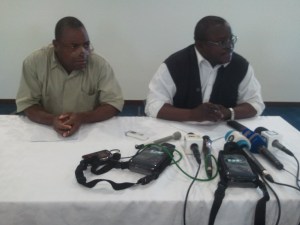
On the 6th of June, a press conference was held at Hotel Africa in Maputo by 23 civil society organisations in Mozambique. The press conference marked the release of an open letter from Mozambican social movements and organizations explaining their grave concerns regarding the controversial ProSavana program. The letter was addressed to the Presidents of Mozambique and Brazil, and the Prime Minister of Japan.

The open letter, dated 28 May 2013, had been handed over to the several dignitaries of the Japanese government, opposition, civil society and academics in Japan just a few days before. This took place in a recent visit to Japan by some of the signatories to discuss the ramifications this program with members of Japan’s civil society.

Coincidentally, this civil society visit had taken place just days before the Tokyo International Conference on African Development (TICAD), where heads of state of various countries of our continent gathered in Tokyo. This included Mozambican President Armando Guebuza and some of his ministers, who suddenly found themselves flooded by ​​questions about ProSavana, which thanks to this letter had gained another dimension in TICAD.

The highest point of the press conference last Thursday undoubtedly came from Augusto Mafigo, president of the National Farmers Union (UNAC). While responding to a question after the letter was read out, he gave a sharp retort to Mozambican Minister of Transport, Paulo Zucula, who in Japan crudely said that “our peasants are still illiterate to make a letter as perfect as that “, thereby no doubt trying to undermine the legitimacy of the letter. Without mentioning the Minister by name, Mafigo cleverly replied that “many of the Ministers of this country have peasants as parents.”

Although there is a relatively small coverage of ProSavana by the national Mozambican media, but on the other side of the planet in Japan, much ink has been spent on the topic. Here are some of the latest news links available online:
http://www.japantoday.com/category/politics/view/at-ticad-clumsy-diplomacy-mars-controversial-japanese-aid-project-in-mozambique

http://www.japantimes.co.jp/news/2013/05/09/national/ticad-to-redefine-japan-aid-to-africa/#.UbC2R5VptFR

http://www.globalpost.com/dispatch/news/kyodo-news-international/130603/concern-mounts-over-agriculture-development-plan-mozam

Justiça Ambiental/FOE Mozambique’s Position on the Prosavana Program

The Prosavana program is inspired by Prodecer, a Japanese-Brazilian agricultural development program developed in the Brazilian Cerrado since the 70’s.  Referred to by Brazilian, Japanese, and Mozambican governments as a success, the Prodecer program promoted the distribution and possession of land to foreigners and turned ​​Brazil into an avid promoter of land usurpation practices abroad.

By way of Prosavana, Brazil plans to export an agro-industrial development model to Mozambique that failed in Brazil where more than 65 million Brazilians are in a situation of food insecurity and millions of people struggle for access to land for food production a means of ensuring livelihood.  Experience shows that the benefits of the Brazilian model have been insignificant compared to the devastating impacts on the lives of peasants, forests, and the biodiversity of the country.

The Prosavana program was skilfully and conveniently wrapped in elegant “green” language and has been presented to Mozambicans and the international community as a program of “sustainable agricultural development”, completely leaving out its potential social and environmental impacts.  However, in a program of this size which requires the resettlement of communities, it is disturbing to realize that they know little or nothing about it.  It is another program designed and decided upon at the highest level without any involvement of farmers, local communities, or the public.

Through Prosavana Japan intends to ensure, in addition to borders, a new source of agricultural goods at low costs the purpose of which is for export to the Asian market particularly Japan and China.
Brazil sees in Prosavana an opportunity for expansion, technical cooperation, and a good investment for their producers and supply companies.
What are the benefits for Mozambique?

A major problem for the promoters of this program is that almost all of the Nacala corridor lands are occupied by peasants.  This is the most populated region of the country, whose fertile soil and abundant rain allows millions of peasants to work and produce food in abundance.  The Nacala corridor is considered the bread basket of the region providing food to the inhabitants of the Northern provinces and allowing the survival of millions of families. The rationale and purpose of Prosavana promotes the usurpation of land and the expulsion of thousands of local farmers who depend on it.  The Prosavana program has been questioned and challenged by civil society organizations among them the National Union of Peasants (UNAC).  UNAC is a peasant movement of the family sector founded in 1987 and recognized by the Government as a partner and by Mozambican peasants as its representative at a national level.  Over the past 25 years UNAC has been playing a crucial role in strengthening farmers’ organizations in the fight for their rights to land and natural resources and the discussion of public policy for the agricultural sector.  It has more than 86,000 individual members grouped into 2200 associations and cooperatives, 83 district unions, 7 unions and 4 provincial unions.  Justiça Ambiental corroborates the statement of UNAC on the Prosavana Program.

Justiça Ambiental / FOE Mozambique strongly condemn the whole process of preparing and implementing ProSavana because:

  1. It is based on the import of top-down policy and so far the circulating information is incomplete and unclear;
  2. The program is connoted as “sustainable agricultural development” and has as main targets peasant families and cooperatives of farmers, however, provides for the resettlement of communities and the expropriation of land;
  3. Promotes the influx of Brazilian farmers turning Mozambican farmers into cheap labour;
  4. Requires millions of hectares of land that is not actually available due to the system of leaving land fallow;
  5. This ignores the benefits of the program for the peasants;
  6. The program is structured to promote the expropriation of land to the peasants and local communities in general;
  7. Promotes the violation of the rights of peasants given the insecurity of land tenure, regarding DUAT (Right to Land Use);
  8. Promotes worsened corruption and conflict of interest given the enormous interests involved;
  9. Will aggravate the already precarious living conditions of many communities completely dependent on agricultural production for their livelihoods which could lead to a massive rural exodus;
  10. The program provides a high mechanization and excessive use of chemicals such as fertilizers and pesticides leading to contamination of the soil and water courses;
  11. There is a convenient lack of clarity over the use or otherwise of genetically modified organisms which given Embrapa’s connection to Monsanto is probably expected.


We demand that the Mozambican state, as stipulated by Article 11 of the Constitution of the Republic of Mozambique, assume its sovereignty and its leading role in defending the interests of its people.
We demand also that the Mozambican government reassess the ProSavana program taking into account the aspirations, concerns, and needs of Mozambicans, particularly farmers who are most affected by the program and who constitute the vast majority of the Mozambican people.  ProSavana, in terms of what it proposes, will threaten food sovereignty, access to land, water, and the entire social structure of families of thousands of Mozambicans thus crippling the nation’s future.


Tagged , , ,

ProSavana – who is it for?

Prosavana was presented as a Programme for the Agricultural and Rural Development of the Nacala Corridor in Mozambique and aims to improve the competitiveness of the rural sector in the region in terms of both food security and the increased productivity of family subsistence agriculture as well as the generation of exportable surpluses resulting from the technical support to agribusiness oriented agriculture.  But it is just one more megaproject, another very clear example of a Top – Down approach, negotiated at the highest level between the 3 countries involved with Mozambique supplying the land, Brazil the technical expertise and input, and Japan providing funds while at the same time securing food production for Japan.

ProSavana focuses on 14 districts in the provinces of Niassa, Nampula, and Zambezia, an area of ​​roughly 14 million hectares along the Nacala corridor.

According to the few documents and information available about the project, ProSavana is supposed to promote rural and agricultural development in an area which was initially described as having large extensions of inhabited land and as being extremely underdeveloped when in fact this area is highly habited due to its rich and fertile soils, regular rain, and abundant water.  Millions of peasants occupy most of this vast area and depend directly on the land which provides for millions of families. It is also a fact that this land can produce much more than what it currently produces and that most peasants and Mozambique as a whole would stand to gain if more adequate farming techniques, equipment, and better access to markets were the main objective of this initiative.  But what we have slowly been learning is that ProSavana is not all that.  ProSavana is agribusiness, it’s big money, it will use and abuse pesticides and fertilizers contaminating rivers and water sources, it will require moving communities away from the good land – resettlements, good examples of which we have yet to see in Mozambique.  These communities are particularly vulnerable to landgrabbing which is already happening in the area with other projects and the communities have not been participating in the design of this project – they know very little about it and how they will be a part of it.

UNAC, União Nacional de Camponeses – the National Peasants Union, has released a statement, a strong message resulting from a meeting with the peasants in Nampula.

UNAC statment can be seen at:

http://www.facebook.com/pages/Uni%C3%A3o-Nacional-de-Camponeses/351893418235290

www.unac.org.mz

Tagged , , , , ,

The Green Deserts of our Future

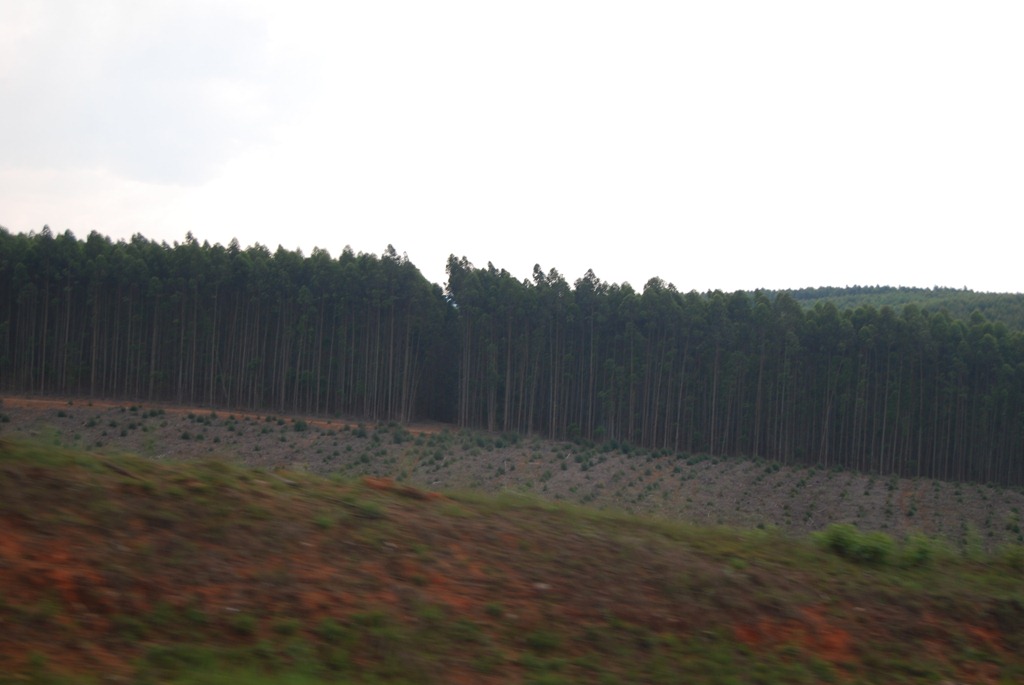
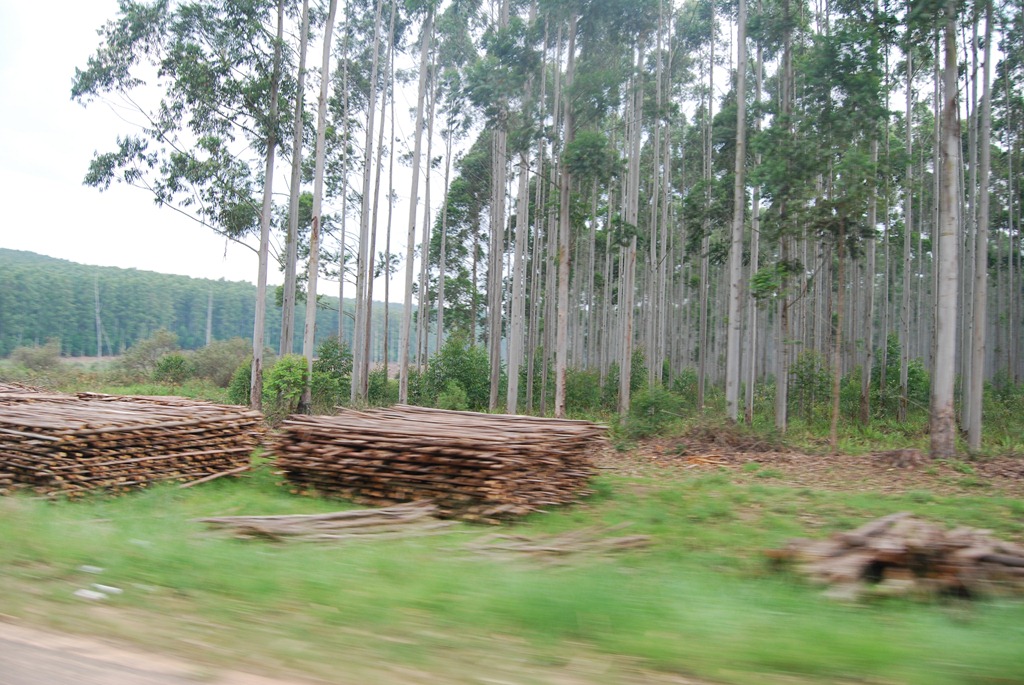
Monoculture forest plantations are fast increasing in developing countries and although this growth is fuelled by low production aDSC_0212nd labour costs, carbon sequestration for the developed, and government incentives, these plantations have serious social and environmental impacts.  Mozambique is no exception, here plantations are springing up rapidly and the government is keen to attract investment into these plantations for paper production.

On the 6th of August 2012 JA! participated in a seminar on ‘Forest Plantations and Industry in Niassa’.  The seminar took place at the VIP Hotel, Maputo and included the presence of a large number of individuals of the Forestry and Agriculture sectors.  The seminar was organised by the Niassa Forest Association together with the State Department of Land and Forestry and presided over by the Minister of Agriculture.  Mozambique is being transformed into a major global producer and the successful examples of South Africa, Uruguay, and Chile were mentioned.

The first presentation of the seminar was the “Evaluation of the Forest Plantations in Niassa Province 2005-2012” wherein it was mentioned that prior to 2005 there was no investment in tree plantations and after 2005 investment into these plantations surged leading to the current occupation of 165.772.80 hectares of land by plantations of which 32.409.00 hectares constitutes Pine and Eucalyptus plantations.  Some social and environmental problems experienced due to this type of investment were recognised as being caused by the enormous demand for land, waves of investment, poorly conducted community consults, and land grabbing cases.  All these problems were treated as if they had either been resolved or were in the process of being resolved, however with every passing day more and more serious incidents of land grabbing continue to be reported here. 

In other meetings the government’s desperate and blind desire to attract more and more investment into monoculture tree plantations has been clear.  This is evidenced by the speed with which the Regulation of Forest Plantations was proposed and approved while other legal instruments await years and years for approval such as the Law of Popular Action and the Law of Conservation Areas to name only those related to the environment.  The land for these DSC_0213plantations which is often described as ‘degraded’ is not degraded in the eyes of local populations who leave tracts of land fallow for revitalisation and future use nor is it degraded in the eyes of conservationists who see great importance in conserving the natural bush for biodiversity.  However others, interested in the implantation of these fake forests, are quick to regard this land as degraded.

The seminar left us with more questions than answers.  Who do the processes of community consult actually serve?  The community does not have the right to veto any project, they could be against it, they could protest, but the state has the final word and the state has decided.  What is the purpose of the Environmental Impact Assessment (EIA) study when the mitigation measures set out to address the impacts of a project are only in some cases possible or realistic?  This kind of situation leaves countries like Mozambique in a very difficult position as they have no way of rectifying a situation made difficult by the plantations and the effect their implantation has on rural farming communities and their environment.  The state gives the go ahead to projects that do not even have completed EIAs required by law. 

At the end of the day, the issue is that there is no clear admittance of the distinction between a natural forest and a monoculture tree plantation or ‘forest plantation’.  This is a serious problem because many would point to the idea that a tree plantation contributes to conservation but the impacts of monoculture tree plantations on the biodiversity of an ecosystem are large.  Consider for a moment what a tree plantation looks like; it is densely planted with only one (or a couple) tree variety.  This impacts the pollinators and other animals dependant on the natural vegetation for their survival (to read more about this research on Nature.com) and the sustainability of the natural forest.  The diversity of tree species in natural forests aids this survival whereas monoculture tree plantations leave no room for it.  It is also important to note that many of the tree monocultures like Pine and Eucalyptus are not indigenous to Mozambique and their impact on local species and water must be taken into consideration.  In Mpumalanga, South Africa, Philip Owen founder of Geasphere describes how the Pine and Eucalyptus plantations have dried up the groundwater, streams and rivers there. 

DSC_0218Tree plantations are a form of agriculture, they are not forests in any way as they have been shamefully described by companies in an attempt to take advantage of the growing concern of deforestation which is a current and ever-increasing issue.  These tree plantations are food deserts, they yield nothing in terms of sustenance, and whatever species are able to survive in these plantations are eradicated as pests. 

These plantations are green deserts.  They offer no sustenance, they offer no reprieve from deforestation or the loss of natural forests and the species therein.  They have been described as being void of life – that not one animal or bird can be heard within these fake forests.  They emit the silence of lifelessness.  They are quite simply wood farms of invasive tree species which dry up water sources and are implanted on community lands labelled as degraded.  This cannot be regarded as a sustainable practise for our future.


For more information on plantations vs. natural forests please follow these links:


‘Green desert’ monoculture forests spreading in Africa and South America

http://www.guardian.co.uk/environment/2011/sep/26/monoculture-forests-africa-south-america


Geasphere Mozambique – Information about the Mozambican experience

http://www.geasphere.co.za/mozambique.htm


“Monoculture tree plantations are “green deserts” not forests, say activists.”  http://news.mongabay.com/2008/0919-plantations_hance.html?menu=Select+a+News+Topic


Plantation vs. natural forest: Matrix quality determines pollinator abundance in crop fields (Scientific Report from Nature.com) http://www.nature.com/srep/2011/111028/srep00132/full/srep00132.html

Tagged , , , , , , , , ,