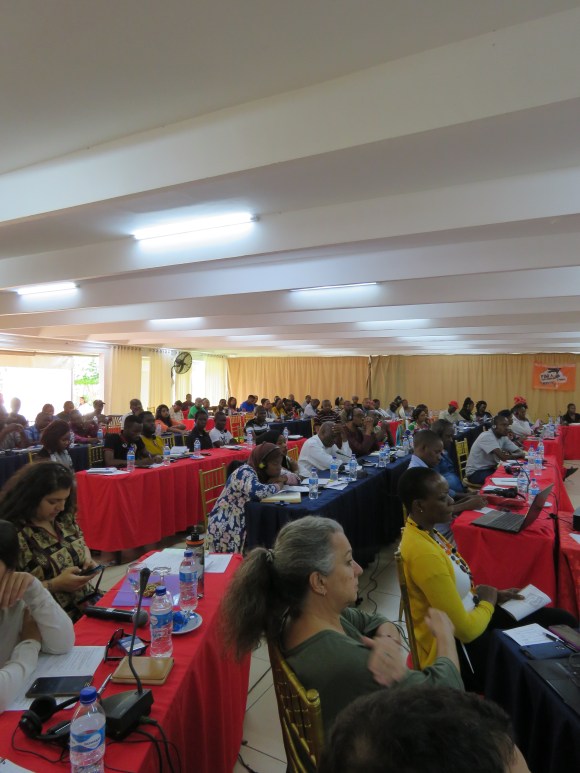
Author Archives: JA

TOKYO DECLARATION: “We reiterate the rejection of ProSAVANA and MATOPIBA and defend the food sovereignty of the peoples”

nao ao prosavana

We, peasants’ movements and civil society organizations from Mozambique, Brazil and Japan, met in Tokyo, Japan, between the 20th and the 22nd of November 2018 for the 4th Triangular Peoples’ Conference against ProSAVANA.

In the days leading up to the conference, we visited the farms of Japanese peasants, whom with we exchanged valuable experiences on peasant agriculture and strengthened solidarity bonds built over the last few years.

With Japanese civil society, and amongst a wider audience, we exposed the agribusiness capital agenda of eliminating peasant agriculture in our territories, exemplified by programs such as ProSAVANA in Mozambique or MATOPIBA in Brazil, which are promoted by the Japanese International Cooperation Agency (JICA), in alliance with the financial capital and governments of these countries. Both ProSAVANA and MATOPIBA are agrarian programs designed for the large-scale production of commodities for the sake of capital. Nevertheless, documents of both programs contain distorted claims regarding its rural development and granting food security intentions.

Our conference also allowed us to share cases of resistance to this type of imposed agricultural programs and to showcase concrete experiences of agroecology in Mozambique, Brazil and Japan.

By the end of these days of meetings and deliberations – and after meeting with the representatives of JICA, the Japanese Ministry of Foreign Affairs (MOFA), the Japanese Ministry of Finance and the Japanese Bank for International Cooperation (JBIC) – we reiterate our rejection of ProSAVANA in Mozambique and of MATOPIBA in Brazil. We demand from the government of Japan and JICA their urgent withdrawal from these programs.

Almost 40 years after its inception, JICA continues praising Brazil’s PRODECER agricultural program. Although in its recent statements they mention the need to avoid replicating PRODECER in Mozambique, JICA continues to use the disastrous experience of Brazil as a case of agricultural success, even though it has caused the extermination, expulsion and subordination of several indigenous and sertanejo peoples who lived there and whose knowledge has constituted over the centuries the agrobiodiversity of the Cerrados. The agriculture promoted by JICA in Brazil is made of extensive monocultures – mainly of transgenic soybeans, causes the reduction of biodiversity and the depletion of soil and water, contaminating the waters with pesticides – some of which are even banned in Japan. In fact, Japan needs to import large quantities of soybeans (corn and wheat) to meet the food needs of its dense population.

Brazilian Cerrado’s most recent front, MATOPIBA, is currently the object of serious conflicts due to the persistence of its vision. Once again, JICA and the Japanese government prefer to ignore public criticism and socio-environmental disasters stemming from decades of predatory occupation by joining the program.

During the last United Nations General Assembly in November (2018), Japan did not vote in favour of the UN Declaration on the Rights of Peasants and Other People Working in Rural Areas. By choosing to abstain, Japan sent us a clear message. It would be illogical to believe that the most important Japanese State cooperation agency intends to support the Mozambican peasants if this country regards peasantry as not worthy of rights.

ProSAVANA and MATOPIBA represent a clear attack on the peasant class. As a result of the way these processes have been conducted so far, peasants in the regions of implementation are being denied the right to decide on their own food systems. They continue to be treated as passive objects and to see denied their key role and accumulated knowledge and values ​​linked to peasant agriculture, as well as the importance of their cooperation and solidarity with each other. Imposing agricultural practices and options that are foreign to its conception, not only jeopardizes the food sovereignty of peoples, but also hampers the social, cultural, economic and environmental organization of peasants in these regions.

We call on Japanese civil society and general public to stand in solidarity with the peoples of Mozambique and Brazil, especially the people of the Nacala Corridor in Mozambique and of the Brazilian Cerrado, rejecting the use of Japanese people’s public resources to finance cooperation programs – such as ProSAVANA and MATOPIBA – that violate the human rights of peoples and devastate the environment of foreign lands.

While reiterating our unconditional rejection of ProSAVANA and MATOPIBA, we demand:

  • That the Governments of Mozambique and Brazil, together with peasant and civil society organizations, draw up genuine, locally-conceived national peasant agriculture plans, with each country’s food sovereignty in mind;

  • That all programs and investments that promote a predatory occupation of territories, compromise the integrity of peoples and systematically violate the human rights of peoples are stopped;

  • That the Japanese International Cooperation Agency abandons ProSAVANA and MATOPIBA;

  • That the Government of Japan, through its Ministries of Foreign Affairs and Finance, responsibly examine the complaints and denunciations made by peasants and civil society;

  • That the State of Japan hold Japanese companies responsible for human rights violations committed in Mozambique and Brazil;

  • That the Government of Mozambique disclose all information regarding ongoing programs and investments in the Nacala corridor, as it is bound do in the case of ProSAVANA, following a decision of the Mozambican court in favour of the Mozambican Bar Association.

We, the peasants and civil society organizations of the Triangular People’s Conference, declare that we will continue to articulate ourselves as the No to ProSAVANA Campaign and that our actions of resistance will carry on, while at the same time we will also continue to practice peasant agriculture in accordance with our customs and our culture, taking care of the land, the water, native seeds and biodiversity as a whole, hence respecting the knowledge of our ancestors and passing it on to future generations, as a guarantee of the food sovereignty of our peoples.

No to ProSAVANA!

Yes to peasant agriculture and Food Sovereignty!

Tokyo, 22nd of November 2018


‘Outrageous’ Mozambique debt deal could make 270% profit for speculators

by Tim Jones on 7 Nov 2018

Close up of roll of $100 bills.

People of Mozambique to pay $1.7 billion to $2.2 billion on original loan of $760 million, which was not agreed by Mozambique parliament, and which has been of no benefit

The government of Mozambique has announced it has reached an agreement on a new debt payment plan to holders of some of the illegitimate debts which have plunged the country into a debt crisis.

Whatever way the deal is looked at, it is outrageous for the people of Mozambique. It leaves the Mozambique people paying between $1.7 billion and $2.2 billion for a $760 million loan which they have not received any benefit from. Meanwhile, companies who now own the debts are set to make large and potentially huge profits.

We estimate that the deal means that a company who bought the debt in 2016 could make a 50% profit if they sell the debt now, or up to 270% profit if Mozambique does repay as has offered over the next 15 years.

Background
The debt comes from a loan of $760 million in 2014 to a Mozambique state owned company, Ematum. Campaigners in Mozambique say the loans were illegal because they were given without parliamentary approval. The loan was supposedly built to invest in a tuna fishing fleet, but $500 million has never been accounted for. The Mozambique government says it was spent on military equipment, but no evidence of this has ever been presented. The tuna fishing fleet sits unused in Maputo harbour.

The face value of the initial loan was $850 million, but $90 million of this was spent on “fees” to the banks which arranged the loan – London based branches of Credit Suisse and VTB Capital. This was a way to make it look like the loan had a lower interest rate than the reality. Of the $760 million that was actually lent, an independent audit found it had all gone to the fishing boat contractor in Abu Dhabi, none had ever entered Mozambique.

Unlike two other loans totaling $1.4 billion given by Credit Suisse and VTB, the loan to Ematum was publicly known about after it was given, with Credit Suisse and VTB selling the debt on financial markets as a bond. However, the government of Mozambique guaranteed to pay the debts if Ematum could not, without getting parliamentary approval, which makes the loan illegal under Mozambique law.

guebuza hand shake pambazuka

Photo: Pambazuka

In 2016, shortly before the $1.4 billion of other debt became publicly known about, the Mozambique government agreed a restructuring of the loan, which reduced payments between 2016 and 2020, but increased them over the lifetime of the loan. Moreover, they brought the debt onto the government’s books, despite its illegality.

After the other debts became known about, Mozambique defaulted on all the loans between 2016 and 2017, including the debt which originally came from the loan to Ematum. Neither Ematum or Mozambique have made any payments since.

The default caused the price of the debt to fall on international markets. In late 2016 and early 2017, the restructured Ematum debt could be bought for between 55% and 65% of its face value.

The debt agreement
The agreement announced yesterday says that the Mozambique government will agree to repay all of the debt, plus the interest payments missed over the last two years. Moreover, it will pay 5.875% interest on both the principal and missed interest payments. And in a final kick in the teeth to the people of Mozambique, 5% of future gas revenues will be paid on top of the interest, up to a maximum of $500 million. The interest payments will begin from 2019, with the principal being paid between 2029 and 2033.

We have calculated that this leaves the Mozambique people paying at least $1.7 billion in total for the debt, rising to $2.2 billion depending on how much in gas revenue is also lost.
In contrast total payments under the original terms of the loan would have been $1.1 billion between 2014 and 2020, and under the first restructuring $1.4 billion between 2014 and 2023. Each time Mozambique restructures this debt, it agrees to pay more, albeit further into the future.

For a company which bought the debt when it was first lent they stand to make almost 200% more than they originally lent, or 65% more than if they had lent to the US government instead.
However, many of the holders of the debt did not buy the debt in 2014. For those who bought when Mozambique defaulted in 2016, they could make 270% more than if they had lent that money to the US government instead. Since the deal was announced the value of the Mozambique debt on financial markets has increased. Even if a 2016 buyer of the debt sells now, they will still make a profit of 50%.

What happens next
The deal the Mozambique government has announced is with four companies who own around 60% of the debt: Farallon Capital Europe, Greylock Capital Management, Mangart Capital Advisors and Pharo Management. If 75% of the holders agree to the deal, the rest will have to abide by it.

The deal has to be agreed by the Mozambique parliament, so it could still be stopped, if Mozambique parliamentarians are willing to stand up against such a bad deal for the people of Mozambique.

Negotiations over the other $1.4 billion of secret debt are still ongoing, but this deal is not a good sign of how much more the people of Mozambique may end up paying across all the illegitimate, unaccountable loans which were of no benefit to them.

The final question is why the Mozambique government would agree to such a bad deal? I have no answer. It is simply appalling.

atum ascendente

Summary figures

Original loan
Amount originally lent: $760 million (face value $850 million, but $90 million of this ‘fees’ which were invented to reduce the headline interest rate)
Interest and principal to be repaid between 2014 and 2020: $1.1 billion

First restructuring in 2016
Interest and principal to be repaid between 2014 and 2023: $1.4 billion

Deal agreed in November 2018
Interest and principal to be repaid between 2014 and 2033: $1.7 billion + 5% of future gas revenues, capped at $500 million. So maximum of $2.2 billion in total

Potential profit:
In late 2016 and early 2017, $100 million of the Mozambique debt could be bought for $60 million. If the deal is implemented, this $60 million will return up $220 million. If it had been lent to the US government it would return $82 million over the same timescale. This is therefore a profit of 270%.

by Tim Jones

Trump vs. California vs. Climate

IMG-20180908-WA0000

In early September, JA staff participated in a series of interesting events in San Francisco. The Governor of the state of California, Jerry Brown was hosting the interestingly-named Global Climate Action Summit (GCAS) from 12-14 September, 2018.

Of course, the world knows that the US politics is dominated by the toxic and racist Trump and his nonsensical claim that climate change is a Chinese hoax. But what is happening in California, known to be a progressive state in the conservative US? When Trump was elected as US President in November 2016, the California Governor Brown opposed him and came out in support of climate action. So that sounds good, right? So is California a climate leader?

The answer unfortunately is no. It is very important to oppose Trump and his vile nonsense. But just opposing Trump is a very low bar to set, and that is what Gov Brown did with his GCAS event. Friends of the Earth US explains perfectly: “Governor Brown talks a good game on climate change. But despite all the talk, oil and gas remains a very big business in California, putting local communities at risk and accelerating global climate chaos … true climate leadership requires more than promises and press conferences that denounce Trump. California promotes itself as a global climate leader – but Big Oil is aggressively turning to processing some of the planet’s dirtiest crude oil at refineries in the state, putting local communities, coastal waterways and the global climate in jeopardy.”

Essentially Governor Brown and Big Oil in California are using the Trump idiocy to make their market mechanisms look like ‘climate action’ and to normalize their false solutions.

US justice-based movements, such as Grassroots Global Justice Alliance, joined with others including Friends of the Earth US to see through this charade. They created the ‘Brown’s Last Chance campaign. They understood that GCAS was a giant green-washing moment and climate action needs to be deeper and call for system change. They demanded that Gov Brown stop any new oil and gas permits and that he announce a phase out of existing fossil fuel production.

The fight against California REDD continues

Now, the plot thickens. This is not just about oil and gas, but California is also pushing false solutions. It would be the kinds of oil refineries mentioned above which would use the REDD (Reducing Emissions from Deforestation and Forest Degradation) credits from Chiapas and Acre and other potential sub-national partner jurisdictions to supposedly “offset” their greenhouse gas emissions pollution under the California cap-and-trade program as it is envisioned to expand in the near future.

So JA joined indigenous peoples from Brazil to California to Canada, demanding that California stop their dangerous REDD scheme. We protested outside the fancy Parc 55 hotel where Gov Brown was planning his REDD scheme. Chief Ninawa from the Huni Kui tribe in Brazil went inside to deliver our statement to the Governor and his team. “No REDD!” – we chanted outside.

‘Rise for Climate’ march

IMG-20180910-WA0002

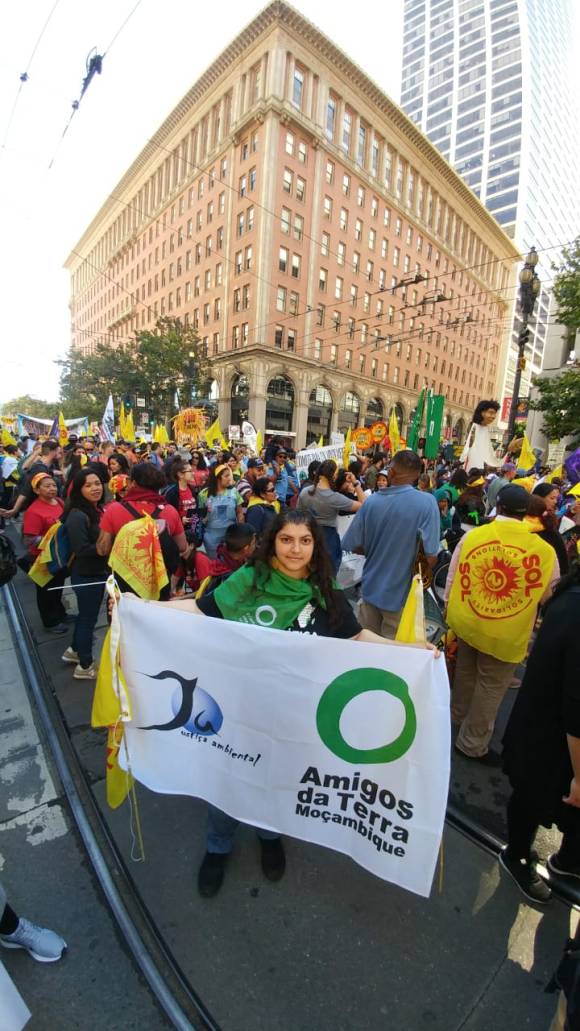
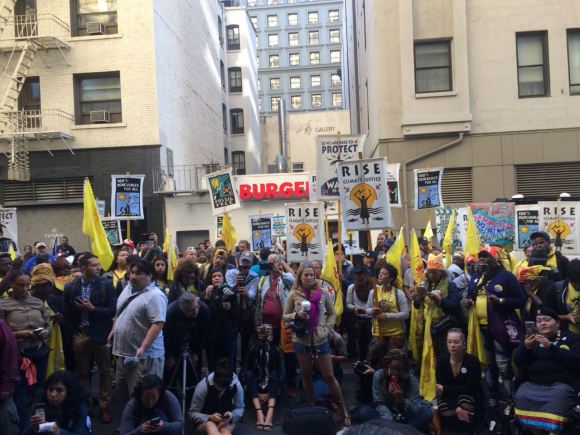
To show people power, we often need to come to the streets. The California activists organised a big march called the ‘Rise for Climate’ march. It was led by local indigenous and frontline communities with a strong foundation in grassroots environmental justice organizing. We mobilized to stop dirty energy everywhere, and to say no to dangerous distractions like carbon trading, which will do nothing to stop the climate catastrophe. We marched alongside communities devastated by wildfires barely 55 miles (90 kms) away from San Francisco, and Puerto Rican movements whose entire island was devastated by hurricanes just a year ago.

The demands of the march were strong, stating:

We demand Real Climate Leadership, which requires:

  • Environmental, racial, and economic justice for all
  • No new fossil fuel development and a managed decline of existing fossil fuel production
  • A just transition to 100% renewable energy that protects workers, Indigenous peoples and frontline communities — both in these extractive industries and more broadly — and ensures family-sustaining jobs with the right to unionize, that are safe for people and the planet
  • Just and equitable resiliency and recovery efforts led by the communities most impacted;

Over 30,000 people came to the streets in this amazing march which shut down the streets of downtown San Francisco.

Sol2sol Alternative Summit

We need to oppose the wrong actions our governments are pushing. But we also need to show our own peoples’ solutions. The California activists organised the amazing alternative summit called Sol2Sol, which stands for ‘Solidarity to Solutions’, to spotlight frontline community solutions. JA participated and we spoke about our work in Mozambique.

Sky Protectors

A new movement is emerging called ‘Sky Protectors’. We are activists who have always defended the land, the water, and now we are being called on to defend the sky too. Geo-engineering is a dangerous phenomena that refers to the deliberate, large-scale technological manipulations of the Earth’s atmosphere, oceans and soils with the stated aim of weakening some of the symptoms of climate change.

Geo-engineering is risky, unsafe with scary implications, it would change rainfall patterns and other weather phenomena in a way that we don’t even understand yet. That’s why we need to stop it and protect the sky. JA! joined a meeting in San Francisco where we learnt about some geo-engineering projects that are already planned and we strategized on how to oppose them. Currently, projects are being planned in North America, South America and Asia, but these dangerous projects can come to our continent of Africa at any time.

IMG-20180910-WA0001

One type of project wants to put sulphates into the stratosphere, with the aim to reduce the amount of sunlight hitting the earth. This will completely change rain and wind patterns, it is predicted to disrupt the Asian monsoon and increase droughts in Africa and Asia. Also, given the current geo-politics and inequities between and among countries, can you imagine a powerful corporation or country controlling the thermostat of the world? They could hold us all hostage to their whims. This would be the militarization of the sky and we need to defend our sky from this. This is not a plot from a sci-fi movie; there is a real Stratospheric Aerosol Injection experiment planned in Arizona state of US called Scopex.

Another crazy idea is called Ocean Fertilization, where the idea is to throw iron filings into the ocean to capture atmospheric CO2. Can you imagine what this will do to the marine life and the fisherfolk who depend on the ocean? Again, this is not a made up story; a project called Oceanos is being planned off the coasts of Chile, Peru and Canada.

Want to hear one more awful idea? In the most sensitive ecosystem of the Arctic, in Alaska, a project called Ice 911 is being planned. The idea is to throw glass microbeads on top of the ice and in the sea in Alaska to absorb CO2. In our meeting, we were joined by Native American people from Alaska who were angry at this project and vowed to oppose it in their territories.

Geo-engineering is dangerous and risky. But worse, it tries to perpetuate the false belief that climate change can be stopped with techno-fixes. It deliberately ignores the fact that the climate crisis and the other inter-related crises we are facing are a result of today’s unjust economic, social and political systems. The unsustainable manner in which we produce, distribute and consume things are devastating our ecology and our people. That’s what needs to be changed. Only system change will stop climate change.

Administrative Court sentences mining company JINDAL and the Government of Tete Province for violation of community rights

Justiça Ambiental submitted a case to the Administrative Court of the Province of Tete (ACPT) in February 2016. The proceedings concerned the behavior of the Government and mining company JINDAL, which results in a breach of the fundamental rights and freedoms of the affected communities by failing to materialize their fair resettlement in the context of coal mining in an area located in Chirodzi, Marara, in the Province of Tete – mining concession No. 3605C attributed to JINDAL.

In response, ACPT rejected the request of Justiça Ambiental, on February 29, 2016, alleging, without legal basis, that the State is an illegitimate party and that the procedural means used by Justiça Ambiental were improper.

For Justiça Ambiental, there is no doubt that the ACPT decision was based on presumptions and tried, at all costs, to accommodate previous questions without knowing the merits of the case. This court reached a decision on the basis of arbitrariness and in clear abuse of the discretionary powers that the law confers on the judge of the case.

Under the terms of the law, in particular the Constitution of the Republic, the Mining Law and the Regulation on Resettlement Resulting from Economic Activities, it is incumbent upon the Mozambican State and JINDAL to create conditions for fair resettlement and to improve the living conditions of cause.

Justiça Ambiental did not agree with the decision of said Judgment nº 03 / TAPT / 16, filed the appeal in March 2016, and the proceeding was processed with reference number 25/2016 – 1ª, in the First Section of Contentious Administrative Court. This Court analyzed the case for a period of two years and decided to give reason to Justiça Ambiental, considering that the request of this civil society organization in defense of the environment and the social and economic rights of the local communities, through Judgment No. 41/2018 of June 12, should be carried out.

The Court ruled that ACPT judgment No 03 / ACPT / 2016 should be annulled and ordered JINDAL and the Government of the Province of Tete to complete, within six months of notification of the judgement, a fair resettlement of the community of Cassoca.

Justiça Ambiental has shown to the Administrative Court that the resettlement of the families affected by the project has not yet been materialized due to the simultaneous responsibility of JINDAL and the Mozambican Government. Justiça Ambiental also demonstrated the lack of necessary infrastructures and other basic social, economic and cultural conditions for a life with the minimum of dignity for the families in question.

It should be noted that the First Section of the Administrative Court states in its decision that the resettlement procedure in question has been going on for a long time, with the consequent deterioration of the living conditions and survival of the populations affected and surrounded by mining in the area granted to JINDAL, which justifies censorship by this Court, so much so that JINDAL has the resettlement plan approved since 2013 and signed commitments with the Government to erect houses and ensure adequate housing of affected families, but has never fulfilled such obligations to date.

Therefore, it is a question of a judicial victory, but one that is not yet felt in the living conditions of the affected communities. Therefore, Justiça Ambiental appeals to all society concerned for a joint campaign in the sense of those condemned to respect the Judgment and carry out resettlement accordingly. Justiça Ambiental is aware that the Mozambican Bar Association has also condemned JINDAL for violating the rights of the communities concerned.

There is no doubt, therefore, that the exploitation of mineral coal in Tete constitutes a breach of the fundamental rights and freedoms of the affected communities, rather than contributing to their social and economic development.

Maputo, 17 September 2018

PRESS RELEASE About the insistence in Mphanda Nkuwa

mk1

“Hydroelectric dams in Africa may be among the most enduring of colonial legacies. They persist in ways that laws or traditions or patterns of life do not. They stand fixed in the landscape, changing the world around them while they themselves prove stubbornly resistant to significant change. Cahora Bassa, completed on the Mozambican stretch of the Zambezi River in 1974, the year before the end of Portuguese rule, was catastrophic for the approximately half-million people who depended on the river and its delta for their livelihood and for the tens of thousands who were forcibly relocated when the dam’s lake was created. Even today, the flow management scheme required to maximize export of electricity to South Africa continues to wipe out dry-season crops and drastically reduce fishing, making life along the Zambezi barely supportable.

Despite the traumatic history of Cahora Bassa, the Frelimo government is committed to a colonial-era plan to build a second dam approximately sixty kilometers downriver from the first. In many respects, Mphanda Nkuwa, as the dam project is called, looks like a replay of the colonial past. Mozambique justifies the dam in language largely unchanged from the colonial era. The overarching economic imperative driving the dam is the same—cheap energy for South Africa.”[1]


In light of our Head of State’s, among others’, recent pronouncements regarding our government’s intention to go forward with the wretched Mphanda Nkuwa dam project, Justiça Ambiental hereby reiterates its position of total repudiation regarding this venture and, as is its duty, once again alerts civil society to the dangers that this project entails for the country, the region and the planet.

Environmentally speaking, it is absolutely obvious and unquestionable that this dam (or any other dam) on the Zambezi (or any other river) is a bad idea, and it’s not just us who are saying it, it’s an entire scientific community in unison. Moreover, in the specific case of the Mphanda Nkuwa hydroelectric plant, the environmental unfeasibility of which we speak is not solely justified within the fundamental scope of ecological preservation, because it also translates into an inevitable and comprehensive economic unfeasibility. This is because, according to reports from the United Nations Framework Convention on Climate Change and International Rivers[2]“, for example, even without the dam in Mphanda Nkuwa, the Zambezi is one of the rivers in Africa that will suffer the most impacts from climate change due to the intense droughts and floods that are projected to the continent in the medium and long term, and such climatic events will certainly jeopardize the energy production of its many dams – particularly the Mozambican ones that are at the end of the line.

Equally troubling, if not more, is that regarding this project, several experts have already warned that building a new dam in a region where seismic risk is already naturally considerable, will substantially increase this risk. Needless to say, if a violent earthquake causes a dam to collapse, the consequences would be catastrophic.

Having said this, we plea to our government’s common sense, and appeal that, once and for all, they forget this madness. However, if they decide to squander the public purse in stubbornness – since the parties involved at least admit that the EIA of the project is out-dated (not to say that it was poorly drawn and / or that it is deeply biased) – we appeal that this time around, for the sake of Mozambique and Mozambicans, they conduct a careful, impartial, serious and inclusive assessment.

Still, before taking that step, in order to dispel understandable speculation about the economic motivations that are bringing this project back into the limelight – made evident in the news regarding investor and/ or pseudo-investors disputes brought up by the media last week – we would like to appeal to the Government that, before actually consulting Mozambicans, bluntly and with full transparency, they clearly and completely clarify the outlines, objectives and the rationale behind this project, including:

  • Where does the investment come from and in exchange for what?
  • Why is this project a priority for the country (taking into account the current socio-economic situation)?
  • Have we considered other alternatives? If so, which ones?
  • What is the real purpose of the dam and what hypothetical gains do you think it would bring to the country in the short and long term, including how do you plan to make it profitable (for example, given that Eskom is, in the world, the utility company that buys energy at a lower price – (guess whom from…?)

But because we are who we are, we can not fail to stress that at this point in time, we believe it is a gross mistake to invest in dams (for more of this dimension) as an energetic solution, when we know very well of its harmful effects. – This positioning is backed by the known and public withdrawal of countless countries from this type of solutions. (In the US alone, for example, in the last 100 years an estimated 1150 dams have been demolished!)
Why are we rowing against the tide, gentlemen?


Maputo, September 4th 2018


[1]  International Journal of African Historical Studies Vol. 45, Nr.2 (2012) “Harnessing the Zambezi: How Mozambique’s Planned Mphanda Nkuwa Dam Perpetuates the Colonial Past”, by Allen F. Isaacman, PHD (University of Minnesota and University of Western Cape) & David Morton (University of Minnesota)

[2] International Rivers “A Risky Climate for Southern African Hydro”, by Dr.Richard Beilfuss

Towards an Ecofeminist Just Transition

The world is facing many inter-connected crises. The one we hear about the most is the climate crisis, the earth is at a CO2 level not seen in 3 million years and our continent Africa will face the brunt of the crisis. But as we lament the climate crisis, we must not forget all the other crises we are confronting. We are facing an energy crisis; the numbers from mid 2017 show that over 60% of the people of Africa did not have access to electricity. We are facing a biodiversity crisis, a crisis of unemployment, a crisis of inequality as the world has never seen before.

As business elites made their way to Davos for the World Economic Forum in January 2018, Oxfam released a report stating that the richest 1% of people on the planet own 82% of the wealth of the planet. From March 2016 to March 2017, the number of billionaires increased by one every two days! Talk about gross domestic product. Oxfam reports that in four days a fashion industry CEO makes the same money as a Bangladeshi woman garment worker will earn in her whole lifetime. Women earn less than men and occupy the lowest-paid and most insecure jobs. This is nothing if not a crisis of planetary proportions.

Why do we need to look at inter-connected crises? Can’t we just deal with the climate crisis now and then deal with the others? The basis of climate justice is that we must deal with inter-connected crises all at once, because if we only try to confront the climate crisis, we will only exacerbate other crises. The basis of climate justice is that in dealing with the climate crisis we must also alleviate the other crises. Climate change is a symptom and a cause of the dysfunction of the system.

So we need a transition, but the transition has to be just, it has to be fair. We need to construct a different world. As Arundhati Roy wrote in her book ‘War Talk’ 15 years ago, “another world is not only possible, she is on her way. On a quiet day, I can hear her breathing.”

What is womens’ role in this system and in the resistance? Why does Roy refer to ‘another world’ as feminine? Similarly, why do the Latin American movements call the earth as ‘madre tierra’ (mother Earth)? This notion is based on the understanding that there is a dependency between human beings and nature, and that we must live on this earth in conjunction with nature and not against nature. Ecofeminism also asserts that capitalism exploits both women and nature, hence those oppressions need to be resisted together.

Capitalism organizes the world into the public sphere and the private sphere, based on the sexual division of labour. Men usually dominate the public sphere, the market, where money is handled and economic decisions are made. This is also the sphere where all the planet-killing decisions are made, such as fossil fuel exploitation, damming rivers, genetically modifying crops, etc. Women are often relegated to the private sphere of the home, where the reproduction of labour happens. This also includes most of the low paid, precarious jobs that women often hold. The way we understand it, the issue is not the division of labour per se, but the different values attributed to different tasks. The public sphere mostly dominated by men is considered important while the private sphere mostly dominated by women is considered inferior.

I believe that capitalism’s exploitative ways are based on exploiting the unpaid care labour of women. Capitalism needs and uses the free labour of women to take care of workers when they come home from the factory, to nurse the coal miners when black lung disease puts them on their deathbeds, to literally give birth to the next generation of workers for capital to exploit.

This does not mean that women do not occupy exploitative roles. We see some women in the public sphere, often making decisions that can be the same or worse for the planet or for vulnerable people. We also see some women being protected by the patriarchy. That’s when we remember that not only is capitalism entrenched along with patriarchy, it is also entrenched along with racism, classism, neocolonialism, the fossil fuel extractivist economy, etc. We need to dismantle all these oppressive systems, not just one or two of them, but all of them, because they reinforce each other. The way our societies are currently structured, the mutual reinforcement between these oppressions is what is destroying the planet and many of her most marginalized people. We need to understand the way structures operate, not individual examples, because these prop up and reinforce each other.

So women must be part of the resistance to this system which has left us reeling from these inter-connected crises. We must move from a world of competition to a world of cooperation and care. Care work should not only be womens’ work, it should be everyone’s work. We must change the culture and values of this current system. As stated beautifully by an organization called Movement Generation in their Just Transition publication called ‘From Banks and Tanks to Cooperation and Caring’, “in humble cooperation with the rest of the living world, we must rip out concrete and build soil; we must undam rivers and cap oil wells like our lives depend on it.”

Because our lives literally depend on it. This is a small step towards what an ecofeminist just transition can look like.


CSO’s warn government and society about the dangers of introducing Genetically Modified Organisms in Mozambique

IMG_1380

The agricultural and food crisis is being felt in different parts of the world, especially in countries that are most vulnerable to climate change, where agriculture is one of the main sources of income for families. This has led to the engagement of a number of material and financial resources – supposedly in order to meet the need and demand for basic foods – through various initiatives promoted by multinational companies of production and multiplication of seeds tolerant to different conditions of nature.

At the same time, the demand for food to address hunger and malnutrition has been used as a pretext to boost the industrial food production business conducted by large multinational companies, using unsustainable technological practices that endanger human health and the ecological balance in general. These practices include the use of biotechnology – especially the so-called genetic engineering, which makes use of scientific knowledge like the application of techniques of manipulation and recombination of genes – for the production of genetically modified organisms (GMOs), thus seeking to meet the growing challenge of food production. GMOs have also been used under the pretext of their useful application in animal farming and in the pharmaceutical industry for health care improvements. However, there are several implications for the use of these bodies, which in recent years have given rise to major debates within the scientific community.

On the European continent, a number of countries have enthusiastically embraced the production and consumption of genetically modified organisms, but today, according to Dr. Angelika Hilbeck[1], as a result of this and other wrong decisions, Europe has lost about 80% of its population of insects and faces a biodiversity crisis. Curiously, today, many of these European countries have introduced policies to discourage the production, marketing and consumption of products resulting from genetic manipulation because of the implications that have been placed on human health and the environment. Even so, year after year, the international campaign carried out by large corporations with the aim of promoting the production, commercialization and consumption of GMOs – especially in the Southern countries (a.k.a. “developing countries”), as is the case of Mozambique – continues to increase.

Since 2001 – when we ratified the Cartagena Protocol on Biosafety (Resolution 11/2001) – Mozambique has been working on the elaboration of national biosafety legislation. This work culminated with the approval of the Regulation on Bio-security on the management of Genetically Modified Organisms (Decree No. 6/2007), which established preventive measures and rules for controlling activities involving GMOs. This decree provided for a series of preventive measures, especially with regard to the import, marketing and research of GMOs. However, seven years later, part of these measures were changed with the repeal of the aforementioned decree and consequent approval of Decree No. 71/2014 – a change whose purpose was clearly to create room to allow the production of GMO crops. Legislation “tweaks” such as this one, are being carried out without the effective consent of the public that potentially consumes these products, thus violating Article 5 of Decree No. 27/2016 that regulates the Consumer Protection Law and also what was stipulated by the Nagoya Protocol regarding the right to information about products entering the country and their impacts.

The project for the introduction of Water Efficient Maize for Africa (WEMA) is a clear example that demonstrates the kind of pressure Mozambique is subject to regarding GMO introduction into its agricultural production system. The WEMA project involves five countries – Mozambique, South Africa, Uganda, Kenya, Tanzania and Uganda – and is a public-private partnership, co-ordinated by the African Agriculture Technology Foundation (AATF) in partnership with the International Maize and Wheat Improvement Centre (CIMMYT), Monsanto and the national agrarian research bodies of the countries in question; and funded by the Bill & Melinda Gates and Howard G. Buffet Foundations. At present, in Mozambique, the project is in its test phase in confined fields and consists basically of the production of maize varieties, both conventional and genetically modified, that are drought tolerant and resistant to insects.

In Mozambique, little is known about the real impacts of GMOs, and public debate on this issue is almost non-existent. Due to the Government’s clear intention to allow the production of GMOs in the country without an effective public consultation, since 2017, a group of organisations has sought to start this debate in a more open, democratic and transparent manner. In this context, the African Centre for Biodiversity (ACB) and Justiça Ambiental (JA) organized a two-and-a-half day training workshop to share updated information on GMOs in Africa, – with an emphasis on Mozambique – as well as knowledge on Biosafety Regulations under the auspices of the Biosafety Protocol in Mozambique, with emphasis on human health, environmental and socio-economic impacts. The workshop was attended by peasants, civil society organisations, government representatives and academics.

In addition to ACB representatives from some African countries, the workshop also had internationally renowned experts on GMOs and its impacts (such as the aforementioned Dr. Angelika Hilbeck or Dr. Lim Li Ching) and in themes related to Biosafety. During the meeting, the researchers presented several scientific studies that point out the impacts of GMOs on the environment and human health in the world – including antibiotic resistance. For the researchers, the safety of GMOs is still very questionable, and while this doubt prevails, the Precautionary Principle set forth by the Cartagena Protocol – to which Mozambique is a signatory – should guide us.

JA regrets that the path to avoid the production of GMOs in Mozambique is never going to be a short one, since governments such as ours are easily manipulated and taken over by large international corporations – such as Monsanto – that intervene in countries agricultural production policies while, at the same time, regretably do not allow, for example, that their genetically modified seeds be subjected to independent and impartial research, claiming the Principle of Intellectual Property. For the sake of science and knowledge, JA believes that technologies must be studied, but those studies must be conducted impartially and independently. The interests of the companies that fund the researches cannot hold them hostage. Important aspects for science and for general public knowledge can never run the risk of being omitted. Moreover, these circumstances only demonstrate that the alleged benefits of GMOs may be a mere product of policy decisions resulting from such public-private partnerships.

In addition, as one of the researchers pointed out during the workshop, truly unbiased studies have to ask the right questions and try to answer them as thoroughly as possible. A study that does not comprehensively address issues pertaining to its purpose, but chooses to answer specifically “commissioned” questions, cannot be taken seriously. The same researcher said she believes in several other technological solutions for seed improvement to increase agricultural production and productivity that do not necessarily require the use of GMOs, provided that the same financial resources granted to GMOs are made available for this purpose.

In conclusion, JA calls on the Government to conduct a broad, transparent and impartial public consultation with all sectors of Mozambican society, without distinction, in order to ensure that policies that only benefit private entities, albeit to fundamental aspects such as human rights and the environment, are not imposed on society.

[1] Angelika Hilbeck, PHD, is a senior researcher and lecturer at the Institute for Integrative Biology of Zurich (ETH Zurich). Specialized in biodiversity and conservation, ecology, entomology and transgenics. She is the author of various books on the problem of genetically modified organisms.

“NATURE-BASED TOURISM INTERNATIONAL CONFERENCE”

img-20170816

It was with pomp and circumstance that the “NATURE-BASED TOURISM INTERNATIONAL CONFERENCE” took place between the 7th and 9th of June 2018 in one of the most expensive hotels in Maputo. A gala dinner and a bunch of speeches by people who all seemed to be very aware that we should have a nature-oriented tourism…

News about the Conference filled the media every day, and there was not a single STV newscast that did not feature it, bringing it straight to our homes.

All entrepreneurs, investors, government members, statesmen and former presidents, as well as world conservation specialists, were present at the great event of the month, advertised daily in prime-time television, with beautiful images of Mozambique’s fauna and flora enchanting our eyes – such is the natural beauty of this country.

But unfortunately, the reality is different. Nature was only a pretext. A beautiful word. An excuse to call in more investors. Because being sustainable, protecting the environment and being environmentally conscious is very fashionable today.

All these beautiful words are only meant to try to secure more and more investments. Hypocrisy abounds in our social environment. And if, this time around, this is the chosen narrative, in other occasions pollution-prone activities that damage the environment severely are shamelessly promoted: like coal mining in Tete or the oil and gas industries offshore drilling in one of Mozambique’s most beautiful nature sanctuaries: Cabo Delgado – the province of the crystal clear waters of Pemba, Ibo, Quirimbas, Mocímboa da Praia and many other beaches.

From Rovuma to Maputo, across the Mozambican coast, inland and on the islands along the Indian Ocean, there is immense tourist potential. However, the oil and gas industry, the timber industry, agribusiness and other environmentally damaging investments are competing with this potential. The countless beauties and natural riches scattered throughout Mozambique – such as the beautiful Inhambane Province with its beautiful beaches and the beautiful Bazaruto Archipelago, the plateaus and hills of Chimanimani, Mount Mabu, the beautiful Gorongosa or the unique biodiversity of our reserves and natural parks – are being threatened by pipelines, deep-sea ports, forest plantations, monocultures…

Throughout Mozambique many are the examples of this, and nature is definitely the last thing in their minds when they sign these great business deals, memorandum of understanding, mining concessions or even the fabulous contracts to build hotels or lodges in clear contempt for the most basic environmental standards.

Mozambique is suffering. There are huge open craters in the mountains, there are corals being destroyed by oil rigs, there are entire forests being (legally or illegaly) destroyed for its wood. And they still have the nerve to say that they are defending nature? What they are doing indeed is spending millions of meticals on yet another business conference in an expensive hotel with a gala dinner where the price of a meal is three times the value of a minimum wage. This, in a country where there are people dying of acute malnutrition. A country that carries on its back a huge debt. A country with all kinds of basic needs, from transport to health care.

“NATURE-BASED TOURISM INTERNATIONAL CONFERENCE”? Forgive me gentlemen, but really?!! We need serious leaders that think about the good of the country and the improvement of life of the Mozambican people, not of leaders burping caviar at 5-star hotels in Maputo and selling nature by the square meter to the first crook that shows up!

Think seriously about nature and everything that is being destroyed instead of promoting these ridiculous deals in the name of the nature. Nature does not deserve this treatment, nor does the Mozambican People.

Dirty Energy at the Climate Justice Meeting

10.jpeg

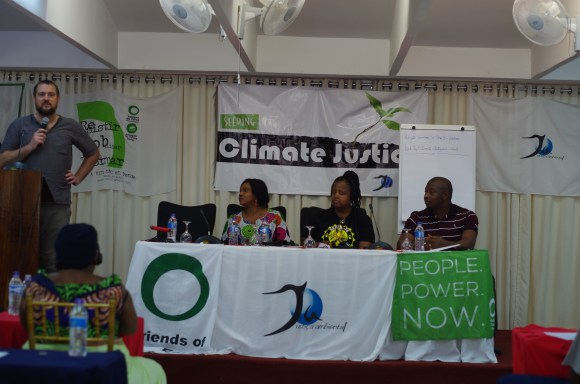
The theme for Day 2 of our Climate Justice meeting that happened last week was Dirty Energy. The topics ranged from oil and gas to coal and waste management.

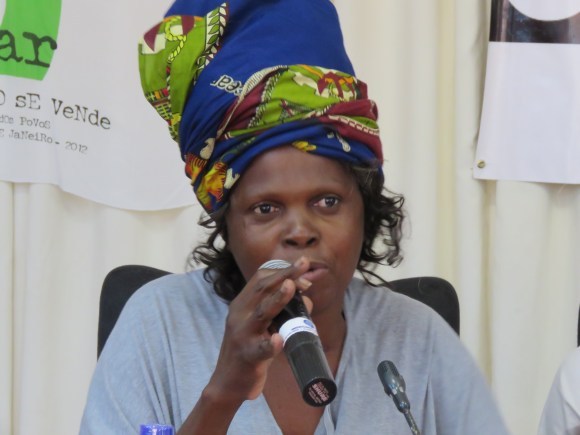
The day started with an input by Makhoma Lekalakala on the impacts of coal mines and coal-fired power stations in South Africa, but which happen around the world. These include water pollution from acid mine drainage, which continues even after the operations are over, because they are either not decommissioned or not closed properly. There is major air pollution, with nearby communities struggling with breathing. In fact, health degradation is the worst impact, and is an externality not included in the price of coal. Another issue is food insecurity, as people are displaced from their farmlands and water sources.

6

Perito Alper Tarquinho talked about the situation of coal mining in Mozambique. When companies talk to communities about new coal operations, they say that this ‘development’ will bring them direct benefits and bring money to the country and the people. But this ‘development’ actually harms people. People are not respected in the companies’ decision making processes. What is most important to them is to satisfy their shareholders.

7

Verónica da Silveira Reino took this further by giving the example of Vale who mines coal in Tete province in Mozambique. It doesn’t consult and forces community members to sign documents which will agree to their forced removals from their homes and their fertile land.

Indian company Jindal, also in Tete is operating where the community still lives.

Thomas Mnguni talked about Eskom, which knows its legal obligations but does not comply. The work they do as groundWork is to point out how Eskom, which is a state-owned entity violates our human rights, according the Bill of Rights in the South African Constitution. People deserve the right to health, land and a clean environment.

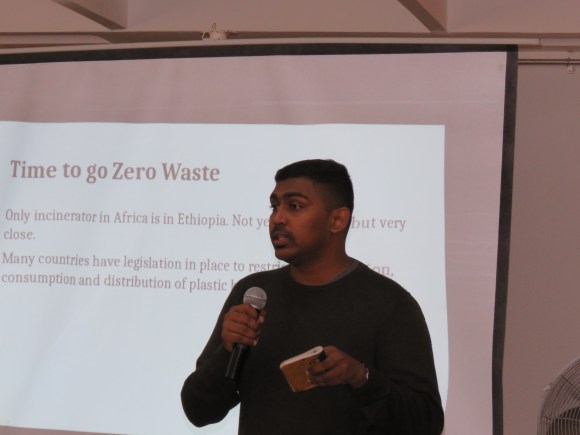
Niven Reddy explained the waste to energy system, which is the thermal treatment of waste. This enforces wasteful culture. For GAIA, burning waste is not the solution, recycling and composting is. If things can’t be re-used or recycled, they should not be produced in the first case.

8

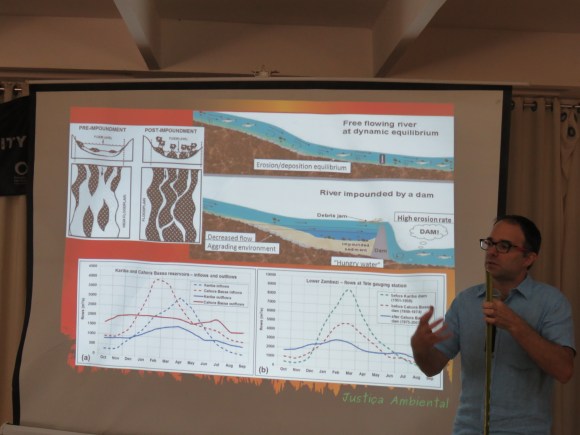
Daniel Ribeiro talked about the impacts of mega-dams. Rivers are vital for distribution of nutrients and sediments. Dams impede this cycle and aggravate erosion. 20% of river fish species were decimated due to mega-dams. 63% of all forced displacements are due to mega dams.

It’s also a water-grab, the wall of the dam is used to remove people from access to water. Mega-dams are also linked to increased seismic activity. Methane emissions are also another impacts of Dams. There are major human rights abuses against people fighting dams. Land is very central to rural communities, we must fight for it. Dams take up huge amount of land leading to loss of life, loss of culture and loss of traditional territories.

9

Greg Muttitt spoke on the global politics of oil. The most important politics of oil, he says, is the struggle against the oil industry. He spoke of three activists from history from whom he gained inspiration to fight the oil industry. The first was American journalist Ida Tarbell who wrote a book about Standard Oil in the 1800’s which led to a successful court case against the oil industry.

The second was Mohammed Mosadegh, the Prime Minister of Iran, who forced BP out of the country in the 1950’s. He who was removed from power in a coup in 1953, by the Shah who was a big supporter of BP. This brought the oil companies back and created authoritarian rule.

The third was Nigerian activist Ken Saro-Wiwa, who led a non-violent campaign against Shell and other companies in the 1980’s. In 1994, the state framed him for murder and executed him.

3

Something we keep seeing a lot through history is how companies go into a new country to drill for oil, and sign a bad deal with the government, who often does not have the same legal and financial expertise as the companies from the global North. When the oil is flowing, and the state realizes that the deal does not benefit them, it is too late.

Not only does the industry need to stop looking for more oil, it needs to stop building pipelines and terminals, and those in operation must be shut down before they run out. Solutions will not come from corporations but from social movements in the north and south. Our movements are stronger now than ever before.

Thuli Makama talked about the politics of oil in Africa and said that people often assume that if oil development happens in Africa, the profit will flow down to communities, but that is never the case. This is the nature of the beast. It is carefully engineered.

The discussions of what will happen with oil exploitation in Africa do not take place in Africa, but in European boardrooms with corporations, financial institutions and states present.

An issue is that extraction is preceded by conflict. Oil and conflict are cousins, it is most often that where you find the one you will find the other. Oil money also ends up funding armed conflict.

Another feature of oil in Africa is causes a lot of suffering at local level. In the Niger delta, oil operations kills farming, fishing and biodiversity, and the people can no longer feed themselves. African governments are captured and cannot rise against corporations.

5

Mike Karipko said that the discovery of oil in your community is a declaration of war on your community! A war on your land, your daughters, your mothers. And oil is so cheap because all the costs to the environment, land rivers and the community are externalized, as big government officials are bought over by companies. Because the companies provide the government with bribes, the tax money of the people is no longer important, so they are not listened to.

Emem Okon talked about the impact that dirty energy has on women. Whatever the impact on a community, the impact on women will be triple, like we see in the Niger Delta. Women are the lifeline in a community and any bad impacts increases the burden on women. For example, women are the farmers and providers of food and water for their families. If their farmland is taken and water is polluted, and there is no other source of livelihood, they are traumatised.

Ike Teuling spoke about the campaign by the farming community of Groningen in the Netherlands, where Shell has gas fields. The drilling regularly created tremors and earthquakes. 100,000 houses were damaged and collapsed, each of these farming families are taking Shell to court individually. These are farmers who are often uneducated having to face Shell’s lawyers every day. The state constantly says that the safety of people in Groningen is most important, but the gas drilling cannot stop because they depend on it for power.

These people have realised that compensation is not enough – if Shell compensates them for the destruction of a house but they continue to drill, their next house will also collapse. So they joined the movement against gas completely.

1

João Mosca said huge parts of corporate profits are not charged as tax, so the state doesn’t collect big amounts as revenues which could be spent on education and healthcare. Until 2016, the Mozambican economy was growing, but who actually benefited? We have a massive increasing external debt.

When companies come and promise job creation, they actually provide very few jobs, because the projects are capital intensive and not labour intensive. The jobs that are available are non-qualified positions leading to even more exploitation of labour.

Fatima Mimbire spoke on the Redistribution of Wealth and Investment in Community Development of the gas exploration in Mozambique to compensate the communities that are impacted by the gas exploration and the models of processes and regulations that needed to be installed. That the legal framework is fragile and that in reality there are many negative examples, all over the world.

Daniel Ribeiro presented on the impacts of gas in Mozambique. There are no examples in Africa that are able to escape this reality. Many impacts are difficult to predict. For example, when boats come from the other side of the world to transport gas, they come empty to carry the gas back. But they add water on the way to keep the ship stable. This brings ballast water which brings organisms not from our coast. This is a reason for the invasion of alien species int the coast.

Our bio system is already diminishing. When drilling takes place, more than 300 chemicals are released that are found to be cancer-causing, in humans, and more than 1000 which are fatal to animals and plants.

The gas industry is notorious for human rights violations. In fact, according to the UN, an increase in human rights violations is proportionate with an increase in dependancy on oil and gas.

Many countries are regarding gas as a ‘transition’ fuel to renewable energy, because they say it has less impact on climate change, because it emits less CO2 than oil. But gas emits methane which is 80% stronger than CO2 over 20 years. Apart from that, the process of exploiting gas is very difficult to control. There is a lot of leakage, and no technology currently available to solve these problems. We need to distinguish their lies from truth. When they say Mozambique will develop through gas, this is a lie. Our debts will only increase.

The discussions at the end of the presentations were intense and with many interventions arising from the participants. Unfortunately we had to end the debate, because we were already past the time and there was still the next day, full of more presentations and debates.

4

When strategy trumps ideology

Who pays the price ?

All struggles that seek to fight the immoral plagues of our societies and take humanity to a higher moral ground, are rooted in a ideology, often structured around justice, equity, solidarity, love and other beautiful values. All of us deep down know that these values are central to the existence of humanity. To be together, live along side each other and develop any sense of community, these values have to be present in some form or another, and the more central and prevalent these values are to one’s society, the more peaceful, happy and sustainable such society can become.

Many amazing justice movements are constantly fighting for this, but there is a growing trend of professionalization of movements and non profit organisations, while pushing them towards a more corporate model that better fits the zombie-like belief of free markets. The pressure to show good annual value for donor funds is reshaping how we fight these social issues and forcing the focus on short term gains at the cost of real long-term change. A large part of what is considered to be civil society is fighting these battles primarily in a strategic manner and not centering them around a moral ideology that takes society as a whole to a better place.

This is clear when we look at how we dealing with the climate crisis. The main solutions pushed by our governments are strategically centered around greed for money, in other words through markets. All over the place one hears comments that societies will not do anything unless there is a economic benefit. That you need to be able to sell it to save it, etc, etc, etc… We have seemed to accept this narrative, and by accepting this narrative we are basically saying the present day societies are not driven by moral values, but by economic incentives. That is a scary thought if you just stop and think about it for a moment. And lets no forget that victories then reinforce the values that guided the campaign and shifts society even further in that direction.

But that’s why our victories against slavery, colonialism, racism, gender inequity, and more were really important. They not only showed that these systems were wrong, but they reinforced the values of equality, equity, solidarity, etc that guided these movements and shifted our societies further in that direction. Its not easy and its always a big balancing act between ideology and strategy. Even in the biggest victories of civil society we can see the cost of strategy on ideology, and there are people that end up paying this cost, even in movements with the highest ideological values. A good example of a movement that had strong guiding ideologies and carefully considered strategies was the US civil rights movement that fought for equality and against racial segregation in the US, but even in such an amazing movement, one can find the cost of strategy and its consequences on the ideology. We can learn a lot from them…

Brown vs the Board of Education
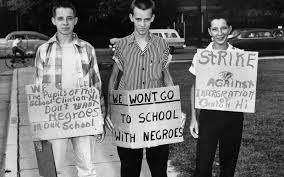
we wont go to school with negroes

A protest in the 1950s in favour of segregation! Photo courtesy: Thurgood Marshall Center Trust


The case of Brown vs the Board of Education in the 1950s is a good example to illustrate the complexity of the issue. Even though equal rights for all races had been recently achieved on paper, most southern states in the 1950s had segregated public schools, with white students going to nearby neighborhood schools, while students of colour went to a different system of schools that were sparsely spread throughout the city. These non-white schools had their own teachers, principals, headmasters and management that were also of colour.

The Brown family, who the case is named for, had a 7 year daughter called Linda who had to walk 7 blocks, often in bad weather, then cross a busy street, to get a bus across the city to be able to go to her non-white school, while a white-only school was just 4 blocks away. In light of this unjust segregation, one of the leading civil rights groups, the National Association for the Advancement of Colored People (NAACP), instructed the Brown family and 12 other black families to try to enroll in their local neighborhood white schools. As we can imagine, they were denied admission due to their race, and this served as the start of a case that finally reached the US Supreme Court and become the famous landmark victory “Brown vs the Board of Education (1954)”.

Now, if one looks into the case information, one notices a trend of setting up a notion of the inferiority of colored schools, it is even highlighted within the actually ruling:

“Segregation of white and colored children in public schools has a detrimental effect upon the colored children”;

policy of separating the races is usually interpreted as denoting the inferiority of the negro group”;

Segregation with the sanction of law, therefore, has a tendency to [retard] the educational and mental development of negro children”.

These are all excerpts from the ruling and all reinforce the notion that white schools were superior, that the segregation of schools was having severe negative effects, even retardation of colored children. This was not what the civil rights movements were saying, they were saying that segregation and racial discrimination was unjust and unconstitutional. That all should have the right to choose which school is best for them. In summary it was based on fundamental legal and moral principles, even if the quality of both white and black schools were the same.

In case you are wondering, no the colored schools were actually not inferior and were actually often better. One of the reasons for this is that highly educated people of color were forbidden to work in certain sectors and overall were discriminated by all sectors to the point that becoming a teacher in the colored school system was one of the few respectable job options, hence there were a very high number of very highly gifted, intelligent and education teachers of colour. Furthermore, the civil rights movement valued the importance of education and many gifted individuals became teachers to contribute to the education of people of colour and their political enlightenment.
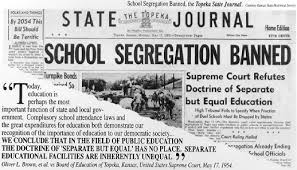
school segregation banned

A newspaper announcing the ban on school segregation, May 1954. Photo courtesy: Thurgood Marshall Center Trust


Why is all this important? The fight was to achieve equal rights for all races, and ending segregation of the education system was an important step in this process. The existing racial basis of the system (including the Court) instinctively believed that people of colour and the education systems they were running were inferior to those run by whites. This is clearly reflected in the ruling that centered around this notion and in the process reinforced these racial, immoral and incorrect views. Even after the ruling, the case was seen as a milestone, a great victory for all and is used as a example for other struggles. And it is all that, but we must not forget the cost of this strategy to allow the framing and at times even use the existing basis to increase the likelihood of victory. The notion that the colored school system were deterimental to colored students was a strategically useful notion to get white people to accept that segregation was unjust, as well as unconstitutional.

Naomi Brooks et al., Appellants, v. School District of City of Moberly, Missouri, Etc., et al

moberley photo

The Moberley case book cover. Photo courtesy: snapdeal.com


The feeding, use of or even letting these incorrect and immoral social views prevail has serious long term consequences. In the case of the Brown vs the Board of Education ruling, it set the stage for how the desegregation process was to play out. As white and colored schools started integrating, there were decisions to be made on which schools should be closed, which were the best teachers to work in these new integrated schools and of course the parents could now choose the closest and best neighborhood school for their kids. Logically, choosing the best of both systems would have produced a great new schooling system, but the ruling had already biasly defined which were the best schools, which were the best teachers and that was incorrectly deemed to be the white schools and white teachers. So almost all the black schools were closed and almost all the teachers that were fired in the process were black teachers, often with higher levels of education then their white counterparts, often with clearly better experience, teaching records and results.

Basically, in any logical, fair and measurable manner their were better qualified black teachers that were let go in favor of less qualified white teachers. What is also sad is that the best qualified black teachers were purposely let go because they were seen as a threat and challenged the notion that was the foundation of the integration process. Across the southern states their were over 82,000 teachers at the time of the Brown ruling and during the integration process almost half (40,000 teachers) were fired, and it would have been more if there were enough white teachers to deal with the larger unified schooling system.

As you can imagine, the civil rights movement didn’t let this injustice towards coloured teachers happen without a fight and in 1959 the case Naomi Brooks et al., Appellants, v. School District of City of Moberly, Missouri, Etc., et al. reached the Supreme Court’s docket, but was denied and the reasoning behind this decision is embedded with racism and prejudice. The case had such clear evidence that the judge had to find odd ways to overcome the facts, stating about one teacher that “she gave the impression that she considered herself superior to other teachers”. She was way superior in all measurable terms to the teacher that was selected in her place and no hard evidence was given to back up this statement. Another statement tries to explain the hiring patterns saying that human abilities can’t be “reduced to a mathematical formula” and with that he set the foundation for ignoring all the hard facts, data and evidence proving that the coloured teachers in question were better qualified than the white counterparts that were selected. Not to go too much into the details, but I think we all understand the patterns.

These two cases are strongly linked and highlight the difficult balance between ideology and strategy. Was the Brown case too strategic in letting the racial biases of the time help guide the ruling to victory? The cost of which the coloured teachers paid the consequences. Was the Moberly case naively ideological and not strategic enough, resulting in the loss? In truth I do not know, and I don’t have the right to criticize the amazing work done by the civil rights movement. However, I do believe that we should know and acknowledge who paid the cost of these battles. The people that paid the price of integration, for example. In this case one of the most affected and under-appreciated of them all were the amazing coloured teaches that were so central to the enlightenment of the colored youth. And let us not forget that even the teachers that did manage to keep their jobs still faced the reality of all coloured people of the time, in their case being constantly harrassed, not allowed to use the whites-only teachers room or even toilets, and much more…

To be clear, Brown vs Board of Education was really important and the US would be far more unjust today without it. But it reminds us that we must always consider and know who pays the price of some of our strategies.

I guess some of you are saying “interesting, but whats the link to us in Mozambique?”

Mozambique’s Context
moz flag

Mozambique’s flag


Well, Mozambique’s civil social is very “service provider” with a strong trend towards professionalization and donor-orientated agendas. Even the few movements we have are heading in the same direction, with the technical staffs having more and more influence over the political leadership of the movements. Most groups strategies and works shift to match funding trends, with the objectives and activities heavily focused on satisfying donor systems and interests, not the long term well-being of the people they claim to represent.

The few ideology-based organizations in Mozambique are often referred to as ‘radical’, ‘unrealistic’ “extreme’, etc…in some cases even ‘against development’, ‘unpatriotic’, foreign agents etc… The problems is that subconsciously our civil society believes that they have no power and never will, so they focus on trying to get the best out of a bad situation. Basically they are fighting for the crumbs that fall off the masters table. A good example of this has been in the Prosavana campaign. At the beginning there were more than 20 groups involved, and given the facts of the project, it was clear that the project was going to be devastating to the subsistence-based farmers in the area. Given this, the campaign “No to Prosavana” developed, but within a short time groups started stepping out of the campaign. Some because large funds were available to do work within the Prosavana process, which were clear attempts to show investors that social and environmental components were taken into consideration (green washing). Other groups started to feel the political pressure and power of the elites. Finally, some groups realized the magnitude of the project, and powers involved, causing them to believe that the project was a reality and the only aspect left was to make the best of the a bad situation and fight for the crumbs.

Of all the groups that started out in the Campaign, no one believed that the project was going to be of any good to the people. All agreed that in a ideal world the only answer to such project would be “NO!”, instead the message from many groups is ‘we must sit at the table, we must negotiate, we can humanize the Prosavana campaign’. None of those NGOs has anything to lose by this so-called ‘strategic approach’. They get paid by funders to sit at the table and be strategic. Not only are they not defending the interests of affected people who would lose their lands and livelihoods, but they are creating a false notion that Prosavana could be beneficial, with just a few tweaks.

We refused to be strategic in this case because as we know sitting at the table is to be complicit with the loss of livelihoods of thousands of subsistence farmers. One can only be strategic within a ideological framing. Being strategic without a ideological foundation makes one prone to drift and lose the long term vision that is required for any significant change. The focus on small winnable activities allows for discontent in one’s objectives, like independent bubbles that pop and leave no lasting impact. Pretty and fun, but substance none.

Even in its early phase of the “No to Prosavana” campaign one can see the benefits of a ideological approach. Originally Mozambique was seen as a country that was favorable for large scale land investment due to its corporate supportive governments and weak civil society that are very willing to sit down and green wash their investments. The “No to Prosavana” (run by just 8 groups) has managed to change this perception of landgrab investors. Mozambique is now seen as a country with risks for investors, where civil society and affected communities can cause major headaches, delays and problems for investors. Where the landgrab situation is starting to cause broad public concern and even mentioned as a possible future trigger for public uproar if not managed. One academic has even speculated that numerous investors have moved away from investing in large landgrab projects in Mozambique due to the “No to Prosavana” and its ability to expose the impacts, develop public perceptions, etc… So even if the project goes ahead the campaign has contributed to a growing vision on land rights and strengthen civil societies confidence, and its right to say NO!
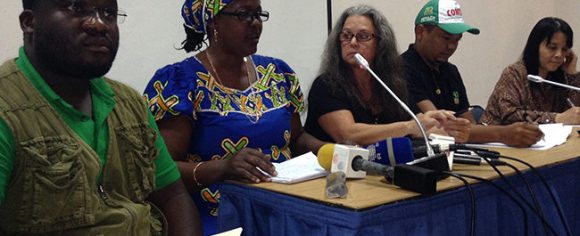
prosavana press conf

2014 press conference from the ‘No to Prosavana’ campaign


Climate change campaigning tells a similar story in Mozambique at the moment. Civil society is too happy to jump on the Paris Agreement bandwagon, celebrating it, even though it doesn’t come close to meeting what science says is needed, even though it doesn’t promote the solutions that the people have shown to be the best, even though its not legally binding and there are little to no serious consequences if countries don’t meet the targets that they set themselves with little regard for science and facts. The Paris Agreement will burn the planet and Mozambique will be one of the countries to be affected quite severely early on. Defending the Paris Agreement is a strategic approach at best (and completely delusional at worst). After emissions stabilized for last few years, they are now set to rise again (research from late 2017). The leaders are not keeping their part of the deal. Even the terribly weak deal they set themselves. Nevertheless, Mozambique civil society is happy to feed on the scraps and work in sync with donor priorities because there are significant amounts of funds; because there are winnable goals; and because that is what they believe is possible and realistic….in short, it is the strategic thing to do…

Its simple, our civil society no longer fights its struggles grounded on ideology, but is over-focused on strategy and short term gains that they try to over-inflate into victories. The Brown case shows how even small strategic actions have long term consequences, but at least they won the battle. So imagine the long term impacts of Mozambique’s current approach, and I doubt even that change can be achieved through this approach. We, civil society, have seem to accept defeat and are focusing on the crumbs. Have we even tried to understand who is going to pay the cost of all this? All struggles need to be centered around an ideology, and its on this foundation that we can be strategic. We can’t let strategy over ride the values of our ideology, even if it implies a longer path to our goals, because when we win our struggle we also bring this foundation of values into our society and not just the specific issue that sparked the struggle. Life is a struggle, and true change takes time and courage.

The monsters of today’s injustices are not going away quietly into the night. They have no morals, heart or conscious, so can’t be guided or convinced based on logic, science or basic humanity. They have an endless hunger for capital and will starve if they stop doing what they do best. They will continue to do so till they consume themselves or cause a planetary collapse. Its not the monsters fault, its the nature of the beast. How long can we live off its crumbs before all we know crumbles. Its time to end capitalism…lets kills this monster!