"Only after the last tree has been cut down, Only after the last river has been poisoned, Only after the last fish has been caught, Only then will you find that money cannot be eaten." Cree Indian Prophecy
Two week long PROTEST CONTINUES against TotalEnergies and its. Mozambique LNG gas project for RESETTLEMENT VIOLATIONS
IN Afungi Communities, Palma District, Cabo Delgado, Mozambique 15 November 2024, 12H00 CAT Justiça Ambiental!, Maputo
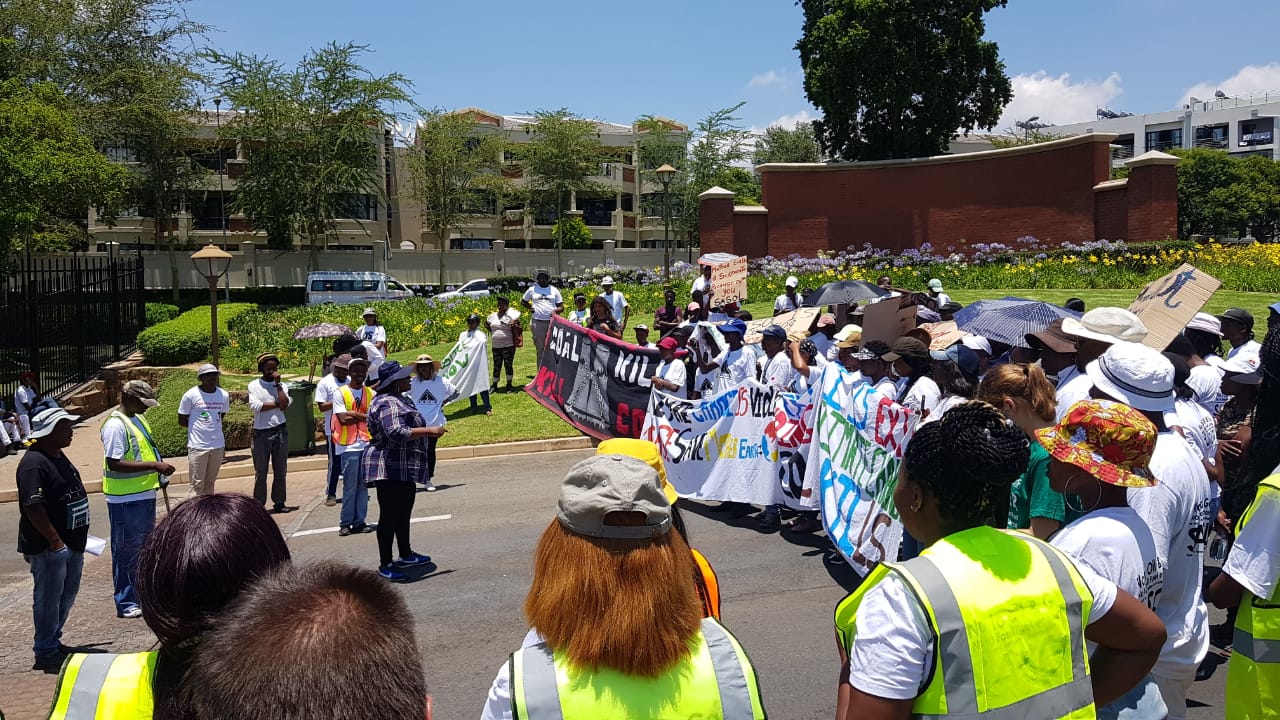
Demonstrations SHUT the gates of TotalEnergies Afungi site
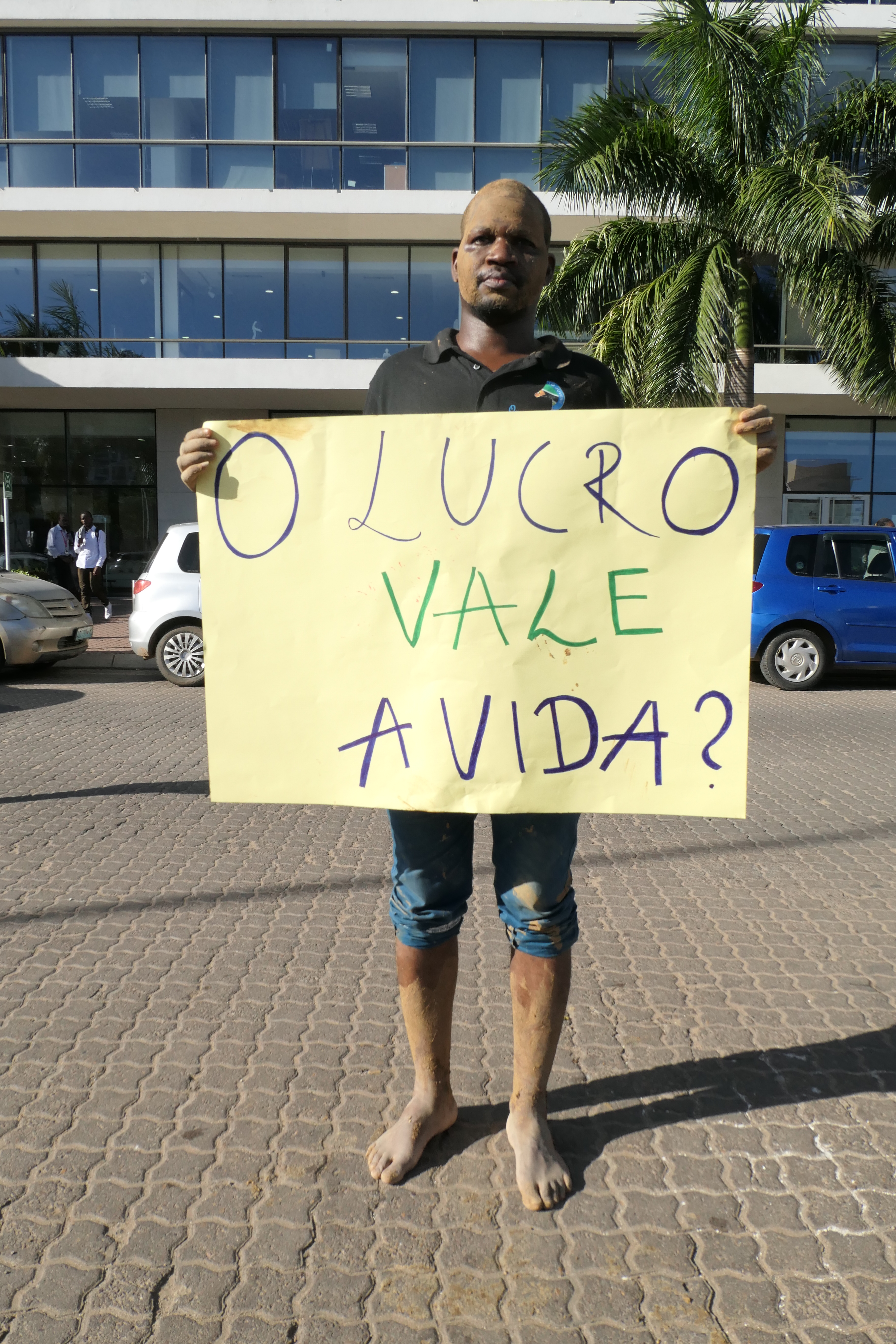
This morning, members of the Macala and Mangala Communities, have been gathering again since early light to continue their two weeks of demonstration against the violations of their land rights by Mozambique LNG gas project, operated by TotalEnergies. Yesterday’s demonstration was attended by at least 400 people. This morning, the number of demonstrators is already high and still increasing. Following yesterday’s attempts by district and provincial governments to convince them to leave the area, the situation is escalating. This morning, families from a third community, Quitunda Resettlement Village, are growing the ranks.
“tal como estamos a parar a produção de alimentos, a empresa também deve parar as suas actividades”
“just as we are stopping food production, the company should stop their activities as well”
In a context of national strikes and demonstrations aimed at demanding electoral justice, the Mozambican people are taking advantage of this moment to express their discontent at the social injustice to which they have been subjected for 50 years. A visibly tired and angry people are taking to the streets to express their indignation at a precarious health system, the poor or non-existent quality of education, a bad transport system, the increase in crime, the lack of access to employment for young people and adults, and to seek measures to end the hunger that hangs over Mozambican families, at a time when – for 20 years – natural resource exploitation projects have been the promise of a better Mozambique for all Mozambicans.
The scene in Afungi today: the demonstrators have split into four groups and obstructed movement at four of the gates to the TotalEnergies Afungi site.
The resettlement process in Afungi has been underway since 2019, with the initial plan to resettle 556 families, and since then many more families have been resettled, yet few of these families have received replacement land for fields that they can use. In addition, there are those who gave up their land for fields for resettled families’ but have not been compensated to date. These are the main groups who have been demanding their rights at the company gates.
Justiça Ambiental says: “The resettlement process has been characterised by a large number of irregularities which has caused the discontent that culminated in these demonstrations.”
The communities state their concerns relate to:
Refusal to pay compensation for the agreements signed between the project and around 445 households, relating to the occupation of land intended for families resettled in Quitunda. These agreements were signed between October 2023 and February 2024. According to clause 4.5(a) of these agreements, the affected families are obliged to cede their land and all assets on it in favour of the project within 30 days of signing these agreements.
Refusal to sign agreements for the payment of compensation for the lands that the project mapped and surveyed, belonging to 158 households in the same two communities. The mapping was carried out between October 2023 and March 2024 by the company.
The communities of Macala and Mangala have made several complaints to the project regarding these matters. In August 2024 TotalEnergies’ representatives in the resettlement area met with the affected families and informed them that the project would not pay compensation to them. This decision was made without respect or consultation with the communities, and the company did not provide a reason for the decision.
This pronouncement not only created a climate of uncertainty and despair among the members of these two communities, but has also caused major frustrations.
It is a rule established by the project in all the affected communities for the families affected to immediately suspend any activity related to agricultural production or maintenance of the affected fields. This rule aims to combat opportunism on the one hand and to ensure that the project compensates the affected properties at the time of mapping. This rule has also been complied with by the affected families.
In the Macala and Mangala communities, 445 families have signed compensation agreements and 158 affected families have not yet. All 603 families affected by the project have been banned from using their land since October 2023. This is land that the project has already used – making roads through the middle of what used to be important food fields. The demonstrators explain that the frustrations in their communities are also very much about lost time.
Community members say they consider this situation to be unfair to them and threatening to their lives, because the land occupied by the project is the only source of their survival.
In September 2024, the members of the Macala and Mangala communities wrote a letter to the Palma district government presenting these concerns and frustrations. The letter also informed the PRM (police) district command and the district administrator about the communities’ intention to hold a demonstration. The demonstrations were postponed by the district administrator, who said they were in discussion with the provincial government about the complaints.
On 2nd November 2024, Macala and Mangala community members began their demonstrations. On that day, they closed the roads that were built through their fields and put up posters explaining their discontent. This did not have a negative impact on the work and movement of the project and its contractors.
On 8th November 2024, protesters gathered at the main gate leading to the entrance to the project camp. On that day the demonstration forced the closure of the entrance and exit of the project staff and their contractors. Community members interrupted their protest only after negotiations with the District Administrator at the site.
The demonstration resumed on 11th November 2024, lasting the whole day. At the end of the day, the administrator told the demonstrators that the Governor of Cabo Delgado Province would meet them on 14 November 2024 for negotiations that could provide answers to their demands.
At the moment, 15 November 2024, the governor and the administrator are inside the TotalEnergies Afungi camp, and information about what is being discussed there will only be known when they return to the population.
There is a clear indication that the gas affected communities intend to remain at the gates. Now, we await news.
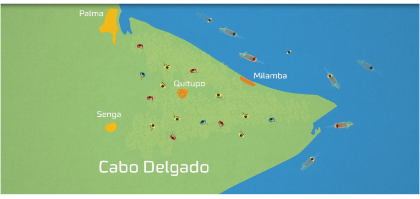
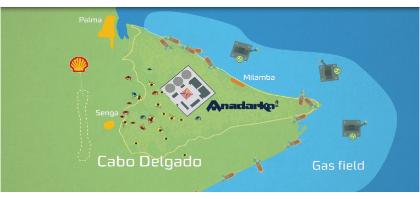
The Mozambique LNG project, operated by TotalEnergies, was allocated land rights to about 7,000 hectares of land on the Afungi Peninsula, as well as rights to coastal areas, for its infrastructure and operations, This required communities who were living and conducting their livelihoods in the area to resettle. The project is required to compensate those affected. Even though TotalEnergies declared in May 2024, that all compensations had been paid, this is evidently not the case. Testimonies from affected people can be viewed here [https://stopmozgas.org/from-the-ground/video-testimonies/]
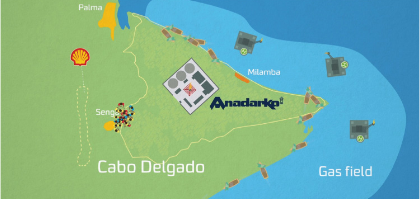
There are complaints registered in all communities affected by the project regarding the lack of housing, machambas (farmlands) and partial or lack of compensation payments. In the communities of Quitunda, Senga, Mangala, Macala, Maganja and Palma Village there are people who are yet to receive compensation or who have received part of the compensation, and others who have not signed agreements yet. Evidence is emerging of even more violations of the rights of people in relation to the project activities.
Justiça Ambiental! (JA!) / Friends of the Earth Mozambique: JA! is a civil society organisation in Mozambique that supports environmental justice at community, national and international level. JA! views the environment as an holistic concept and thus environmental justice as the act of using the environment as a vehicle for ensuring equity and equality across society. In support of sustainable development they view the concept of equality on a grand scale, and as such, values the rights of future generations to a healthy and safe environment, to the same degree that that right is valued for humanity. JA! received the Silver Rose Just Transition Award 2023 for their fight for a just transition and against fossil fuel projects and land grabs in Mozambique. In 2024, JA!’s director, Anabela Lemos is being honoured with the Right Livelihoods Award. Justiça Ambiental! (JA!) is Portuguese for Environmental Justice! and ‘ja’ means ‘now’ in Portuguese.
15 years ago, when the Mozambican government signed the contract with VALE, almost everybody in Mozambique believed that coal would develop the country. This investigation exposes part of the destruction that VALE Moçambique is preparing to leave behind now that it has announced an agreement to sell its projects to Vulcan Minerals for US $270 million.
Located in the Province of Tete, in Mozambique, the Moatize Coal Mine was officially inaugurated in May 2011. It is owned by VALE Moçambique and Mitsui Corp and it produces 11.3 million tonnes of coal per annum.
In its 2009 annual report, VALE stated that it had 1.087 million tonnes of coal resources (both proven and probable) across all its mines and projects, of which 954 million were in the Moatize mine. The report also stated that the projected depletion date of the project was 2046.
In January 2021, VALE announced plans to pull out of the project. Then, in December 2021, VALE announced it had entered into a binding agreement with Vulcan Minerals – a company that is part of the Jindal Group – to sell the Moatize coal mine and the Nacala Logistics Corridor for US$ 270 million. However, this transaction can only take place if the Government of Mozambique approves it.
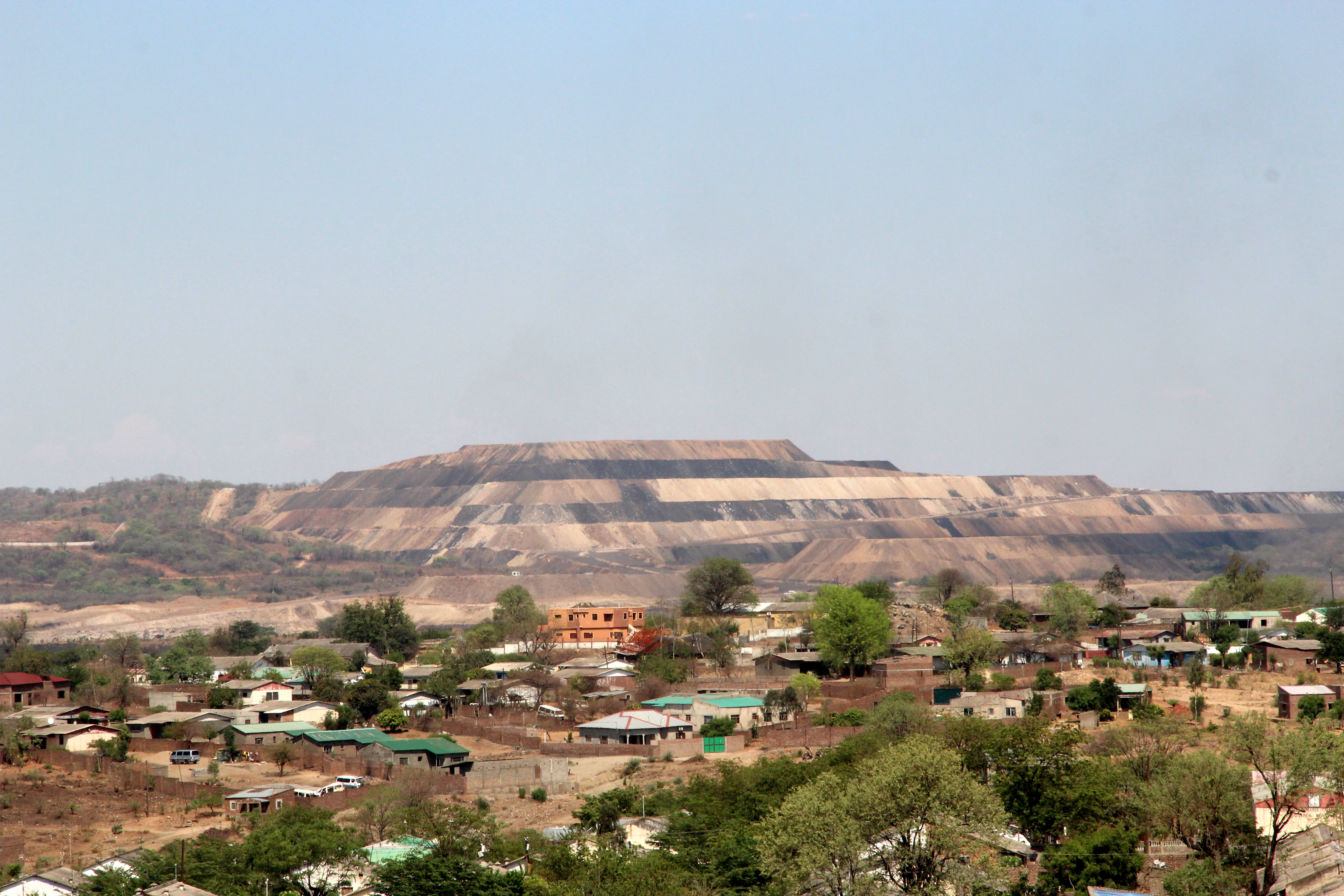
But in those brown, black concession areas held by the transnational company in the hot province of Tete, we found a troubling pattern of violence, land-grabbing and death that completely contradicts VALE’s claim of “responsibly sourced” coal.
Between 2009 and 2010, VALE resettled 1,365 families – in the Cateme and 25 de Setembro resettlements areas – in order to install the Moatize mine. Along the Nacala Corridor, an additional 2,000 families were resettled. Most of the families resettled by VALE relied on subsistence agriculture and cattle raising in order to survive.
The resettlement areas were plagued by a number of problems which have already been widely documented, such as unsafe housing (e.g. faulty infrastructure and poorly installed electrical and sewage systems), andland unsuitable for subsistence agriculture (due to bad quality of soil, no access to water and being far from markets). Although these problems have long been denounced by affected communities and various organizations at national and international level, the vast majority of them are yet to be resolved.
The Mozambican Police (PRM), including its Rapid Intervention Unit (UIR), have been “used” by VALE in several occasions. They have dispersed and repressed protesters by beating them up or shooting at them with rubber bullets and even live ammunition, and they have arbitrarily detained local brickmakers (a.k.a. oleiros) – who still seek compensation for losing their livelihoods.
To make matters worse, local journalists are being intimidated and threatened by local authorities – including the Mayor of Moatize, Carlos Portimão – and told not to report on these issues.
“If you want to report about VALE, talk with its directors, not with the locals nor with the oleiros.” – local radio directors are telling their reporters.
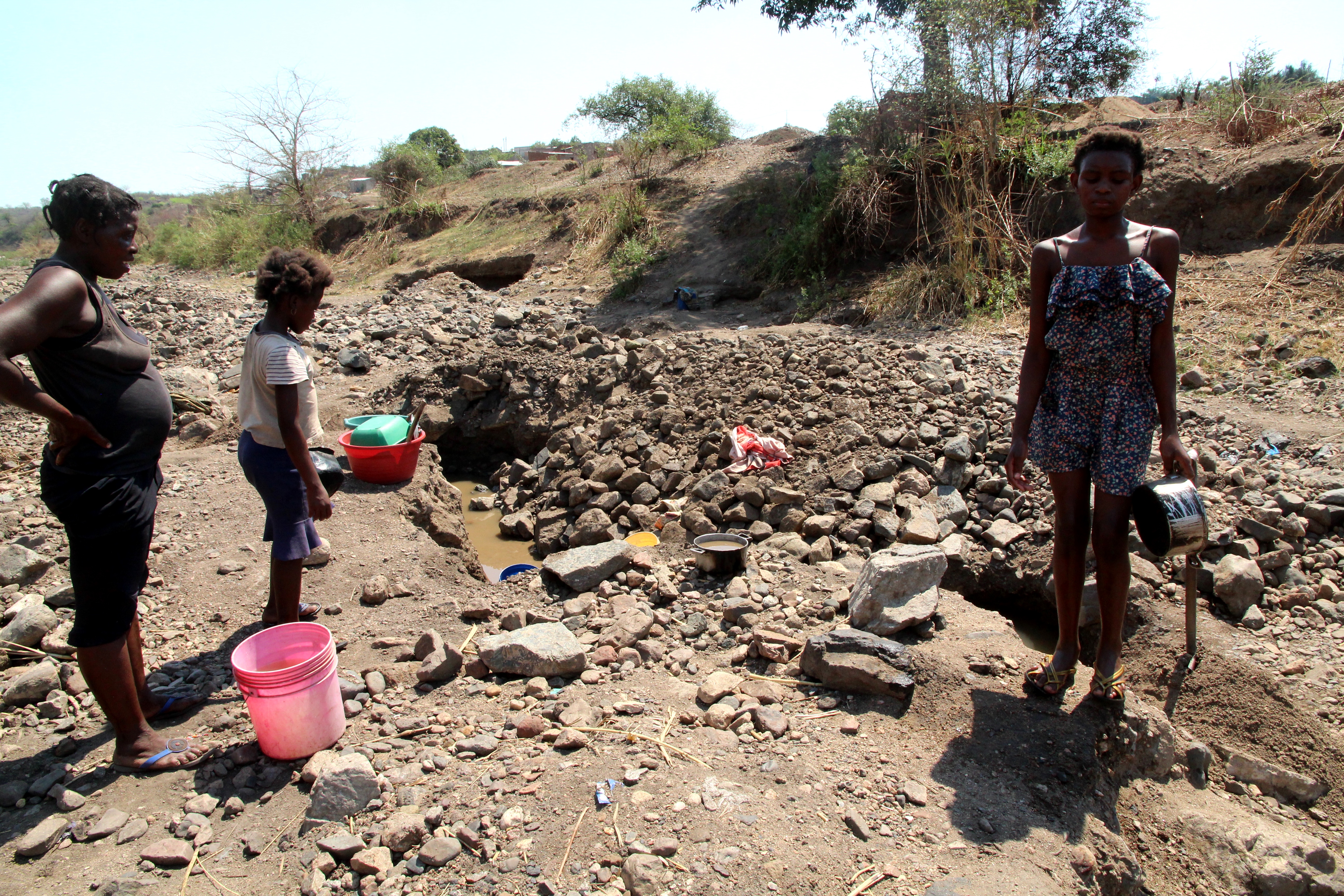
To make place for open-pit mining, the people who lived inside the concession areas were “forcefully removed” from their homes, from the small family farms that kept them fed, from the rivers that provided them with plenty of water and from the river banks where they produced clay bricks for a living. Today, “pushed” outside the fence, these people, along with tens of thousands of others who already lived in the outskirts of the mine, are facing a very harsh reality: there is no water left. The rivers that used to provide them with water for farming, cattle and other basic needs, have either been diverted to supply water to the mine, polluted or simply burried by tons of sand – a shameful and blatant violation of their human rights.
Unlike what some may think, the number of people severely affected by VALE goes way beyond those who have been resettled and the thousands of families who live in Bagamoyo, Nhantchere, Primeiro de Maio or Liberdade – the neighbourhoods that border the mine, under a permanent cloud of dust and whose inhabitants get sistematically sick from VALE’s pollution. The oleiros are a good example of a different kind of highly impacted group. Even though VALE has compensated some of those who were forced to hand over their land to the mining company, many others claim they were left out of the agreements.
In 2019, for example, when VALE started the expansion of the Moatize IIIMine, the company cut Primeiro de Maio, Liberdade and Paiol’s access to the Moatize River, affecting brickmakers and peasants from those communities. Since then, several meetings were held between the affected people, VALE and the government. More recently VALE changed the tone and started stating that no compensation is owed to any brickmakers. While this process is dragging on, more than 4,000 oleiros are having a very hard time supporting themselves and their families.
In the Province of Tete, with the abetment of the Mozambican government, roughly half a million people are currently abandoned to their fate: to live in a deadly ring of coal for (at least) 35 years.
VALE’s arrival and the communities’ downfall
Zita, a forty-some year old widow, told us she lived with her late husband Refo Agostinho – held by many as the best brickmaker in Moatize – before they were gradually forced to give their land away to VALE. Mother of four, she and her husband Refo had brick making as their main source of income. The money was used to feed their children, pay for school and cover other needs. “They all grew up supported by money from brickwork.”
In 1993, both unemployed at the time, with no one to support them and already with a daughter to raise (the eldest), Zita and Refo decided to make a life plan and thus guarantee their family’s livelihood. It was then that they began to work in pottery and brick production near the Paiol area. At first, they were generating around 30,000 Meticais (approximately US$470) per month (depending on the season). Soon, to meet demand, they had to hire workers.
“First we had five workers, then ten and then fifteen… Payment depended on the kind of work and on each worker’s results. Some workers could make 3,000 bricks a day for about 900 to 1,000 Meticais (approximately US$15). With the money from brick making we could buy curry, we were able to build our own house, we also bought a car. At home, Refo ran other businesses. With the bricks, he set up mills and he was a welder and a panel beater too. We also used our car to transport the bricks to where our clients needed them… For 20 years we developed this activity”.
Refo died of stress and grief: he had a heart attack
“Refo lost his life after things changed. VALE took everything from us. In Chipanga, where we used to make bricks, our property was large: one hectare. My machamba [farm] was elsewhere, in Canchoeiro. VALE took us out of there but they did not want to pay us compensation (for the land), nor for having us cease our activities. They would say process X had to go to position Y, but they refused to give us money, always talking but without a solution. So, they [the brickmakers] had to organise demonstrations to receive the money. When they protested, the police arrived, intimidated him and took him to jail. He stayed (in jail) for a week, then left and continued to fight until VALE compensated us. I’m not sure how much money it was, but I heard it was about 60,000 Meticais (approximately US$940).”
But the brickmaker’s life was never the same again. “After losing the land where he worked, Refo began to suffer from stomach aches and having blood pressure problems, and with that, he died. Now, I support the children and they all go to school. I depend of a single mill, which he left to us”.
Tampered community survey lists
We were in the District of Moatize when the representative of the Nhankweva brickmakers commission, Nordino Timba Chaúque, told us he was fed up with VALE’s neverending promises and unfulfilled agreements with local communities over the years. “The company is doing things the community doesn’t like.”
They started to list the brickmakers and peasants who had to be compensated in Nhankweva and other neighbourhoods in 2020, but the process is still unfinished. “A long time ago, we met with VALE to discuss these payments. The company promised us that it would pay us all – a group of 571 brickmakers – and each of us would receive 125,000 Meticais (approximately US$1960). We stopped our activities. They only paid for the trucks that took our bricks from the place they occupied to somewhere else. We were not compensated. This Wednesday, again, the company told us to come back on December 22, 2021.”
But from one Wednesday to the next, the situation remains unresolved, and now VALE says it will no longer pay any compensation to these brickmakers.
“About 500 or so people, each received 60,000 Meticais (approximately US$940) to stop their activities, but they still had to pay us 125,000 Meticais each (approximately US$1960) – the value of the compensation. At one point VALE just said that it no longer recognized us and that we are not part of the registration lists.
VALE subcontracted a company – MP – to carry out the registration. The people from that company were trained and qualified professionals. But later on – in order to stall or avoid payment – VALE told us that those lists, made by their people, had been tampered by infiltrated people from the community! VALE surveyed Chipanga in 2009. They know the job. One cannot say that there were infiltrated people from the community because there were local authorities in place: government staff, technical staff from the municipality too. So, where and how did the people infiltrate?! The entire local authorities from all the neighbourhoods followed this process” – said another brickmaker.
VALE and the government keep playing hot potato. “These are VALE’s maneuvers to avoid paying us. They are the ones who used to do the registration, but they chose MP to do this registration. So, they must have the numbers. We have 3,000 people [on our list].” – says the President of the brickmakers commission.
Former employees of MP confirm that VALE claims to have 5,000 people on its list and accuses the company’s employees of tampering with the numbers. According to them, this is but a maneuver by VALE to stall the process. “We were even expelled! They confiscated our private phones and searched them. They accused us of putting extra people on the lists in exchange for money, which is not true.”
Little to nothing has been done to address all the 2008, 2010 or 2012 pending processes and cases regarding compensations, new land allocations and social projects
Paulo Vítor Maferrano, 41 years old, from Chipanga, Moatize, claims that he too made around 30,000 Meticais (approximately US$470) per month.
“Chipanga is our area. The mining company started occupying it in 2008. In the beginning, VALE said that it would not occupy Chipanga, so people who were removed from other areas came to Chipanga to make their machambas. But suddenly, VALE started moving people out of Chipanga too, which meant they had to negotiate with those people too. 2021 is about to end and people have not been compensated yet.”
Paulo’s reality is no different from that of other brickmakers. He was also left without his machamba and without his brickworks – his main source of income. “We already tried to send the documents. We went to the government, and VALE really did say that it would not pay us. So we tried to turn to other forums. (…) VALE only started working on this specific area in May 2021, these are the new lands VALE is expanding to. Neither the company nor we know the extent of the mine concession. When VALE arrived, they said that first they were going to give us 60,000 Meticais (approximately US$940) so we would leave our fields and stop our activities immediately, and then they would give us 125,000 Meticais (approximately US$1960) in compensation. But so far, they have not given us anything.”
Police violence against brickmakers and local communities
Cases of police violence – carried out by State forces to protect the interests of the mining company – date back to the beginning of the project. People have been arrested, beaten, shot with rubber bullets and sometimes real bullets and tear gas has also been used on citizens, including on pregnant women and children.
On the 20th of November 2021, four members of the Nhantchere community, who had been representing families whose homes have cracks on the walls caused by the mine explosions, were unjustly detained and remained in prison for 3 days. Shortly afterwards, on December 23rd, two brickmakers were detained for five days during a meeting where they were debating with their community what to do about VALE’s refusal to pay compensation to the expropriated brickmakers and peasants. Community members who play leading roles in the negotiation processes with VALE tend to suffer increasing reprisals and intimidation, including arbitrary and illegal detentions.
Vasco was shot inside his own home
On the 6th of May 2021, tired of VALE’s lack of interest in resolving the compensations and payments owed to people from the Primeiro de Maio neighbourhood who lost land and access to the river, a group of brickmakers and peasants occupied Section 6 of the mine and blocked the road that grants access to it, demanding answers from the company. This demonstration ended peacefully, when brickmakers reached an agreement with representatives of VALE and the government – who went to the site – and agreed that the matter would be debated the following day with the entire community, in the neighbourhood square.
But the agreed meeting on the 7th of May 2021, in Primeiro de Maio’s square, was a ‘ambush’ set up by VALE and the local government. Representatives of VALE and the local government did not come to the site. Instead, the Police – including agents of the Rapid Intervention Unit (UIR) – showed up at the square and decided to intervene by repressing the community that was lawfully demanding its rights.
Vasco was at home. At the square, just outside his door, the population was gathering, eager to hear what the company and the government would have to say about their destroyed farms and lost lands. Neighbourhood leaderships insisted on summoning all the people in the community to await the arrival of government and VALE representatives.
“Suddenly, we realised UIR and the people were moving from one place to another. There were gunshots. They threw tear gas. People were running around, so I decided to pick up my 6 year old son from school immediately. When I got back home, we got inside the house and I shut the door. But everytime they have a meeting here at the headquarters, they come to borrow my chairs, and that day I had lent the chairs to my neighbour. So, amidst the havoc, the neighbour came to return the chairs. He knocked on the door, I peeked out the window and only saw him. I didn’t know he was accompanied by a UIR agent. I opened the door and he shot me in the stomach. No questions asked. Nothing. He just said ‘these are the agitators’ and fired the gun at me.”
Vasco was abandoned and left to die
“I was in pain. My 6-year-old son managed to take my phone out of my pocket and called his mother to inform her of the situation. His mother called a taxi driver and they managed to take me to the local hospital, but due to the serious situation I had to be urgently transferred to the city hospital [in Tete], where a doctor helped me promptly. If it hadn’t been quick, I don’t know what would have happened. I arrived unconscious and only woke up after the operation. I had a bandage around my belly, when I tried to find out I was informed that they had operated on my belly and that I had ‘dirt’ inside. They had to operate to remove it, I was in hospital for 7 days.”
Vasco had black particles inside his body – ‘dirt’. “Yes, the doctor informed me. It was because of the bullet I got in my stomach. It could even be because of the dust we inhale every day.”
Unemployed at the time, Vasco was applying for a job opening. “They called me and I was still in the hospital, but because I was in no condition to go, I asked them to give me another week, and they accepted.” Still weak from both being shot and the surgery, he was called in for the interview. At the time, with no choice, and after a long time looking for a job, he decided that, weak or not, he was going to show up at the interview. “It was sad. I was called in, and I needed to find a way to earn some money while my wound was healing. I went there but I was still unwell.”
While Vasco was in hospital, his wife sustained the family by selling cookies and other casual work from home. But since he was shot, Vasco’s health is not the same. He can’t do tasks like weeding or carrying water, and at work he has to maneuver the car using the seat belt.
“When I put on the seat belt, it goes through my belly here, and I still have stitches. I have been feeling pain whenever there are changes in temperature or when it is about to rain. The people who did this to me were not held responsible and I did not have any support. I would like to point out that the government was aware of what happened to me, and nobody came here to, at least, see how I was doing these days. So far, I have no information or response from them”.
Prosecuting VALE
At least two cases were brought up against the mining company VALE Moçambique regarding access to public interest information: one by the non-governmental organization Justiça Ambiental (JA!), and the other by the Mozambican Bar Association (OAM).
JA! demanded that “VALE’s environmental monitoring reports between 2013 and 2020 be made available, as they are public documents that should be widely known, especially by the communities that have to live with VALE’s operations on a daily basis.”
VALE claims to be a “transparent company” but denies access to documents of public interest, trying to argue in different ways against court decisions that, more than once, went Justiça Ambiental’s and OAM’s way. In the appeal filed by the mining company, VALE argues that “there is no doubt that the reports that contain the information requested by the applicant […] are of a confidential nature”.
This argument was refuted by Justiça Ambiental, who stood its ground.
Regarding case No. 26/2020, the Administrative Court – through Ruling No. 130/2020, of December 30th 2020 – gave reason to the civil society organization, concluding that “the intended information cannot be classified as confidential” since “it has to do with mining operations, namely, whether or not they are harmful to the environment” and reiterated that “the Constitution of the Republic defines the environment as a citizen’s right and determines everyone’s duties regarding this right”. Yet again, VALE appealed this decision.
OAM, in turn, asked the court to subpoena the mining company VALE Moçambique, S.A., to make available various information of public interest, including the Memorandums of Understanding and other agreements signed between the Government, VALE Moçambique and the affected communities; information regarding the total amount of taxes paid by VALE to the Mozambican State; information on ongoing resettlement processes; among others.
The Administrative Court of the City of Maputo agreed with the OAM and mandated VALE to provide the information in question. Not satisfied with this decision, VALE filed an appeal. Once the process was filed and the allegations and counter-claims presented were analyzed, the Counselor Judges of the First Chamber of the Administrative Court – through Ruling No. 119/2020, of December 15, 2020, referring to case No. 131/2020 – decided to dismiss the appeal filed by the mining company, for lack of legal basis to reverse the appealed decision, and agreed with the previous decision that condemned VALE for violating the right to information of public interest.
VALE S.A.’s posture (and VALE Moçambique is no exception) in regards to providing any relevant information of their impacts is renowned. Publicly, and in meetings, they will tell you they are keen to share any information requested by citizens and/or civil society organizations, but they never do.
In April 2021, during the General Shareholders’ Meeting of VALE S.A. in Rio de Janeiro, Brazil, some company’s shareholders voted not to approve the management report, as it omitted important information about the project in Mozambique. These shareholders also requested numerous documents of public interest, including documents requested by Mozambican civil society organizations regarding VALE Moçambique’s activities in Moatize. Senior executives of the company pledged to send the requested documents, but these promises, too, were not kept.
Despite so much reluctance to inform the general public about the real impacts of its activities, VALE strives to greenwash its image and constantly claims to be a transparent, ethical and honest company.
Continuous and systematic Human Rights violations
In Moatize, thick black clouds blanket the skies every time dynamite is blasted in the mine. The air is polluted, the surfaces are always covered with black dust, and maize flour can no longer be left to dry in the open air. The roads, used by VALE’s trucks, are a source of dust too.
There is a great lack of water, and the water that comes out of the tap is black like coal. The company closed, diverted, or polluted the rivers that fed thousands of people. Animals and plants are struggling too. The cattle were left without pasture and are surviving on garbage dumps scattered throughout the city of Moatize. Walking through the city, you may even get confused, and think that dogs are unusually large in the area, with leashes and all. But no, it’s cattle turned stray.
With the violent and almost daily explosions in the mines of Moatize, more than 1,000 houses in the neighbourhoods of Primeiro de Maio, Nhantchere, Liberdade and Bagamoyo have cracked walls, and many have already collapsed. These cracks in the houses of the mine’s neighbouring districts have become a registered trademark of the company in the area. The affected families have for years been demanding compensation for these damages and a decent resettlement in a place where they do not have to live with this situation.
The surroundings of VALE’s mine are also full of tragic stories that show the true face of their so-called “development”.
In September 2014, little Ester, from Primeiro de Maio, lost her life while playing in a hole opened by VALE. She was accidentally buried alive by a dump truck hired by the mining company. All that VALE did was to give the child’s familly 5,000 Meticais to help with the funeral expenses. In November 2020, in Cateme, a child died and four others were seriously injured while playing in their grandfather’s machamba, inside the resettlement built by VALE. The children found a buried object: an old war mine that exploded. Another tragic case concerns a group of children who were bathing in an open hole abandoned by VALE, which had been filled with water during the rainy season. Two children drowned because they didn’t know the hole was so deep. Neither the company nor the government were held responsible for any of these cases.
Open-pit mining: sky-high levels of pollution and public health endangerment
“Here, when people cough, black stuff comes out (of their throats), and the doctors say it’s mine dust. VALE, the government and a team from the hospital came to test people for a week. They saw that they had a cough, and that they were spitting out black things. Hence, the company never came here to give us an answer”, said one of the community members.
The levels of water and air pollution in Moatize put thousands of people at risk, many of them ending up in hospitals with respiratory problems, acute cough, tuberculosis. But for the mining company only profit matters. In 2021, the pollution situation in Moatize worsened.
According to laboratory analyses carried out on water (Liberdade neighbourhood) in 2021 at JA’s request, water and air pollution are three times above the national and international limits established by law. For example, Cadmium (Cd) levels of 0.009 mg/l were recorded in VALE’s concession area, while the levels considered admissible by Mozambique and the World Health Organization are 0.003 mg/l. Cadmium is a heavy metal that causes damage to the nervous system and can cause disturbances in fetal development, even in low concentrations.
According to hospital sources, most of the people treated at the Moatize Hospital are diagnosed with tuberculosis.
“Every day, here at the hospital, we receive a greater number of people who are diagnosed with tuberculosis due to the pollution caused by VALE here in Moatize. Pollution is affecting a lot of people, this company is hurting us, even I am feeling sick. I saw many people drinking dirty water from the river, the water is not coming as it used to. With Section 6, that VALE has just opened, all the dirt, chemicals that leave the mine, flow into the Moatize river, up to where the Revúboé river flows. This is just wrong.”
*This investigation was conducted in partnership with Mozambican NGO Justiça Ambiental JA!
Today, the 7 September 2021 has been exactly 17 months since Mozambican journalist Ibrahimo Abu Mbaruco disappeared in Cabo Delgado. His last message was to a colleague saying that the army was coming towards him.
Ibrahimo worked for Palma Community Radio and had been reporting on the violence in the area. Since then, what effort has the government put into finding him and bringing him back to his family? Absolutely nothing.
Since 2017 Cabo Delgado has been ravaged by a fatal conflict between insurgents, the Mozambican military, Russian and South African mercenaries and now the Rwandan and South African armies as well, that has created 800 000 refugees. This violence is deeply linked to the gas industry that has exploded over the last few years. The industry is headed by Total (France), Eni (Italy) and ExxonMobil (US), and is one industry filled with a great amount of treachery in the Mozambican and other states involved, which forms part of the corruption trial currently in the Mozambican courts.
Over the last few months several media outlets have arrived in Cabo Delgado, after at least three years of the area being closed to international journalists.
It is a good thing that Mozambican and international media has finally been allowed there, since free media is a crucial part of any democracy. However, journalists who actually live in Cabo Delgado and were the first to report on the happenings since 2017, have not been allowed to work in the conflict areas, unless they are from state-owned media outlets.
In an article in O Pais 26 August, Cabo Delgado-based journalist Hizidine Acha wrote that journalists from the area are being humiliated by having to report on the topic from a distance, even though they are the ones who know the terrain and the local language. They fear that the lack of reporting in local languages might lead to disinformation among the communities. The article quotes journalist Emanuel Muthemba as saying, “Journalists from here have to be on the front line, because we have basic knowledge about the reality of the province, the people and the languages spoken by the population, which is very important,”; and journalist Assane Issa says “speculation grows that we are not capable of doing this type of coverage – that only those from the country’s capital are. But this is not true, because we are the ones who have been reporting on the daily life of the province.”
In fact, the article continues saying that recently 20 local journalists were invited to cover the conflict, but for reasons they were never told, were never actually able to leave Cabo Delgado’s capital and largest city, Pemba.
But even if they were able to report, the government has made it clear that they will not make it easy. On 11 April, on the ‘Day of the Mozambican Journalist’, even though his general rhetoric has been about free press, President Felipe Nyusi sent a document to O Pais, saying, journalists must report with “rigour, professionalism and patriotism”. He said “the Mozambican journalist should not be a reproducer of wishes contrary to our unity.” And he followed this in May saying that journalists have to be “disciplined”: “To have discipline is to report only the truth, to combat fake news and not to incite violence and hatred.”
This is not freedom. This is a threat. This is saying that journalists have the ‘freedom’ to write or to film or to record for radio, as long as this is in aligned with the state’s narrative. Or else.
The public media and many international journalists are reporting on the violence in the province as only a humanitarian issue created by violence caused by insurgents, and not on how many of these refugees were actually already displaced from their villages, and had lost everything, because of the Afungi Liquid Natural Gas (LNG) Park that Total is building to house the support facilities for the industry. Reporting in this way allows the gas industry off the hook for the part they have played in this humanitarian crisis and conflict, including how Total has left the displaced communities who were relying on them for compensation and aid with nothing as they pulled out of the country when claiming force majeure.
International journalists are protected by having foreign passports. But who is protecting local journalists from non-state outlets, like Ibrahimo, or like Amade Abubacar from the Nacedje Community Radio who was arrested, tortured and held without charge for 3 months in 2019 after interviewing a group of displaced people? Or the journalists of Canal de Moçambique whose office was bombed in 2020 after exposing corruption between the government and gas companies?
In April 2020, Reporters Without Borders and 16 other press freedom organisations wrote an open letter to President Filipe Nyusi, who ignored it, just like the military and relevant government officials did not even bother to respond, and the police treated it like a joke. On 8 June 2020, Ibrahimo’s brother contacted the local police to inform them that he had called Ibrahimo’s phone and it rang. He reported it to the public investigators responsible for finding him, the National Agency for Criminal Investigations. They promised they would look into it, but since then there has been silence.
But we must not stop fighting!
In January, the African Union (AU) launched the Digital Platform for Safety of Journalists in Africa. At the launch, South African President Cyril Ramaphosa, who was AU chairperson at the time said: Media freedom “requires that we rigorously defend the right of journalists to do their work, to write, to publish, and to also broadcast what they like, even if we disagree with some or all of it.. The digital platform for the safety of journalists in Africa is an important tool in promoting the safety of journalists and other media workers across Africa.”
Now they must put their money where their mouth is, by holding the Mozambican government accountable for its violent media oppression and pressurise it to stop, and they must recognise how part of this oppression is to protect the gas industry. The platform was supported by the United Nations, and both they and the AU have the responsibility to find out what has happened to Ibrahimo, and must use their power to do so.
It is clear that Mozambican journalists cannot rely on their state for their protection – the very people who are obliged to protect them, but sadly are reliant rather on non-governmental organisations and media groups – both international, and local, who themselves are putting their safety on the line just by speaking out. When journalists are told they need to report with “patriotism” and “discipline”, it is clear that, just as history has shown, they cannot know that they are safe. They cannot know their colleagues will not be arrested and tortured or that their offices won’t be attacked. They cannot know that they, too, will not disappear and be another Ibrahimo.
We must not stop pushing to find out, where is Ibrahimo?
Our Say No to Gas! In Mozambique Campaign has many elements, but one of the crucial ones is confronting fossil fuel criminals involved in Mozambique’s gas industry, about the destruction, violence and devastation they have caused in Cabo Delgado province.
One way of challenging them and making demands for them to leave and stop their involvement in Mozambique gas, is attending Annual General Meetings (AGM) of several large international players in the Mozambique gas industry, which this year we did for the fourth year running. Attending these AGMs is a way to force the highest level decision-makers in these companies to hear our voices and the voices of the people whose lives they are devastating, to demand information and call them out on their crimes against the climate and peoples in a large public forum that includes their shareholders and employees. It is a way to prevent them from saying “we didn’t know” about the impacts – even though taking active measures to identify potential risks of human rights violations is part of their responsibilities. There is often media at the AGMs of the large companies, giving us another opportunity to bring to the international public the issue of Mozambique gas and the violence and destruction being perpetrated by those who profit from it tremendously.
With the Covid-19 pandemic still raging, most of the AGMs were held online.
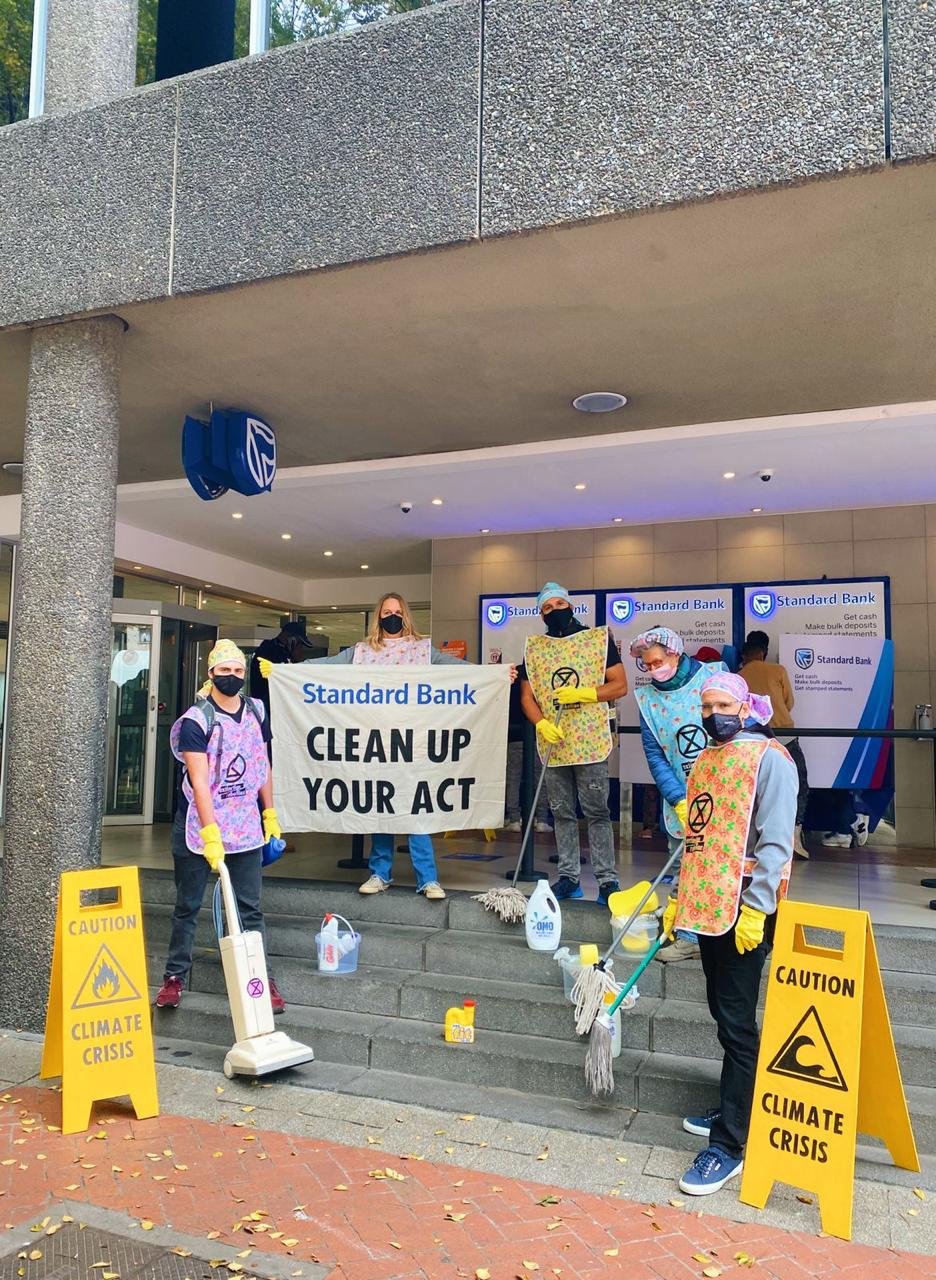
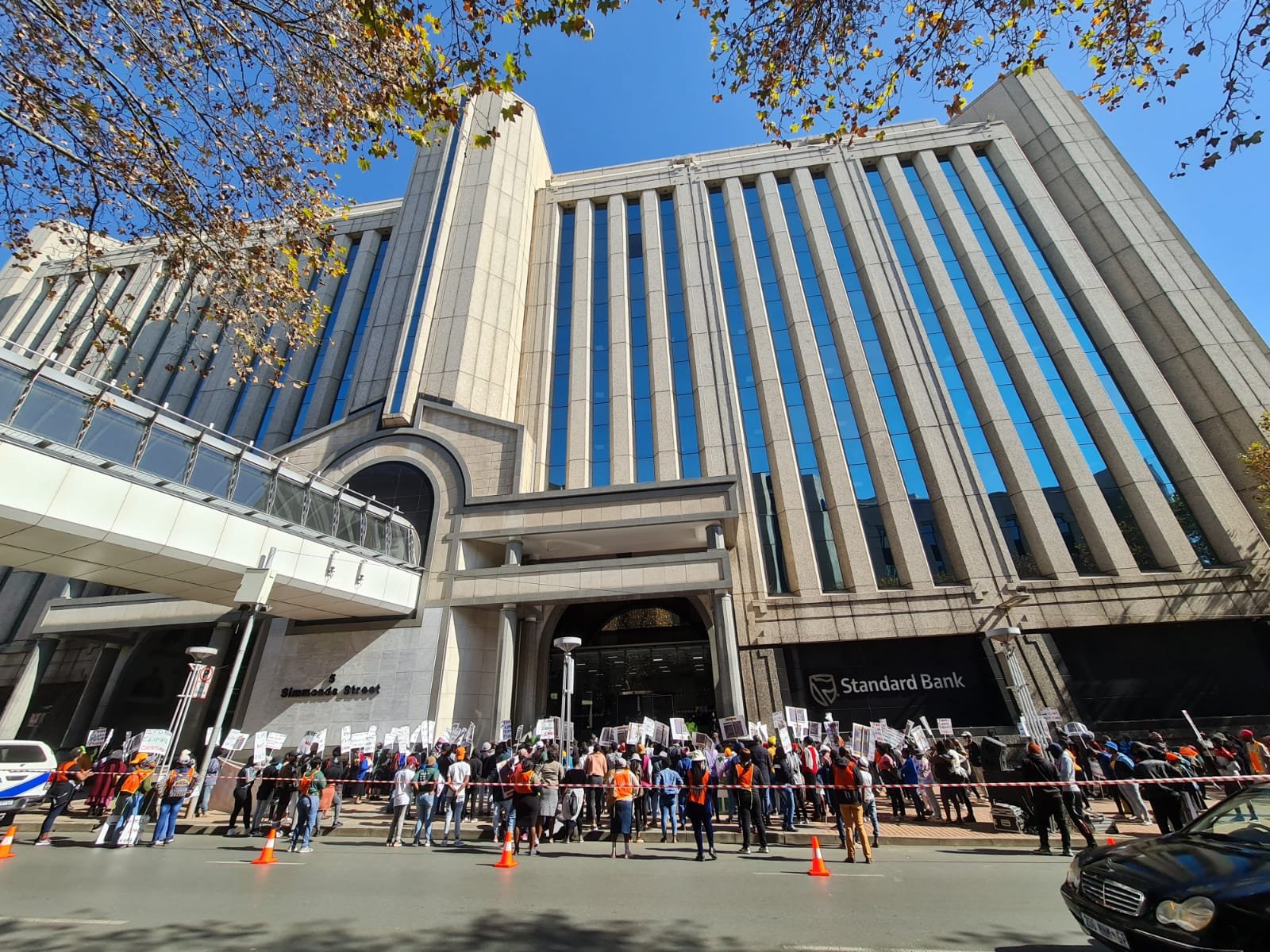
The AGMs we attended were of Eni (Italy) which is co-leading the Coral Liquid Natural gas project with ExxonMobil; Total (France) which is leading the Mozambique LNG Project; Shell (Netherlands), who was previously involved; Standard Bank (South Africa), one of the major financiers; and HSBC (UK), another massive financier. While there are some questions specific to each company, many of them are standard. This is because, while Eni, Total and ExxonMobil may be the companies leading the actual gas extraction and responsible for constructing the offshore and onshore facilities, every player involved in the Mozambique gas industry is to some degree responsible for the negative human rights, climate, environmental and socio-economic violations and impacts it has created. Companies and governments involved often try to wriggle out of their responsibilities and accountability by claiming that they are not ‘directly’ responsible for the impacts. This is utter nonsense – without financiers, contractors or confirmed purchasers, the Mozambique gas industry would not exist.
We demand to know why they continue to invest or operate in Cabo Delgado considering the horrific violence and conflict that has been taking place for years between insurgents, the military and private security companies, in which thousands of civilians have been killed and over 800 000 people displaced. We want them to recognise that they have directly created suffering and deeper impoverishment for the communities affected by the project, who have lost their homes and livelihoods, and received no decent jobs; and we ask what is their plan to make reparations. We want them to provide transparent information, something lacking in an industry which is so opaque and secretive.
Eni insists they are ‘providing support to the basic needs of local populations’, even when we tell them that the only jobs Mozambicans have received have been menial and unskilled. They say that a mere 370 permanent jobs will be available in total over the life cycle of the Coral LNG project, although they don’t say if these will actually go to Mozambicans.
All companies refuse to see a link between the gas industry and the violence, with Eni even saying they see no risk whatsoever, and denying any human rights violation by the military, even though this had been exposed in mainstream media and international human rights organisations’ reports.
Total, which claimed force majeure in April 2021 due to the violence, putting the Mozambique LNG project on hold indefinitely, made the contradictory remark that the safety and well-being of communities was a priority, but at the same time, “our mission is to protect the interests of Total’s shareholders and our partners”. These are obviously mutually exclusive, as continuing with the project will only continue the violence and dispossession that communities are facing. While they insist that the Mozambique LNG project has not been “abandoned”, they put the responsibility of the impacts on communities solely on the Mozambican government.
Standard Bank also believes that their investments are not at risk because of the violence. Even as people in Cabo Delgado are being killed every week, they carry on with business as usual, as though the militarisation and its accompanying human rights violations creating refugees and forcing displacement, do not matter to them at all. Clearly, even though they use an undisclosed “consortium” of civil society organisations in Cabo Delgado to do “monitoring”, the lives of the rural affected peoples means nothing to them.
HSBC on the other hand, just refused to answer the questions, except to say they cannot talk about private clients and very few jobs will go to Mozambicans because of the project’s “advanced technical requirements”.
Company AGMs can be very frustrating events. Directors often dodge questions or answer them insufficiently on purpose, or just pretend they didn’t hear them at all. But this year, as with most, these experiences and actions are more than confronting fossil fuel companies and financiers, they also strengthen civil society’s collective struggle against fossil fuels and the impunity of transnational corporations.
We use these as opportunities to work with other regional and international organisations and movements who are fighting against the same company or projects for crimes they are committing in the different countries. As partners, we support each other in asking questions, gaining access, publicising on social media and holding protests, and use the opportunity to exchange with each other about the different ways we are campaigning against the same culprits. When we attend as a group, our presence is powerful. As a team, we have more numbers and confidence in our actions inside and outside AGMs, more access to media and more impact if we choose to cause any disruption. If these companies do not want to take the time to talk to us and our comrades, this is a way for us to force them to listen. The strongest outcome of attending AGMs is that we are saying clearly, with a collective voice ‘we are watching you and we are not going away’, while we demand that they leave and stop their profit-mongering activities that are killing peoples and the planet.
24 February 2020: Climate justice organisations today release a new report: Chasing Carbon Unicorns: The deception of carbon markets and “net zero”.
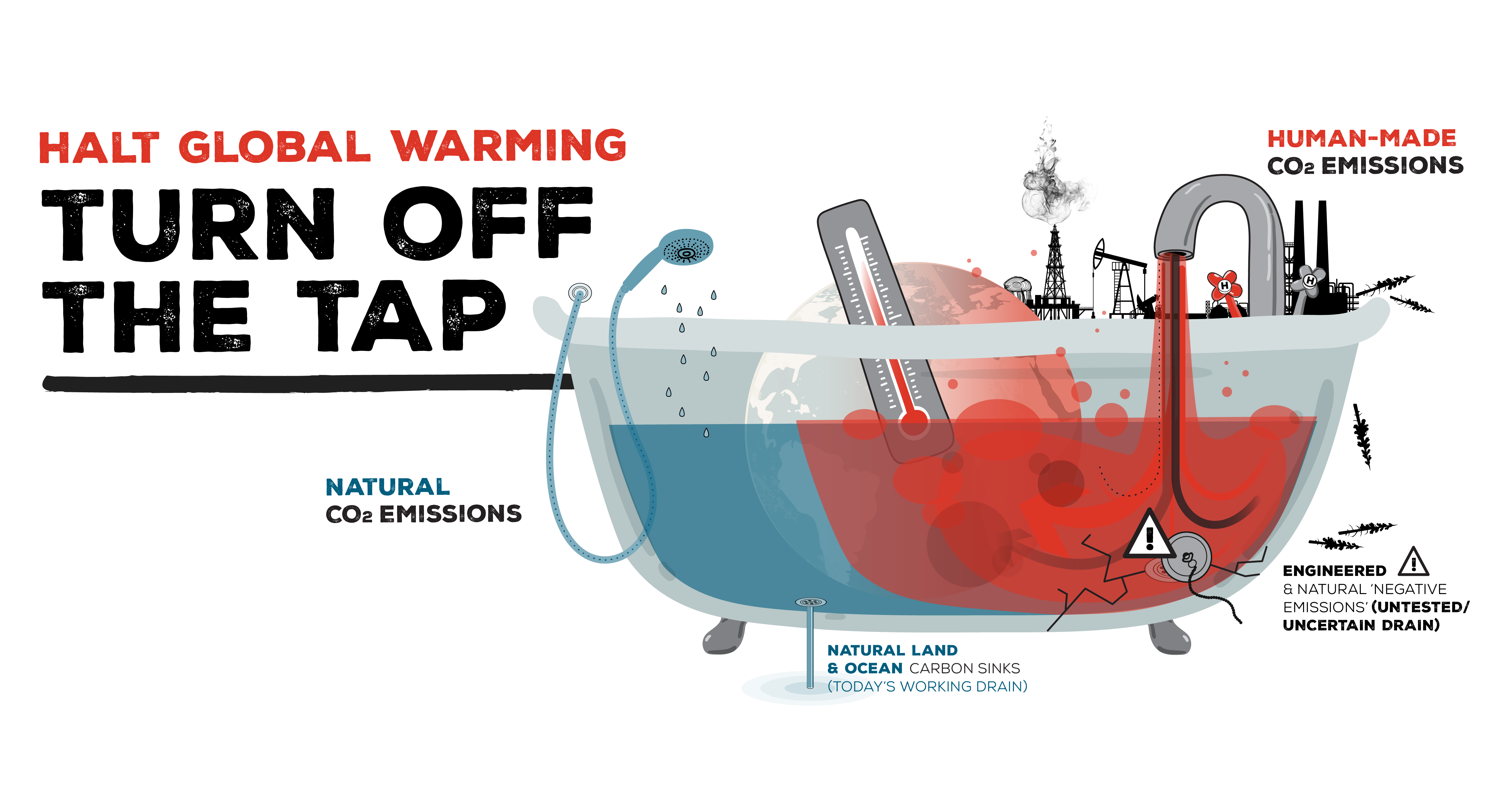
In the lead up to delayed COP26 climate talks in the UK, and as big polluters continue to expand fossil fuel exploitation, this report unpacks the science behind carbon offsetting and reveals how “net zero” pledges will never solve the climate crisis.
Powerful actors are using “net zero” pledges to hide their climate inaction. Stopping the climate crisis requires us to stop burning fossil fuels – no magical thinking will solve this problem, just immediate action and system change. But transnational corporations and governments are hiding behind the “net” in “net zero” – claiming that they just need to pay someone else to remove carbon, through carbon offsetting, rather than taking action on their own.
This report unpacks the science behind “net zero” claims and how they are used to obscure climate inaction. It explores the new strategies to expand carbon offset markets, linked with new “net zero” demand for offsets. It also explains the roles played by various actors involved in the effort to “make offsetting great again”. These include less obvious players such as a few large mainstream conservation organisations, as well as the more obvious ones: the banks, the finance industry, and corporate interests behind maintaining the status quo of fossil fuel production and consumption.
Report published by Friends of the Earth International, La Via Campesina, Indigenous Environmental Network, Corporate Accountability, Asian Peoples’ Movement on Debt and Development, Third World Network, Grassroots Global Justice Alliance, Climate Justice Alliance and Justiça Ambiental.
Historic process continues at the UN: States resume substantive negotiations on the text for a binding treaty on transnational corporations with respect to human rights
28 October 2020, Geneva:
Amidst the challenges of the Covid-19 pandemic, the United Nations (UN) Open Ended Inter-governmental Working Group (OEIGWG) enters its sixth round of negotiations on a treaty on “transnational corporations and other business enterprises with respect to human rights,”1 from 26 -30 October. UN member states will negotiate a second revised draft of this groundbreaking treaty, which aims to elaborate an international legally binding instrument to regulate, in international human rights law, the activities of transnational corporations.
Interest in the process continues to grow as evidenced by the significant presence of UN member state delegates taking part in negotiations.
The Global Interparliamentarian Network (GIN) has issued a statement in support of the UN Binding Treaty urging “states to actively engage in this UN process and to work towards an effective and legally binding instrument, to ensure that people´s dignity enshrined by universal political, economic, social and cultural rights, is prioritised and guaranteed worldwide over private profits.”2
Mayors and City Council Members of cities including Barcelona, Strasbourg and, Paris have issued a call to local authorities around the world to support the UN Binding Treaty on Transnational Corporations and Human Rights.3
The continued presence each year since 2015 – the start of this process – of hundreds of representatives from affected communities, civil society organisations, trade unions and social movements makes it one of the most strongly supported in the story of the OEIGWG. This year, however, due to COVID19 restrictions, physical presence in Geneva is limited, although remote participation has been enabled through various online platforms. In this context, the Global Campaign to Reclaim Peoples Sovereignty, Dismantle Corporate Power and Stop Impunity (Global Campaign)4 together with the GIN hosted a virtual Press Conference (full recording here) with high level political and civil society actors.
Leïla Chaibi, Member of the European Parliament, France insoumise (GUE/NGL) remarked :
“Today there is no Binding International Treaty that protects people, but there are treaties that protect the investments of large corporations. Thanks to initiatives such as the Toxic Tour, I was able to see how these companies destroy health and communities in Mexico. The EU has had no problem signing free trade agreements with third countries and this is deeply unfair. Along with many of my deputies, we continue to ask that we cannot put ourselves in the sidelines in the face of these human rights violations by transnational corporations.”
Charles Santiago.Member of the Malaysian Parliament. Chairperson of ASEAN Parliamentarians for Human Rights stated:
“At present, 43 million people have been infected by the Corona virus and more than one million have died. It is a catastrophe. Developing a Covid-19 vaccine is critical and has to be a global public good. Prices and profits need to be regulated. Intellectual Property Rights (IPR) provisions in the Trade-Related Aspects of Intellectual Property Rights (TRIPS) agreement need to be suspended to allow patent production of generic and bio similar products.
Transnational corporations (TNCs) and rich countries are refusing to suspend IPR provisions because, they claim, it would undermine patent protection. A global mechanism must be developed to regulate big pharmaceuticals on prices, profits and IPR. Transnational corporations’ ‘business as usual approach’ which prioritises profit during a global pandemic is not politically sustainable. The UN Binding Treaty is the best place to reset and enhance accountability of TNCs.”
Dr. Manoela Carneiro Roland. HOMA’s Coordinator (Human Rights and Business Center) Prof Federal University of Juiz de Fora, Brazil stated:
“We must regulate transnational corporations. This implies establishing direct obligations for them. Transnational companies already have rights established in the 3,000 plus signed investment agreements. We need to transform the paradigm of due diligence because it is a framework that erroneously leaves the task of self-monitoring to companies. We must establish effective control mechanisms, such as an International Court that has competence to judge transnational companies.”
Keamogetswe Seipato.Coordinator of the Southern African Campaign to Dismantle Corporate Power. Alternative Information & Development Center (AIDC), South Africa. claimed:
“We have to reduce or limit the power of companies. The African continent is a breeding ground for human rights violations. The primacy of human rights must be respected. It is a question of underlining the need for companies to be accountable because they cannot come to our countries to expand and neglect the main Human Rights Conventions. We must remember that the UN Binding Treaty must be a mechanism to help communities access redress for human rights violations – one that provides both the assistance and support affected people need.”
(1) This mandate is a result of resolution 26/9 adopted by the Human Rights Council in 2014. Official page: https://www.ohchr.org/en/
(2) Global Interparliamentarian Network in support of the UN Binding Treaty is formed by more than 300 members of parliaments from all over the world. https://bindingtreaty.org
Gas in Mozambique: A Windfall for the Industry, a Curse for the Country
Today JA!, Friends of the Earth France and Friends of the Earth International have released a report which exposes deep French involvement in the gas industry in Mozambique. The report, entitled Gas in Mozambique: A Windfall for the Industry, a Curse for the Country, details how the French government, its banks and corporations are part of a web of state corruption, arms deals, human rights violations and economic diplomacy, all in the interests of a $60 billion industry that has left destruction in its wake before a single drop of liquid natural gas has even been extracted.
The report shows how the French State, major private banks including BNP Paribas, Société Générale and Crédit Agricole, and fossil fuel giant Total, are some of the greatest beneficiaries of the devastating impacts of the industry in the northern province of Cabo Delgado.
JA! works closely with local communities directly facing these impacts on a daily basis. We have seen entire villages uprooted from their homes, fisherpeople moved many kilometres from the coast, and their struggle and heartbreak at losing the land and sea that has been their livelihood for generations.
We have been present with them as they try to speak up in meetings where Total brings the news of their coming difficulties and losses, but have their voices suppressed. They have told us of their nightmarish fear of insurgents who have terrorised the region with violent and fatal attacks, and of the heavy-handedness of the military that has been deployed to protect the industry.
The report includes detailed and up-to-date information from the ground, and divulges the depths to which the French public authorities have gone to ensure their economy, bankers, fossil fuel and arms industry are the greatest profiteers of the gas exploitation, even it it means devastation of the local environment, lives, economy and climate.
With this report, JA!, Friends of the Earth France and Friends of the Earth International call for the French state, banks and fossil fuel companies to withdraw from their involvement in Mozambique, stop the country’s dependence on fossil fuels and cease corrupt diplomatic dealings which are leaving the Mozambican people, and the planet, in a state of hardship and chaos.
“France is determined to ensure that this gas windfall benefits first and foremost its own transnational corporations, even if this means sowing chaos for Mozambique and setting off a climate bomb equivalent to seven times France’s annual greenhouse gas emissions. Neither the French government, nor Total and its bankers, seem concerned about the impacts this will have in fuelling climate crisis, local conflict, corruption and human rights violations.”— Cécile Marchand, Climate and Corporate Justice Campaigner at Friends of the Earth France
“The fossil fuel industry is peddling a lie that gas can be part of the clean energy transition. In reality, this so-called transition in Mozambique has meant a shift from freedom to human rights violations, from peace to conflict, from communities living well through farming and fishing to starving populations deprived of their livelihoods. The gas rush, which is exacerbating the climate crisis and benefiting only transnational corporations and corrupt elites, must stop.”— Anabela Lemos, Director of Justiça Ambiental (JA!)/Friends of the Earth Mozambique
JA!’s friends in Portugal contest the AGM of Galp Energia, part of the destructive gas industry in Cabo Delgado
Cabo Delgado, the northernmost province of Mozambique is being ripped apart by the gas industry. Companies like Galp, who are part of the industry are taking homes, land and livelihoods from people who have lived, farmed and fished there for generations. And now, the gas industry has brought the disastrous COVID-19 pandemic to Cabo Delgado province, in Mozambique, and it is the people, and surrounding communities who will suffer.
Last week, Portuguese company Galp Energia held its Annual General Meeting (AGM), and JA!’s friends in Portugal created a tremendous online direct action that brought over 400 people together. This is just the beginning of what will clearly be a fierce and powerful fight: Galp Must Fall!
JA! is part of the No to Gas campaign! in Mozambique campaign that is targeting Galp as one of the companies involved in the devastating liquid natural gas industry in Cabo Delgado in the north of Mozambique, where multinational fossil fuel giants like Eni, Exxon and Total are committing human rights and environmental violations, and irreversibly damaging the climate to extract gas. Galp owns 10% of Coral LNG, one of these projects.
The action was created by Climaximo, a Lisbon-based organisation working on climate justice, just transition and energy democracy; 2degrees artivism, a Lisbon-based artivist collective; and Greve Climática Estudantil, Portugal’s Fridays for Future hub. JA! Has been working closely with Climaximo leading up to this action.
As part of Galp Must Fall, three Climaximo activists took part in the AGM and asked questions directly to the board of executives. And while this was happening, more than 400 people were watching a live show with real-time concerts, talks and an online demonstration.
Sinan Eden, a Climaximo activist and one organiser of the action, said “Galp Must Fall is an action that had various elements. It was online and offline, inside and outside the AGM, in connection with national and international struggles, with activist and artivist elements.
We consider Galp’s AGM as a crime scene and the global fossil fuel industry as international organized crime against humanity. So our approach was to denounce the social and climate injustices of Galp in all spaces available.”
This year, like most AGM’s around the world, the COVID-19 pandemic lockdown meant that the AGM was virtual, and shareholders had to stream in. This meant that the CEO or Chairman could cut off a shareholder with a click of a button, so the activists had to ask very succinct questions. The three activists who attended had to submit questions in writing, which the board then screened before asking it to the CEO.
Sinan points out that, “In Portugal, the tactics of entering in AGMs was nonexistent so far in the social movements in general. Climáximo’s theory of change informs us that a dialogue with the industry would not produce real solutions, so our approach inside the AGM was more contesting and denouncing than debating.”
Activists inside the AGM:
The Climaximo activists asked questions (they should have been four, but Galp blocked the fourth at the last minute claiming some administrative issues). They submitted 15 questions, mostly about Mozambique, which JA! Had worked with them on. They received 5 responses from the board, which were very evasive and vague, repeating the usual rhetoric about Galp’s commitment to economic development in Mozambique, as they claim to do in every country in the global South where they have projects.
One of the activists who was part of the AGM, Manuel Araujo, described his experience at the AGM: “We asked about the ongoing climate crisis and their criminal business model of resource and social extractivism, which they answered by repeating their commitment to natural gas as a transition fuel, even though it is known to be a major source of GHG emissions. Predictably, they had no comment on the compatibility of their planned 50% increase in fossil fuel extraction over the next ten years with the emissions goals set in the Paris agreement.”
Manuel says the CEO, Carlos Gomes da Silva, made a particularly absurd argument, comparing the hypothetical emissions cuts obtained by replacing every car by an electric car (3.5%) with those obtained by replacing coal with gas in electricity generation (15%), as if these were the only two alternatives on the table.
They also asked what is usually the most uncomfortable question for executives – Why does the board and other top level executives earn absurdly high salaries and why do shareholders receive a ridiculous € 580 million, when this money could be better spent on a program of just transition for the company’s workers.
In 2019, da Silva received € 1.8 million in remuneration. The salaries to the board in total was € 6.6 million, half of which were bonuses.
Manuel says: “We got only evasive answers, but it was worth it to hear the President of the GM Board ask the Company Secretary what makes it legitimate for the CEO of Galp to earn 197 times the minimum wage.”
Ines Teles, who also asked a question, took this away from her experience: “During the AGM, the management of Galp revealed once again their profound disregard for questions related to climate and social justice. They are unable to see past the profits they reap from the sea of destruction they cause, proudly distributing their dividends amongst themselves.”
Galp Must Fall Live
While this was happening, “outside” the AGM, 400 people took part in the other component of the Galp Must Fall direct action, which included a twitter storm, live interviews with activists, including from JA!, an online demonstration, and the shareholder questions also streamed live.
Part of this action was Galp Must Fall Live – a live show, via instagram, convening emergent artists and long-standing activists from countries that Galp is co2lonizing: Mozambique, Brazil, Guinea-Bissau and Cape Verde.
The organization of this live event was made possible by 2degrees artivism, and Greve Climática Estudantil.
Diogo Silva, one of the organisers of the action from 2degrees artivism, and believes that art is crucial for revolution says: “This event marked a lot of firsts in Portugal: the first time Portuguese activists stormed Galp shareholder meeting; the first direct action involving mostly online means; the first fully-online live artivist action; and the first online demonstration.”
From here on, our goal as an artivist community based in Portugal is to build stronger links, to empower each-other and to mobilize a new generation of artivism for climate justice. Another world is possible and it’s not our revolution if art is not involved”.
This action and this year’s AGM was the first that the No to Gas! Campaign and JA! Has confronted Galp and built awareness specifically about this company. The amount of attention and support that Galp Must Fall received was very inspiring, the social media following was great, this was is a strong beginning to what is clearly going to be a powerful collective campaign. Next year will be even stronger.
We will certainly be updating all of you, our friends on what comes next in the Galp Must Fall campaign.
Sinan says: “I’d like to be clear about one thing: We must dismantle Galp, because if it instead collapses, we all will be underneath its ruins. Galp must be dismantled by a democratic, planned and deliberate process. A rapid and just transition and climate justice based on global solidarity are only possible through a publicly owned, democratically controlled, 100% renewable energy sector.”
And lastly, some words from Daniel Ribeiro, of JA!:
“Galp is planning to make millions in Mozambique, at the cost of grabbing land from peasant communities and sea access of fisherfolk, loss of their livelihoods, human rights abuses and conflict. Galp’s investment is also serving as an amplifier of the country’s corruption, injustices and even assassinations of activists and journalists. Galp must stop, Galp must fall, if they do not want the blood of those crimes on their hands. They must start putting people before profits.”
Over the last month, JA! has been confronting South African energy company Sasol in several ways, interrogating them on what they’re really getting up to in Mozambique.
Most recently, last week JA! attended the Sasol 2019 Annual General Meeting (AGM) in Johannesburg, along with four other civil society organisations, to question the board and inform shareholders about what the company is currently doing, and planning to do, in Mozambique.
Leading up to the AGM, JA! sent the company questions to understand the technicalities of their present and future projects, followed by a meeting with five vice presidents at their headquarters in Johannesburg, with the support of a fellow activist from partner organisation groundWork.
JA! raised two issues at the AGM:
The first was about the Pande and Temane gas fields in Inhambane that Sasol has been operating since 2006 after removing many community members from their homes and creating only 300 permanent jobs. Sasol has been accused of transfer pricing in this operation – Sasol Petroleum International (now Sasol Africa) is the sole purchaser of the gas extracted here by its wholly-owned subsidiary Sasol Petroleum Temane, which it buys at a tiny percentage of the market value.
The second question was about Sasol’s planned shallow-water drilling off the coast of Vilankulos, also in Inhambane. The drilling will destructively affect fishing communities, endangered species of animals and plants, and the tourism industry, a huge income generator for the province. Accompanying JA! Was a member of the Protect Bazaruto Campaign, which is working to stop the project.
Here are the questions asked by JA!:
“1. The first subject is the Pande and Temane project in Inhambane.
To give context, Sasol has regularly insisted that the fields have brought benefits to the surrounding communities since operations began in 2006. However, setting aside schools and soccer fields, the rate of literacy and employment has increased only in line with the rest of the country, including those provinces without extractive industries. Furthermore, 12 years later, according to the World Bank, only 25% of the population of Inhambane has access to electricity, which is lessthan the country as a whole, at 27%.
When communities were relocated from their homes in 2006, they were given once- off compensation of R 12 000. I emphasise, R 12 000. However, Sasol signed a Power Purchase Agreement (PPA) with the government which promises annual benefits to the people. Note that this amount is a mere 2.75% of the 6% production tax that the company pays to the government.
JA! questions are:
Why has Sasol not paid the annual benefits to the communities as per the PPA for the last four years?
Does Sasol recognise that the amount it offers as benefits is too little to maintain the livelihood of a family?
And will Sasol renegotiate the terms of the PPA to increase the amount of the benefit, by using total revenue as a basis as opposed to production tax, now that it has the option to do so?
2. The second subject regards Sasol’s planned seismic testing and drilling for gas in the shallow waters off the coast of Vilankulos
Sasol plans to do seismic testing and drilling in ocean shallow water ocean blocks 16 and 19 in Bazaruto, a national park and IUCN Important marine mammal area. Block 16 is home to the only viable dugong species in the Western Indian Ocean as well as two important reefs for commercial and subsistence fishing for many communities.
The best case scenario for this drilling is impacting critically endangered species such as dugong; Fish stocks and livelihoods of fishing communities; sustainable tourism which is central to the economy and can outlast oil and gas.
While Sasol maintains that it is taking all necessary actions to avoid environmental damage, it has been well documented that mitigation of the impacts of gas drilling and seismic testing is impossible. Communities, too, have shown strong resistance to the project.
JA! question is:
As it is scientifically certain that seismic testing and drilling will diminish the last viable population of dugong in the Western Indian Ocean, why does Sasol believe it has the right to contribute to the extinction of an iconic species, violate national laws protecting national parks, and detrimentally affecting the livelihood of fishing communities?”
Responses:
At the end of the round of questions, we received a verbal response from Jon Harris, Executive Vice President: Upstream, who JA! has engaged with on previous occasions.
His response was vague, a public relations exercise and in it he repeated the same story of the great benefits that the company had allegedly brought, and that we need to look at smaller sections of the population of Inhambane, those in the immediate vicinity of the plant, and not the province as a whole. He said he was not aware of whether people had been receiving benefits or not, and did not answer whether they would renegotiate their PPA with the government, which would enable the people to receive more benefits.
Regarding Vilankulos, he said that seismic drilling has no impact on the environment, and that they are putting the utmost care into avoiding any impact on animals.
There are several aims of JA! Attending an AGM like this – to confront the board, to inform shareholders, to ask questions, to receive information and to alert the media. There is always the risk that the responses will not be helpful, or even relevant, but our presence there was imperative – were it not for JA!’s presence few people would have known about Sasol’s crimes in Mozambique.
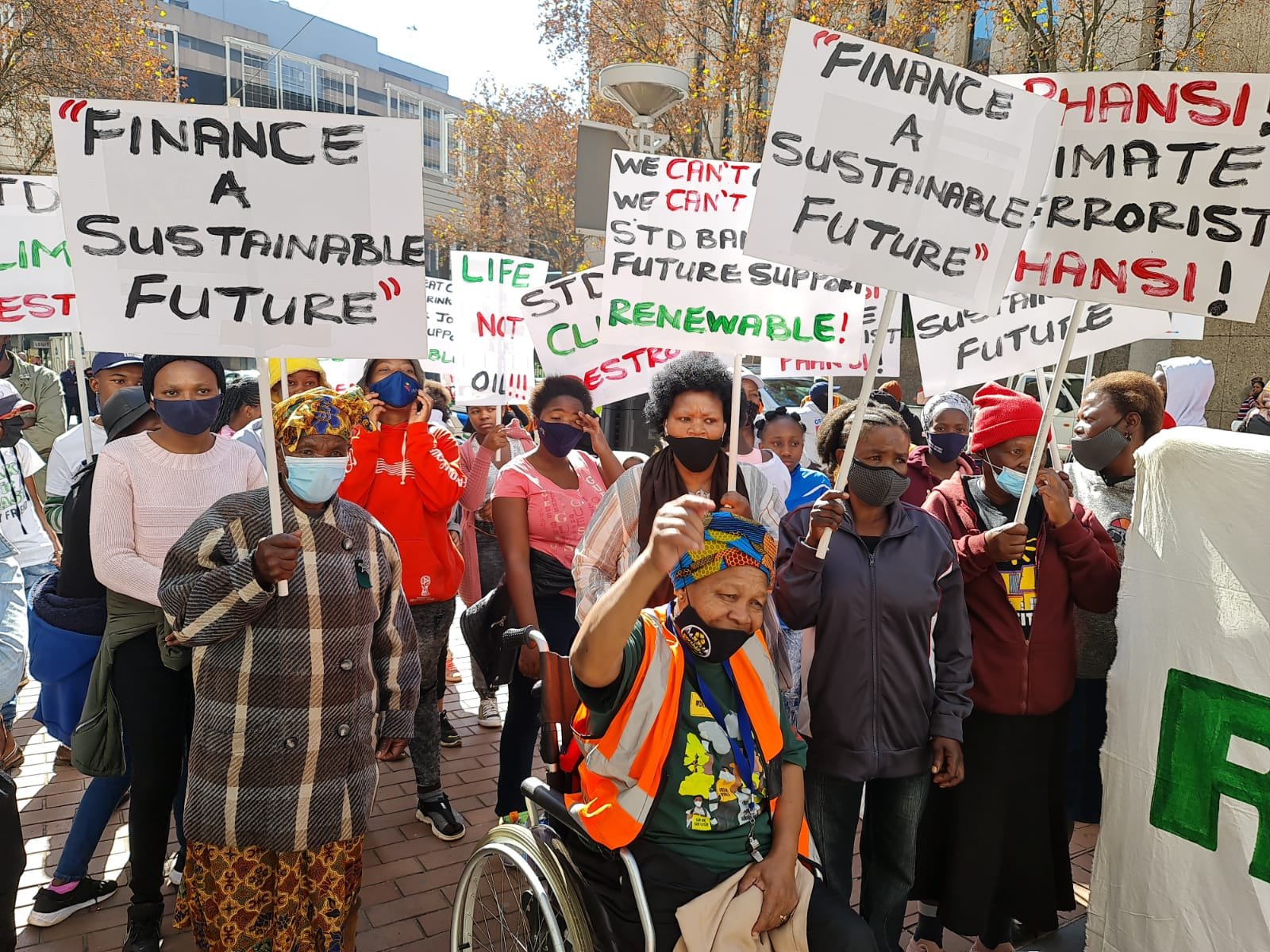
Outside protesters, against Sasol, and same are about to hand over the memorandum to Sasol Vice President Marcel Mitchelson
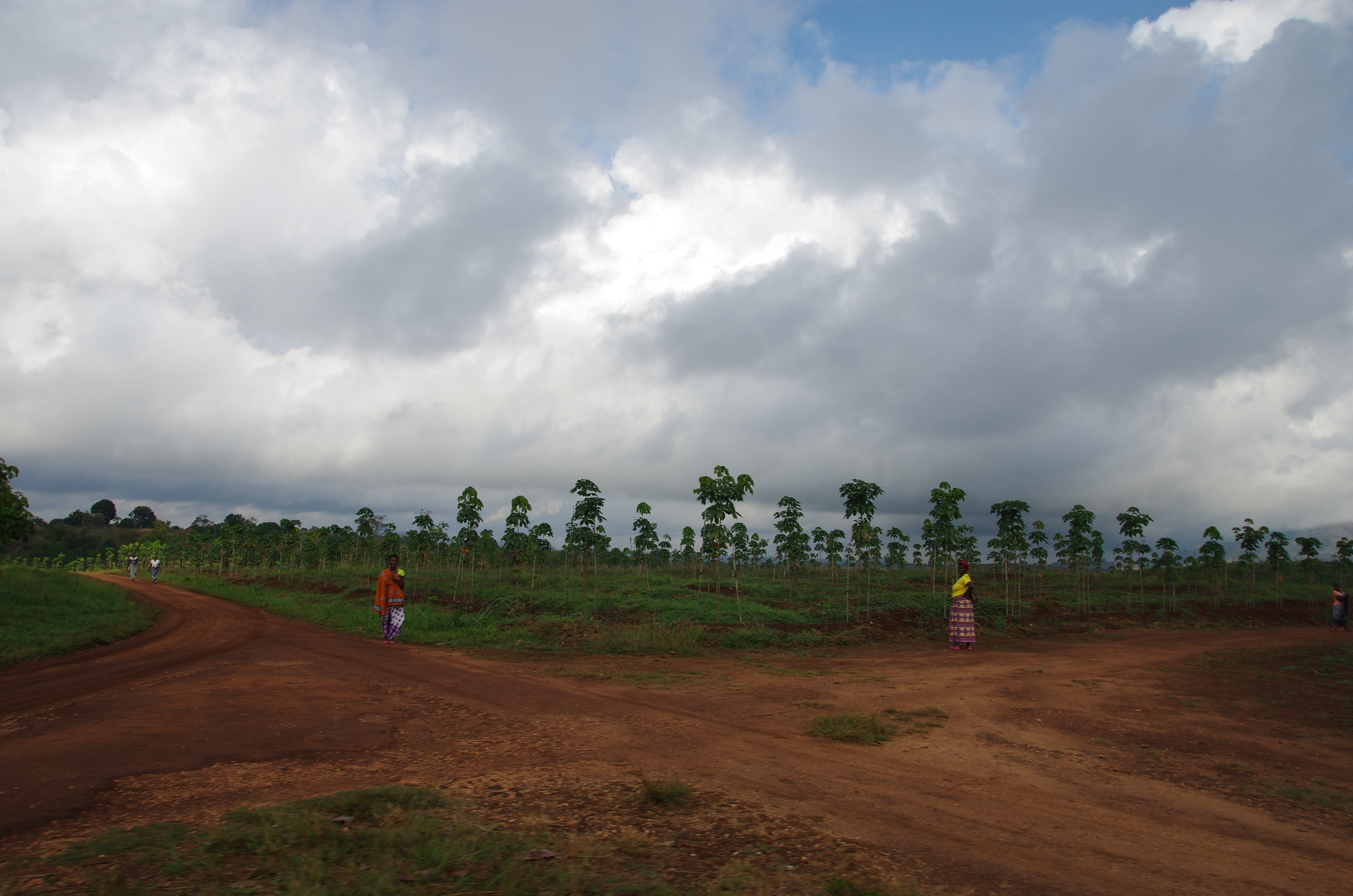
Justiça Ambiental has been following, for about 9 years, with much concern and indignation, the promotion and establishment of eucalyptus monoculture plantations in the country. It has paid particular attention to the plantations of Portucel, Navigator Company and Green Resources, the size of the area granted, and the negative social impacts that both have caused, which are already evident and documented.
In recent years, JA! has maintained contact with the rural communities affected by both companies and has unsuccessfully denounced the irregularities and numerous conflicts that exist with the companies concerned and government authorities, through letters, petitions and requests for meetings. JA! has also requested access to the processes of acquiring Land Use titles (Direito de Uso e Aproveitamento de Terra: DUAT) and Environmental Performance Reports, which constitute information of public interest and nature, but these companies have never offered to share or publish these. Finally, JA! very recently obtained access to the numerous processes for the acquisition of Portucel’s DUAT by means of a court action through Judgment 09 / TACM / 2019. We remain without access to Portucel’s Environmental Performance Reports because it “refuses” to share these. In May of this year, Justiça Ambiental, the Academic Action for Rural Development (ADECRU) and the World Rainforest Movement organized the “Sharing of experiences and resistance among communities affected by Monoculture Plantations” in Quelimane with community representatives from Nampula, Zambezia, Manica and Sofala provinces affected by monoculture plantations and rural communities struggling to protect their forests and natural resources. This meeting was preceded by visits to the communities affected by Portucel, where those present, members and leaders of these communities, reiterated their dissatisfaction with Portucel’s actions, with the numerous promises made during the community consultations as a way deceive the communities into giving up their land, promises that remain unfulfilled until today. Portucel was invited to the meeting so that we could, together with representatives of the affected communities and representatives of the provincial government, share the numerous complaints and discuss possible solutions. However, Portucel apologized and did not send a representative to attend but made sure to send someone to report on what was discussed, so they have full knowledge of what was discussed and how dissatisfied these communities are. The provincial government was represented and heard all the complaints, but also evaded the matter.
It is quite despicable to note through a news article published in “Clubofmozambique” that World Wildlife Fund (WWF), a huge international non-governmental organization that works on environmental issues, recently organized a debate on “Planting sustainable forests in Africa” that no more than gives companies such as Portucel a green seal once again, despite numerous studies and reports demonstrating the numerous problems this type of plantation brings, and in this case the numerous impacts of Portucel in Mozambique. It is unacceptable that it gives a ‘green seal’ to plantations, with a masked and misleading speech that intends to spread the belief that they are planting forests, leading those most inattentive to even believe that they are supporting concrete action to mitigate the effects of climate change. It is indeed misleading and problematic to completely disregard the systematic appeals of the communities affected by Portucel, as it is unacceptable to use its brand and the image of the harmless Panda to lead people to believe that large-scale monoculture plantations are somehow beneficial for mitigating the impacts of climate change. It is also equally unacceptable for WWF to position itself in this way, giving the green seal to companies with so many complaints against them and that are causing so many impacts, knowing that so many NATIONAL organizations have been working on this issue for many years and that it is quite problematic, and that NATIONAL organizations do not have a unanimous position on monoculture plantations… this corporate act is shameful!!!








 JA4change