Tag Archives: climate

My point of view on premature marriage and early pregnancies

Namadoe Agro Agosto 19 (164)

By: Alana Sousa (10 years)

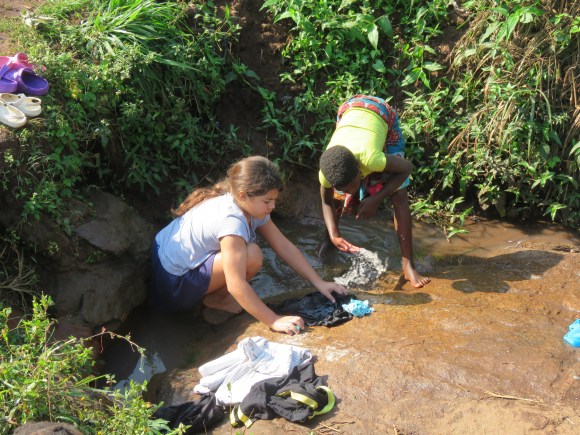
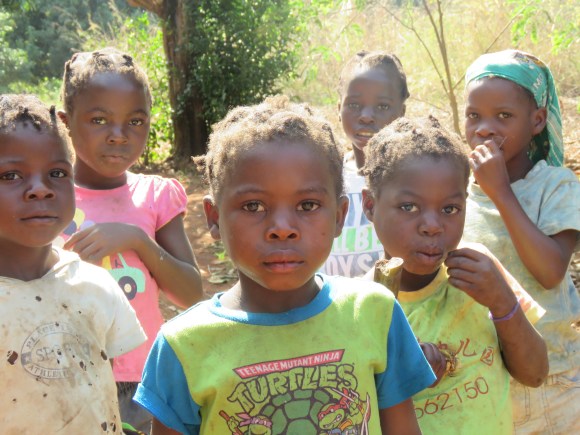
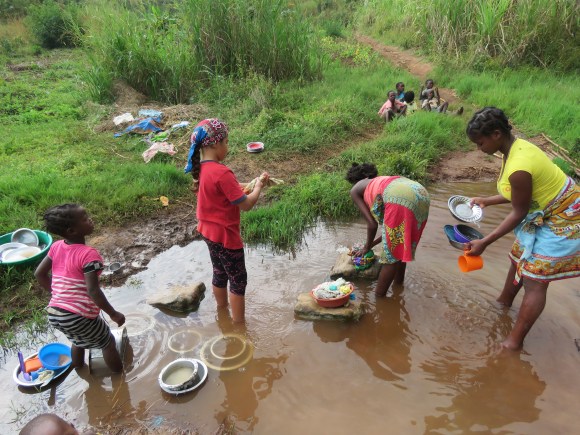
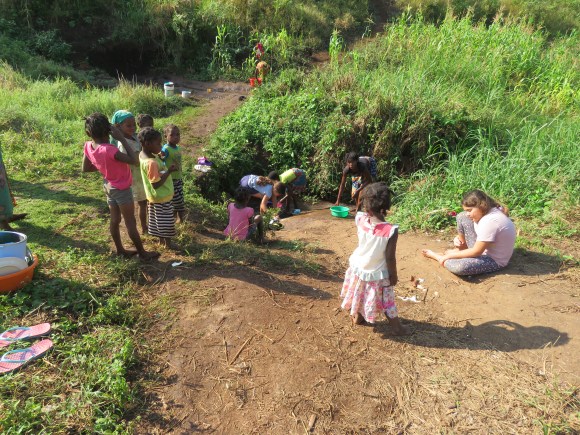
I had the privilege of being one of the only city children to visit Namadoe, one of the 4 communities JA works with, at the base of Mount Mabu.

One of the things I noticed first was how many girls already had babies, such as Mr. Cubaniwa’s daughter who already had a 2-year-old son and she is only 19, which indicates that she had the baby while she was only 17-year-old. In this community it seems normal for girls to marry at 16 years of age and to have children at 17. The case that struck me the most, was that of a 15 year old girl holding a baby she who claimed to be hers, it was clear that the baby was at least 1 year old, because the baby was already walking and walking fast. For example, my cousin is 15 years old already and no one in our family could even imagine her pregnant.

Namadoe Agro Agosto 19 (208)

And this child-mother is my friend, and it was evident that she still wanted to play, and that she was not at the right age to have a daughter, even though she was already a mother she was also still a child, a girl. Still I am sure she loves her daughter, but… she has a life to enjoy as a child, to play, to run, to clown, to do things that normal kids do.

This short text was written by a 10-year-old girl, who lived a very different reality from her own, who enjoyed a lot of what she saw and made many friends, but she also saw a lot that she did not like, that she could not understand or accept as normal… Out of this indignation this text was born, laden with the typical innocence of a 10-year-old girl!”

Limbue Agro Agosto 19 (176)

Namadoe Agro Agosto 19 (160)

Tagged , , , , , , , ,

JA! speaks truth to TNC’s in Europe!

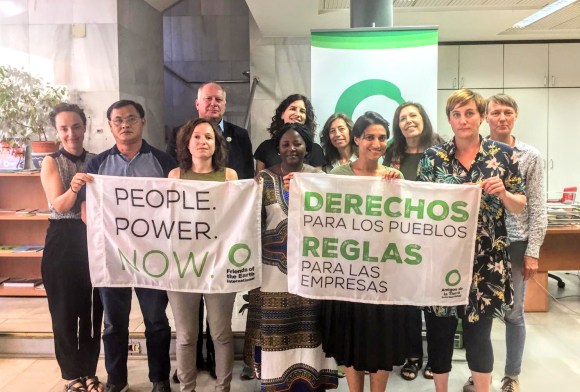
Lobby tour participants and organisers FoE Spain in Madrid


Over the past few weeks, JA! took part in a lobby tour organised in Europe, by Friends of the Earth Europe, where we met with current partners, made new allies, shared our anti-gas struggle and confronted the companies and banks who make up the liquid natural gas industry in northern Mozambique. This tour was imperative for the campaign, because so many of the companies and banks involved in the industry are based in Europe.

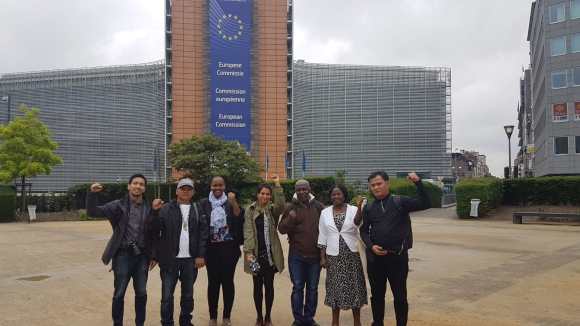
Lobby tour participants outside the EU Brussels

The tour, which went through Rome, Madrid, Amsterdam, Paris and Brussels, was aimed at creating awareness about our struggle against the gas industry in Mozambique and demonstrating the critical need for a Binding Treaty on Human Rights and Transnational Corporations (TNCs) at the United Nations. Currently, there is no accountability mechanism at the UN, only guiding principles which companies do not abide by, as they see them as an impediment to their greed and profit.


Our partners had arranged for JA!, along with activists from the DRC and the Phillipines to meet with current and new partners and allies, as well as industry players and state authorities.
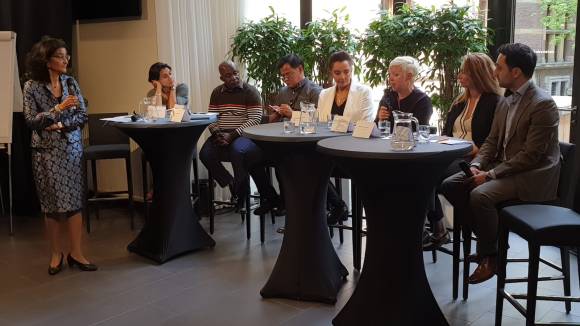
Panel discussion with lobby tour participants and parliamentarians in the Hague2

Our confrontations with the industry were often met with blatant hostility, when we tried to hold them accountable for their actions, and when we raised questions they didn’t like. We attended four annual general meetings (AGM’s), those of Shell, Natixis, Eni and Total.

Intervention at natixis AGM

Natixis, the French bank which arranged for the entrance of three major French banks to finance the Coral LNG Project1, was so hostile at their AGM that when JA! attempted to ask a question about their negligence and ineptness in the project, they turned off the microphone and refused to answer the question. Shareholders were shouting “go home!” as JA! and partner organisations walked out of the meeting.


At the Shell AGM in Amsterdam, we were part of a large contingent of civil society organisations, mostly Dutch but also some European. Shell has a sale and purchase agreement (SPA) with Mozambique LNG to buy 2 million tonnes of gas per year for 13 years.


JA! and an organisation from Nigeria were the only attendees from the global South. The response to our questions was, as expected, vague, but our voice had been heard and carried in the Dutch media. Shell had little respect for activists – when the Nigerian activist raised the impacts that Anadarko’s project was having on their community in the Niger Delta, the Charles Holliday, Shell’s Chairman, responded that he should approach the ‘helpdesk’ in the foyer for assistance.

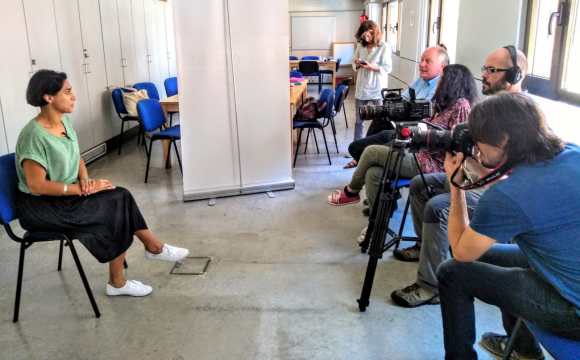
Interview with online news outlet madrid2

The third AGM we attended was that of Total in Paris, which is the new owner of the Mozambique LNG Project2, since May when it purchased Anadarko’s Africa assets. Anadarko, however, is still operating the project, and plan to hand over the lead to Total at the end of the year. After Greenpeace disrupted the AGM last year, there was a large police presence, and for some reason that was not properly explained to us, even though dozens of activists had arranged for access to the AGM, only JA! and an activist from Greenpeace were allowed into the plenary. JA!’s question was met with a dismissive answer, with Total evading responsibility for the impacts of the gas industry on the ground, claiming that responsibility lies with Anadarko.


This was a theme that came up in all AGM’s that we attended, including the fourth one, that of Italian company Eni, in Rome. Eni, along with ExxonMobil has the biggest stake in operating the Coral South LNG Project in Mozambique. We found that all the companies that we confronted, including during the one-on-one meetings we had with industry financiers BNP Paribas and BPI (French Public Investment Bank) put all the blame for the impacts on Anadarko. When we pushed them for answers, it became clear that none of these companies had even looked at the Environmental Impact Assessment that Anadarko had made in 2014, and yet were blaming them for all the climate injustices that were taking place. They are conveniently ignorant.


JA!’s partners had arranged for us to hold meetings with several authoritative bodies, including Michel Forst, UN Rapporteur on HRD; French parliamentarians from the working group on human rights and TNC’s; the deputy director of the Dutch Ministry of Foreign Affairs; a parliamentarian from political party ally in Spain, Unidas Podemos; Belgian parliamentarians, and party representatives at the European Union.


We also met with other organisations, including Oxfam, Amnesty International, Food First Information and Action Network (FIAN), the Centre for Research on Multinational Corporations (SOMO) and Action Aid.


In each country we spoke at events, to full houses of activists, journalists and the general public, some meetings of over 100 people. Our partners organising the tour had built a media campaign around our visit. Here are links to some of the articles about our struggle in European media and blogs:


Publico (Spain)


Les Echos (France)


Basta (France)


Observatories de Multinationales


L’Humanite (France)


Banktrack


Foe Scotland


It was great to see the amount of interest in our campaign, once people were made aware of the issue, and on the flipside, frightening to see how little attention the industry had been given in European media. But we believe that this tour has taken us several steps forward in the following ways:

  •  We have made many new partners and allies in the campaign throughout Europe, strengthening our coalition
  • We have shared the campaign with people working on or interested in the issue of fossil fuels and climate justice, including activists, journalists, academics and students.
  • We have directly questioned industry players one on one, from which we received some crucial information
  • We raised the issue in large industry public platforms, AGM’s, leading to attention on written and social media, and making shareholders aware
  • We have brought the issue to the radar of high level individuals on an EU level, and on the level of political parties, parliament and ministries

Now that we have strengthened the foundation of the Campaign in Europe, we must continue to push for answers and accountability. Push for activists in Europe to take their power as European citizens to hold their companies to account, and push them to force their governments, at national and EU level, to take responsibility for those corporations from whom they receive their tax.

1 Area 4 is operated by MRV, a joint venture company comprising ExxonMobil, Eni and CNPC, which holds a 70% interest in the concession for prospection and production in that area. Galp, KOGAS and Empresa Nacional de Hidrocarbonetos de Moçambique each hold 10% interest. ExxonMobil will lead the construction and operation of liquefied natural gas production facilities and related infrastructure on behalf of MRV, and Eni will lead the construction and operation of upstream infrastructure, extracting gas from offshore deposits and piping it to the plant.

2 The Area 1 block is operated by Anadarko Mozambique Area 1, Ltd, a wholly-owned subsidiary of the Anadarko Petroleum group, with a 26.5% stake, ENH Rovuma Area One, a subsidiary of state-owned Empresa Nacional de Hidrocarbonetos, with 15%, Mitsui E&P Mozambique Area1 Ltd.(20%), ONGC Videsh Ltd. (10%), Beas Rovuma Energy Mozambique Limited (10%), BPRL Ventures Mozambique BV (10%), and PTTEP Mozambique Area 1 Limited (8.5%).

Tagged , , , , , , , , , , , , , , , , , , , , , , , , , , , ,

JA! causes a ruckus at the Eni AGM

On Wednesday 14 May, JA! Attended the AGM of Italian oil and gas giant Eni, in Rome, where we put CEO, Claudio Descalzi, Chairperson Emma Marcegaglia and the board of executives on the spot in front of about 50 shareholders, by asking them questions about their work on gas in Mozambique and oil in South Africa that they really did not want to deal with. This was the first time we had been at the Eni AGM and we were able to go with the help of our Italian partners, Re:Common.

The meeting started at 10am and went on till 9pm, unusually late. After submitting written questions two weeks ago, we received the written answers, in Italian, literally as we walked into the meeting, and had to study them while the meeting was already in session, to see what they had or had not answered sufficiently before we were given a chance to speak.

JA! was given 10 minutes for an intervention. We first gave the context of the way Enis Coral Liquid Natural Gas Project was destroying endangered flora and fauna, and forcing people off their land before operations had even started, as well as their oil exploration in Block ER236, off the South Coast of Durban, affecting the livelihoods of at least 20 fishing communities and followed this with a barrage of questions about both of these issues, none of which were properly answered by CEO Descalzi.

While we asked many questions covering a range of topics, the main issues we raised were:

– Why did Eni begin operations in Mozambique in 2006, when they only received their license in 2015, and only completed their environmental impact assessment (EIA) in 2014? (This EIA was done in conjunction with Anadarko)

– Why is Enis gas project in Mozambique releasing greenhouse gases that will increase the whole of Mozambiques carbon emissions by 9.4% by 2022, when their main focus for the next ten years is decarbonisation?

– Why did Eni ignore the poor and marginilised communities of the South Coast of Durban, while only engaging with the wealthy communities at country clubs and upmarket hotels, to do their EIA?

Descalzi was extremely patronising in his responses, saying that Eni had not done any drillingin South Africa, so he is not sure about the forced removals of fishing communities that you (Ilham) are talking about.

He also interrupted JA, to say that Eni is not involved in Area 1 so the EIA for Mozambique But this is a lie, as Enis logo is on the front page of the EIA.

He did not answer the questions about them beginning operations in Mozambique before they received their license. He also claimed that the resettlement process of what we know to be forcefully-removed communities in Mozambique was in line with the EIA.

He said that the answers to the other questions were in the document of written responses, which will be released next month.

After the end of the AGM, Descalzi sought out JA !representative, and thanked JA! for the questions, to which JA! responded that none of the questions had actually been sufficiently answered, and that his so-called responses were offensiveas they contradicted what JA! Has seen on the ground, and which we are told by affected communities. He is basically, JA! said, saying that we are either ignorant or lying.

It was clear that we, and our partners Re:Common had an impact on Descalzi as he was answering our questions, he stumbled, saying Im well-cooked, an Italian saying meaning that he was extremely tired. That he sought Ilham out before anybody else was quite telling, offering her his personal contact details. Now lets see what happens

JA! will publish a more detailed post, the questions asked, and the verbal responses from Descalzi, as well as an analysis. Its important to note that Eni, and Descalzi, along with Shell, are currently defendants in a court case, charged with one of the worlds biggest corruption scandals, allegedly paying $ 1.3 billion in bribes, to Nigerian politicians for the purchase of an oil field in Nigeria. Lets see now, if he keeps his word by responding fully and personally to the questions he has offered to personally answer, while also remembering, Can we trust one of the most corrupt men in the world?

Tagged , , , , , ,

Justica Ambiental’s intervention at Eni Annual General Meeting

14 June 2019

Rome

I represent an organisation called Justica Ambiental/Friends of the Earth Mozambique in maputo. Ive come quite a long way to ask Eni some questionsI will ask in particular questions about the onshore and offshore work in Area 1 and Area 4 of the Rovuma Basin in Mozambique, which includes the Coral Floating Liquid Natural Gas Project, and the Mozambique Liquid Natural Gas Project, and the offshore oil and gas exploration in Block ER236 off the South Coast of Durban in South Africa.

we want to give some context to the shareholders:

Although the extraction in Mozambique has not yet begun, already the project has taken land from thousands of local communities and forcefully removed them from their homes. We work with and visit most regularly the villages of Milamba. Senga and Quitupo. The project has taken away peoples agricultural land, and has instead provided them with compensatory land which is far from their homes and in many cases, inarable. Fishing communities which live within 100 metres of the sea are now being moved 10 km inland.

Furthermore, the noise from the drilling will chase fish away from the regular fishing area, and the drilling and dredging will raise mud from the seabed which will make fishing even more difficult with little visibility.

There is little to no information about the type of compensation people will receive. Communities think the ways in which peoples compensation has been measured and assessed is ridiculous. For example, the company assesses someones land by counting their belongings and compensating them financially for those goods. Another way is by counting the number of palm trees that one person has on their land. Most people have been given a standard size of land of 1 hectare. This is regardless of whether they currently have 1 hectare, 5 hectares, or even ten hectares.

80% of Mozambicans dont have access to electricity, and need energy to live dignified lives. Despite this incredibly low electricity rate, the LNG projects will not help Mozambique and its people benefit from its resources. Instead the LNG will be processes and exported to other countries, in particular Asia and Europe.

The projects will have a huge negative impact on the local environment, destroying areas of pristine coral reefs, mangroves, and seagrass beds, including endangered flora and fauna in the Quirimbas Archipelago, a UNESCO Biosphere.

Mozambique is a country that is already facing the impacts of climate change. In the last two months, two cyclones hit the country hard, as we saw most recent with Cyclone Idai and Cyclone Kenneth that together killed over 600 people and affected at least 2 million.. The EIA admits that the contribution of the projects greenhouse gases to Mozambiques carbon emissions will be major.

This project will require a huge investment by the Mozambican government, which would be better spent on social programs and renewable energy development. The project itself will require an investment of up US$ 30 billion. This project will divert funds that should be going to education and other social necessities, including $2 billion that the World Bank estimates is necessary to rebuild the country after the cyclones, in order to build and maintain infrastructure needed for the gas projects.

Over the last year and a half, there as been a scourge of attacks on communities in the gas region, which many communities believe are linked to the gas projects because they only began once gas companies became visible. In order to ensure the security of the gas companies and contractors, the military has been deployed in the area and maintains a strong presence, and several foreign private security companies have been contracted by the companies.


SOUTH AFRICA

While the human rights and environmental violations against the people of the South Coast are many, the particular issue Id like to raise is that of the lack of meaningful public participation with the affected communities, who were totally excluded from the process.

Exclusivity of meetings:

Eni held a total of 5 meetings.

Three of them were at upper end hotels and country clubs in the middle class areas of Richards Bay, Port Shepstone and in Durban. This is extremely unrepresentative of the vast majority of people who will be affected, many of whom live in dire poverty: communities of as Kosi Bay, Sodwana Bay, St Lucia,, Hluluwe, Mtubatuba, Mtunzini, Stanger, Tongaat, La Mercy, Umdloti, Verulam, Umhlanga, Central Durban, Bluff, Merebank, Isipingo, Amanzimtoti, Illovu, Umkomaas, Ifafa Beach, Scottsburgh, Margate, Mtwalume, Port Edward and surrounding townships like Chatsworth, Inanda, Umlazi, Phoenix and KwaMakhuta. This is blatant social exclusion and discrimination.

During the two so-called public participation meetings with poorer communities in February and October 2018, attended by both Eni and consultants Environmental Resources Management, the majority of people affected were not invited. The meetings, held by Allesandro Gelmetti and Fabrizio Fecoraro were held in a tiny room with no chairs. Eni had not invited any government officials.

[Sasol head of group medial liaison Alex Anderson, confirming the meeting, said: Eni, our partner, is the operator and the entity managing this process. Sasol is committed to open and transparent engagement with all stakeholders on this project, as its an ongoing process over the coming year. We value the engagement and the feedback we receive, so that we consider stakeholder concerns into the development of the project.]

Eni says it dropped the finalised EIAs off at 5 libraries for the interested parties to read. However these libraries are difficult for most of the affected communities to travel to, and one of the libraries, Port Shepstone library, was in fact closed for renovations at the time.

QUESTIONS:

Civil society in Mozambique:

The response to our question was not answered, and I would like to reformulate it.

Is Eni working with any Mozambican organisations as part of its community engagement, and which are they?

Is Eni working with any organisations, Mozambican and from elsewhere, who are NOT paid by the company?

Reforestation:

Id like to quote an article in the FT article David Sheppard and Leslie Cook 15 March 2019- Eni to plant vast forest in push to cut greenhouse gas emissions, which says, I quote:

by planting trees which absorb CO2 from the atmosphere, companies like Eni are looking to offset their pollution that their traditional operations create.

Italian energy giant Eni will plant a forest 4 times the size of Wales as part of plans to cut greenhouse gas emissions

1. Does Eni dispute the truthfulness of the Financial Times article

Eni says that it has already begun the contract process with the governments of the countries in Southern Africa, where these forest projects will take place.

1. Has the company assessed whether there actually is 81 000 hectares of unused land available for this project?

2. Has Eni already held any public participation meetings with the communities who live on the land that will be used for ?

3. who is doing this assessment and when will it begin

4. how many communities and people will be affected?

EIA s:

1. In the case of Area 1, Eni responded that the responsibility for ongoing public participation with the communities of Cabo Delgado lies with Anadarko for the joint EIA. Does Eni confirm it is relying on another company to guarantee that its own project fulfills requirements for an EIA?

2. Also on Area 1, the last EIA was done in 2014? Why does Eni rely on an impact assessment that is 5 years old?

3. Eni has responded that it only concluded its EIA in 2014, but had already begun seismic studies in 2007 and prepared for exploration in 2010. Furthermore, Eni only received its license from the Mozambique government in 2015. This is a whole 8 years after it had begun seismic studies.

Why did Eni begin studies that affect the environment and people before completing an EIA?

Decarbonisation:

This question was not sufficiently answered: I have asked why Enis decarbonisation strategy does not align with its actions in Mozambique, where the EIA says, and I quote from Chapter 12: The project is expected to emit approximately 13 million tonnes of CO2 during full operation of 6 LNG trains.

By 2022 the project will increase the level of Mozambiques GHG emissions by 9.4%

The duration of the impact is regarded as permanent, as science has indicated that the persistence of carbon dioxide in the atmosphere is said to range between 100 and 500 years, and therefore continues beyond the life of the project.

I ask again, how does this align with Enis decarbonisation strategy?

Private security:

1. Who is Eni using as their private security companies in Mozambique and in South Africa?

2. What was the legal process the company went through to contract these private security companies?

3. If any companies are not registered locally, what legal process did Eni go through to bring them to Mozambique and South Africa?

Contractors:

1. Will Eni provide us with a list of all their contractors in Mozambique and in South Africa?

2. if not why not?

Jobs in South Africa:

You have not answered our question here

How many jobs will Eni create at its operation in SA?

How many of these jobs will be paid by Eni?

Contract

I ask this in the name of the South Durban Community Environmental Alliance. The organisation requested Eni to make available the contract signed with the Dept of Environmental Affairs and Petroleum Agency South Africa that gives Eni permission to conduct seismic testing. Eni has said no, because the right to the document lies with a contractor.

Tagged , , , , , , , , , , , ,

The “ A, B , C “ of Large and Mega Dams

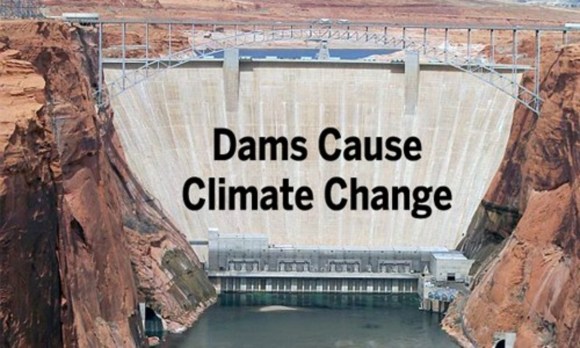
 What is a Dam, large and Mega?
img

It is a big cement hall, that stop the course of the river. The word seems to be related to the Greek word taphos, meaning “grave” or “grave hill”, in reality it is a tombstone for the river.

By the International Commission of Large Dams (ICOLD), a large dam is higher than 15m while a Mega dam is over 100m. Most Mega dams worldwide are used for energy production.

Mega dams have been the center of many debates, research and studies for the last decade.

Between 1930 and 1970, the boom of Mega dams was seen to be synonymous with “economic development” and a symbol of human ability to assert control over nature. But then the truth of their negative impacts started to arise, and it become the center of many debates and arguments around costs-versus-benefits, ecological impacts, social impacts, etc.

From one side the proponents claim dams as a source of energy and as such a tool for development, from another side the opponents state that those benefits are far outweighed by disadvantages such as loss of communities livelihoods and rivers ecosystems to name just some.

The late 1980s and 1990s era, were marked by large protests, and controversial debates about mega dams. Pressure and huge campaigns from civil society, social movements and communities affected by dams to stop financing mega-dams. Same financed institutions, with the pressure and information about crimes against human rights, by mega dams financed by the world bank, funds were decrease to the world Bank Dams projects. Due to such an outcry, an independent commission under the chairmanship of Kader Asmal, the South African water minister, was created in April 1997, the “World Commission on Dams (WCD)”, to research the environmental, social and economic impacts of mega Dams globally. The WCD was composed of members of civil society, academia, private sector, professional associations and government representatives. The report findings and recommendations were launched under the patronage of Nelson Mandela in November 2000. The WCD found that while “ dams have made an important and significant contribution to human development, and benefits derived from them have been considerable… in too many cases an unacceptable and often unnecessary price has been paid to secure those benefits, especially in social and environmental terms, by people displaced, by communities downstream, by taxpayers and by the natural environment.” The study also made recommendations and provided guidelines which all dam projects should follow, including five core values and seven priorities detailed below:

Values

Equity,

Sustainability,

Efficiency,

Participatory decision-making and

Accountability.

Priorities

Gaining public acceptance,
comprehensive options assessment,

Addressing existing dams,

Sustaining Rivers and Livelihoods
Recognising entitlements and sharing benefits,
Ensuring compliance and

Sharing rivers for peace, development and security.

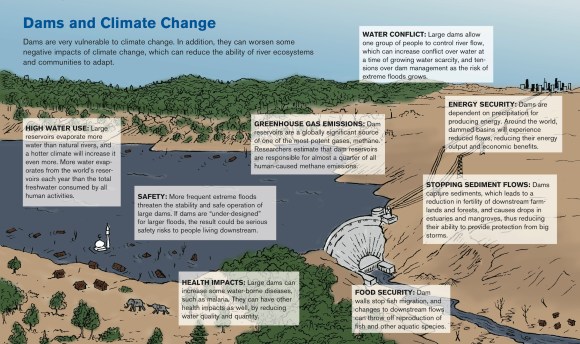
For a while, the understanding of the large costs of Mega dams started to become a reality, but suddenly with the climate crises, they came back with the tag of “Solution for Climate change”. But it is not a solution. It is riddled with problems and earns our tag of “false solution”.

At JA’s last year climate justice meeting “Seeding Climate justice II”, held in Maputo, JA invited Rudo Sanyanga, Africa Director of International Rivers (IR), who presented the impacts of dams on the climate, and debunked the myth that mega dams are one of the energy sources to address our climate crises. Without going into the known social and environmental impacts, the presenter began her presentation by asking “Hydro dams, do they provide CLEAN energy? NO, THEY DON’T, ITS NOT TRUE! They exacerbate climate change instead”. Dams especially tropical dams can often produce a huge amount of methane and carbon dioxide from rotting biomass in the reservoir. Then there are huge impacts of droughts and floods on the energy production, and dependency of hydroelectric on a changing climate is questionable.

Rudo spoke about the breakthrough research done in 2012, “ A Risky Climate for Southern African Hydro”, there was a lot of opposition, attacked by politicians, statements that IR ‘’was scaring people, and that was not going to happen’’. But it is real, 4 years after, we see that is happen, this year, Lake Kariba never went above 20% capacity, Lesotho Katse dam was 63%, Zambia that was 80% dependent of Hydro, due to a 2 years drought is turning into solar. This is real , Zambezi Basin countries will have a decrease in stream flow, as many studies estimate and a decrease of run-off to be between 26% to 40% by 2050. No one is trying to scare people, but it is already happen and is going to only become worse.

We recall back in 2012, when Rudo come to Maputo to present the finding of this study, we were attacked by most of the government participants at the launch meeting, to the point of becoming quite an ugly and unproductive meeting.

We raised the question again, how can Mozambique build a dam as risky as it is Mphanda Nkuwa is to the environmental and communities, seismic risk, and now adding the economic and climate change risk? Those risks exist, due to extreme climate changes, and they must be included in any evaluation and decision to build or not a dam.

But as the researcher stated on their study, that government, dam builders and decisions makers, are not taking into consideration the economic risks associated to climate change, in his wordsThere is been a neglect of climate risks in hydropower planning – in an approach that might be called either ‘wait and see’ or ‘head in the sand’ ”.

But it still amazes me how difficult is for people to understand and see mega dams for what they really are: a monstrosity that destroys lives, livelihoods and rivers ecosystem, to say some. In a way I can understand if you look into a coal power station, you see ugliness, you see smoke, pollution and a landscape that no one wants to live there if they have a choose. At the other end, a mega dam is an huge infrastructure that makes any engineers proud of it, a lake, and an enormous hall that splits water in amazing speed, and a sound that make you feel small in this world… for sure looks much better then a coal power station. But it is just that, a facade. Because it is not synonymous with development, just ask the 40-80 million people displaced by dams, how their lives and livelihoods have been destroyed. Neither is it a solution for climate change as it often emits methane (more in tropical areas), destroys forests for the reservoir. Neither it is good for the environmental as it block rivers and inundates forests and agricultural land , and deny downstream enough water for wetlands to operate accordingly. Neither they protect us, from flood if they are not build to do so, or a way to keep water during drought.

Why they do not protect us from floods…. Well, if they are build just for that, yes, but you do not need a Mega dam for that, a mega dam is either for energy production, irrigation or water supply. To produce energy, you need to keep as much water as possible, and then when a big flood comes, there is no space to keep all the water in, same for irrigation, and to protect us from floods we do not need mega dams, small dams are the ideal, and system that can divert water when is too much, same for drought.

JA released in 2009 a study about renewable energy sources for Mozambique, another study that was attacked by the government participants in such a way that the author had difficulties to do his presentation without being constantly interrupted, simply because that study showed that we do not need Mphanda Nkuwa, and there are other ways forward to have energy for everyone with less impacts. The magic potion is not that difficult, we need to start with decentralized energy systems, clean energy, solar, wind, even mini to small hydro dams, a mix of energy sources, which must be affordable by all people.

We can do, and we should think more on solutions to tackle and minimize climate change impacts, instead to follow a path that put us where we are…. In a crises, can we be more smart and take decisions that are smarter, at least we live in a era that we have many options, and we know what mistakes where made, that we can avoid them.

So why build mega dams, to destroy rivers systems, communities livelihoods, increase climate impacts adding the economic risk , is really a mega dam worthwhile? It is not a solution for the climate crises we are hurtling towards. Climate change will affect rivers flow, and worsen extreme and intense floods and droughts that will put a risk on the economic benefit, so why ????

For whom and what. That’s the million dollar question. Because is not for us the people, is not a solution for our climate crises, is not for the environment…. who is it for? And what is it for?

Some info on dams, from the article of 12 dams that change the world from: https://www.internationalrivers.org/blogs/227-3

Chixoy: the grave on the Rio Negro

Dam-affected communities have often suffered repression and human rights abuses. In 1982, more than 400 indigenous men, women and children were massacred to make way for the World Bank’s Chixoy Dam in Guatemala. In a historic breakthrough, the country’s government in 2014 signed a $154m reparations agreement with the affected communities.

Banqiao: the dam that washed away

When dams are not properly built or maintained, they can break. In the world’s biggest dam disaster, the failure of China’s Banqiao Dam killed an estimated 171,000 people in 1975. In more than 100 cases, scientists have also linked dam building to earthquakes. Strong evidence suggests that China’s Sichuan earthquake, which killed 80,000 people in 2008, may have been triggered by the Zipingpu Dam.

Yacyretá: the monument to corruption

Large dams are often pet projects of dictators. Lacking accountability leads to massive corruption and cost overruns. On average, large dams experience cost overruns of 96% and are not economic. The cost of Argentina’s Yacyretá Dam has mushroomed from $2.5bn to $15bn. A former president called Yacyretá “a monument to corruption”.

Merowe: when Chinese dam builders went global

In 2003, the Chinese government decided to fund the Merowe Dam in Sudan as its first big overseas hydropower project. The dam displaced more than 50,000 people and caused serious human rights violations. Chinese banks and companies are by now involved in some 330 dams in 74 countries, leading an unprecedented global dam building boom.

Glines Canyon: the dam that came down

Dams have serious environmental impacts, and their benefits dwindle as they age. Since the 1930s, the United States has removed more than 1,150 dams to restore river ecosystems and particularly fish habitats. In 2014, the 64 meters high Glines Canyon Dam on the Elwha River in the Pacific northwest was breached in the world’s biggest dam removal so far.

Patagonia: the dams that were never built

Recent years, solar and wind energy have seen their commercial breakthrough. These renewable energy sources are cleaner than coal or hydropower and can be built were people need electricity, even far away from the electric grid. In 2014, Chile cancelled five dams in the Patagonia region under strong public pressure and approved 700 megawatts of new solar and wind farms.

Kariba: the dam that ended poverty in Southern Africa (or did it?)

The Kariba Dam on the Zambezi was built in the 1950s to power Zambia’s copper belt, as the first large dam funded by the World Bank. Kariba was considered the symbol of a “brave new world”, in which controlling nature would bring quick economic development. Yet the 57,000 people who were displaced by the dam suffered famine and are still impoverished
climate_graphic2

References on WCD and more info:

https://en.wikipedia.org/wiki/World_Commission_on_Dams

https://energypedia.info/wiki/World_Commission_on_Dams_(WCD)_Report

http://www.unep.org/dams/documents/Default.asp?DocumentID=663

https://www.internationalrivers.org/campaigns/the-world-commission-on-dams

http://www.unep.org/dams/WCD/report/WCD_DAMS%20report.pdf

more https://www.internationalrivers.org/questions-and-answers-about-large-dams

Tagged , , , , , , , , ,